
Every enterprise support and revenue team eventually hits the same wall: call volume and buyer expectations rise faster than headcount ever can. Legacy IVRs route callers in circles. Web chatbots stall the moment a conversation drifts off script. By 2026, the enterprises that have solved this problem have moved past static scripts and adopted conversational AI agents: systems that reason about intent, hold context across a full conversation, and complete tasks directly inside CRMs, ERPs, and support platforms instead of simply answering questions. That broader shift, often described simply as conversational AI, is reshaping how support, sales, and operations teams work across every channel.
This blog covers how these systems operate under the hood, where they create measurable value across the enterprise, and what to look for in a conversational AI platform before you sign a contract.
What Are Conversational AI Agents
A conversational AI agent is a software system that understands natural language, spoken or typed. It uses that understanding to complete a task on a user’s behalf rather than simply returning an answer. The distinction that matters is agency. A scripted bot matches a query to a pre-written response and stops there. AI conversational agents reason about what the caller is trying to accomplish, decide which system they need to act on, and execute the task directly, often without a human ever joining the conversation.
Enterprises deploy these systems in two forms. Text-based agents sit inside websites, apps, and messaging platforms. Voice AI agents handle spoken conversations over the phone or inside contact center software, and are commonly called AI voice assistants when deployed for customer-facing calls. Both run on the same reasoning layer; the difference is the input channel and the speech recognition and synthesis required for voice. The wider category, conversational AI solutions, spans both, but the agentic tier described here is where most 2026 buying decisions are concentrated.
How Conversational AI Agents Work
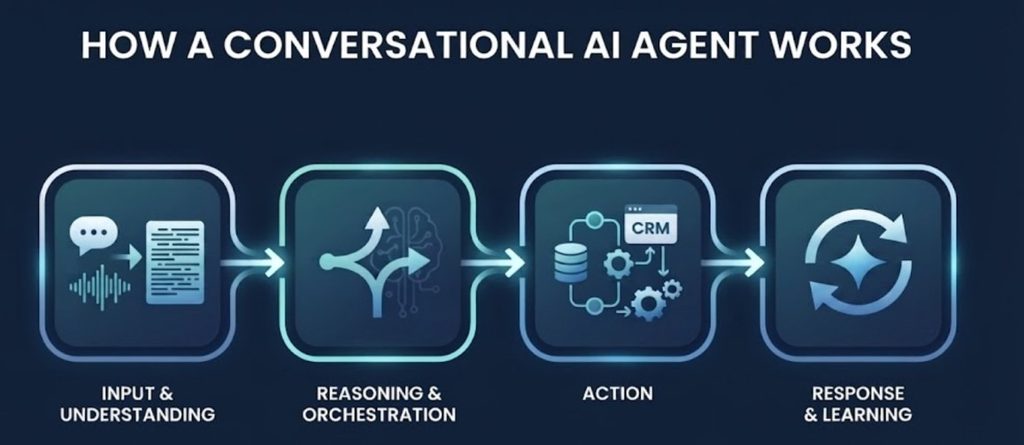
Input and understanding
Text arrives as-is; voice passes through speech recognition first. Natural language understanding then extracts intent, entities, and sentiment, carrying context from earlier in the same conversation.
Reasoning and orchestration
This layer separates a genuine agent from a scripted bot. Instead of following a fixed decision tree, the agent decides whether it has enough information to act, needs to ask a clarifying question, or needs to call a tool such as a CRM lookup before responding.
Action
A conversational AI platform connects to enterprise systems through APIs and pre-built connectors: CRMs, ticketing systems, ERPs, and payment processors. This is what lets an agent complete a task instead of describing what a human should do next.
Response and learning
Natural language generation produces the reply; for voice, text-to-speech renders it as natural audio. Feedback loops then refine intent recognition and response quality over time.
Conversational AI Agents vs Traditional Chatbots
The terms get used interchangeably, but the technology differs in ways that matter for a buying decision.
| Traditional Chatbot | Conversational AI Agent | |
| Logic | Rule-based decision trees, keyword matching | LLM-powered reasoning and intent understanding |
| Context | Limited to a single turn or scripted flow | Maintains context across a full conversation and prior sessions |
| Action | Provides information or routes to a human | Executes tasks directly via system integrations |
| Flexibility | Breaks on unscripted phrasing | Handles ambiguity, follow-ups, and topic shifts |
| Setup | Manually authored conversation flows | Trained on knowledge bases, policies, and business logic |
A rule-based bot can still handle a narrow task like collecting a zip code. For anything involving judgment or account-specific data, enterprises evaluating conversational AI solutions are standardizing on agent-based architecture instead. Buyers researching AI conversational agents typically use this distinction as the first filter before comparing individual vendor features.
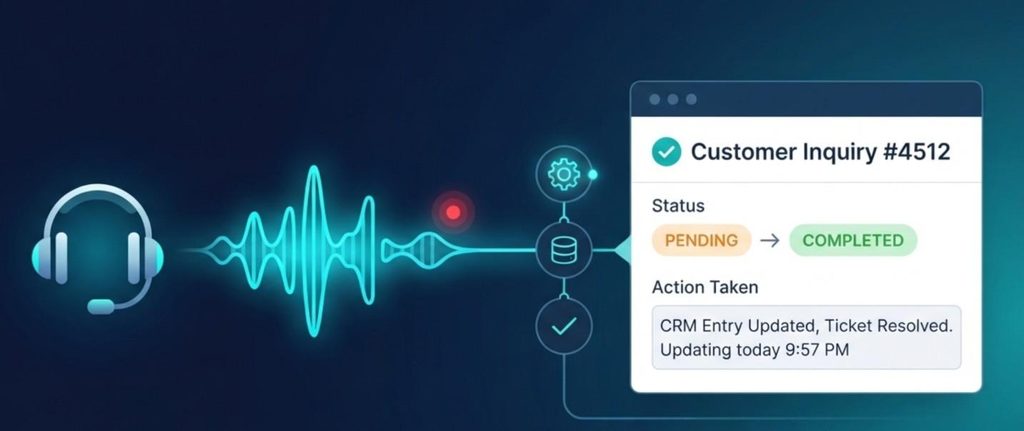
This shift has a name in 2026: Agentic Voice AI, and it is where enterprise budgets are actually moving, well beyond the text-based chat that most coverage of this topic stops at. The phone channel, specifically, is where voice AI agents, often marketed as AI voice assistants, are absorbing volume that used to sit with IVR trees alone.
Three capabilities separate genuinely agentic voice systems from a language model bolted onto an old IVR tree. Live task execution means the agent updates the CRM or schedules the visit while the caller is still on the line, not afterward. Multi-agent orchestration routes billing, support, and scheduling sub-tasks between specialized agents within one call, without a transfer. Vernacular and code-switching support matters in markets like India, where a single call routinely moves between English and a regional language mid-sentence; voice AI agents built for code-mixed speech hold up where generic AI voice assistants fail.
Enterprise Use Cases Across Departments
Conversational AI solutions are no longer confined to the contact center. AI conversational agents are already live in production across these departments, not just pilot programs:
- Customer service
Resolving tickets, refunds, and account questions across chat and voice.
- Sales
Qualifying inbound leads and booking meetings directly inside the CRM.
- IT helpdesk
Password resets and access requests resolved without ever opening a ticket.
- HR and talent acquisition
Screening candidates and scheduling interviews inside the ATS.
- Finance
Invoice status checks and fraud flagging with a full audit trail attached.
What to Look For in a Conversational AI Platform
Evaluation criteria that matter when comparing conversational AI solutions:
- Integration depth: Native connectors to your CRM, ERP, or ATS, not custom engineering for every workflow.
- Reasoning quality: Genuine handling of ambiguous, multi-turn conversations, not a fallback to rigid scripts.
- Voice fidelity: Natural handling of interruptions, accents, and code-switching for voice AI agents specifically.
- Security and governance: Encryption, role-based access, and audit logs for regulated data.
- Human handoff: A seamless escalation path with full conversation context.
Getting Started with a Conversational AI Platform
Start with a narrow, high-volume interaction. Order status, appointment scheduling, or password resets are common first deployments for conversational AI agents because success is easy to measure and the downside risk is low. Map the CRM, ERP, or ATS integrations the agent will need to touch before comparing conversational AI solutions, since integration depth is usually what separates one conversational AI platform from another in practice. If phone volume matters to the business, pilot voice AI agents alongside the text deployment rather than treating AI voice assistants as a later-phase add-on. Voice conversations tend to carry the highest-urgency, highest-value interactions first, which makes them the fastest place to prove measurable return.
The Ello Advantage: Real-Time Voice Execution for the Enterprise
Ello is built for the gap most conversational AI platforms and conversational AI solutions vendors leave open: acting live, on the call, inside the systems that run the business.
Adaptive Prompting Engine
Handles dynamic, non-scripted dialogue in real time, reading caller sentiment and urgency as the conversation unfolds.
Voice-to-Action Engine
Executes tasks autonomously inside enterprise CRMs, ERPs, ATS, and PMS platforms while remaining live on the call.
Self-Evolving Architecture
An autonomous learning loop rebuilds Ello’s own prompts after approximately 200 calls, without manual developer intervention, driving roughly a 30 percent boost in operational efficiency.
Linguistic capability
Native support for 30 languages and regional accents, handling code-switching that most AI voice assistants skip entirely, a capability built specifically for markets like India.
Security and compliance
SOC 2 compliance (and HIPAA where relevant), data encryption, and automated adherence to TRAI, DND, and calling hour restrictions.
Put together, this is what Agentic Voice AI actually looks like in production: dialogue that adapts, reasons, and acts inside enterprise systems while the caller is still on the line, not a chatbot with a phone number attached to it.
Frequently Asked Questions
1) What are conversational AI agents used for in the enterprise?
Conversational AI agents, sometimes called AI conversational agents, handle customer support, sales qualification, and internal helpdesk requests by completing the task directly inside enterprise systems, not just answering a question about it.
2) How is a voice AI agent different from a text-based agent?
The reasoning layer is the same. The difference is the channel: voice AI agents add speech recognition and synthesis, which is why they are also called AI voice assistants when deployed for phone-based service.
3) How long does it take to deploy a conversational AI platform?
A narrow use case such as order status can go live in weeks with pre-built connectors. Broader deployments touching several systems typically take a few months.
4) Are conversational AI solutions secure enough for regulated data?
Reputable platforms provide encryption, role-based access, audit logging, and compliance support for standards such as SOC 2 and HIPAA. Confirm these details during vendor evaluation.
5) Will conversational AI agents replace human support teams?
Not entirely. Agents handle repetitive, well-defined interactions, freeing human teams for complex, high-empathy conversations, with a clear escalation path to a person.
The Bottom Line
Conversational AI agents have moved well past scripted chatbots and static IVR trees. The systems built for 2026 reason, remember context, and act inside real business systems during the call, not after it ends. The organizations getting the most value are choosing a conversational AI platform built for real-time voice execution from the ground up, not the flashiest demo.
Ready to put a voice AI agent to work inside your own systems? Get started with Ello.
Leave a Reply