Tag: voice AI

  • Enterprise Conversational AI and the Path to Better Customer Engagement

    Enterprise Conversational AI and the Path to Better Customer Engagement

    Customer engagement architectures across global organizations face severe operational bottlenecks. Legacy interaction systems, built on static Decision-Tree logic and rigid Interactive Voice Response (IVR) scripts, fail to resolve complex multi-step inquiries. Modern customers expect immediate, hyper-personalized, and context-aware responses across every channel. When legacy tools fail, calls flood contact centers, live agent queues back up, and operational overhead spikes. Enterprise conversational AI marks the structural shift from reactive, scripted text bots to proactive, agentic systems that can handle complex business transactions autonomously.

    The Evolution of Conversational AI for Enterprises

    Traditional customer engagement tools were designed to deflect traffic rather than resolve inquiries. Early chatbots operated on basic intent recognition, guiding users down predetermined decision paths. If a user deviated from the script or asked a multi-part question, the system failed, frustrating customers and forcing escalations to human agents.

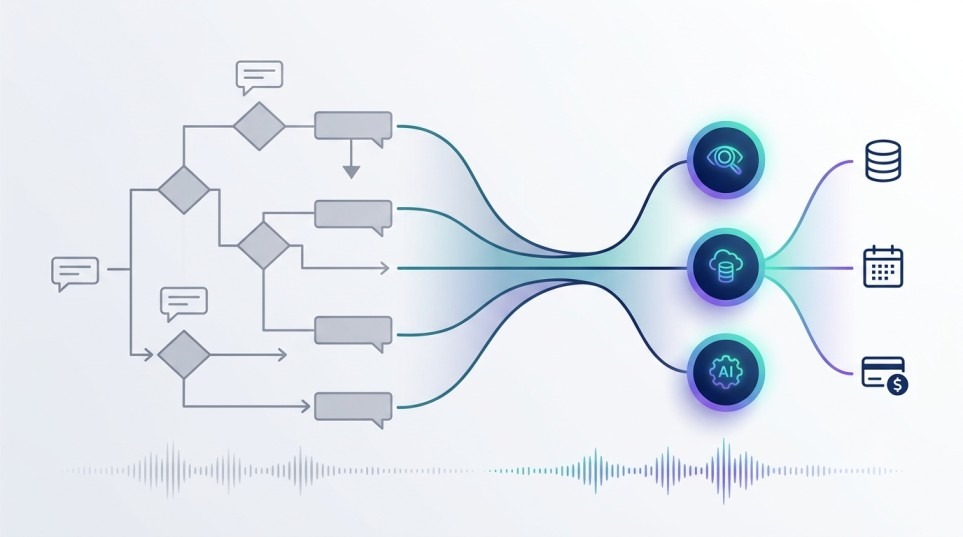
    Enterprise conversational AI has evolved far beyond simple pattern matching. Modern deployments use sophisticated multi-agent cognitive orchestration, marking a fundamental shift toward agentic voice AI agents that operate beyond basic script matching. Instead of relying on a single monolithic language model, enterprise platforms coordinate specialized AI agents that operate in parallel:

    • Intent and Context Agent: Analyzes sentiment, urgency, user intent, and subtle language nuances in real time.
    • Knowledge and Data Retrieval Agent: Queries internal knowledge bases, product catalogs, and transactional histories instantaneously.
    • Action Execution Agent: Interfaces directly with enterprise software to update records, schedule appointments, or process payments during the interaction.
    The Evolution of Conversational AI for Enterprises

    This multi-agent architecture lets an enterprise AI system retain context across long conversations, recover naturally from interruptions, and handle complex enterprise workflows without human intervention.

    Architectural Requirements of an Enterprise AI Solution

    Deploying AI systems within large organizations requires meeting strict technical standards around scale, integration, and security. Consumer-grade or basic mid-market solutions cannot withstand the transaction volumes or security scrutiny of an enterprise ecosystem.

    While legacy chatbots rely on rigid scripts, passive data retrieval, single-language models, and manual prompt tuning by developers, modern enterprise platforms use dynamic, non-scripted adaptive reasoning, bi-directional action execution, multilingual support with dynamic code-switching, and autonomous, self-evolving learning loops.

    System Integration and Real-Time Execution

    An enterprise conversational solution must integrate bi-directionally with existing infrastructure, including custom enterprise resource planning (ERP) software, customer relationship management (CRM) platforms, and supply chain management tools. To review the technical blueprint behind these connections, explore our breakdown of conversational AI architecture design.

    Scalability and High Throughput

    Enterprise systems must manage thousands of concurrent conversations across channels (web, mobile apps, messaging platforms, and voice) without degradation in response latency. Response times must remain sub-second to preserve natural conversational cadence.

    Enterprise Guardrails and Security

    Autonomous customer interactions require reliable safety measures. Conversational platforms enforce deterministic guardrails to prevent unauthorized data disclosure, reduce model hallucinations, and ensure compliance with global privacy mandates such as GDPR and CCPA. Platforms adhere to SOC 2 Type II audit standards and maintain HIPAA-compliant safeguards supported by Business Associate Agreements (BAAs).

    Unlocking High-Value Touchpoints with Enterprise Voice AI

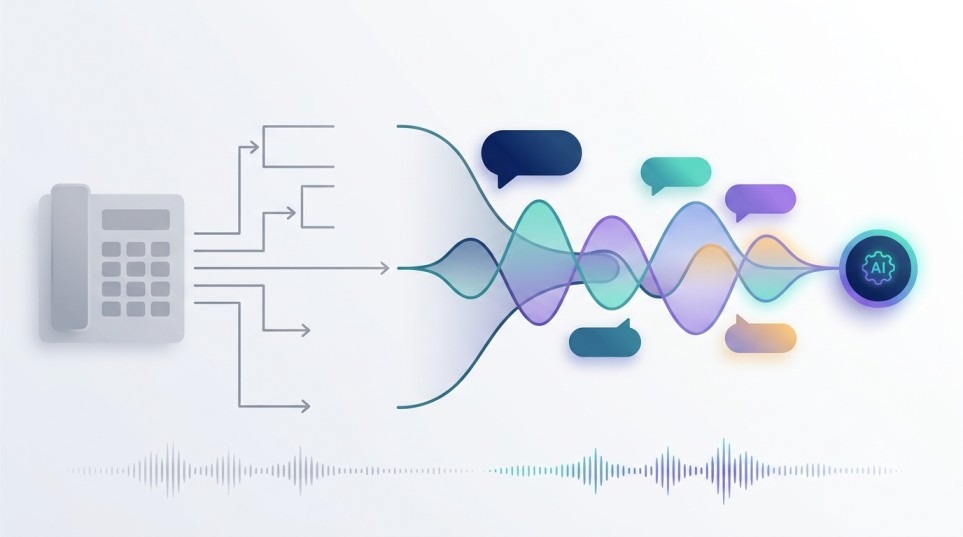
    While text-based channels handle routine queries efficiently, voice remains the most critical and cost-intensive customer engagement channel. Enterprise voice AI replaces frustrating touch-tone menus and static phone trees with natural, human-grade vocal interactions—see our operational guide on upgrading legacy IVR systems for step-by-step migration frameworks.
    High-Value Touchpoints with Enterprise Voice AI

    Managing Interruptions and Complex Intent

    Human speech is fluid, irregular, and rarely follows a linear path. Customers pause, talk over the agent, change their mind mid-sentence, or introduce secondary requests. Advanced enterprise voice AI leverages low-latency streaming architecture to process interruptions, pause immediately when spoken over, and adjust conversation paths in real time.

    Vernacular Nuances and Code-Switching

    In multicultural and regional markets, customers routinely switch languages within a single sentence. Modern conversational AI solutions are built to understand multilingual code-switching and regional accents; read our analysis on multilingual voice AI strategies to see how regional markets leverage this capability.

    Enterprise Conversational AI Use Cases by Industry

    Organizations across industries deploy conversational platforms to streamline complex operations, reduce administrative overhead, and resolve customer inquiries faster.

    Banking, Financial Services, and Insurance (BFSI)

    Financial institutions deploy enterprise conversational platforms to automate complex, identity-verified interactions; discover more about voice AI applications in banking for fraud detection and loan processing. Systems handle routine balance checks, loan status tracking, suspicious transaction flags, and card activations. By automating identity verification and initial claims intake, institutions drastically reduce average handle times (AHT) while improving compliance reporting.

    Healthcare and Pharmaceuticals

    In healthcare settings, conversational agents operate under HIPAA compliance guidelines to manage patient appointment scheduling, prescription refill requests, pre-procedure guidance, and insurance eligibility checks without adding administrative staff.

    Retail, E-Commerce, and Supply Chain

    Global retailers deploy conversational AI platforms to manage order tracking, return processing, product recommendations, and subscription adjustments—explore our breakdown of retail voice AI automation for inventory integrations. Connected directly to inventory management databases, AI agents provide real-time tracking updates and process exchanges autonomously.

    The Ello Advantage: Autonomous Agentic Voice Architecture

    Ello delivers a fully autonomous conversational platform engineered specifically for complex enterprise environments, moving beyond the static automation offered by traditional vendors to establish an Autonomous Agentic Voice Architecture.

    Multi-Agent Cognitive Orchestration

    Ello runs on an advanced multi-agent architecture designed to eliminate conversational rigidity. Instead of relying on predefined decision paths, Ello coordinates specialized AI agents that analyze intent, evaluate business logic, and execute actions dynamically during the conversation.

    Adaptive Prompting and Voice-to-Action Engine

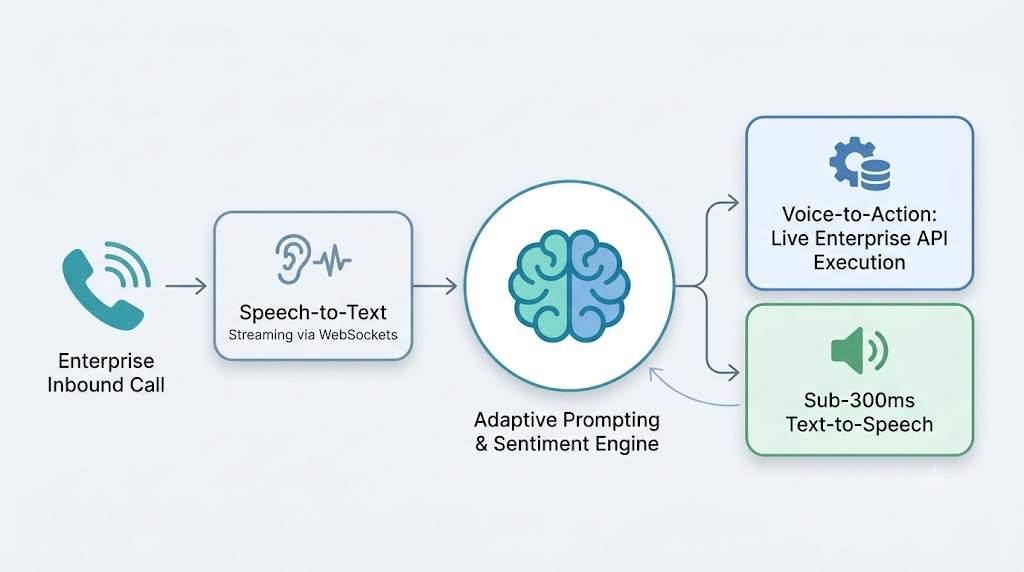
    Ello’s Adaptive Prompting Engine allows conversations to flow naturally, handling sudden context shifts, pauses, and speech interruptions effortlessly. At the same time, Ello’s Voice-to-Action Engine connects directly to enterprise CRMs, ERPs, Applicant Tracking Systems (ATS), and Property Management Systems (PMS), performing live transactional tasks (such as updating account records, booking appointments, or executing API requests) while staying live on the call.

    Self-Evolving Architecture

    Ello eliminates the need for ongoing manual prompt tuning and developer maintenance. Featuring a self-evolving architecture, Ello refines its internal operational logic every 200 calls. This autonomous feedback loop enables enterprise teams automating manual call workflows to achieve up to a 30% increase in operational efficiency over early deployment cycles without continuous developer intervention.

    Global Linguistic Capabilities

    Engineered for global deployment, Ello natively supports 30 languages, plus hundreds of regional dialects and accents. It handles fluid, real-time code-switching, allowing callers to mix languages mid-sentence while maintaining complete comprehension and accurate task execution.

    Compliance and Regulatory Assurance

    Ello meets strict enterprise standards with built-in SOC 2 Type II compliance, robust data encryption protocols, and automated regulatory guardrails. The platform enforces regional calling hour restrictions and respects global Do Not Call (DNC) and Do Not Disturb (DND) registries to protect enterprise brand reputation.

    Frequently Asked Questions

    1) What is Enterprise Conversational AI?

    Enterprise conversational AI is an advanced architecture utilizing multi-agent orchestration, dynamic reasoning, and real-time backend integrations to automate complex, multi-step customer interactions across voice and text channels.

    2) How does Enterprise Conversational AI differ from basic chatbots?

    Basic chatbots rely on rigid decision trees and predefined scripts to handle simple, linear queries. Enterprise conversational AI leverages autonomous reasoning, natural language understanding, and direct system integrations to resolve complex, non-linear business transactions.

    3) How does enterprise voice AI handle customer interruptions during a call?

    Enterprise voice AI uses low-latency, real-time audio processing to detect human speech instantly. When a customer speaks over the system, the AI pauses its output immediately, re-evaluates the user’s new input, and adapts its response without breaking the conversation flow.

    4) How do conversational AI solutions integrate with existing enterprise systems?

    Conversational AI solutions connect directly to enterprise CRMs, ERPs, core banking databases, and ticketing software via secure APIs. This bi-directional integration enables AI agents to retrieve data and execute actions autonomously during live customer sessions.

    5) Can enterprise AI platforms handle multiple languages and regional accents?

    Yes, sophisticated enterprise AI platforms support multilingual processing across dozens of languages. Systems like Ello natively comprehend diverse regional accents and handle colloquial code-switching, allowing users to mix languages naturally within a single conversation.

    Conclusion

    The shift from simple script-based call deflection to cognitive, agentic workflows marks a permanent transformation in how large institutions approach customer operations. Legacy tools that rely on decision trees can no longer keep pace with modern customer expectations or the operational realities of complex enterprise environments. By adopting platforms built on multi-agent cognitive orchestration, real-time voice-to-action execution, and continuous self-learning loops, forward-thinking leaders eliminate persistent operational bottlenecks while protecting brand reputation.

    Modern customer engagement requires an architecture that can handle fluid context, regional code-switching, and live transactional execution directly inside enterprise systems. Deploying autonomous conversational capabilities helps organizations reduce support friction, let human teams focus on high-value initiatives, and deliver immediate, personalized interactions at enterprise scale. To learn how Ello can transform your customer operations, explore Ello’s enterprise voice solutions today.

  • Customer Support Automation and the Rise of Voice AI

    Customer Support Automation and the Rise of Voice AI

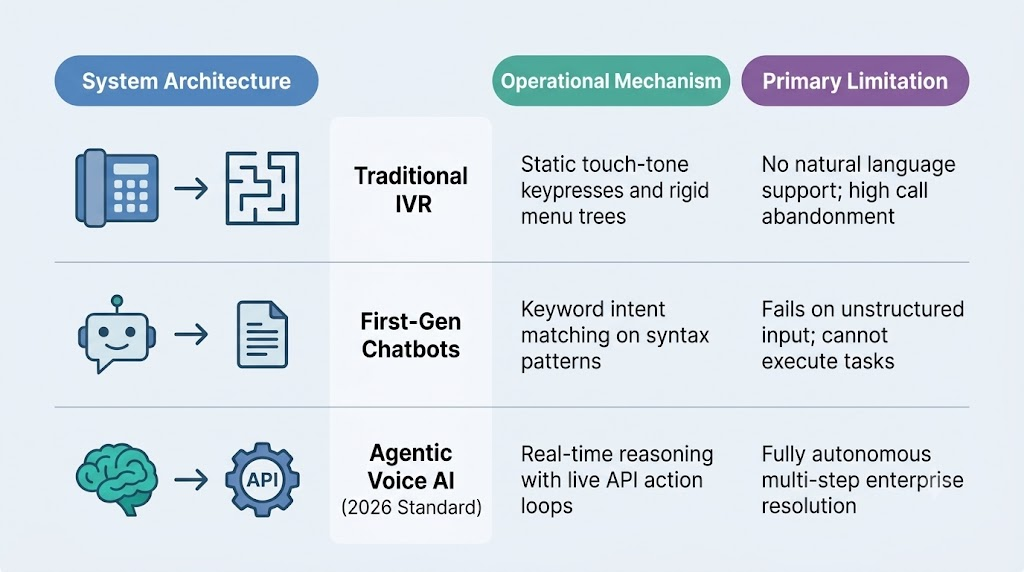
    Scaling customer support automation requires more than incremental fixes: high contact center handle times, rising staffing overhead, and fragmented ticket routing continue to strain operational margins across enterprise service organizations. Traditional self-service options, such as rigid Interactive Voice Response (IVR) phone trees and rule-based chatbots, routinely fail when confronted with complex customer requests. Modern contact center automation strategies address these operational bottlenecks.

    The industry is shifting away from static decision trees toward cognitive, agentic workflows. At the center of this transformation is the rise of real-time voice AI, enabling enterprises to resolve high-consequence customer service issues over the phone without human intervention.

    The Structural Limits of Legacy Support Automation

    For over a decade, automated customer service relied on deterministic branching logic. Traditional text chatbots that matched basic intent triggers worked for simple tasks like checking an account balance or checking an order status. However, when transactional inquiries required dynamic reasoning, context switching, or multi-system database updates, rule-based systems collapsed.

    Legacy voice infrastructure suffered even greater limitations. Traditional voice menus forced customers through repetitive touch-tone options, only to land them in a waiting queue to repeat their issue to a human agent. This dynamic is why enterprises are increasingly retiring legacy IVR systems in favor of dynamic conversation. True efficiency demands a system that can handle natural conversation and execute tasks immediately and autonomously.

    Deconstructing Voice AI for Autonomous Support

    Deconstructing Voice AI for Autonomous Support

    Modern voice AI for support operates on a cognitive architecture that processes speech, reasons through policy rules, and executes operational workflows in real time. Unlike legacy text bots wrapped in a basic text-to-speech engine, an agentic voice AI framework handles the unpredictable nature of human speech, including interruptions, sudden context shifts, and background noise.

    Ultra-Low Latency Conversational Processing

    Human conversation relies on turn-taking intervals of 200 to 300 milliseconds. Early voice software introduced 2-to-3-second latencies between a caller finishing a sentence and the machine responding, creating an awkward, unnatural experience. Understanding and managing voice AI latency is critical for maintaining fluid dialogue. Current architectures stream audio via WebSockets directly into speech recognition and language models, keeping total response latency below 300 milliseconds for seamless, fluid dialogue.

    Dynamic Context Management and Non-Linear Dialogue

    Customers rarely state their issues in neat, structured sentences. A caller reporting a damaged shipment might interrupt the system mid-verification to change their delivery address or ask about a refund policy. An advanced customer service AI agent maintains state tracking across multi-turn interactions, holding context variables in memory while dynamically updating conversation branches.

    Real-Time Voice-to-Action Execution

    Answering a question is only half the challenge; resolving an issue requires action. Modern voice systems don’t just read script responses. Instead, they trigger backend system functions during the call, authenticate user identities, modify records in enterprise platforms, update support tickets, and process payments securely while staying live on the phone.

    Architectural Pillars of Enterprise Support Automation

    Architectural Pillars of Enterprise Support Automation

    Building a scalable framework for AI customer support automation requires unifying voice interactions with back-office data pipelines and ticket systems.

    1. Multi-Agent Cognitive Orchestration: 

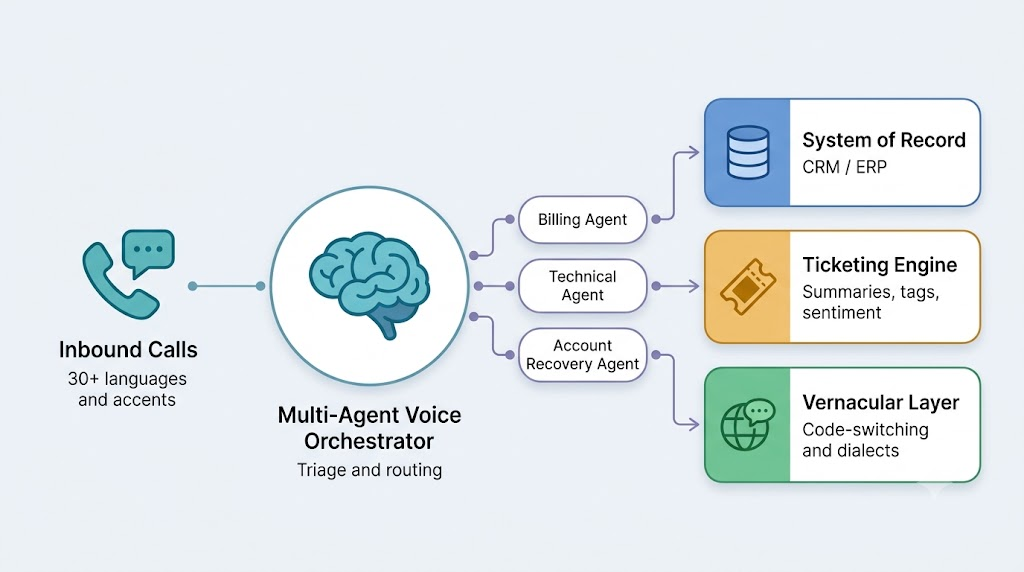
    Rather than relying on a single monolithic model to process every inquiry, enterprise systems use dedicated micro-agents to eliminate manual call workflows across specialized operational domains. A primary triage agent evaluates caller intent and hands off execution to specialized sub-agents optimized for specific domains, such as billing adjustments, technical troubleshooting, or account recovery.

    2. Autonomous Support Ticket Automation: 

    Manual data entry remains a major driver of post-call agent fatigue and administrative overhead. Deploying modern AI agents in call centers ensures every interaction handled by a voice agent generates structured call summaries, tag categories, sentiment metrics, and resolution logs directly in systems like Zendesk or Salesforce.

    3. Vernacular Code-Switching and Accent Adaptation: 

    Global enterprises serve diverse user bases speaking multiple languages and regional accents. Modern voice architectures handle colloquial phrasing, dialect variations, and mid-sentence language transitions. Adopting multilingual voice AI strategies allows global enterprises to serve diverse user bases seamlessly.

    Overcoming Security, Guardrails, and Hallucination Risks

    Deploying autonomous voice interactions in production environments requires strict security operational controls and compliance enforcement.

    • Hallucination Containment: Voice models operate within defined knowledge spaces, pulling responses strictly from verified policy docs and API payloads. If a query falls outside permitted guidelines, the system gracefully transfers the call with full context.
    • Deterministic Guardrails: Hard-coded security rules sit on top of probabilistic models, ensuring the system never wavers on identity verification, refund limits, or regulatory disclosures.
    • Data Privacy and Regulatory Compliance: Voice pipelines enforce SOC 2, HIPAA, and regional telephony compliance standards (including TRAI rules and local calling window restrictions), ensuring customer audio data is encrypted in transit and at rest.

    The Ello Advantage: Autonomous Voice AI Built for the Enterprise

    Ello provides the specialized cognitive infrastructure required to fully automate complex contact center operations, moving beyond general enterprise systems that only streamline basic workflows. Designed explicitly for high-volume enterprise environments, Ello moves past static scripts to deliver fully agentic voice interactions across operations, sales, and customer care:

    • Ello’s Self-Evolving Architecture: Features an autonomous learning loop that continuously analyzes live conversational telemetry and post-call resolution rates. After processing approximately 200 calls on a given workflow, the system autonomously refines its prompting parameters and dialogue paths, delivering a 30 percent boost in operational efficiency without manual developer updates.
    • Ello’s Adaptive Prompting & Voice-to-Action Engine: Dynamically adapts to real-time caller emotion, urgency, and sudden speech interruptions. The platform authenticates callers and executes complex transactional tasks directly inside CRMs, ERPs, and ticketing tools while maintaining natural conversation on the line.
    • Ello’s Multilingual Vernacular Capabilities: Natively supports 30 languages and hundreds of regional accents. It handles fluid, mid-sentence code-switching and local colloquialisms seamlessly, ensuring high resolution rates across diverse global markets.
    • Ello’s Enterprise Security Standards: Built with enterprise-grade guardrails, Ello guarantees SOC 2 compliance, robust data encryption, zero-hallucination policy enforcement, and automatic adherence to localized telecommunication mandates.

    Frequently Asked Questions

    1) How does voice AI differ from traditional speech recognition IVR systems?

    Legacy speech recognition IVRs use strict keyword matching to navigate pre-programmed touch-tone menus. Voice AI utilizes real-time natural language reasoning to understand conversational intent, handle non-linear dialogue interruptions, and execute downstream enterprise API tasks directly during the call.

    2) Can customer support automation handle complex, multi-step user inquiries?

    Yes. Modern support automation uses agentic orchestration to break complex requests into sub-tasks. The system authenticates user identities, queries backend databases, executes policy rules, and updates records across enterprise platforms within a single continuous interaction.

    3) How does voice AI handle caller interruptions or sudden changes in context?

    Advanced voice AI architectures maintain dynamic state tracking while operating low-latency streaming pipelines. If a caller interrupts mid-sentence or changes the topic, the engine halts current speech generation, updates its internal context variables, and responds naturally to the new query.

    4) What happens when an automated customer service agent cannot resolve an issue?

    If an inquiry falls outside predefined operational boundaries or requires human authorization, the system executes a context-aware handoff. It routes the call to a live agent alongside a real-time transcript, sentiment score, and complete summary of steps taken, eliminating caller repetition.

    5) How does voice AI maintain compliance and security during sensitive support calls?

    Enterprise voice AI platforms incorporate strict guardrails, zero-retention data pipelines, and end-to-end encryption. They adhere to industry frameworks such as SOC 2 and HIPAA and enforce strict identity verification checks before sharing sensitive account information.

    Conclusion

    The shift from reactive deflection to fully autonomous voice interaction represents the next major evolution in enterprise customer care. Legacy IVRs and basic text chatbots exposed the limits of rigid decision trees, creating operational bottlenecks and driving up cost-per-contact metrics. By combining ultra-low latency speech processing, dynamic reasoning, and real-time backend API execution, agentic voice AI enables enterprises to resolve complex, multi-step inquiries entirely over the phone while preserving natural, human-like dialogue.

    Organizations that modernize their contact center infrastructure with self-evolving voice architectures can eliminate handling delays, scale operational capacity, and deliver immediate customer resolution at lower overall overhead. To discover how autonomous voice agents can elevate your enterprise contact center capabilities, explore Ello’s enterprise voice platform.

  • Will AI Replace Call Center Agents in 2026?

    Will AI Replace Call Center Agents in 2026?

    Will AI replace call center agents in 2026? The answer depends on what part of the job we are talking about.

    AI can already handle a growing number of customer conversations without human involvement. It can answer routine questions, retrieve information, schedule appointments, process simple requests, and complete defined workflows. But call center work also includes situations that require judgment, empathy, negotiation, and accountability.

    The investment in this technology is accelerating. According to Gartner’s 2026 survey, customer service leaders increased AI spending by 38%, while overall service and support budgets grew by only 2%. 

    That makes one thing clear: AI is becoming a significant part of the contact center operating model. The more important question is how much of an agent’s work it can realistically take over.

    What AI Can Already Replace in a Call Center

    The easiest work to automate has a few things in common: high volume, predictable requests, accessible information, and clearly defined outcomes.

    These are some of the areas where AI for call centers can already reduce the need for human involvement:

    • Checking order, delivery, or application status
    • Scheduling and rescheduling appointments
    • Answering routine account questions
    • Handling basic billing requests
    • Confirming customer information
    • Sending payment reminders
    • Qualifying inbound leads
    • Providing standard troubleshooting
    • Processing simple changes or cancellations

    An AI call center agent can also connect with business systems to retrieve information and complete actions during a conversation.

    That distinction matters. AI is increasingly capable of taking over tasks and call types, even when the broader role of a call center agent remains necessary.

    So, when asking will AI replace call center agents, enterprises should first look at the work inside the role rather than treating the job as a single unit.

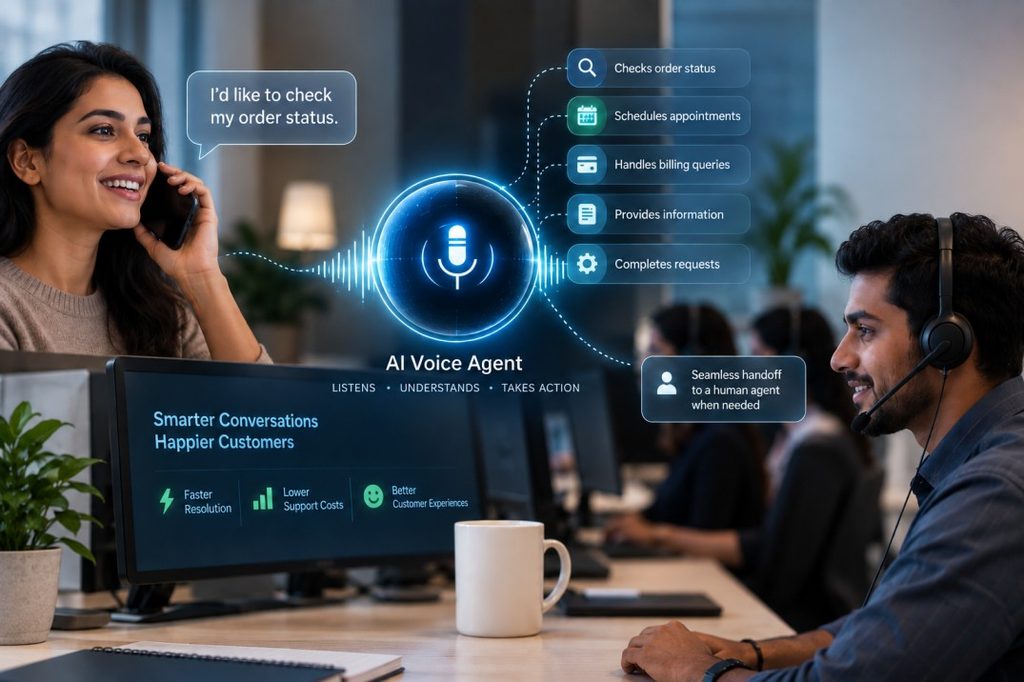
    AI voice agent and human support agent working together in a call center

    Why Some Call Center Work Still Needs People

    Not every customer problem follows a defined workflow.

    A billing dispute may involve several previous interactions. A technical problem may require investigation beyond the standard troubleshooting process. A frustrated customer may need someone who can understand the situation, make a judgment call, and take responsibility for the resolution.

    These situations are harder to automate because the desired outcome cannot always be determined from a fixed set of rules.

    Human agents also remain important when the stakes are high. Customers dealing with financial issues, complaints, cancellations, or serious service failures may want the reassurance of speaking with a person who can take ownership of the situation.

    Customer expectations reinforce this. A GenAI customer service survey says 87% of customers believe companies using GenAI for customer service should provide access to a human agent.

    The implication is important: customers may be comfortable with AI handling their request, but they still expect a clear path to human support when automation reaches its limits.

    How AI Changes the Call Center Agent’s Role

    If AI takes over repetitive conversations, human agents are left with a different mix of work.

    Instead of spending much of their day answering the same questions or entering information into multiple systems, agents can focus more heavily on:

    • Complex escalations
    • Difficult troubleshooting
    • Customer retention
    • Sensitive conversations
    • Exceptions that fall outside standard workflows
    • High-value customer interactions
    • Decisions that require business judgment

    This also changes the skills that matter in the role.

    Agents may need to interpret AI-generated information, review automated interactions, manage escalations, work across multiple systems, and make decisions when a customer situation does not fit the expected workflow.

    That is why whether AI will replace call center agents is ultimately a workforce-design question as much as a technology question.

    The number of conversations handled by humans may decline. The value of the conversations they handle can increase.

    Where Should Enterprises Draw the Line?

    The mistake is trying to automate based only on call volume.

    A high-volume interaction may still require human involvement if errors carry significant financial, regulatory, or reputational consequences. Conversely, a large volume of straightforward requests may be excellent candidates for automation.

    Enterprises should evaluate each call type against a few practical criteria:

    Predictability: Can the request be resolved through a defined process?

    Data access: Can the AI securely access the information required?

    Risk: What happens if the system misunderstands the request or takes the wrong action?

    Escalation: Is there a clear point where the conversation should move to a human?

    Outcome: Can success be measured through resolution, completion, transfer rate, customer satisfaction, or another business metric?

    This gives enterprises a more useful way to determine will AI replace call center agents within their own operations.

    The answer will vary by industry, customer journey, and the complexity of the calls being handled.

    AI voice agent assisting a customer call with human handoff

    How Ello Supports AI-Powered Call Centers

    Ello helps enterprises automate voice-based customer interactions while keeping business workflows and human escalation connected.

    Its voice AI agents can handle conversations in real time, understand customer intent, access relevant business information, and execute defined actions during the call. When a request requires human judgment, the interaction can be routed to an agent instead of forcing automation beyond its limits.

    This approach gives enterprises more control over which conversations they automate and where human involvement remains essential.

    For call center outsourcing, the objective is not simply to increase the number of calls handled by AI. It is to build an operating model where routine interactions can be automated reliably while human teams have the time and context to handle the conversations that require them.

    Conclusion

    AI will replace parts of the job. Routine conversations, repetitive processes, and administrative work will increasingly be handled by AI systems.

    But the human role is likely to remain important wherever customers need judgment, accountability, empathy, complex problem-solving, or an exception handled properly.

    The bigger change is in what call center agents spend their time doing.

    Enterprises that approach AI as a way to remove repetitive work can create a more focused human workforce. Those that treat automation as a reason to eliminate human involvement across every type of interaction risk creating frustrating customer experiences.

    In 2026, the better question is not whether AI can replace a call center agent. It is which parts of the job AI should own, and where human expertise should remain in control.

    FAQs

    1) Will AI replace call center agents completely?

    AI can replace many routine call center tasks, but human agents will continue to play an important role in complex, sensitive, and high-value interactions.

    2) What call center tasks can AI automate?

    AI can automate routine inquiries, appointment scheduling, status checks, basic troubleshooting, lead qualification, payment reminders, and other structured workflows.

    3) Will AI reduce the number of call center jobs?

    It may reduce demand for some repetitive roles while increasing the need for agents who can manage complex cases, escalations, and AI-assisted workflows.

    4) What are the main AI call center use cases?

    Common AI call center use cases include customer service, appointment management, lead qualification, order tracking, payment reminders, troubleshooting, and automated follow-ups.

    5) Will human agents still be needed in 2026?

    Yes. Human involvement remains valuable for situations requiring judgment, empathy, negotiation, complex problem-solving, and accountability.

  • Conversational AI Agents Explained for Modern Enterprises

    Conversational AI Agents Explained for Modern Enterprises

    Every enterprise support and revenue team eventually hits the same wall: call volume and buyer expectations rise faster than headcount ever can. Legacy IVRs route callers in circles. Web chatbots stall the moment a conversation drifts off script. By 2026, the enterprises that have solved this problem have moved past static scripts and adopted conversational AI agents: systems that reason about intent, hold context across a full conversation, and complete tasks directly inside CRMs, ERPs, and support platforms instead of simply answering questions. That broader shift, often described simply as conversational AI, is reshaping how support, sales, and operations teams work across every channel.

    This blog covers how these systems operate under the hood, where they create measurable value across the enterprise, and what to look for in a conversational AI platform before you sign a contract.

    What Are Conversational AI Agents

    A conversational AI agent is a software system that understands natural language, spoken or typed. It uses that understanding to complete a task on a user’s behalf rather than simply returning an answer. The distinction that matters is agency. A scripted bot matches a query to a pre-written response and stops there. AI conversational agents reason about what the caller is trying to accomplish, decide which system they need to act on, and execute the task directly, often without a human ever joining the conversation.

    Enterprises deploy these systems in two forms. Text-based agents sit inside websites, apps, and messaging platforms. Voice AI agents handle spoken conversations over the phone or inside contact center software, and are commonly called AI voice assistants when deployed for customer-facing calls. Both run on the same reasoning layer; the difference is the input channel and the speech recognition and synthesis required for voice. The wider category, conversational AI solutions, spans both, but the agentic tier described here is where most 2026 buying decisions are concentrated.

    How Conversational AI Agents Work

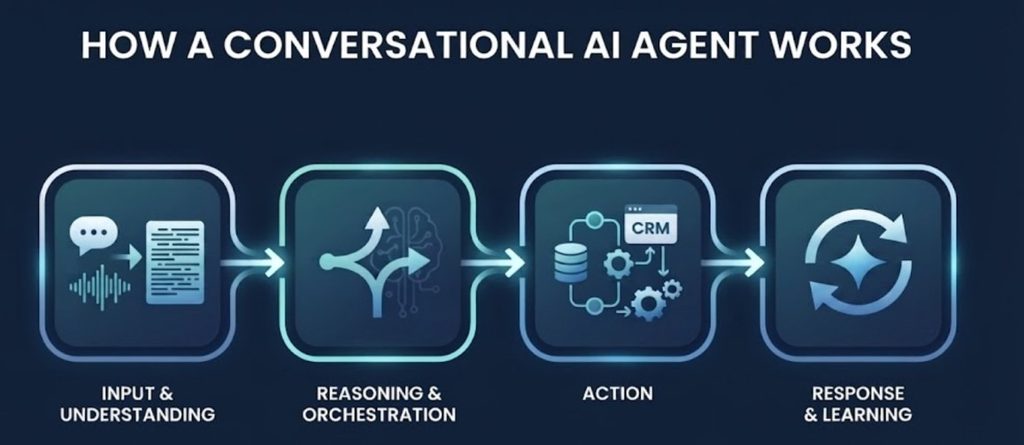
    Working process of conversational AI agent

    Input and understanding

    Text arrives as-is; voice passes through speech recognition first. Natural language understanding then extracts intent, entities, and sentiment, carrying context from earlier in the same conversation.

    Reasoning and orchestration

    This layer separates a genuine agent from a scripted bot. Instead of following a fixed decision tree, the agent decides whether it has enough information to act, needs to ask a clarifying question, or needs to call a tool such as a CRM lookup before responding.

    Action

    A conversational AI platform connects to enterprise systems through APIs and pre-built connectors: CRMs, ticketing systems, ERPs, and payment processors. This is what lets an agent complete a task instead of describing what a human should do next.

    Response and learning

    Natural language generation produces the reply; for voice, text-to-speech renders it as natural audio. Feedback loops then refine intent recognition and response quality over time.

    Conversational AI Agents vs Traditional Chatbots

    The terms get used interchangeably, but the technology differs in ways that matter for a buying decision.

    Traditional ChatbotConversational AI Agent
    LogicRule-based decision trees, keyword matchingLLM-powered reasoning and intent understanding
    ContextLimited to a single turn or scripted flowMaintains context across a full conversation and prior sessions
    ActionProvides information or routes to a humanExecutes tasks directly via system integrations
    FlexibilityBreaks on unscripted phrasingHandles ambiguity, follow-ups, and topic shifts
    SetupManually authored conversation flowsTrained on knowledge bases, policies, and business logic

    A rule-based bot can still handle a narrow task like collecting a zip code. For anything involving judgment or account-specific data, enterprises evaluating conversational AI solutions are standardizing on agent-based architecture instead. Buyers researching AI conversational agents typically use this distinction as the first filter before comparing individual vendor features.

    Customer enquiring with conversational AI agent

    This shift has a name in 2026: Agentic Voice AI, and it is where enterprise budgets are actually moving, well beyond the text-based chat that most coverage of this topic stops at. The phone channel, specifically, is where voice AI agents, often marketed as AI voice assistants, are absorbing volume that used to sit with IVR trees alone.

    Three capabilities separate genuinely agentic voice systems from a language model bolted onto an old IVR tree. Live task execution means the agent updates the CRM or schedules the visit while the caller is still on the line, not afterward. Multi-agent orchestration routes billing, support, and scheduling sub-tasks between specialized agents within one call, without a transfer. Vernacular and code-switching support matters in markets like India, where a single call routinely moves between English and a regional language mid-sentence; voice AI agents built for code-mixed speech hold up where generic AI voice assistants fail.

    Enterprise Use Cases Across Departments

    Conversational AI solutions are no longer confined to the contact center. AI conversational agents are already live in production across these departments, not just pilot programs:

    • Customer service

    Resolving tickets, refunds, and account questions across chat and voice.

    • Sales

    Qualifying inbound leads and booking meetings directly inside the CRM.

    • IT helpdesk

    Password resets and access requests resolved without ever opening a ticket.

    • HR and talent acquisition

    Screening candidates and scheduling interviews inside the ATS.

    • Finance

    Invoice status checks and fraud flagging with a full audit trail attached.

    What to Look For in a Conversational AI Platform

    Evaluation criteria that matter when comparing conversational AI solutions:

    • Integration depth: Native connectors to your CRM, ERP, or ATS, not custom engineering for every workflow.
    • Reasoning quality: Genuine handling of ambiguous, multi-turn conversations, not a fallback to rigid scripts.
    • Voice fidelity: Natural handling of interruptions, accents, and code-switching for voice AI agents specifically.
    • Security and governance: Encryption, role-based access, and audit logs for regulated data.
    • Human handoff: A seamless escalation path with full conversation context.

    Getting Started with a Conversational AI Platform

    Start with a narrow, high-volume interaction. Order status, appointment scheduling, or password resets are common first deployments for conversational AI agents because success is easy to measure and the downside risk is low. Map the CRM, ERP, or ATS integrations the agent will need to touch before comparing conversational AI solutions, since integration depth is usually what separates one conversational AI platform from another in practice. If phone volume matters to the business, pilot voice AI agents alongside the text deployment rather than treating AI voice assistants as a later-phase add-on. Voice conversations tend to carry the highest-urgency, highest-value interactions first, which makes them the fastest place to prove measurable return.

    The Ello Advantage: Real-Time Voice Execution for the Enterprise

    Ello is built for the gap most conversational AI platforms and conversational AI solutions vendors leave open: acting live, on the call, inside the systems that run the business.

    Adaptive Prompting Engine

    Handles dynamic, non-scripted dialogue in real time, reading caller sentiment and urgency as the conversation unfolds.

    Voice-to-Action Engine

    Executes tasks autonomously inside enterprise CRMs, ERPs, ATS, and PMS platforms while remaining live on the call.

    Self-Evolving Architecture

    An autonomous learning loop rebuilds Ello’s own prompts after approximately 200 calls, without manual developer intervention, driving roughly a 30 percent boost in operational efficiency.

    Linguistic capability

    Native support for 30 languages and regional accents, handling code-switching that most AI voice assistants skip entirely, a capability built specifically for markets like India.

    Security and compliance

    SOC 2 compliance (and HIPAA where relevant), data encryption, and automated adherence to TRAI, DND, and calling hour restrictions.

    Put together, this is what Agentic Voice AI actually looks like in production: dialogue that adapts, reasons, and acts inside enterprise systems while the caller is still on the line, not a chatbot with a phone number attached to it.

    Frequently Asked Questions

    1) What are conversational AI agents used for in the enterprise?

    Conversational AI agents, sometimes called AI conversational agents, handle customer support, sales qualification, and internal helpdesk requests by completing the task directly inside enterprise systems, not just answering a question about it.

    2) How is a voice AI agent different from a text-based agent?

    The reasoning layer is the same. The difference is the channel: voice AI agents add speech recognition and synthesis, which is why they are also called AI voice assistants when deployed for phone-based service.

    3) How long does it take to deploy a conversational AI platform?

    A narrow use case such as order status can go live in weeks with pre-built connectors. Broader deployments touching several systems typically take a few months.

    4) Are conversational AI solutions secure enough for regulated data?

    Reputable platforms provide encryption, role-based access, audit logging, and compliance support for standards such as SOC 2 and HIPAA. Confirm these details during vendor evaluation.

    5) Will conversational AI agents replace human support teams?

    Not entirely. Agents handle repetitive, well-defined interactions, freeing human teams for complex, high-empathy conversations, with a clear escalation path to a person.

    The Bottom Line

    Conversational AI agents have moved well past scripted chatbots and static IVR trees. The systems built for 2026 reason, remember context, and act inside real business systems during the call, not after it ends. The organizations getting the most value are choosing a conversational AI platform built for real-time voice execution from the ground up, not the flashiest demo.

    Ready to put a voice AI agent to work inside your own systems? Get started with Ello.

  • AI Voice Agent Latency Explained: Why Response Time Makes or Breaks the Call

    AI Voice Agent Latency Explained: Why Response Time Makes or Breaks the Call

    A voice conversation depends on timing. Even a short pause after a customer finishes speaking can make an AI agent feel slow, uncertain, or disconnected.

    That makes AI voice agent latency a critical part of the customer experience. It affects how naturally an agent responds, handles interruptions, retrieves information, and keeps a conversation moving.

    For enterprises, even small delays can affect thousands of daily interactions. Understanding where latency comes from and how to measure it is essential for delivering reliable voice AI at scale.

    What AI Voice Agent Latency Actually Means

    AI voice agent latency refers to the time between a customer finishing their speech and hearing the AI begin its response.

    That gap can involve several stages:

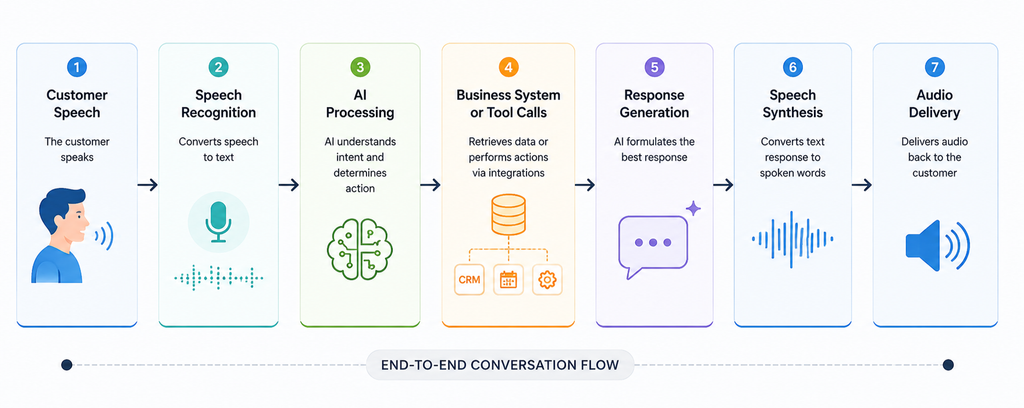
    AI voice agent latency gap can involve several stages

    Each stage can add delay. Speech-to-text needs to process what the customer said. The AI needs to interpret the request and determine what to do. If the request requires information from a CRM, payment system, scheduling platform, or other backend application, that interaction adds another layer. The response then needs to be converted into speech and delivered back to the caller.

    This means the most important factor is the end-to-end experience the customer hears, not the processing time of any single component.

    Why Latency Changes the Conversation

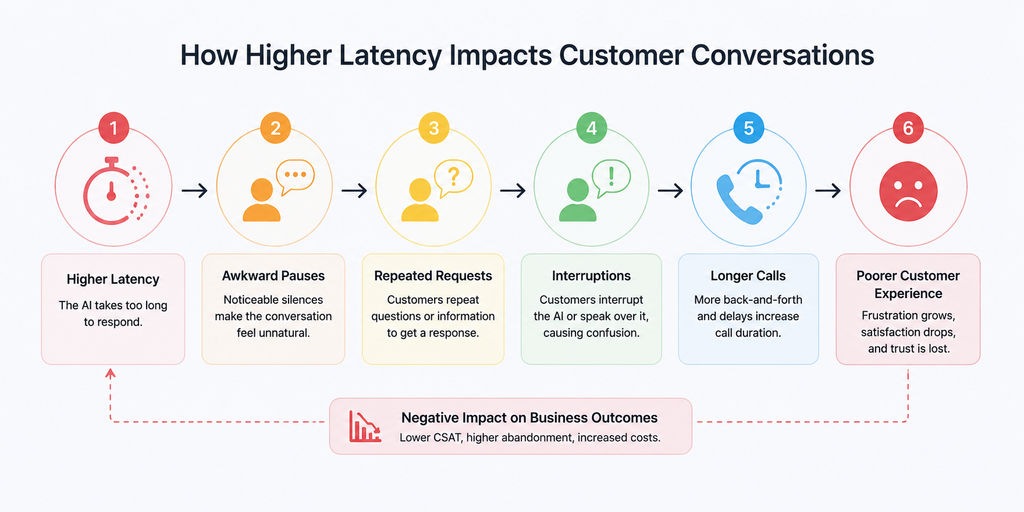
    When the response arrives quickly, the interaction feels continuous. When the pause becomes noticeable, customers may repeat themselves, interrupt the agent, or assume something went wrong.

    NVIDIA recommends targeting under one second between the end of a customer’s speech and the first synthesized audio for a conversational voice agent to feel responsive. Its 2026 guidance notes that delays above one second can begin to interrupt the natural flow of conversation.

    That makes response time in voice AI a practical customer experience consideration, not simply an engineering benchmark. A slower response can create a chain reaction:

    How higher latency impacts customer conversations

    Latency also affects how well an agent handles interruptions. If a customer starts speaking while the AI is responding, the system needs to detect the interruption and stop speaking quickly. Otherwise, even an accurate response can feel disconnected from the conversation.

    The goal, therefore, is not simply to make an AI voice agent respond faster. It is to create real-time voice AI performance that keeps turn-taking natural, responses timely, and the conversation moving.

    The Fastest First Response Can Still Feel Slow

    A voice agent can respond quickly to a simple question and still create noticeable delays when it needs to complete a business action.

    Consider a customer asking, “Where is my order?”

    The AI may recognize the request immediately. But it still needs to identify the customer, retrieve the order from the relevant system, check the latest status, and formulate a response.

    The customer experiences all of that as part of one conversation.

    The same applies when a voice agent needs to:

    • Schedule or reschedule an appointment
    • Retrieve account information
    • Update a customer record
    • Verify an identity
    • Process a service request
    • Check payment or order status

    This is why real-time voice AI performance depends on the entire technology stack. A fast speech model cannot compensate for a slow backend workflow.

    Enterprises should therefore evaluate latency across the complete customer journey rather than looking only at model or platform benchmarks.

    How Enterprises Should Measure Real-Time Voice AI Performance

    Asking a provider, “What is your latency?” doesn’t provide enough information.

    Enterprises should understand how that number was measured.

    A meaningful evaluation should consider:

    • End-to-end latency: Measure the time the customer actually experiences, including network and telephony factors.
    • p50 latency: Shows the typical interaction.
    • p95 and p99 latency: Reveal how the system performs during slower interactions. An attractive average can hide delays that customers encounter regularly.
    • Geography: Network distance and telephony routing can affect response times.
    • Concurrency: A system that performs well during a small test may behave differently under production call volumes.
    • Tool calls: Test the agent while it accesses real CRM, scheduling, payment, or other enterprise systems.
    • Language: Measure performance across the languages and accents the target customer base actually uses.

    The evaluation should happen under conditions that resemble production. A laboratory benchmark provides useful information, but it doesn’t tell the whole story.

    How Enterprises Can Reduce Voice AI Latency

    Improving AI voice agent latency requires attention to the full interaction, not a single component.

    • Optimize the architecture

    Streaming speech recognition, incremental response generation, and parallel processing can reduce unnecessary waiting between stages.

    • Reduce backend delays

    If every customer request requires a slow API call, the voice experience will inherit that delay. Design critical enterprise workflows for fast retrieval and execution.

    • Improve interruption handling

    The agent should recognize when a customer starts speaking and stop its response quickly. This keeps turn-taking natural and prevents customers from talking over the system.

    • Use concise responses

    A voice agent doesn’t need to deliver a long explanation when a short answer completes the task. Concise responses reduce interaction time and keep conversations focused.

    • Monitor the complete call

    Teams should track response latency alongside task completion, transfer rates, call duration, and customer satisfaction. This provides a clearer picture of whether faster responses are actually improving the customer experience.

    How Ello Supports Real-Time Voice Experiences

    For enterprise voice AI, responsiveness depends on more than the conversational model’s speed. Customer interactions also involve business systems, workflows, data retrieval, multilingual communication, and human handoffs.

    Ello brings these elements together through AI voice agents designed for real-time customer interactions. The platform can understand customer intent, work with enterprise systems, automate workflows, and transfer conversations to human agents when additional expertise is required.

    This approach helps organizations evaluate AI voice agent latency as part of the complete customer interaction rather than as an isolated technical benchmark. Faster responses, connected workflows, and contextual conversations work together to create voice experiences that feel more natural and responsive.

    Conclusion

    AI voice agent latency directly influences how customers experience a conversation.

    A technically capable voice agent can still frustrate customers when responses arrive too slowly, interruptions take too long to register, or backend workflows create unexplained pauses. Enterprises therefore need to evaluate response time across the complete call journey, under realistic production conditions.

    The right benchmark isn’t simply the lowest latency number. It is consistent, responsive performance that helps customers complete tasks without awkward pauses, repeated requests, or unnecessary transfers.

    For businesses deploying voice AI at scale, treat real-time voice AI performance as a core customer experience metric, alongside accuracy, task completion, reliability, and service quality.

    FAQs

    1. What is AI voice agent latency?

    AI voice agent latency is the time between a customer finishing their speech and hearing the AI respond. It can include speech recognition, AI processing, backend calls, and speech generation.

    2. What is a good response time for voice AI?

    There is no single ideal number. Enterprises should evaluate end-to-end latency, including p50, p95, and p99 performance.

    3. Why does latency matter for voice AI?

    High latency creates awkward pauses, repeated requests, interruptions, and longer calls, which can affect the overall customer experience.

    4. How can enterprises improve AI voice agent latency?

    Enterprises can reduce latency by optimizing the AI architecture, backend integrations, API calls, streaming, and interruption handling.

    5. How should businesses evaluate voice AI latency?

    Test real customer scenarios across target geographies, languages, integrations, and call volumes, while measuring end-to-end p50, p95, and p99 latency.

  • AI Voice Agents for HR: How Indian Enterprises Are Automating Candidate Screening

    AI Voice Agents for HR: How Indian Enterprises Are Automating Candidate Screening

    Managing recruitment across major Indian enterprise sectors in 2026 presents a significant operational challenge. Human resource teams in information technology, banking, retail, and business process outsourcing often receive thousands of applications for a single open role. The traditional candidate screening process, reliant on manual phone calls and spreadsheet tracking, creates a severe bottleneck. Recruiters spend countless hours chasing voicemails, confirming basic qualifications, and coordinating schedules, which leads to recruiter burnout and high candidate drop-off rates.

    To overcome these delays, forward-thinking organizations are modernizing their talent acquisition stacks. The deployment of an AI voice agent for recruitment has emerged as an essential strategy for streamlining candidate screening. By replacing manual phone screens with reasoning-based voice technology, Indian enterprises are engaging applicants instantly, evaluating candidates objectively, and accelerating time-to-hire.

    1. Closing the Recruiter Gap with Instant Outreach

    For the hiring market, speed of engagement dictates recruitment success. Research indicates that candidate interest drops sharply when applicants wait several days for a response following an initial application. When a qualified candidate applies for a role, competing employers are often evaluating the same talent pool.

    A man sitting at a desk with a laptop, gesturing while speaking to an AI voice interface on the screen

    An AI voice agent for recruitment eliminates this latency by initiating phone screens within seconds of an application submission. The moment a resume is uploaded or a web form is completed, the system can trigger an automated, conversational call to verify candidate interest, evaluate core availability, and answer initial questions about the role. This immediate touchpoint keeps candidates engaged while their interest is at its peak, drastically reducing drop-off rates at the top of the hiring funnel.

    2. Dynamic, Multi-Turn Screening Beyond Static Scripts

    Legacy automated calling tools operated on rigid, touch-tone IVR trees that forced applicants through unnatural decision logic. These static systems could not handle multi-part answers or clarify ambiguous candidate responses.

    Modern agentic voice systems bring conversational reasoning to first-round screening. An AI voice agent for recruitment conducts natural, multi-turn dialogues that adapt dynamically to the candidate’s responses. The system evaluates essential screening parameters:

    • Notice Period and Availability: Verifying immediate joiner status or exact notice obligations.
    • Compensation Expectations: Confirming alignment with fixed and variable budget bands.
    • Geographic Flexibility: Assessing willingness to relocate or commute to specific office locations.
    • Core Competency Verification: Asking structured domain questions to assess foundational technical or operational knowledge.

    If a candidate interrupts, asks a question about the company culture, or provides a complex response regarding their notice period, the voice agent processes the context smoothly and guides the conversation back to the qualification goals.

    3. Navigating the Indian Vernacular Landscape and Code-Switching

    Conducting phone screens across India requires an understanding of the country’s immense linguistic diversity. Candidates across different regions speak with varied accents and frequently mix English with regional languages during natural speech. This hybrid communication, known as code-switching, presents a major challenge for basic voice engines.

    To deliver a consistent experience, an AI voice agent for recruitment must understand regional accents and linguistic code-switching naturally. Whether a candidate switches between English and Hindi, Tamil, or Kannada mid-sentence, the system maintains comprehension without breaking the conversation. This linguistic flexibility allows Indian enterprises to scale talent acquisition across Tier 1, Tier 2, and Tier 3 cities without needing localized human screening teams in every state.

    4. Voice-to-Action Integration and Inline Scheduling

    A primary source of inefficiency in traditional hiring is the manual coordination required between candidate screening and interview scheduling. When a recruiter completes a successful phone screen, they often exchange multiple emails or messages to find a mutually agreeable time slot on a hiring manager’s calendar.

    Enterprise voice platforms solve this through voice-to-action integration with leading applicant tracking systems (ATS) like Darwinbox, Workday, Zoho Recruit, and SAP SuccessFactors.

    When an AI voice agent for recruitment identifies a high-scoring candidate, it executes an inline scheduling workflow while remaining on the call. The agent checks live calendar availability, offers available interview slots to the candidate, confirms the booking, and updates the candidate profile in the ATS automatically.

    5. Standardized Evaluation and Unbiased Talent Assessment

    Human phone screening is inherently vulnerable to subjective bias, recruiter fatigue, and inconsistent questioning. A recruiter at the end of a long day may evaluate a candidate differently than they would first thing in the morning, leading to uneven candidate experiences and potential compliance risks.

    Automating first-round screens ensures standardized evaluation criteria across every candidate interaction. Every applicant is asked the same core qualification questions, and their answers are evaluated against objective job requirements. The system generates complete audio transcripts, structured call summaries, and standardized fit scores, creating a clear audit trail for fair-hiring reviews and internal compliance audits.

    A woman wearing a headset sits at a desk with a laptop, interacting with a digital interface showing candidate profiles

    The Ello Advantage: Transforming Enterprise Talent Acquisition

    As an independent, proprietary platform, Ello provides the core technology required for enterprise recruitment automation. Built on 2026-standard agentic frameworks, Ello functions as a reasoning teammate that integrates seamlessly into major enterprise ATS and HR management systems.

    Ello specifically supports 30 different languages and various regional accents: ensuring your organization can screen candidates across diverse geographies with native-level fluency. Its Adaptive Prompting Engine allows the platform to navigate complex, non-scripted conversations naturally, adjusting its persona to address candidate queries with empathy and clarity.

    A key innovation of Ello is its self-evolving architecture. Utilizing an autonomous learning loop, Ello analyzes performance data and rebuilds its own prompts after approximately 200 screening calls. This continuous self-optimization drives a 30 percent boost in operational efficiency without requiring manual developer maintenance. Combined with enterprise-grade SOC 2 compliance, Ello offers a secure, highly effective solution for scaling enterprise recruitment operations.

    FAQ: AI Voice Agent for Recruitment

    Q1. What is an AI voice agent for recruitment?

    It is an autonomous conversational voice system that calls applicants, conducts structured screening interviews, answers candidate questions, and schedules follow-up interviews directly on hiring manager calendars.

    Q2. How does an AI voice agent handle candidate interruptions?

    The system utilizes an adaptive reasoning engine that processes natural speech, allowing candidates to ask questions, interrupt, or clarify points without breaking the screening flow.

    Q3. Can Ello integrate with our existing Applicant Tracking System?

    Yes, proprietary platforms like Ello feature Voice-to-Action capability that connects directly with enterprise ATS platforms such as Darwinbox, Workday, and Zoho Recruit to update records instantly.

    Q4. How many languages does Ello support for candidate screening?

    Ello supports 30 different languages and regional accents, allowing enterprises to conduct localized, native-level candidate screenings across diverse geographies.

    Q5. Does candidate screening using voice AI comply with data privacy regulations?

    Yes, enterprise-grade platforms maintain strict SOC 2 compliance and generate detailed audit trails for every call, ensuring full data privacy and compliance with fair-hiring standards.

    Conclusion: Accelerating Talent Acquisition at Scale

    The shift toward intelligent recruitment automation is reshaping how Indian organizations compete for talent. By deploying an AI voice agent for recruitment, enterprises are eliminating top-of-funnel delays, reducing hiring costs, and delivering a fast, transparent candidate experience. The organizations that win the competition for top talent in 2026 will be those that treat their hiring software as a strategic, reasoning partner.

  • IVR System vs Voice AI: Why Enterprises Are Retiring Legacy IVR

    IVR System vs Voice AI: Why Enterprises Are Retiring Legacy IVR

    For decades, the IVR system was the backbone of customer service.

    Whether customers wanted to check an account balance, reach a support team, or make a payment, Interactive Voice Response helped businesses handle growing call volumes without adding more agents. It introduced automation when efficiently routing calls was the primary challenge.

    Today, customers expect voice interactions to do more than route their calls. They want to explain their request naturally and complete tasks such as updating information, scheduling appointments, tracking orders, or resolving issues without having to navigate multiple menu options.

    According to Gartner, 36% of customers still rely on the phone as their primary customer service channel despite the growing availability of digital self-service options. As a result, enterprises are replacing traditional IVR systems with conversational voice AI that understands intent, completes tasks, and delivers a more seamless customer experience.

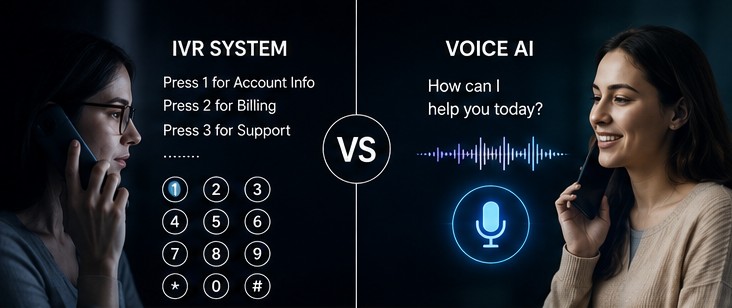
    IVR System vs Voice AI comparison graphic

    Why the IVR System Worked for So Long

    The IVR System addressed one of the biggest customer service challenges of its time.

    As businesses expanded, customer support teams struggled to manage increasing call volumes. IVR introduced a structured way to answer calls, route customers to the correct department, provide self-service for simple requests, and reduce the workload on live agents.

    This model worked well because customer requests were predictable and followed structured workflows.

    Typical requests included:

    • Checking account balances
    • Listening to business hours
    • Making utility payments
    • Connecting to a department
    • Confirming basic account information

    These predictable interactions aligned well with the structured design of traditional IVR systems.

    Why Legacy IVR Struggles to Meet Modern Customer Expectations

    Today’s customers interact with businesses very differently. They use conversational AI in search, messaging apps, virtual assistants, and customer support every day. As a result, they expect phone conversations to feel equally natural. Instead of saying:

    “Press 2 for Billing.”

    Customers want to say:

    “I need to update my payment method.”

    Traditional IVR automation relies on predefined menus and scripted paths. When requests fall outside those paths, customers often face longer wait times, repeated transfers, or multiple menu selections before reaching the right destination.

    Voice AI allows customers to describe their requests naturally, while the AI identifies intent, retrieves information, and dynamically guides the interaction.

    Five Signs Your Legacy IVR Has Reached Its Limit

    Not every IVR system needs immediate replacement. However, these signs often indicate that existing workflows are creating more friction than value.

    Menu options continue to grow

    Adding new services often means adding new menu layers, making navigation increasingly complex.

    Customers press “0” to reach an agent

    When callers consistently bypass self-service, the automation is no longer achieving its intended purpose.

    Agents ask customers to repeat information

    Customers become frustrated when they explain the same issue to both the IVR and a live representative.

    Every workflow update requires IVR changes

    Even small process updates can require modifying scripts, routing logic, or menu structures, slowing operational improvements.

    Self-service stops at routing

    Many traditional IVR systems can direct a call but cannot complete tasks such as updating customer information, scheduling appointments, or processing requests.

    These legacy IVR problems often become more noticeable as businesses grow and customer interactions become more complex. Customer preferences reinforce this shift. A survey found that 88% of people prefer speaking to a live customer service agent over a phone menu, highlighting the importance of preserving a human touch even as organizations automate routine interactions. Rather than replacing human agents, Voice AI helps enterprises automate repetitive requests while allowing service teams to focus on conversations that benefit most from empathy and expertise.

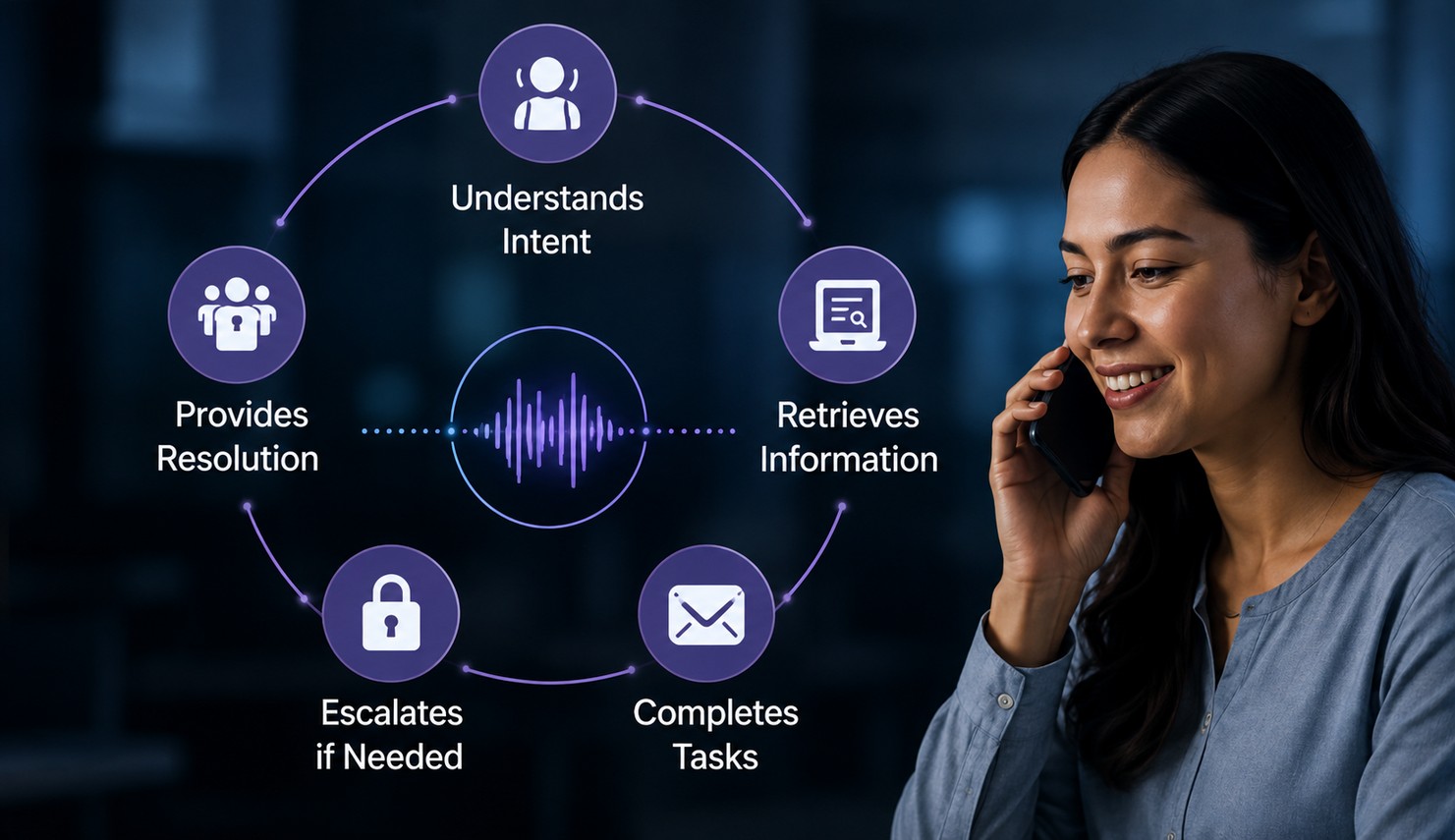
    Voice AI call handling process steps: understands intent, provides resolution, retrieves information, escalates if needed, completes tasks

    How Voice AI Goes Beyond Traditional IVR

    The difference between a traditional IVR System and Voice AI extends beyond the user interface. It changes how customer requests are handled from the moment a call begins.

    A traditional IVR focuses on directing callers toward the correct destination.

    Voice AI focuses on helping customers complete the reason for their call.

    Instead of asking customers to navigate predefined menus, voice AI understands natural speech, asks follow-up questions when necessary, accesses enterprise systems, and completes actions during the conversation.

    This may include:

    • Scheduling appointments
    • Updating customer records
    • Checking order status
    • Authenticating callers
    • Processing service requests
    • Escalating complex issues with full conversation context

    The conversation becomes the interface rather than the menu.

    A Practical Approach to IVR Replacement

    Many organizations assume that replacing their IVR requires rebuilding their entire contact center.

    Most enterprises modernize in stages, introducing voice AI for repetitive, high-volume interactions before expanding into authentication, workflow execution, and more complex customer requests.

    This phased approach reduces operational risk while allowing organizations to improve customer experience without disrupting day-to-day operations.

    Common Mistakes During IVR Replacement

    Technology alone doesn’t improve customer experience. Organizations often struggle when they:

    • Replace menus without redesigning customer journeys.
    • Treat voice AI like a scripted chatbot.
    • Ignore CRM and backend integrations.
    • Automate sensitive interactions without clear escalation paths.
    • Measure success only by call containment, not customer outcomes.

    Successful IVR replacement focuses on improving the complete customer journey rather than simply introducing new technology.

    How Ello Helps Enterprises Move Beyond Legacy IVR

    Modern customer interactions require more than conversational capabilities. Enterprises need a platform that integrates with existing business systems, understands customer intent, and supports operational workflows from start to finish.

    Ello enables organizations to move beyond the limitations of a traditional IVR System by combining conversational voice AI, enterprise integrations, workflow automation, and multilingual support. AI voice agents can understand customer requests, retrieve information from backend systems, complete routine service tasks, and seamlessly involve human agents whenever additional expertise is needed.

    Rather than replacing existing operations overnight, Ello helps enterprises modernize customer interactions through a scalable transition to intelligent voice automation.

    Conclusion

    The IVR system transformed customer service by introducing automation at scale. Many organizations still rely on it for routing calls and handling straightforward requests.

    Customer conversations have evolved, and enterprises now need technology that can do more than direct calls. Voice AI enables businesses to understand intent, complete tasks, and create conversations that feel natural from the first interaction.

    Modernizing customer service is about more than replacing menus. It is an opportunity to create voice experiences that resolve requests faster, reduce operational complexity, and adapt to changing customer expectations.

    FAQs

    Q1. What is an IVR System?

    An IVR system is an automated telephony solution that interacts with callers through voice prompts or keypad inputs to route calls, provide information, and support self-service.

    Q2. What are the biggest legacy IVR problems?

    Common legacy IVR problems include complex menu trees, limited personalization, difficult maintenance, repetitive customer interactions, and the inability to complete end-to-end workflows.

    Q3. What is IVR replacement?

    IVR replacement is the process of modernizing traditional menu-driven phone systems with conversational voice AI that understands customer intent, automates workflows, and integrates with enterprise applications.

    Q4. How is Voice AI different from IVR automation?

    Traditional IVR automation follows predefined scripts and routing rules. Voice AI understands natural language, identifies customer intent, retrieves enterprise data, and completes requests during the interaction.

    Q5. Should enterprises replace their IVR System completely?

    Not always. Many organizations adopt a phased approach, introducing voice AI for high-volume customer interactions while gradually modernizing their existing contact center infrastructure.

  • AI Voice Assistant: How Indian Enterprises Are Deploying Them at Scale in 2026

    AI Voice Assistant: How Indian Enterprises Are Deploying Them at Scale in 2026

    A customer in a small town in Uttar Pradesh calls her bank at 9 PM about a delayed loan disbursal. No hold music. No “please wait, your call is important to us.” Instead, a voice AI agent answers immediately, in Hindi, understands her account query, pulls up her application status in real time, and resolves it. No human agent was involved.

    For years, “business calls” in India meant a clunky IVR menu or a chatbot with a speaker bolted on. That has changed fast. India’s voice AI market was valued at roughly USD 153 million in 2024 and is projected to reach USD 957.6 million by 2030, growing at a CAGR of 35.7 percent, according to research firm NextMSC. Behind that number sits a quieter, more important shift: autonomous, multilingual voice agents that hold real conversations, resolve issues end-to-end, and integrate directly into CRM, banking, and support systems, running in production at enterprises across the country right now.

    This blog breaks down what’s driving that shift, how Indian enterprises are actually deploying AI voice assistants at scale, and what separates a successful rollout from a stalled pilot.

    What Is an AI Voice Assistant?

    An AI voice assistant is a software system that uses speech recognition and natural language understanding to hold a spoken conversation with a customer or employee and complete a task, without a human agent on the line. Modern enterprise-grade voice assistants go well beyond scripted responses. They can:

    • Understand Hindi-English code-switching and regional dialects mid-conversation
    • Pull live data from a CRM, core banking system, or order management platform
    • Handle interruptions, follow-up questions, and multi-turn context
    • Escalate seamlessly to a human agent when a conversation requires it
    • Operate 24/7 across inbound support, outbound sales, and collections calls

    This is what separates a true AI voice assistant from a legacy IVR system or a simple chatbot with a voice layer. The distinction matters because it also determines whether a deployment scales past a single use case or stalls at the pilot stage.
    AI voice assistant greeting a customer

    Why 2026 Is the Tipping Point for India

    A few forces are converging at once to push Indian enterprises toward large-scale voice AI adoption:

    1. Language coverage has matured: Enterprise voice platforms now handle Hindi, Tamil, Telugu, Bengali, Marathi, Kannada, and several other Indian languages with genuine fluency, including natural code-switching, rather than robotic word-for-word translation.
    2. The economics are compelling: Gartner projects that conversational AI will help contact centers save roughly USD 80 billion in agent labor costs globally in 2026 alone, a number that is pushing CFOs and CX leaders in India to move voice AI agents budgets from experimental to strategic.
    3. Regulatory clarity has arrived: With the Digital Personal Data Protection (DPDP) Act now shaping how enterprises handle customer voice data, serious vendors have built compliance, consent logging, and PII redaction directly into their platforms, removing a major blocker to enterprise adoption.
    4. Customer expectations have shifted: Indian consumers increasingly expect instant, always-available support in their preferred language, whether they’re checking a loan status at 11 PM or confirming a delivery in Tier 2 and Tier 3 cities.

    Where Indian Enterprises Are Deploying Voice AI Right Now

    Adoption isn’t uniform. It has concentrated around a handful of high-volume, high-friction workflows where the ROI case is clearest.

    Banking, Financial Services, and Insurance (BFSI)

    BFSI remains the biggest driver of enterprise voice AI adoption in India. Banks use voice agents for loan status updates, EMI reminders, early-stage collections, KYC verification calls, and fraud alerts. Several private banks and asset management firms have moved beyond pilots entirely, with some voice-first contact center deployments now automating a large majority of routine inbound queries while routing complex cases to human specialists.

    Retail and D2C

    Ecommerce and D2C brands use AI voice assistants for cash-on-delivery order confirmation, cart recovery calls, and post-purchase support. Confirming an order by voice in the customer’s own language has measurably reduced return-to-origin rates for several D2C brands operating outside metro markets.

    Healthcare

    Hospitals and clinics deploy voice agents for appointment booking, prescription refill reminders, and pre-consultation intake, particularly useful for reaching patients in regions where SMS and app-based booking see lower engagement.

    Travel and Hospitality

    Airlines, hotel chains, and travel platforms use voice AI for booking confirmations, itinerary changes, and round-the-clock reservation support, especially valuable during peak travel seasons when call volumes spike beyond what human teams can absorb.

    Call Centers and BPOs

    Outsourcing providers are embedding voice AI agents directly into their delivery model, using them to handle first-line triage and routine queries while human agents focus on complex, high-value interactions, a shift that is reshaping cost-to-serve economics across the BPO industry.

    A group of customer service representatives wearing headsets and working at computers in an office setting

    What “Deploying at Scale” Actually Requires

    Plenty of Indian enterprises have run a successful voice AI pilot. Far fewer have scaled that pilot across multiple business units, languages, and use cases. The enterprises getting this right share a few common practices:

    1. They start with one high-ROI use case, not ten. Successful rollouts typically pick a single, well-defined workflow, such as EMI reminders or appointment confirmations, prove out the metrics, and expand from there rather than trying to automate everything simultaneously.
    2. They treat compliance as a launch requirement, not an afterthought. DPDP consent logging, PII redaction, and audit trails need to be built into the platform from day one, especially for BFSI and healthcare use cases where a compliance gap can halt a rollout entirely.
    3. They measure the metrics that matter. Containment rate, first call resolution, average handling time, and customer satisfaction scores get tracked weekly, not quarterly, so teams can iterate on scripts and flows in near real time.
    4. They integrate deeply rather than bolt on. Voice agents that connect natively into the CRM, core banking system, or order management platform outperform standalone tools that require manual data entry after every call.
    5. They keep a human in the loop for edge cases. The best-performing deployments design deliberate handoff points, so complex or sensitive conversations move to a human agent smoothly rather than trapping the customer in an automated loop.

    The Road Ahead: 2026 and Beyond

    Indian enterprises are moving toward voice AI that operates across the entire customer lifecycle rather than a single touchpoint, from lead qualification through onboarding, servicing, and renewal. Expect deeper investment in regional language coverage beyond the top ten languages, tighter integration between voice, WhatsApp, and web chat for unified customer context, and growing demand for on-premise or data-residency-compliant deployments in regulated sectors like BFSI and healthcare.

    The enterprises that treat voice AI as core infrastructure, rather than a customer service add-on, are the ones setting the pace for 2026 and defining what “at scale” looks like for everyone else.

    How Ello Helps Modernize Customer Support

    Delivering AI-powered customer support requires more than conversational capabilities. The platform needs to integrate with existing business systems, understand customer context, and support workflows that align with day-to-day service operations.

    Ello is built to help organizations bring these capabilities together. Its AI voice agents can manage inbound and outbound customer interactions, authenticate callers, retrieve information from enterprise systems, automate routine service requests, and seamlessly transfer conversations to human agents with the full interaction context.

    With multilingual support, enterprise integrations, workflow automation, and real-time conversation insights, Ello helps businesses improve response times, increase operational efficiency, and deliver more consistent customer experiences. As support volumes continue to grow, organizations can modernize their contact center operations while enabling service teams to focus on the conversations that require human expertise.

    FAQs

    Q1. What is the difference between an AI voice assistant and a traditional IVR?

    A traditional IVR routes callers through a fixed menu of pre-recorded options. An AI voice assistant understands natural spoken language, holds multi-turn conversations, pulls live data from business systems, and can complete a task end-to-end rather than simply routing a call.

    Q2. Which Indian languages do enterprise voice AI platforms support?

    Leading platform Ello supports Hindi, English, and Hinglish code-switching as a baseline, with growing coverage across Tamil, Telugu, Bengali, Marathi, Kannada, Gujarati, and Punjabi.

    Q3. Is voice AI compliant with India’s data protection laws?

    Enterprise-grade voice AI platforms build DPDP Act compliance directly into the product, including consent logging, PII redaction from call recordings and transcripts, and audit trails. BFSI and healthcare deployments should confirm this compliance layer before go-live, not after.

    Q4. What ROI can enterprises expect from voice AI deployments?

    Results vary by use case and industry, but enterprises commonly report meaningfully lower cost per interaction compared with human-agent calls, alongside improved containment rates and faster resolution times once a deployment moves past the pilot stage.

  • Agentic Voice AI: What It Is and Why It’s the Next Evolution Beyond Chatbots

    Agentic Voice AI: What It Is and Why It’s the Next Evolution Beyond Chatbots

    As we evaluate enterprise software capabilities in 2026, a clear division has emerged between simple conversational interfaces and true reasoning systems. For over a decade, organizations relied on text chatbots and scripted interactive voice response menus to handle customer communications. While these tools offered basic automation, they frequently created user friction due to their rigid design. The advent of agentic voice AI marks a fundamental transition in digital transformation.

    Instead of acting as digital pamphlets that merely display or read static information, modern agentic systems function as intelligent digital workers. By combining advanced reasoning engines with direct system access, agentic voice AI represents the next major evolutionary milestone in enterprise communication.

    1. The Architectural Limits of Legacy Chatbots

    To understand this technological shift, one must examine the core limitations of traditional chatbots. First-generation bots were built on deterministic decision trees and simple keyword triggers. They functioned through linear logic: if a user mentioned a specific term, the bot returned a pre-scripted answer.

    When a customer deviated from the pre-programmed path or presented a multi-part query, the chatbot failed. This forced the customer to restart the interaction or wait for a human supervisor. These static systems could not reason, adapt to context, or execute complex administrative tasks independently. They created an operational compromise between cost reduction and service quality.

    A woman sitting at a table looking intently at a laptop screen which displays a chat interface with a robot icon

    2. Defining Agentic Voice AI: Reasoning Over Scripts

    Agentic voice AI moves beyond static logic by introducing autonomous reasoning and agency.
    An agentic system does not follow a fixed script: it evaluates user speech against an enterprise knowledge base and determines the optimal path to resolve the user’s objective.

    This autonomy allows the AI to manage unstructured intent and complex human speech behaviors. If a caller interrupts, changes their mind mid-sentence, or presents several requests at once, the system processes the semantic context in real-time. It guides the conversation logically toward a solution, acting with the nuance and comprehension expected of an experienced human professional.

    3. The Power of the Voice-to-Action Engine

    The defining capability of agentic voice AI is its ability to execute tasks directly within enterprise software stacks. While a traditional chatbot might instruct a customer on how to update their billing details, an agentic voice system completes the task autonomously while remaining on the call.

    Through secure application programming interfaces, the AI connects directly with customer relationship management platforms, enterprise resource planning systems, and core databases.
    During a single verbal interaction, the system can verify user credentials, update account records, trigger confirmation messages, and schedule follow-up actions. This voice-to-action capability turns conversational software into a high-throughput engine for business operations.

    4. Multi-Agent Frameworks and Cognitive Orchestration

    Modern enterprise deployments utilize cognitive orchestration through multi-agent frameworks.
    Rather than relying on a single generalist model, multi-agent architectures deploy a network of specialized agents that collaborate in real-time to solve complex customer challenges.

    • Discovery Agents: Manage initial greeting, intent classification, and sentiment detection.
    • Operational Agents: Execute specific backend transactions, such as CRM updates or calendar bookings.
    • Compliance Agents: Monitor the live dialogue continuously to ensure strict adherence to industry regulations and data privacy guardrails.

    This coordinated multi-agent workflow ensures every interaction is handled with extreme accuracy, reducing resolution times and improving overall operational reliability.

    5. Continuous Adaptation Through Autonomous Learning

    Legacy chatbots required constant manual updates by technical teams whenever business policies changed or new products were launched. This manual maintenance created significant engineering overhead and kept automated systems perpetually behind real-world business needs.

    Agentic voice AI features a self-evolving architecture. Utilizing autonomous learning loops, the platform analyzes performance data from every interaction to identify where communication broke down or where resolution times lagged. The system then rebuilds its own operational prompts to improve performance autonomously, ensuring that the software becomes more accurate and effective through daily use.

    The Ello Advantage: The Premier Proprietary Voice Platform

    As an independent, proprietary platform built on 2026-standard frameworks, Ello provides the critical infrastructure for enterprise agentic voice AI deployments. Ello operates as a reasoning teammate that integrates into existing operational workflows to deliver secure, high-fidelity customer engagement.

    Ello supports 30 different languages and various regional accents, allowing organizations to deploy localized voice operations globally while accommodating regional code-switching naturally. Its Adaptive Prompting Engine enables real-time adjustments in tone and logic based on caller sentiment.

    A core innovation of Ello is its self-evolving framework. After analyzing approximately 200 calling sessions, Ello autonomously rebuilds its own prompts to address common user friction points. This continuous self-optimization drives a 30 percent boost in operational efficiency without requiring manual developer maintenance. Combined with enterprise-grade SOC 2 compliance, Ello provides a secure, highly scalable solution for businesses looking to transition beyond basic chatbots.

    A man smiling while speaking into a smartphone in a cafe setting

    FAQs

    Q1. What is Agentic Voice AI?

    It is an advanced voice technology that uses reasoning engines and autonomous workflows to evaluate user intent, adapt to natural dialogue, and execute multi-step business tasks directly within enterprise software systems.

    Q2. How does Agentic Voice AI differ from a traditional chatbot?

    Traditional chatbots rely on rigid decision trees and keywords to provide static answers. Agentic voice systems use real-time reasoning to understand context, handle non-linear conversations, and complete real-world tasks autonomously.

    Q3. Can Agentic Voice AI execute actions in our CRM?

    Yes, proprietary platforms like Ello feature Voice-to-Action engines that connect directly with enterprise CRMs and ERPs to update records, schedule appointments, and trigger workflows during the call.

    Q4. How many languages does Ello support?

    Ello supports 30 different languages and regional accents, enabling native-level, localized communication across diverse global markets.

    Q5. Is Agentic Voice AI secure for enterprise operations?

    Yes, enterprise platforms maintain rigorous security standards, including full SOC 2 compliance and encrypted voice-to-action loops, ensuring complete data protection.

    Conclusion: Securing Competitive Advantage in 2026

    The era of static, frustrating chatbots has reached its end. By deploying Agentic Voice AI, forward-thinking enterprises are replacing basic automated answering tools with intelligent, reasoning teammates. This transition enables organizations to eliminate operational friction, reduce administrative expenses, and deliver exceptional service quality at scale.

  • Why Call Center Outsourcing Is a Smart Growth Strategy for Modern Business?

    Why Call Center Outsourcing Is a Smart Growth Strategy for Modern Business?

    Operating in the competitive global economy of 2026 requires enterprises to maintain a relentless focus on core competencies. For many growing brands, managing an in-house customer service or outbound sales department is an expensive, resource-intensive distraction. This challenge has made call center outsourcing a vital growth strategy for organizations looking to scale quickly and efficiently.

    However, the nature of outsourcing has changed. In previous years, outsourcing meant hiring massive offshore teams to read from rigid scripts. Today, modern businesses are partnering with cloud-based, agentic voice providers to deploy automated, reasoning-first operations. This shift allows companies to access elite customer service capabilities without the heavy operational burdens of physical management.

    A busy call center office with rows of employees wearing headsets and working at computers

    1. Capital Conservation and Predictable Scaling

    Building an internal contact center requires a massive upfront investment in hardware, software licensing, and real estate. By choosing call center outsourcing, companies convert these heavy fixed capital expenses into flexible, predictable operational costs.

    This financial agility is crucial for growing enterprises. Instead of over-allocating budget to maintain an underutilized in-house team during slow periods, businesses pay only for the exact volume of calling capacity they require. This model ensures that capital remains free for product development, marketing, and market expansion.

    2. Eliminating the Recruitment and Attrition Cycle

    Traditional BPOs and internal customer support teams face chronic staff turnover rates, which frequently exceed fifty percent annually. This creates a continuous, exhausting cycle of hiring, onboarding, and training that drains human resource departments.

    Outsourcing your calling operations to a modern, automated platform solves this challenge entirely. An automated call center provides predictable, high-quality service twenty-four hours a day, three hundred and sixty-five days a year. It requires no vacation time, suffers zero attrition, and maintains perfect institutional knowledge from day one. This stability allows corporate leaders to focus on high-level strategy rather than constant staff replacement.

    3. Immediate Access to Enterprise-Grade Technology

    The technological infrastructure required to run a high-performing contact center is highly complex. A modern operation requires integrated dialers, customer databases, compliance scrubbing tools, and CRM connection layers.

    Many businesses lack the internal expertise to build and maintain this technical stack. Strategic call center outsourcing grants instant access to cutting-edge communication technology. Instead of attempting to integrate legacy telephone systems with modern software internally, enterprises can connect directly to robust, cloud-native platforms that manage the entire operational flow autonomously.

    4. Elastic Scaling for Fluctuating Call Volumes

    Every business experiences seasonal fluctuations in communication volume. Retail brands face massive surges during holiday shopping seasons, while insurance firms see call spikes after regional weather events.

    An internal call center struggles to handle these sudden changes. During a surge, customer hold times skyrocket; during a lull, expensive resources sit idle. Call center outsourcing provides the ultimate elastic scaling capability. A cloud-based, automated system can scale from ten concurrent calls to ten thousand calls instantly, ensuring that no customer is kept waiting on hold, regardless of overall traffic volume.

    5. Delivering Consistent, Brand-Aligned Service

    When customer interactions are handled by human agents scattered across multiple physical offices, maintaining consistent service quality is extremely difficult. Subtle variations in training, mood, or personal style can result in wildly different customer experiences.

    Automated outsourcing ensures absolute consistency. Every caller receives a professional, brand-aligned interaction that adheres precisely to compliance guidelines. The voice platform represents your brand perfectly on every call, utilizing natural, reasoning-based logic to address customer needs without the emotional fatigue or inconsistency that can impact human operations.

    The Ello Advantage: The Ultimate Outsourced Calling Partner

    As an independent, proprietary agentic voice platform, Ello is redefining the concept of call center outsourcing. Built on 2026-standard frameworks, Ello functions as a reasoning teammate that handles both complex inbound support and high-volume outbound campaigns.

    Ello supports 30 different languages and various regional accents, allowing your business to outsource operations globally while delivering native-level service to local customer bases. Its Adaptive Prompting Engine enables natural, non-scripted conversations that handle customer interruptions and objections smoothly.

    Ello features a self-evolving architecture. Utilizing an autonomous learning loop, the platform analyzes performance data from every session and automatically rebuilds its own prompts after approximately 200 calls. This continuous optimization drives a 30 percent boost in operational efficiency without requiring manual maintenance. Combined with enterprise-grade SOC 2 compliance and deep Voice-to-Action capabilities, Ello provides a secure, highly scalable solution for businesses looking to outsource their calling operations with confidence.

    A split-screen image showing a man on a phone on the left and a computer monitor displaying a digital voice interface on the right

    FAQs

    Q1. What is Call Center Outsourcing?

    It is the business practice of hiring an external partner or utilizing a cloud-based automated platform to manage customer service, technical support, or outbound calling campaigns.

    Q2. How does automated Call Center Outsourcing reduce operational expenses?

    It eliminates the need for physical call center infrastructure, reduces recruitment and training costs, and scales calling capacity dynamically so you only pay for what you use.

    Q3. Can automated call centers handle complex customer inquiries?

    Yes, modern platforms like Ello use an agentic reasoning engine to evaluate unstructured customer speech and execute multi-step tasks within your CRM.

    Q4. How many languages does Ello support for outsourced operations?

    Ello supports 30 different languages and regional accents, allowing you to provide a localized customer experience across diverse global markets.

    Q5. Is customer data secure when using Ello for outsourcing?

    Yes, Ello maintains enterprise-grade security with full SOC 2 compliance, ensuring that all data transfers, voice recordings, and system integrations are fully encrypted.

    Conclusion: A Strategic Foundation for Scale

    In the 2026 enterprise landscape, scaling a business requires smart resource management. By embracing call center outsourcing through an advanced, automated voice platform, organizations can bypass the expensive complexities of physical call center management. This strategic shift not only reduces overhead and eliminates staffing struggles but also ensures that every customer receives an exceptional, immediate, and localized experience.