Tag: voice AI agents

  • Customer Support Automation and the Rise of Voice AI

    Customer Support Automation and the Rise of Voice AI

    Scaling customer support automation requires more than incremental fixes: high contact center handle times, rising staffing overhead, and fragmented ticket routing continue to strain operational margins across enterprise service organizations. Traditional self-service options, such as rigid Interactive Voice Response (IVR) phone trees and rule-based chatbots, routinely fail when confronted with complex customer requests. Modern contact center automation strategies address these operational bottlenecks.

    The industry is shifting away from static decision trees toward cognitive, agentic workflows. At the center of this transformation is the rise of real-time voice AI, enabling enterprises to resolve high-consequence customer service issues over the phone without human intervention.

    The Structural Limits of Legacy Support Automation
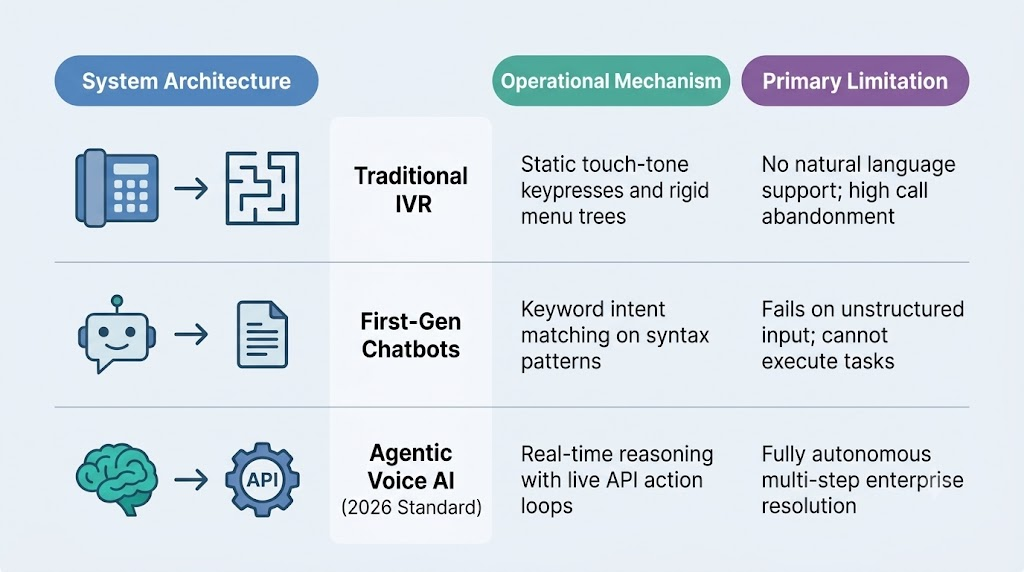
    For over a decade, automated customer service relied on deterministic branching logic. Traditional text chatbots that matched basic intent triggers worked for simple tasks like checking an account balance or checking an order status. However, when transactional inquiries required dynamic reasoning, context switching, or multi-system database updates, rule-based systems collapsed.

    Legacy voice infrastructure suffered even greater limitations. Traditional voice menus forced customers through repetitive touch-tone options, only to land them in a waiting queue to repeat their issue to a human agent. This dynamic is why enterprises are increasingly retiring legacy IVR systems in favor of dynamic conversation. True efficiency demands a system that can handle natural conversation and execute tasks immediately and autonomously.

    Deconstructing Voice AI for Autonomous Support
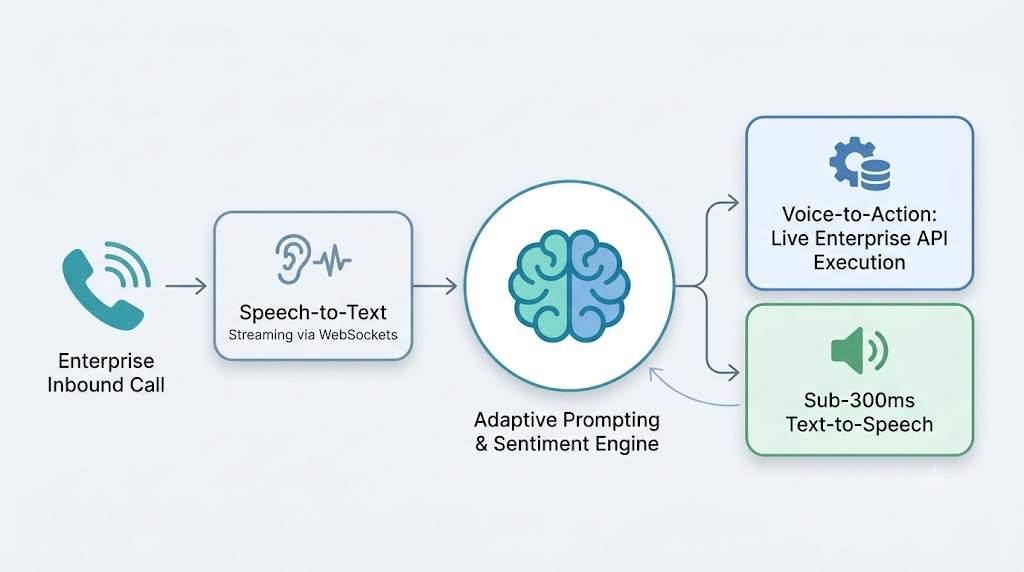
    Deconstructing Voice AI for Autonomous Support

    Modern voice AI for support operates on a cognitive architecture that processes speech, reasons through policy rules, and executes operational workflows in real time. Unlike legacy text bots wrapped in a basic text-to-speech engine, an agentic voice AI framework handles the unpredictable nature of human speech, including interruptions, sudden context shifts, and background noise.

    Ultra-Low Latency Conversational Processing

    Human conversation relies on turn-taking intervals of 200 to 300 milliseconds. Early voice software introduced 2-to-3-second latencies between a caller finishing a sentence and the machine responding, creating an awkward, unnatural experience. Understanding and managing voice AI latency is critical for maintaining fluid dialogue. Current architectures stream audio via WebSockets directly into speech recognition and language models, keeping total response latency below 300 milliseconds for seamless, fluid dialogue.

    Dynamic Context Management and Non-Linear Dialogue

    Customers rarely state their issues in neat, structured sentences. A caller reporting a damaged shipment might interrupt the system mid-verification to change their delivery address or ask about a refund policy. An advanced customer service AI agent maintains state tracking across multi-turn interactions, holding context variables in memory while dynamically updating conversation branches.

    Real-Time Voice-to-Action Execution

    Answering a question is only half the challenge; resolving an issue requires action. Modern voice systems don’t just read script responses. Instead, they trigger backend system functions during the call, authenticate user identities, modify records in enterprise platforms, update support tickets, and process payments securely while staying live on the phone.

    Architectural Pillars of Enterprise Support Automation
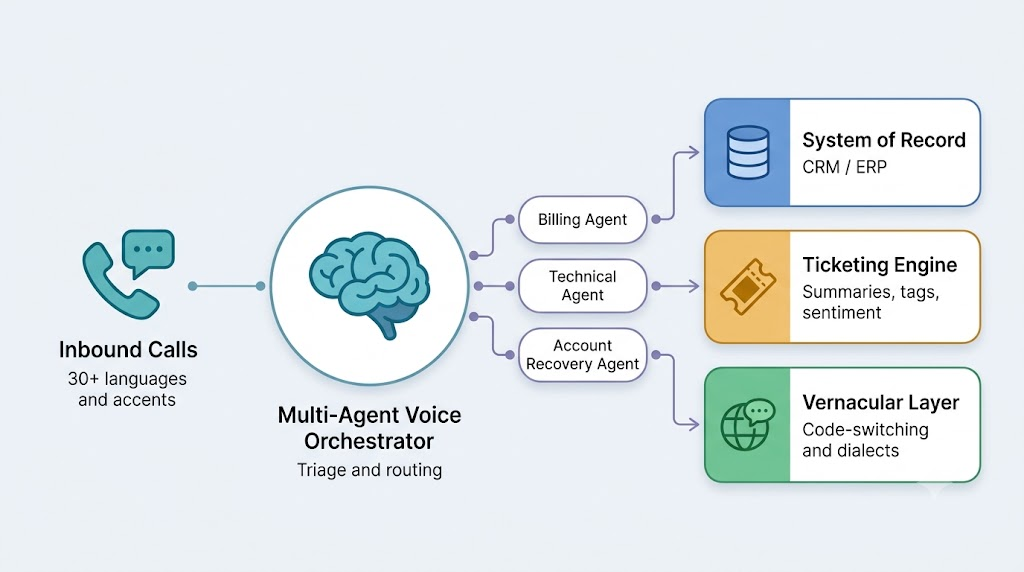
    Architectural Pillars of Enterprise Support Automation

    Building a scalable framework for AI customer support automation requires unifying voice interactions with back-office data pipelines and ticket systems.

    1. Multi-Agent Cognitive Orchestration: 

    Rather than relying on a single monolithic model to process every inquiry, enterprise systems use dedicated micro-agents to eliminate manual call workflows across specialized operational domains. A primary triage agent evaluates caller intent and hands off execution to specialized sub-agents optimized for specific domains, such as billing adjustments, technical troubleshooting, or account recovery.

    2. Autonomous Support Ticket Automation: 

    Manual data entry remains a major driver of post-call agent fatigue and administrative overhead. Deploying modern AI agents in call centers ensures every interaction handled by a voice agent generates structured call summaries, tag categories, sentiment metrics, and resolution logs directly in systems like Zendesk or Salesforce.

    3. Vernacular Code-Switching and Accent Adaptation: 

    Global enterprises serve diverse user bases speaking multiple languages and regional accents. Modern voice architectures handle colloquial phrasing, dialect variations, and mid-sentence language transitions. Adopting multilingual voice AI strategies allows global enterprises to serve diverse user bases seamlessly.

    Overcoming Security, Guardrails, and Hallucination Risks

    Deploying autonomous voice interactions in production environments requires strict security operational controls and compliance enforcement.

    • Hallucination Containment: Voice models operate within defined knowledge spaces, pulling responses strictly from verified policy docs and API payloads. If a query falls outside permitted guidelines, the system gracefully transfers the call with full context.
    • Deterministic Guardrails: Hard-coded security rules sit on top of probabilistic models, ensuring the system never wavers on identity verification, refund limits, or regulatory disclosures.
    • Data Privacy and Regulatory Compliance: Voice pipelines enforce SOC 2, HIPAA, and regional telephony compliance standards (including TRAI rules and local calling window restrictions), ensuring customer audio data is encrypted in transit and at rest.

    The Ello Advantage: Autonomous Voice AI Built for the Enterprise

    Ello provides the specialized cognitive infrastructure required to fully automate complex contact center operations, moving beyond general enterprise systems that only streamline basic workflows. Designed explicitly for high-volume enterprise environments, Ello moves past static scripts to deliver fully agentic voice interactions across operations, sales, and customer care:

    • Ello’s Self-Evolving Architecture: Features an autonomous learning loop that continuously analyzes live conversational telemetry and post-call resolution rates. After processing approximately 200 calls on a given workflow, the system autonomously refines its prompting parameters and dialogue paths, delivering a 30 percent boost in operational efficiency without manual developer updates.
    • Ello’s Adaptive Prompting & Voice-to-Action Engine: Dynamically adapts to real-time caller emotion, urgency, and sudden speech interruptions. The platform authenticates callers and executes complex transactional tasks directly inside CRMs, ERPs, and ticketing tools while maintaining natural conversation on the line.
    • Ello’s Multilingual Vernacular Capabilities: Natively supports 30 languages and hundreds of regional accents. It handles fluid, mid-sentence code-switching and local colloquialisms seamlessly, ensuring high resolution rates across diverse global markets.
    • Ello’s Enterprise Security Standards: Built with enterprise-grade guardrails, Ello guarantees SOC 2 compliance, robust data encryption, zero-hallucination policy enforcement, and automatic adherence to localized telecommunication mandates.

    Frequently Asked Questions

    1) How does voice AI differ from traditional speech recognition IVR systems?

    Legacy speech recognition IVRs use strict keyword matching to navigate pre-programmed touch-tone menus. Voice AI utilizes real-time natural language reasoning to understand conversational intent, handle non-linear dialogue interruptions, and execute downstream enterprise API tasks directly during the call.

    2) Can customer support automation handle complex, multi-step user inquiries?

    Yes. Modern support automation uses agentic orchestration to break complex requests into sub-tasks. The system authenticates user identities, queries backend databases, executes policy rules, and updates records across enterprise platforms within a single continuous interaction.

    3) How does voice AI handle caller interruptions or sudden changes in context?

    Advanced voice AI architectures maintain dynamic state tracking while operating low-latency streaming pipelines. If a caller interrupts mid-sentence or changes the topic, the engine halts current speech generation, updates its internal context variables, and responds naturally to the new query.

    4) What happens when an automated customer service agent cannot resolve an issue?

    If an inquiry falls outside predefined operational boundaries or requires human authorization, the system executes a context-aware handoff. It routes the call to a live agent alongside a real-time transcript, sentiment score, and complete summary of steps taken, eliminating caller repetition.

    5) How does voice AI maintain compliance and security during sensitive support calls?

    Enterprise voice AI platforms incorporate strict guardrails, zero-retention data pipelines, and end-to-end encryption. They adhere to industry frameworks such as SOC 2 and HIPAA and enforce strict identity verification checks before sharing sensitive account information.

    Conclusion

    The shift from reactive deflection to fully autonomous voice interaction represents the next major evolution in enterprise customer care. Legacy IVRs and basic text chatbots exposed the limits of rigid decision trees, creating operational bottlenecks and driving up cost-per-contact metrics. By combining ultra-low latency speech processing, dynamic reasoning, and real-time backend API execution, agentic voice AI enables enterprises to resolve complex, multi-step inquiries entirely over the phone while preserving natural, human-like dialogue.

    Organizations that modernize their contact center infrastructure with self-evolving voice architectures can eliminate handling delays, scale operational capacity, and deliver immediate customer resolution at lower overall overhead. To discover how autonomous voice agents can elevate your enterprise contact center capabilities, explore Ello’s enterprise voice platform.


  • AI Cold Calling and the Future of Outbound Sales

    AI Cold Calling and the Future of Outbound Sales

    Outbound revenue generation faces a mathematical ceiling. Sales development representatives spend countless hours dialing, leaving voicemails, and navigating gatekeepers, which depletes morale and slows pipeline velocity. Enterprise sales cycles require precision at scale. Manual dialing and static scripts fail to meet the dynamic demands of modern procurement teams. As organizations enter 2026, they’re replacing these bottlenecks with AI Cold Calling. This shift replaces human repetition with autonomous agentic systems that handle initial outreach, overcome objections, and qualify leads with zero human fatigue.

    Overcoming the Limits of Legacy Infrastructure

    Manual cold calling transitioning to AI-powered voice analysis

    Traditional outbound methods rely on volume over cognitive adaptation. Sales teams historically depended on a standard AI sales dialer to increase call volume, but these systems only accelerated how quickly human agents burned through lead lists. True cold calling automation requires more than predictive dialing. It demands a system that can reason contextually during the live conversation. Modern cognitive frameworks analyze the prospect’s tone, urgency, and specific objections in real time. For a broader introduction to how these systems work, see our voice AI agent guide.

    Architectural Shifts in Outbound Sales

    Deploying autonomous agents for revenue generation requires a sophisticated underlying architecture. Early iterations of automated cold calling relied on decision trees that broke down the moment a prospect interrupted or asked an unscripted question. In 2026, agentic voice AI systems utilize dynamic prompting engines. When a prospect deviates from the expected conversational path, the system instantly recalculates the optimal response. These AI outbound sales calls execute logic sequences simultaneously, ensuring that the prospect receives accurate product information, pricing context, or technical validation without awkward pauses.

    Seamless Workflow Integration

    AI voice agent connected to CRM, calendar, and email

    An isolated calling system creates fragmented data. Effective AI cold calling software must integrate directly into the enterprise technology stack. Agentic voice systems now feature voice-to-action engines that trigger background workflows while the call is still active. If a prospect agrees to a discovery meeting, the system autonomously queries the calendar, secures the time slot, updates the CRM record, and dispatches a confirmation email before the call concludes. To see how enterprises are applying this in practice, explore our breakdown of high-ROI voice AI use cases.

    Regulatory Adherence at Enterprise Scale

    Scaling outbound outreach introduces significant compliance risks. Revenue leaders must navigate complex regulatory environments across different regions. Autonomous compliance guardrails reduce regulatory audit exposure compared to manual outbound processes. Advanced systems manage these variables autonomously. Built-in guardrails ensure strict adherence to regional calling hour restrictions, DND (Do Not Disturb) registries, and local telemarketing frameworks like TRAI. Coupled with enterprise-grade SOC 2 compliance and robust data encryption, these platforms protect organizational liability while executing thousands of concurrent outbound connections.

    The Ello Advantage: Autonomous Outbound Execution

    Ello provides a proprietary, 2026-standard agentic framework engineered specifically for enterprise revenue operations. The platform operates through a multi-agent cognitive orchestration model that eliminates static scripts.

    Ello’s Adaptive Prompting Engine handles interruptions and understands caller sentiment in real time, enabling fluid, non-scripted dialogues. Ello’s Voice-to-Action Engine executes complex tasks autonomously within enterprise CRMs and ERPs while remaining live on the call. Its self-evolving architecture continuously analyzes conversational data and periodically rebuilds its own prompts, driving measurable gains in operational efficiency without requiring manual developer intervention. Furthermore, Ello natively supports 30 languages and diverse regional accents. The system seamlessly handles colloquial code-switching and code-mixing, which is highly critical for regional markets like India. Ello operates with strict guardrails against hallucinations, maintaining SOC 2 compliance and automated regulatory adherence for secure enterprise deployment.

    Frequently Asked Questions

    1) What exactly is AI Cold Calling?

    AI Cold Calling involves using autonomous voice agents to initiate outbound sales interactions. These systems converse naturally, handle objections, and qualify prospects without human intervention.

    2) How does AI cold calling software handle prospect interruptions?

    Modern software utilizes adaptive prompting and real-time cognitive processing to pause, listen, and recalculate its response. This allows the system to address the interruption naturally and guide the conversation back on track.

    3) Can automated cold calling integrate with existing CRM platforms?

    Yes. Modern agentic voice systems offer direct integrations that let them read CRM data before a call and write updates, book meetings, or log notes during the conversation.

    4) What prevents AI outbound sales calls from sounding robotic?

    Advanced generative voice models in 2026 utilize deep contextual understanding and dynamic sentiment analysis. They adjust their pacing, tone, and inflection based on the prospect’s reactions to simulate a highly realistic human interaction.

    5) Is cold calling automation compliant with telemarketing regulations?

    Enterprise-grade platforms include automated compliance guardrails. They autonomously cross-reference DND lists, follow legal calling hours, and maintain strict data privacy standards to reduce regulatory risk.

    Conclusion

    The era of manual outbound dialing is over. Enterprises leveraging autonomous agentic workflows are experiencing unprecedented pipeline velocity and operational efficiency. By adopting cognitive voice systems, revenue organizations can redirect human capital to high-value closing activities while AI handles the friction of top-of-funnel outreach.

    Ready to deploy autonomous revenue agents for your enterprise? Get Started with Ello

  • How Helpdesk Automation Is Reshaping Enterprise Support

    How Helpdesk Automation Is Reshaping Enterprise Support

    Modern enterprise support operations face a persistent paradox: ticket volumes scale faster than headcount. Traditional support tiers are buckling under repetitive Tier-0 and Tier-1 requests, causing resolution times to balloon and operational costs to surge. Organizations can no longer scale their support teams by simply adding more human agents to the queue. Intelligent helpdesk automation provides the structural remedy needed to absorb unbounded ticket volume while protecting gross margins and maintaining high service level agreements.

    The transition from reactive ticketing systems to proactive automation marks a fundamental shift in how organizations manage internal IT service desks and external customer operations. Legacy macros and rigid, rule-based routing trees fail when faced with nuanced customer queries or complex, multi-step technical troubleshooting. Modern support infrastructures require systems that can handle ambiguity and execute tasks autonomously, a trend Ello’s voice AI insights explore in greater depth.

    The Architectural Limits of Legacy Support Systems

    Traditional support desks rely on static knowledge bases, keyword-matching bots, and manual ticket triage workflows. These legacy tools create friction rather than resolution. When an enterprise customer or employee encounters a multifaceted issue, legacy systems typically route them through frustrating menu trees before dumping them into an overflowing human queue. This architecture produces high abandonment rates, excessive average handle times, and inflated operational expenditures.

    Traditional interactive voice response structures often exacerbate this bottleneck. Examining how modern channels surpass legacy setups highlights why forward-thinking enterprises are actively retiring legacy IVR systems in favor of intelligent frameworks. Scaling human-only support teams linearly against revenue growth creates unsustainable margin compression. Enterprise leaders must decouple support volume from headcount requirements by moving past basic string-matching bots toward architectures capable of true conversational comprehension and backend execution.

    AI routing customer support requests to human agents

    The Evolution to Cognitive and Conversational Workflows

    Advanced support environments demand real-time resolution capabilities that match human tier-1 capabilities. Automated service desks have evolved past text-only chat interfaces that frequently abandon users when faced with complex scenarios. Deploying a voice AI agent for helpdesk operations now enables natural, spoken interactions that instantly interpret user intent, emotional tone, and urgency.

    Mini Case Study: Consider a mid-sized e-commerce enterprise handling thousands of daily order-tracking and return inquiries. Instead of routing callers through rigid IVR menus, an intelligent voice agent converses naturally with the customer, verifies account details, checks real-time shipping logs, and initiates a replacement order or refund in seconds—all while the user remains on the line.

    These autonomous systems leverage large language models fine-tuned for enterprise operational logic. They maintain context across lengthy troubleshooting sessions, handle dynamic user interruptions gracefully, and execute system commands in real time. Rather than merely deflecting calls to an FAQ page, these intelligent agents diagnose system errors, verify user credentials, and initiate backend remediation workflows. Understanding the core mechanics behind these platforms involves analyzing how voice AI agents operate as comprehensive conversational engines.

    Multi-Agent Orchestration in Complex Enterprise Environments

    Enterprise ecosystems consist of fragmented software stacks, ranging from proprietary ERP systems and CRM platforms to ticketing tools and human resources databases. Resolving a single support ticket often requires querying multiple systems of record. AI-driven customer service automation addresses this complexity through multi-agent orchestration frameworks where specialized cognitive agents collaborate to solve intricate requests, mirroring advanced agentic voice AI architectures.

    AI voice agents connected to a central platform, phone systems, and cloud data

    In these distributed architectures, a primary conversational agent manages the dialogue while background reasoning agents simultaneously query inventory databases, check shipping logs, or update account permissions. This division of labor eliminates the latency associated with human agents navigating multiple browser tabs and legacy interfaces. The result is near-instantaneous resolution for complex operational workflows that traditionally required multiple internal escalations.

    Overcoming Linguistic and Regional Operational Barriers

    Global enterprises face significant hurdles when deploying automated support across diverse geographic markets. Linguistic diversity, regional accents, and the common practice of code-switching between languages present severe challenges for standard speech recognition engines. Enterprise support automation must accommodate these linguistic variations without degrading accuracy or forcing users into unnatural phrasing.

    Modern enterprise support systems incorporate advanced multilingual models that can natively understand dozens of languages and regional dialects. These systems process colloquialisms and mixed-language inputs fluidly, ensuring that regional customers and remote employees receive the same high-quality support experience as domestic headquarters staff. This linguistic versatility is essential for maintaining brand equity and operational continuity across international footprints, similar to regional deployments seen in multilingual enterprise voice assistants.

    The Ello Advantage: Autonomous Cognitive Support

    Organizations deploying enterprise-grade support automation require infrastructure that continuously adapts to shifting operational patterns without requiring constant developer intervention. The Ello platform delivers this capability through a proprietary, self-evolving architecture designed specifically for demanding enterprise environments. Ello combines advanced multi-agent cognitive orchestration with an adaptive prompting engine that processes dynamic, non-scripted dialogues, handles interruptions effortlessly, and perceives caller urgency in real time.

    A defining capability of the platform is its self-evolving architecture, which autonomously analyzes conversational data and rebuilds its own prompts after approximately 200 calls. This automated refinement loop drives a 30 percent boost in operational efficiency over time without manual engineering overhead. Furthermore, Ello’s voice-to-action engine executes tasks directly inside enterprise CRMs, ERPs, ATS, and PMS platforms while remaining live on the call. Natively supporting 30 languages with seamless regional code-switching, Ello operates under enterprise-grade SOC 2 compliance, strict hallucination guardrails, and automated adherence to regional regulatory frameworks.

    Frequently Asked Questions

    1) What is helpdesk automation?

    Helpdesk automation uses software, artificial intelligence, and autonomous agents to triage, route, and resolve IT and customer support tickets without human intervention. It streamlines repetitive workflows and accelerates time-to-resolution.

    2) How does voice AI improve enterprise support operations?

    Voice AI enables natural, spoken interactions that instantly interpret user intent and execute complex backend workflows in real time. This reduces average handle times and eliminates the friction associated with traditional text chatbots.

    3) Can automated support systems integrate with existing enterprise software?

    Yes. Advanced support automation platforms feature voice-to-action engines that connect directly to existing enterprise CRMs, ERPs, and ticketing systems to update data in real time and execute tasks.

    4) How do modern support agents handle multiple languages and regional dialects?

    Modern support platforms leverage advanced multilingual models that natively support numerous languages and regional accents. They process colloquial code-switching seamlessly to deliver consistent experiences across global markets.

    5) What security standards should enterprise support automation maintain?

    Enterprise automation platforms must maintain strict security frameworks, including SOC 2 compliance, robust data encryption, hallucination guardrails, and automated adherence to regional calling and data privacy regulations.

    Conclusion

    Reshaping enterprise support requires moving past incremental optimizations to adopt fully autonomous architectures. As ticket volumes scale, organizations that rely on legacy ticketing and static chat tools will continue to face escalating costs and lagging customer satisfaction metrics. Implementing advanced support automation allows enterprises to protect operating margins while delivering frictionless, instant resolutions across every operational channel.

    Ready to transform your enterprise support operations? Get started with Ello today.

  • Will AI Replace Call Center Agents in 2026?

    Will AI Replace Call Center Agents in 2026?

    Will AI replace call center agents in 2026? The answer depends on what part of the job we are talking about.

    AI can already handle a growing number of customer conversations without human involvement. It can answer routine questions, retrieve information, schedule appointments, process simple requests, and complete defined workflows. But call center work also includes situations that require judgment, empathy, negotiation, and accountability.

    The investment in this technology is accelerating. According to Gartner’s 2026 survey, customer service leaders increased AI spending by 38%, while overall service and support budgets grew by only 2%. 

    That makes one thing clear: AI is becoming a significant part of the contact center operating model. The more important question is how much of an agent’s work it can realistically take over.

    What AI Can Already Replace in a Call Center

    The easiest work to automate has a few things in common: high volume, predictable requests, accessible information, and clearly defined outcomes.

    These are some of the areas where AI for call centers can already reduce the need for human involvement:

    • Checking order, delivery, or application status
    • Scheduling and rescheduling appointments
    • Answering routine account questions
    • Handling basic billing requests
    • Confirming customer information
    • Sending payment reminders
    • Qualifying inbound leads
    • Providing standard troubleshooting
    • Processing simple changes or cancellations

    An AI call center agent can also connect with business systems to retrieve information and complete actions during a conversation.

    That distinction matters. AI is increasingly capable of taking over tasks and call types, even when the broader role of a call center agent remains necessary.

    So, when asking will AI replace call center agents, enterprises should first look at the work inside the role rather than treating the job as a single unit.

    AI voice agent and human support agent working together in a call center

    Why Some Call Center Work Still Needs People

    Not every customer problem follows a defined workflow.

    A billing dispute may involve several previous interactions. A technical problem may require investigation beyond the standard troubleshooting process. A frustrated customer may need someone who can understand the situation, make a judgment call, and take responsibility for the resolution.

    These situations are harder to automate because the desired outcome cannot always be determined from a fixed set of rules.

    Human agents also remain important when the stakes are high. Customers dealing with financial issues, complaints, cancellations, or serious service failures may want the reassurance of speaking with a person who can take ownership of the situation.

    Customer expectations reinforce this. A GenAI customer service survey says 87% of customers believe companies using GenAI for customer service should provide access to a human agent.

    The implication is important: customers may be comfortable with AI handling their request, but they still expect a clear path to human support when automation reaches its limits.

    How AI Changes the Call Center Agent’s Role

    If AI takes over repetitive conversations, human agents are left with a different mix of work.

    Instead of spending much of their day answering the same questions or entering information into multiple systems, agents can focus more heavily on:

    • Complex escalations
    • Difficult troubleshooting
    • Customer retention
    • Sensitive conversations
    • Exceptions that fall outside standard workflows
    • High-value customer interactions
    • Decisions that require business judgment

    This also changes the skills that matter in the role.

    Agents may need to interpret AI-generated information, review automated interactions, manage escalations, work across multiple systems, and make decisions when a customer situation does not fit the expected workflow.

    That is why whether AI will replace call center agents is ultimately a workforce-design question as much as a technology question.

    The number of conversations handled by humans may decline. The value of the conversations they handle can increase.

    Where Should Enterprises Draw the Line?

    The mistake is trying to automate based only on call volume.

    A high-volume interaction may still require human involvement if errors carry significant financial, regulatory, or reputational consequences. Conversely, a large volume of straightforward requests may be excellent candidates for automation.

    Enterprises should evaluate each call type against a few practical criteria:

    Predictability: Can the request be resolved through a defined process?

    Data access: Can the AI securely access the information required?

    Risk: What happens if the system misunderstands the request or takes the wrong action?

    Escalation: Is there a clear point where the conversation should move to a human?

    Outcome: Can success be measured through resolution, completion, transfer rate, customer satisfaction, or another business metric?

    This gives enterprises a more useful way to determine will AI replace call center agents within their own operations.

    The answer will vary by industry, customer journey, and the complexity of the calls being handled.

    AI voice agent assisting a customer call with human handoff

    How Ello Supports AI-Powered Call Centers

    Ello helps enterprises automate voice-based customer interactions while keeping business workflows and human escalation connected.

    Its voice AI agents can handle conversations in real time, understand customer intent, access relevant business information, and execute defined actions during the call. When a request requires human judgment, the interaction can be routed to an agent instead of forcing automation beyond its limits.

    This approach gives enterprises more control over which conversations they automate and where human involvement remains essential.

    For call center outsourcing, the objective is not simply to increase the number of calls handled by AI. It is to build an operating model where routine interactions can be automated reliably while human teams have the time and context to handle the conversations that require them.

    Conclusion

    AI will replace parts of the job. Routine conversations, repetitive processes, and administrative work will increasingly be handled by AI systems.

    But the human role is likely to remain important wherever customers need judgment, accountability, empathy, complex problem-solving, or an exception handled properly.

    The bigger change is in what call center agents spend their time doing.

    Enterprises that approach AI as a way to remove repetitive work can create a more focused human workforce. Those that treat automation as a reason to eliminate human involvement across every type of interaction risk creating frustrating customer experiences.

    In 2026, the better question is not whether AI can replace a call center agent. It is which parts of the job AI should own, and where human expertise should remain in control.

    FAQs

    1) Will AI replace call center agents completely?

    AI can replace many routine call center tasks, but human agents will continue to play an important role in complex, sensitive, and high-value interactions.

    2) What call center tasks can AI automate?

    AI can automate routine inquiries, appointment scheduling, status checks, basic troubleshooting, lead qualification, payment reminders, and other structured workflows.

    3) Will AI reduce the number of call center jobs?

    It may reduce demand for some repetitive roles while increasing the need for agents who can manage complex cases, escalations, and AI-assisted workflows.

    4) What are the main AI call center use cases?

    Common AI call center use cases include customer service, appointment management, lead qualification, order tracking, payment reminders, troubleshooting, and automated follow-ups.

    5) Will human agents still be needed in 2026?

    Yes. Human involvement remains valuable for situations requiring judgment, empathy, negotiation, complex problem-solving, and accountability.

  • Conversational AI Agents Explained for Modern Enterprises

    Conversational AI Agents Explained for Modern Enterprises

    Every enterprise support and revenue team eventually hits the same wall: call volume and buyer expectations rise faster than headcount ever can. Legacy IVRs route callers in circles. Web chatbots stall the moment a conversation drifts off script. By 2026, the enterprises that have solved this problem have moved past static scripts and adopted conversational AI agents: systems that reason about intent, hold context across a full conversation, and complete tasks directly inside CRMs, ERPs, and support platforms instead of simply answering questions. That broader shift, often described simply as conversational AI, is reshaping how support, sales, and operations teams work across every channel.

    This blog covers how these systems operate under the hood, where they create measurable value across the enterprise, and what to look for in a conversational AI platform before you sign a contract.

    What Are Conversational AI Agents

    A conversational AI agent is a software system that understands natural language, spoken or typed. It uses that understanding to complete a task on a user’s behalf rather than simply returning an answer. The distinction that matters is agency. A scripted bot matches a query to a pre-written response and stops there. AI conversational agents reason about what the caller is trying to accomplish, decide which system they need to act on, and execute the task directly, often without a human ever joining the conversation.

    Enterprises deploy these systems in two forms. Text-based agents sit inside websites, apps, and messaging platforms. Voice AI agents handle spoken conversations over the phone or inside contact center software, and are commonly called AI voice assistants when deployed for customer-facing calls. Both run on the same reasoning layer; the difference is the input channel and the speech recognition and synthesis required for voice. The wider category, conversational AI solutions, spans both, but the agentic tier described here is where most 2026 buying decisions are concentrated.

    How Conversational AI Agents Work

    Working process of conversational AI agent

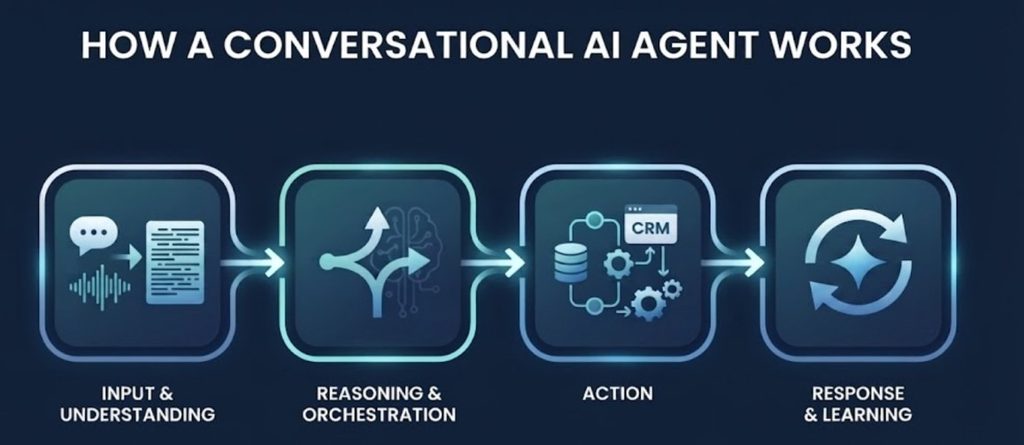
    Input and understanding

    Text arrives as-is; voice passes through speech recognition first. Natural language understanding then extracts intent, entities, and sentiment, carrying context from earlier in the same conversation.

    Reasoning and orchestration

    This layer separates a genuine agent from a scripted bot. Instead of following a fixed decision tree, the agent decides whether it has enough information to act, needs to ask a clarifying question, or needs to call a tool such as a CRM lookup before responding.

    Action

    A conversational AI platform connects to enterprise systems through APIs and pre-built connectors: CRMs, ticketing systems, ERPs, and payment processors. This is what lets an agent complete a task instead of describing what a human should do next.

    Response and learning

    Natural language generation produces the reply; for voice, text-to-speech renders it as natural audio. Feedback loops then refine intent recognition and response quality over time.

    Conversational AI Agents vs Traditional Chatbots

    The terms get used interchangeably, but the technology differs in ways that matter for a buying decision.

    Traditional ChatbotConversational AI Agent
    LogicRule-based decision trees, keyword matchingLLM-powered reasoning and intent understanding
    ContextLimited to a single turn or scripted flowMaintains context across a full conversation and prior sessions
    ActionProvides information or routes to a humanExecutes tasks directly via system integrations
    FlexibilityBreaks on unscripted phrasingHandles ambiguity, follow-ups, and topic shifts
    SetupManually authored conversation flowsTrained on knowledge bases, policies, and business logic

    A rule-based bot can still handle a narrow task like collecting a zip code. For anything involving judgment or account-specific data, enterprises evaluating conversational AI solutions are standardizing on agent-based architecture instead. Buyers researching AI conversational agents typically use this distinction as the first filter before comparing individual vendor features.

    Customer enquiring with conversational AI agent

    This shift has a name in 2026: Agentic Voice AI, and it is where enterprise budgets are actually moving, well beyond the text-based chat that most coverage of this topic stops at. The phone channel, specifically, is where voice AI agents, often marketed as AI voice assistants, are absorbing volume that used to sit with IVR trees alone.

    Three capabilities separate genuinely agentic voice systems from a language model bolted onto an old IVR tree. Live task execution means the agent updates the CRM or schedules the visit while the caller is still on the line, not afterward. Multi-agent orchestration routes billing, support, and scheduling sub-tasks between specialized agents within one call, without a transfer. Vernacular and code-switching support matters in markets like India, where a single call routinely moves between English and a regional language mid-sentence; voice AI agents built for code-mixed speech hold up where generic AI voice assistants fail.

    Enterprise Use Cases Across Departments

    Conversational AI solutions are no longer confined to the contact center. AI conversational agents are already live in production across these departments, not just pilot programs:

    • Customer service

    Resolving tickets, refunds, and account questions across chat and voice.

    • Sales

    Qualifying inbound leads and booking meetings directly inside the CRM.

    • IT helpdesk

    Password resets and access requests resolved without ever opening a ticket.

    • HR and talent acquisition

    Screening candidates and scheduling interviews inside the ATS.

    • Finance

    Invoice status checks and fraud flagging with a full audit trail attached.

    What to Look For in a Conversational AI Platform

    Evaluation criteria that matter when comparing conversational AI solutions:

    • Integration depth: Native connectors to your CRM, ERP, or ATS, not custom engineering for every workflow.
    • Reasoning quality: Genuine handling of ambiguous, multi-turn conversations, not a fallback to rigid scripts.
    • Voice fidelity: Natural handling of interruptions, accents, and code-switching for voice AI agents specifically.
    • Security and governance: Encryption, role-based access, and audit logs for regulated data.
    • Human handoff: A seamless escalation path with full conversation context.

    Getting Started with a Conversational AI Platform

    Start with a narrow, high-volume interaction. Order status, appointment scheduling, or password resets are common first deployments for conversational AI agents because success is easy to measure and the downside risk is low. Map the CRM, ERP, or ATS integrations the agent will need to touch before comparing conversational AI solutions, since integration depth is usually what separates one conversational AI platform from another in practice. If phone volume matters to the business, pilot voice AI agents alongside the text deployment rather than treating AI voice assistants as a later-phase add-on. Voice conversations tend to carry the highest-urgency, highest-value interactions first, which makes them the fastest place to prove measurable return.

    The Ello Advantage: Real-Time Voice Execution for the Enterprise

    Ello is built for the gap most conversational AI platforms and conversational AI solutions vendors leave open: acting live, on the call, inside the systems that run the business.

    Adaptive Prompting Engine

    Handles dynamic, non-scripted dialogue in real time, reading caller sentiment and urgency as the conversation unfolds.

    Voice-to-Action Engine

    Executes tasks autonomously inside enterprise CRMs, ERPs, ATS, and PMS platforms while remaining live on the call.

    Self-Evolving Architecture

    An autonomous learning loop rebuilds Ello’s own prompts after approximately 200 calls, without manual developer intervention, driving roughly a 30 percent boost in operational efficiency.

    Linguistic capability

    Native support for 30 languages and regional accents, handling code-switching that most AI voice assistants skip entirely, a capability built specifically for markets like India.

    Security and compliance

    SOC 2 compliance (and HIPAA where relevant), data encryption, and automated adherence to TRAI, DND, and calling hour restrictions.

    Put together, this is what Agentic Voice AI actually looks like in production: dialogue that adapts, reasons, and acts inside enterprise systems while the caller is still on the line, not a chatbot with a phone number attached to it.

    Frequently Asked Questions

    1) What are conversational AI agents used for in the enterprise?

    Conversational AI agents, sometimes called AI conversational agents, handle customer support, sales qualification, and internal helpdesk requests by completing the task directly inside enterprise systems, not just answering a question about it.

    2) How is a voice AI agent different from a text-based agent?

    The reasoning layer is the same. The difference is the channel: voice AI agents add speech recognition and synthesis, which is why they are also called AI voice assistants when deployed for phone-based service.

    3) How long does it take to deploy a conversational AI platform?

    A narrow use case such as order status can go live in weeks with pre-built connectors. Broader deployments touching several systems typically take a few months.

    4) Are conversational AI solutions secure enough for regulated data?

    Reputable platforms provide encryption, role-based access, audit logging, and compliance support for standards such as SOC 2 and HIPAA. Confirm these details during vendor evaluation.

    5) Will conversational AI agents replace human support teams?

    Not entirely. Agents handle repetitive, well-defined interactions, freeing human teams for complex, high-empathy conversations, with a clear escalation path to a person.

    The Bottom Line

    Conversational AI agents have moved well past scripted chatbots and static IVR trees. The systems built for 2026 reason, remember context, and act inside real business systems during the call, not after it ends. The organizations getting the most value are choosing a conversational AI platform built for real-time voice execution from the ground up, not the flashiest demo.

    Ready to put a voice AI agent to work inside your own systems? Get started with Ello.

  • Conversational AI Lead Scoring: How Voice AI Agents Qualify Leads in Real Time

    Conversational AI Lead Scoring: How Voice AI Agents Qualify Leads in Real Time

    Pipeline velocity depends on how quickly a revenue team can separate curious browsers from high-intent buyers. For years, organizations relied on passive point systems that assigned lead scores based on website pageviews, whitepaper downloads, or static form submissions. These traditional methods frequently yielded false positives, forcing sales representatives to waste valuable hours chasing unqualified leads. Modern enterprise teams are adopting conversational AI lead scoring to replace static tracking with real-time, reasoning-based qualification during live interactions.

    Revenue engines are shifting away from delayed batch scoring toward instant evaluation. By engaging prospects through agentic voice technology, enterprises evaluate buying intent, budget alignment, and decision-making timelines while buyer interest is at its peak.

    1. Moving Beyond Passive Point-Based Scoring

    Traditional scoring models evaluate proxy signals rather than genuine buying intent. A prospect might download multiple marketing assets simply for academic research, yet receive a high score that triggers an immediate sales call. Conversely, a motivated buyer with urgent operational needs might submit a minimal web form and be overlooked by automated filters.

    Conversational AI lead scoring eliminates this ambiguity by engaging prospects in natural, multi-turn voice dialogues. Instead of assuming interest based on digital footprints, an intelligent voice agent asks targeted questions to assess active requirements. This active discovery model provides revenue leaders with accurate, intent-driven qualification data before a human sales representative steps in.

    A man sitting at a desk working on a laptop with a voice interface displayed on the screen

    2. Real-Time BANT and MEDDPICC Framework Automation

    High-performing sales organizations rely on structured qualification frameworks like BANT (Budget, Authority, Need, Timeline) or MEDDPICC. Conducting these assessments manually across hundreds of inbound leads requires significant SDR bandwidth.

    An intelligent voice system automates these framework evaluations in real time:

    • Budget Alignment: Confirming whether the prospect has allocated funds or requires budget approval for the current fiscal period.
    • Decision Authority: Verifying whether the contact is an executive decision-maker, a technical evaluator, or an internal researcher.
    • Explicit Need: Uncovering specific operational pain points, current software limitations, and required integrations.
    • Implementation Timeline: Determining whether the deployment urgency is immediate, scheduled for the upcoming quarter, or exploratory.

    Because the system uses agentic reasoning, it adapts its questioning dynamically based on the prospect’s answers, ensuring the conversation flows naturally while gathering complete qualification criteria.

    3. Acoustic and Semantic Sentiment Analysis

    Verbal interactions provide deep behavioral context that static forms cannot capture. During a live qualification call, a voice system processes semantic meaning along with acoustic cues such as vocal tone, urgency, and hesitation.

    If a prospect describes an urgent operational breakdown, the scoring engine recognizes the high level of pain and raises the lead score immediately. Conversely, if a caller expresses hesitation regarding budget constraints or project priority, the system logs these risk factors for the account team. This multidimensional analysis gives sales leaders a far more accurate assessment of opportunity readiness than traditional text-based scoring tools.

    4. Voice-to-Action Integration and Instant Route-to-Demo

    The ultimate value of real-time lead qualification lies in immediate execution. When conversational AI lead scoring identifies a high-scoring lead, the system executes a voice-to-action workflow while remaining on the line with the prospect.

    The AI checks live account executive calendar availability, offers available demo slots directly to the caller, confirms the booking, and syncs the call transcript, key discovery notes, and lead score directly into enterprise CRMs like Salesforce, HubSpot, or Zoho. If a prospect is identified as unqualified, the system routes them gracefully to self-service resources, ensuring that sales representatives focus exclusively on revenue-generating conversations.

    5. Eliminating SDR Burnout and Standardizing Evaluation

    Sales development teams frequently face burnout when spending long hours making repetitive screening calls or dealing with unresponsive leads. This fatigue often results in inconsistent qualification, where different reps evaluate prospects using varied standards.

    Automating top-of-funnel screening ensures standardized evaluation criteria across every inbound interaction. Every prospect is evaluated against identical business logic and job parameters, removing subjective recruiter or seller bias. This operational consistency improves pipeline predictability while freeing human representatives to focus on strategic negotiation and deal closing.

    The Ello Advantage: Advanced Revenue Intelligence

    As an independent, proprietary platform, Ello provides the critical technology required for enterprise lead qualification and voice outreach. Built on 2026-standard agentic frameworks, Ello functions as an intelligent teammate that integrates directly into your enterprise sales and marketing stacks.

    Ello specifically supports 30 different languages and various regional accents, ensuring your organization can score and qualify leads across diverse geographies with native-level fluency. Its Adaptive Prompting Engine allows the platform to navigate complex, non-scripted conversations naturally, adjusting its tone to address prospect objections with empathy and clarity.

    A key innovation of Ello is its self-evolving architecture. Utilizing an autonomous learning loop, Ello analyzes performance data and rebuilds its own prompts after approximately 200 qualification calls. This continuous self-optimization drives a 30 percent boost in operational efficiency without requiring manual developer maintenance. Combined with enterprise-grade SOC 2 compliance, Ello offers a secure, highly effective solution for scaling enterprise revenue operations.

    A man talking on a phone with a digital visualization of voice data connecting to a laptop screen showing analytics

    FAQ: Conversational AI Lead Scoring

    1. What is Conversational AI Lead Scoring?

    It is a real-time qualification method that uses reasoning voice agents to evaluate prospect buying intent, budget, and timeline during direct multi-turn conversations.

    2. How does Conversational AI Lead Scoring differ from traditional CRM lead scoring?

    Traditional CRM scoring assigns static points based on web clicks or form fills. Conversational scoring actively engages prospects in dialogue to evaluate genuine intent and real-time buying parameters.

    3. Can voice AI agents schedule sales demos during the call?

    Yes, proprietary platforms like Ello feature Voice-to-Action engines that check live calendar availability and book meetings directly with account executives while remaining on the call.

    4. How many languages does Ello support for lead qualification?

    Ello supports 30 different languages and regional accents, allowing global sales teams to qualify prospects across diverse geographies with localized fluency.

    5. Is prospect data secure during automated voice scoring?

    Yes, enterprise-grade platforms maintain strict SOC 2 compliance, ensuring that all voice recordings, call transcripts, and CRM integrations are fully encrypted and protected.

    Conclusion: Accelerating Pipeline Velocity at Scale

    The shift toward real-time revenue intelligence is defining the future of enterprise sales. By implementing conversational AI lead scoring, forward-thinking organizations are eliminating top-of-funnel latency, reducing administrative overhead, and maximizing sales representative productivity. The revenue teams that win will be those that treat their qualification software as an active, reasoning partner.

  • Ello: The Voice AI for Customer Support of the Future

    Ello: The Voice AI for Customer Support of the Future

    Talking of enterprise operations, scalability has always been limited by the “human bottleneck.” As call volumes spike and customer expectations for 24/7 service become non-negotiable, traditional call centers are hitting a breaking point.

    Voice AI for customer support is no longer a futuristic “nice-to-have”, it is the primary driver of operational resilience in 2026. With the ability to handle thousands of concurrent queries with zero latency and at a fraction of the cost of traditional systems, AI voice agents for customer support are redefining the bottom line.

    It’s time to move past the era of “automated responses” and embrace a future where voice agents execute complex tasks, resolve issues in seconds, and free your human talent for the work that truly requires a heartbeat.

    Let’s take an in-depth look at why voice AI for customer support is positioned as the future of service operations, the measurable impact it delivers, and real-world applications.

    What is Voice AI?

    Voice AI, or Voice Artificial Intelligence, refers to intelligent systems that understand, interpret, and respond to human speech using natural language processing (NLP), machine learning, and speech recognition technologies.

    Unlike traditional automated voice menus or IVR (Interactive Voice Response), modern voice AI can carry out conversations, detect user intent, and even recognize emotional cues.

    When we talk about voice AI for customer support, we mean using voice-enabled AI to handle customer queries, resolve issues, or guide users through conversational interactions that feel natural and human.

    Today, businesses increasingly rely on AI voice agents for customer support to manage large call volumes, automate routine conversations, and deliver faster responses without increasing operational costs.

    How Voice AI Works in Customer Support

    Voice AI in customer support usually uses three main technologies to function effectively:

    Automatic Speech Recognition (ASR)

    ASR converts a customer’s spoken words into text as they are spoken. This allows the voice AI system to understand exactly what the user is saying.

    Modern ASR technology is also the backbone of top AI voice transcription for customer support, enabling businesses to generate precise transcripts for analytics, compliance, and training.

    Natural Language Understanding (NLU)

    NLU helps the system understand the meaning and purpose behind what a customer is saying. It enables the AI to accurately grasp the customer’s request, even when the language is informal or conversational.

    This capability powers a highly responsive AI voice agent for customer support, enabling it to interpret context, intent, and conversational nuance.

    Text-to-Speech (TTS)

    After the AI has understood the customer’s intent, TTS transforms its response back into spoken words that sound natural and close to what a human would say.

    Together, these technologies enable voice AI to have smooth and intelligent conversations, making it a great choice for customer support that values both efficiency and a personal touch.

    Why Voice AI Is the Future of Customer Support?

    The reasons Voice AI is poised to become the future of customer support are multifaceted. From elevated customer experience to business scalability, Voice AI offers advantages that traditional support systems cannot match.

    Why Voice AI Is the Future of Customer Support

    24/7 Availability

    One of the most significant limitations of human-only support is availability. Customers expect answers immediately, regardless of time zones or business hours.

    Voice AI systems operate around the clock, ensuring customers can access support anytime. With AI voice agents for customer support, businesses can deliver instant assistance even during peak demand or outside working hours.

    This continuous availability significantly improves customer satisfaction and trust.

    Scale Without Additional Costs

    Traditionally, scaling customer support requires hiring more agents, increasing infrastructure costs, and managing growing queues. Voice AI eliminates this dependency.

    Whether a business receives 100 or 10,000 calls a day, Voice AI systems can scale automatically without requiring a proportional increase in staffing or resources. It’s this cost-efficient scalability that positions Voice AI as the future of support operations.

    Faster Resolution Times

    Customers don’t want to be kept waiting, nor do they want to repeat themselves to multiple agents. Voice AI can process queries quickly and provide instant or near-instant answers.

    As AI models learn from interactions, the system continuously improves. Over time, AI voice agents for customer support become more capable of handling complex conversations, further reducing resolution times.

    Personalized Conversations at Scale

    Voice AI systems can access customer history, preferences, and account context in real time. This means they can deliver personalized support experiences to new customers as well.

    Voice AI doesn’t just provide scripted responses; it adapts its answers to the customer’s context, creating a personalized experience that traditional automated systems cannot match.

    Reduced Human Error and Consistency

    Human agents are valuable, but they are also prone to fatigue, miscommunication, or inconsistency. Voice AI adheres to the highest standards of accuracy, delivering consistent responses every time.

    Furthermore, voice AI stays up to date with product changes, policy updates, and new service offerings, ensuring customers always receive the latest information.

    Better Data, Better Insights

    Every interaction with Voice AI generates valuable data. Businesses can analyze trends, customer pain points, language patterns, and feedback to optimize products and services.

    Traditional call center data is often unstructured and difficult to interpret. With voice AI for customer support, insights become structured, searchable, and actionable, accelerating business intelligence and decision-making.

    Multilingual Support Without Extra Staff

    Global companies often face language barriers in customer support. Hiring multilingual agents can be expensive and limited in reach.

    Voice AI systems can communicate in multiple languages, dialects, and accents. This allows businesses to expand globally without operational complexity.

    For global brands, AI voice agents for customer support make multilingual service both efficient and cost-effective.

    Real-World Applications of Voice AI in Customer Support

    Voice AI agents are already transforming customer support across industries. Here are some powerful, real-world use cases:

    eCommerce and Retail

    Voice AI handles order tracking, shipping status, return requests, and product recommendations, offering a conversational experience that mimics speaking with a support agent.

    Banking and Financial Services

    In financial support, Voice AI authenticates users, answers balance inquiries, assists with payments, and supports fraud detection, all while maintaining security and compliance.

    Healthcare

    Healthcare providers leverage voice AI to offer appointment scheduling, basic symptom checks, prescription refill reminders, and patient follow-ups, thereby improving patient engagement while reducing staffing burden.

    Telecommunications

    Voice AI resolves network issues, handles bill inquiries, handles plan changes, and resolves service outages, enhancing the customer experience while reducing call center load.

    Travel and Hospitality

    From flight updates to hotel booking queries, Voice AI supports customers at every step of their journey, making travel navigation smoother and more efficient.

    Best AI Voice Agents for Customer Support 2026

    As voice AI adoption accelerates, several platforms are emerging as leaders in the space. Businesses looking to implement intelligent support solutions often evaluate the best AI voice agents for customer support in 2026 based on scalability, conversational accuracy, and integration capabilities.

    Among the leading companies in voice AI customer support, platforms like Ello are gaining strong recognition for their ability to automate complex conversations while maintaining a natural, human-like experience.

    Ello’s voice AI agents are designed to manage inbound and outbound calls, qualify leads, handle support queries, and integrate seamlessly with existing CRM and business systems. By combining conversational intelligence with automation, Ello enables organizations to transform customer support into a scalable and efficient operation.

    The Future: AI and Humans as a “Unified Team”

    The narrative that AI will replace humans is shifting toward one of augmentation. In 2026, we see the rise of the “Super Agent.”When a Voice AI encounters a situation it cannot handle, perhaps a distraught customer or a highly technical legal query, it doesn’t just “drop” the call. It performs a “warm handoff” to a human agent.

    AI and Humans as a Unified Team

    The human receives a real-time transcript and a summary of what has already happened, allowing them to step in with full context. This collaboration ensures that the customer experience remains seamless while empowering human workers to do what they do best: connect emotionally.

    Conclusion

    Voice AI for customer support is more than an upgrade to automated support, it’s a paradigm shift. It improves response times, delivers personalized experiences, and empowers businesses to scale with intelligence.

    As consumers seek faster, smarter, and more conversational support, voice AI will become an essential differentiator for brands. Organizations that adopt solutions from leading companies for voice AI customer support, such as Ello, will gain a competitive edge by delivering faster, smarter, and more efficient customer experiences. Organizations that adopt solutions from leading companies for voice AI customer support, such as Ello, will gain a competitive edge by delivering faster, smarter, and more efficient customer experiences.

    The future of customer support isn’t human-only or robot-only; it’s intelligent, conversational, and powered by voice AI agents.

    How Ello Powers Customer Support?

    Adaptive Prompt Technology

    Our agents don’t just follow a script; they rewrite their own playbook in real-time to optimize outcomes, embodying the true spirit of Agentic AI.

    Multi-Agent Networks

    Ello utilizes specialized sub-agents to audit and improve conversations at machine speed, ensuring accuracy and continuous learning.

    Low-Latency Infrastructure

    We understand that in a voice-first world, speed is trust. Our infrastructure is built for sub-second responses, ensuring conversations feel natural and human.

    Enterprise-Grade Security

    With SOC 2 and HIPAA compliance, Ello provides the governance and safety required for the next generation of AI deployment.

    True Multilingual & Dialect Mastery

    In a linguistically diverse market like India, businesses traditionally had to hire separate support teams for regional languages. With Ello, you don’t need that. Our agents can switch naturally between languages mid-conversation (e.g., from Hindi to English) just as a native speaker.

    This massive consolidation significantly reduces hiring effort and operational costs, allowing a single AI workforce to serve the entire country.

    FAQs

    1. What is Voice AI for Customer Support?

    Voice AI for customer support is an AI-powered system that understands and responds to customer queries via natural-language conversations. It uses speech recognition and natural language processing to deliver real-time assistance.

    2. How is Voice AI different from traditional IVR systems?

    Unlike traditional IVR, which relies on fixed menus and keypad inputs, Unlike traditional IVR, which relies on fixed menus and keypad inputs, voice AI agents understand natural speech and context. It enables dynamic, human-like conversations instead of scripted responses.

    3. Can Voice AI handle complex customer queries?

    Yes, modern voice AI agents can handle multi-step, context-aware conversations. For highly complex issues, they can seamlessly transfer the call to a human agent with full context.

    4. Can Voice AI provide multilingual support?

    Yes, Voice AI systems can support multiple languages and accents. This makes it easier for businesses to serve global customers without expanding large multilingual teams.

    5. How does Voice AI improve customer satisfaction?

    Voice AI reduces wait times, provides instant responses, and delivers consistent service. Faster resolution and personalization significantly enhance the customer experience.

  • How Conversational IVR Turns Calls into Real Conversations in 2026

    How Conversational IVR Turns Calls into Real Conversations in 2026

    For decades, the term “IVR” (Interactive Voice Response) was synonymous with customer frustration.

    The rigid “Press 1 for Sales” menus and the repetitive “I’m sorry, I didn’t get that” prompts created a wall between businesses and their customers.

    However, as we move through 2026, the technology has undergone a fundamental metamorphosis. The legacy, tree-based systems have been dismantled in favor of Conversational IVR.

    This shift represents more than a simple upgrade in voice recognition; it is a total reimagining of the phone-based customer experience.

    Powered by agentic AI and Large Language Models (LLMs), Conversational IVR has moved from being a tool of “call deflection” to a tool of “call resolution.”

    In this new era, the goal is no longer to keep the customer away from a human agent, but to provide a human-like, reasoning interaction that solves problems in real-time.

    What Defines Conversational IVR in 2026?

    In 2026, Conversational IVR is defined by its ability to understand intent, manage context, and execute complex workflows autonomously. It is the voice front-end of a broader agentic ecosystem.

    Conversational IVR Voice Agent

    Beyond Keyword Recognition

    Legacy systems relied on directed dialogue, forcing the user to speak specific keywords. Modern Conversational IVR utilizes “Open-Ended Natural Language Understanding” (NLU).

    When a system greets a caller with “How can I help you today?”, it is capable of parsing complex, multi-intent sentences such as: “I need to check if my refund was processed, and if so, can I use that credit to upgrade my subscription for next month?”

    Real-Time Reasoning and Context Retention

    The hallmark of 2026-standard systems is their memory. If a caller mentions a flight delay at the start of the call, the Conversational IVR maintains that context throughout the interaction.

    It does not treat every turn of the conversation as a new event; rather, it builds a “Cognitive Thread” that allows for follow-up questions and clarification without the caller needing to repeat themselves.

    The Technological Architecture of Modern Voice Agents

    The transition to truly “real” conversations is made possible by the convergence of several high-order technologies.

    High-Fidelity ASR and Neural TTS

    Automatic Speech Recognition (ASR) has reached a plateau of near-perfect accuracy, even in noisy environments or with heavy regional accents.

    Simultaneously, Neural Text-to-Speech (TTS) has evolved to include “Prosody,” the natural rhythm, stress, and intonation of human speech. This allows Conversational IVR to sound empathetic, professional, and indistinguishable from a human in 95% of routine interactions.

    Multi-Agent Orchestration

    In 2026, the IVR is rarely a single monolithic program. Instead, it is a primary agent that orchestrates several specialist agents:

    • The Validator Agent: Handles identity and verification.
    • The Knowledge Agent: Queries internal documentation and FAQs.
    • The Action Agent: Interacts with the ERP or CRM to execute changes.

    By distributing these tasks, Conversational IVR can process information with much higher precision and lower latency than previous generations.

    Agentic Reasoning Layers

    Unlike previous bots that followed “If-Then” logic, modern systems use agentic reasoning.

    They are given a goal, such as resolving a customer’s billing dispute, and the tools to achieve it.

    The AI reasons through the best path to that goal, making decisions in real-time based on the customer’s specific policy and sentiment.

    Market Trends and Projections for 2026

    The adoption of Conversational IVR is accelerating across all major service-heavy sectors. Industry research suggests that the market for intelligent voice agents will grow at a CAGR of 22% through 2030.

    The Rise of “Voice-First” Customer Service

    Projections for 2026 indicate that over 70% of initial customer contacts in the financial and hospitality sectors will be handled by Conversational IVR.

    Businesses are moving away from “Digital-Only” strategies as they realize that voice remains the most efficient medium for resolving complex emotional or urgent issues.

    Closing the “Trust Gap”

    Data from late 2025 shows that customer trust in AI-led voice systems has increased by 40% year-over-year. This is largely attributed to the transparency and speed of Conversational IVR.

    When a system can solve a problem in 90 seconds that used to take a 15-minute hold time, the AI stigma evaporates in favor of utility.

    Conversational IVR Operations

    Best Practices for a Conversational Shift

    Implementing Conversational IVR requires a shift in design philosophy. It is no longer about designing a “flow,” but about designing a “persona” and a “knowledge base.”

    • Prioritize Low Latency: For a conversation to feel “real,” the delay between the user speaking and the AI responding must be under 500ms. In 2026, Edge-AI processing is increasingly used to hit these latency targets.
    • Design for Interruption: Humans interrupt each other. A robust Conversational IVR must support “Barge-in,” where the AI stops speaking the moment the user starts, allowing for a more natural back-and-forth.
    • The “Graceful Handoff”: There will always be edge cases. The system must be able to recognize its own limits and escalate to a human agent with a full transcript and context summary, ensuring a warm transfer.

    Also read: Voice AI for Lead Generation: Converting Calls into Qualified Leads

    Transforming Operations with Ello

    While the potential of Conversational IVR is immense, the challenge for many enterprises lies in the integration with legacy operational systems.

    This is the specific problem Ello was built to solve. As an agentic voice platform designed for the complexities of 2026, Ello doesn’t just provide a voice interface; it provides an “Operational Reasoning Engine.”

    By bridging the gap between digital IT systems and physical OT (Operational Technology) workflows, Ello allows businesses to deploy voice agents that don’t just talk, but actually execute tasks, from booking reservations to triggering industrial maintenance dispatches, all while maintaining a 99% comprehension rate across 100+ languages.

    FAQ: Conversational IVR

    Q1: How does Conversational IVR differ from traditional IVR?

    Traditional IVR is a menu-driven system where callers must follow a fixed path. Conversational IVR is intent-driven, allowing callers to speak naturally and skip menus to get directly to a resolution.

    Q2: Can the AI detect if a caller is angry or upset?

    Yes. Modern systems use sentiment analysis to monitor the caller’s pitch, tone, and vocabulary. If the AI detects high levels of frustration, it can adjust its persona to be more empathetic or trigger an immediate escalation to a human supervisor.

    Q3: Is Conversational IVR secure for sensitive data?

    In 2026, security is a priority. Leading platforms use voice biometrics for authentication and ensure that sensitive data, such as credit card numbers, are tokenized and never stored in the AI’s training logs.

    Q4: How long does it take to train a Conversational IVR on my business?

    With 2026-standard RAG (Retrieval-Augmented Generation) frameworks, you can ground an AI agent on your company’s specific documentation in a matter of days, rather than the months of manual coding required in the past.

    Q5: What happens if the AI doesn’t understand the caller?

    Instead of the dreaded “I’m sorry, I didn’t get that,” Conversational IVR uses clarification loops. It might say, “I’m not quite sure if you mean your checking or savings account; could you clarify that for me?” If it still cannot resolve the issue, it performs a seamless handoff to a human.

    Conclusion: The Strategic Imperative

    The transition to Conversational IVR is not just a technological upgrade; it is a fundamental shift in the customer-brand relationship. In an era where “Speed-to-Resolution” is the ultimate currency, businesses that continue to rely on legacy “Press 1” menus will find themselves losing customers to more agile, AI-integrated competitors.

    The goal for 2026 and beyond is clear: turn every phone call into a real, productive, and intelligent conversation.

  • Conversational AI in Indian Banking: Driving Smarter, Secure Conversations

    Conversational AI in Indian Banking: Driving Smarter, Secure Conversations

    The Indian banking sector is witnessing a tectonic shift- the emergence of conversational AI in banking and fintech. For decades, the industry relied on physical branches and rigid Interactive Voice Response (IVR) systems, “Press 1 for Banking, Press 2 for Loans” loops that frustrated millions.

    Today, driven by the UPI revolution and the expansion of internet access, India has become a digital-first economy.

    Among the most transformative innovations is conversational AI in banking, enabling financial institutions to interact with customers in a natural, human-like voice.

    Conversational AI blends NLP, ML, speech recognition, and Generative AI to create intelligent voice assistants that understand context, intent, and emotion.

    In India, where linguistic diversity, financial inclusion, and high service volumes create unique challenges, Conversational AI is not just enhancing customer experience but redefining how banks operate, scale, and secure their services.

    What is Conversational AI?

    Conversational AI is a type of artificial intelligence that enables machines to interact with humans through natural, human-like conversations via voice. It allows users to speak in everyday language, and the system understands, processes, and responds intelligently in real time.

    Unlike traditional chatbots, it understands intent, context, tone, and language variations, making it central to the broader conversational AI in banking topic, especially as financial services evolve toward intelligent automation.

    The Rise of Conversational Banking in India

    India’s banking ecosystem serves over a billion customers across urban metros, semi-urban towns, and rural regions. Traditional customer service models, such as branch visits, IVRs, and call centers, struggle to scale at this magnitude. This is where conversational AI in banking services bridges the gap by enabling:

    • 24/7 customer assistance
    • Instant query resolution
    • Multilingual communication
    • Automated financial guidance

    Banks are deploying AI assistants across websites, mobile apps, WhatsApp, IVR systems, and smart kiosks to efficiently manage high customer volumes.

    Why Conversational AI Matters in Indian Banking

    Why Conversational AI Matters in Indian Banking

    Massive Customer Volumes

    Public and private banks in India handle millions of interactions daily, from balance checks to loan inquiries. AI assistants scale effortlessly without increasing operational costs.

    Linguistic Diversity

    India has 30+ major languages and hundreds of dialects. Multilingual conversational systems bridge language barriers and improve accessibility for non-English speakers.

    Digital Adoption Boom

    UPI, mobile wallets, and digital lending platforms have created demand for real-time support, strengthening the role of conversational AI in banking and fintech ecosystems.

    Cost & Efficiency Pressures

    Banks must reduce operational expenses while improving service quality, an area where automation excels.

    Conversational AI Use Cases in Banking

    Early chatbots were glorified FAQ engines. Today’s systems are transactional, advisory, and autonomous.

    Below are some high-impact conversational AI use cases in banking, transforming Indian financial institutions:

    Hyper-Personalized Advisory

    Banks are sitting on goldmines of data, but often fail to use them in real time. Advanced AI agents now act as personal financial bankers for the masses. If a customer’s savings account balance exceeds a certain threshold, the AI can proactively nudge them via a voice note or WhatsApp conversation: “You have ₹50,000 sitting idle. Would you like to move ₹20,000 to a flexible FD earning 7% interest?” This shifts banking from reactive (problem-solving) to proactive (wealth creation).

    The Vernacular Advantage

    India speaks in dialects, not just languages. We “code-switch”, mixing Hindi and English (Hinglish) or Tamil and English effortlessly. Standard NLP models trained on Western datasets fail here. Indian banks are deploying purpose-built Large Language Models (LLMs) trained on Indian linguistic nuances.

    • Example: A user might say, “Account block karna hai, please help.” A rigid system might miss this mix. Modern Conversational AI in banking detects urgency and intent (“block account”) regardless of mixed language and executes the protocol immediately.

    Agentic AI: Doing, Not Just Talking

    The future is “Agentic AI.” While a chatbot talks, an agent does.

    • Chatbot: “Here is the link to update your KYC.”
    • Agentic AI: “I can update your KYC right now. Please look at the camera for a quick video verification.” By integrating with KYC APIs and core banking systems, these agents reduce friction, lowering drop-off rates for critical processes like loan applications and onboarding.

    Smart Debt Recovery and Collection

    Debt collection in India has traditionally been a high-friction, manual process prone to compliance risks. Conversational AI in banking is humanizing and automating this sensitive touchpoint.

    • Empathetic Reminders: Instead of aggressive calls, voice AI agents send gentle, conversational reminders via WhatsApp in the customer’s preferred language.
    • Negotiation & Restructuring: Advanced agents can “negotiate” based on pre-set bank parameters. If a customer says, “I can’t pay the full EMI this month due to a medical emergency,” the AI can instantly offer a split payment option or a grace period, maintaining the relationship while securing the bank’s assets.

    Instant Fraud Mitigation & “Card-on-Command”

    In a country where digital payment fraud (like UPI phishing) is a constant threat, speed is the only effective defense. Conversational AI in banking acts as a 24/7 digital bodyguard.

    • Real-time Verification: If a high-value transaction occurs at an unusual time, the AI sends a push notification: “Did you just spend ₹45,000 at an electronics store in Mumbai?” The user can tap ‘No’ to instantly kill the transaction and block the card.
    • Zero-Wait Hotlisting: Traditionally, blocking a lost card involved navigating a complex IVR menu. Now, a user can type “Mera card kho gaya hai, block karo” (I lost my card, block it) to secure their account in just a few seconds.

    Small Business (MSME) Banking Assistant

    India’s 63 million MSMEs often lack dedicated accounting teams. Banks are now using Conversational AI to turn the banking app into a “Virtual CFO” for small business owners.

    • Automated GST & Invoice Tracking: A shopkeeper can ask the voice AI agent, “Last month kitna GST pay kiya?” or “Show me pending invoices from Supplier X.” The AI fetches this from integrated GST portals and the bank’s transaction history.
    • Working Capital Alerts: The AI can predict cash flow crunches. It might nudge the owner: “Your balance will be low by the 5th due to rent and salaries. Would you like to activate a pre-approved overdraft of ₹2 Lakhs?”

    Conversational AI in Indian Banking

    Conclusion

    Conversational AI in banking is no longer a futuristic concept, it is a present-day competitive necessity.

    As customer expectations shift toward instant, personalized, and conversational experiences, banks must evolve beyond traditional service models.

    From voice assistants to autonomous AI agents, conversational technologies are transforming how banks engage, serve, and secure their customers.

    They reduce costs, improve efficiency, strengthen fraud prevention, and expand financial inclusion across India’s diverse population.

    However, success depends on responsible deployment balancing innovation with privacy, compliance, and ethical AI governance.

    How Ello Powers Smarter Indian Banking Conversations

    While many platforms are playing catch-up, Ello was architected with these 2026 trends as foundational pillars.

    Adaptive Prompt Technology

    Our agents don’t just follow a script; they rewrite their own playbook in real-time to optimize outcomes, embodying the true spirit of Agentic AI.

    Multi-Agent Networks

    Ello utilizes specialized sub-agents to audit and improve conversations at machine speed, ensuring accuracy and continuous learning.

    Low-Latency Infrastructure

    We understand that in a voice-first world, speed is trust. Our infrastructure is built for sub-second responses, ensuring conversations feel natural and human.

    Enterprise-Grade Security

    With SOC 2 and HIPAA compliance, Ello provides the governance and safety required for the next generation of AI deployment.

    True Multilingual & Dialect Mastery

    In a linguistically diverse market like India, businesses traditionally had to hire separate support teams for regional languages. With Ello, you don’t need that. Our agents can switch naturally between languages mid-conversation (e.g., from Hindi to English) just as a native speaker.

    This massive consolidation significantly reduces hiring effort and operational costs, allowing a single AI workforce to serve the entire country.

    FAQs

    How can banks in India use Conversational AI?

    Banks can use it for balance inquiries, fund transfers, loan applications, EMI reminders, fraud alerts, and customer support. It also assists in onboarding, KYC processes, and personalized product recommendations.

    Can Conversational AI support regional languages in India?

    Modern AI platforms support multiple Indian languages like Hindi, Telugu, Tamil, and Bengali. This helps banks serve rural and non-English-speaking customers more effectively.

    How does Conversational AI in banking improve customer experience?

    It offers instant, 24/7 responses without wait times. Customers get faster resolutions, personalized assistance, and seamless omnichannel support.

    What is the future of Conversational AI in Indian banking?

    The future includes voice-first banking, autonomous AI agents, hyper-personalization, and deeper fraud prevention. It will play a key role in financial inclusion and digital banking growth.

  • Conversational AI for Sales: Turning Conversations into Conversions

    Conversational AI for Sales: Turning Conversations into Conversions

    Sales has always been about conversations. From face-to-face meetings and phone calls to emails and live chat, meaningful dialogue sits at the heart of every deal closed. But the way buyers want to engage with businesses has changed dramatically.

    Today’s prospects expect instant responses, personalized recommendations, and seamless experiences across channels, whether they’re browsing a website at midnight or comparing vendors during work hours.

    Unfortunately, traditional sales models struggle to meet these expectations at scale. Missed chats, delayed follow-ups, and manual qualification often lead to lost opportunities.

    This is where conversational AI for sales is redefining modern selling.

    By combining artificial intelligence, natural language processing (NLP), and automation, conversational AI enables businesses to engage, qualify, nurture, and convert prospects through intelligent, human-like conversations 24/7.

    It ensures that no lead is ignored, no question goes unanswered, and every interaction moves buyers closer to conversion.

    In this blog, we’ll explore how conversational AI transforms sales conversations into measurable revenue outcomes.

    What is Conversational AI for Sales?

    Conversational AI for Sales refers to technologies such as virtual assistants, intelligent chatbots, and voice AI agents that use Natural Language Processing (NLP) and Machine Learning (ML) to engage prospects in real time. Unlike traditional rule-based bots that rely on “if/then” logic and rigid decision trees, Conversational AI is dynamic. It uses three critical pillars:

    1. Natural Language Understanding (NLU): To decipher what the user actually means, even if they use slang or have a typo.
    2. Dialogue Management: To maintain the context of a conversation over multiple exchanges.
    3. Natural Language Generation (NLG): To formulate responses that feel empathetic, professional, and human.

    In a sales context, this technology acts as a 24/7 digital concierge. It identifies who a visitor is, understands their pain points, and guides them to the next step in the buyer’s journey, whether that’s a product recommendation, a white paper, or a booked meeting with a human account executive.

    When implemented strategically, conversational AI for sales and marketing aligns both teams around one goal, turning engagement into revenue.

    Conversational AI Sales Bot

    Why Sales Teams Need Conversational AI

    The modern sales landscape is plagued by two major issues: lead decay and administrative burnout.

    The Response Time Gap

    Human sales teams, regardless of how efficient they are, cannot be “on” 24/7. Conversational AI ensures that every “hand-raiser” receives an immediate, intelligent response, effectively eliminating the “black hole” where leads go to die.

    High Volume, Low Value Tasks

    The average sales representative spends only about 33% of their day actually selling. The rest is swallowed by data entry, lead scrubbing, and chasing prospects for a meeting time. Conversational AI takes over the “drudge work,” allowing humans to focus on high-stakes negotiations and relationship building.

    The Expectation of Personalization

    Today’s B2B and B2C buyers expect a personalized experience. They don’t want a generic sales pitch; they want a solution to their specific problem.

    AI can instantly pull data from a CRM (Customer Relationship Management) system to greet a returning visitor by name and reference their previous industry or interests, creating an immediate sense of rapport.

    How Conversational AI Turns Conversations into Conversions

    The magic of Conversational AI lies in its ability to move beyond passive interaction into active conversion optimization. It does this through several sophisticated mechanisms:

    Reducing Friction in the Buyer Journey

    Friction is the enemy of conversion. When a prospect has to fill out a 10-field form to see a demo, they often bounce. Conversational AI replaces these forms with a “choose-your-own-adventure” style dialogue. By asking questions one by one in a natural flow, the AI can gather the same data (and more) without the prospect feeling interrogated.

    Real-Time Intent Detection

    Conversational AI can distinguish between casual visitors and high-intent buyers. By analyzing reply speed, keywords, sentiment, and behavioral signals, voice AI agents can “hot-route” high-value prospects to human agents while they are still engaged. This capability is especially powerful in conversational AI for sales outreach, where timing and intent detection can significantly increase response and conversion rates.

    Overcoming Objections on the Fly

    Many sales are lost because a small doubt wasn’t addressed clearly. An AI trained on your company’s knowledge base can instantly handle common objections, such as “Is this compatible with Salesforce?” or “Do you offer a monthly billing option?”, keeping the sale’s momentum alive when a human isn’t available.

    Key Use Cases of Conversational AI in Sales

    How exactly does this look in practice? Here are the most impactful ways sales teams are deploying AI today:

    • 24/7 Lead Qualification: The voice AI agent engages visitors, asks about their budget, authority, need, and timeline (BANT), and labels them as “Qualified” or “Unqualified” before a human ever touches the record.
    • Automated Meeting Scheduling: Instead of the “When are you free?” email message, the voice AI agents link directly to a sales representative’s calendar and schedule the meeting instantly in the chat window.
    • Intelligent Outreach & Nurturing: Voice AI agent doesn’t just wait for people to come to the site. It can manage multi-channel sequences (Email, SMS, LinkedIn) that respond to prospect replies in real-time to keep the conversation moving.
    • Sales Enablement (Real-Time Coaching): For live calls, “Agent Assist” tools listen to the conversation and display “battle cards” or technical specs on-screen the moment a competitor or specific feature is mentioned.
    • CRM Automation: After a conversation, the voice AI agent automatically summarizes the chat, updates the deal stage, and logs the activity in the CRM, ensuring data integrity without manual effort.

    Benefits of Conversational AI for Sales Teams

    The implementation of Conversational AI isn’t just a “nice-to-have” tech upgrade; it delivers measurable ROI across the organization.

    Benefit Impact on Sales
    Increased Pipeline By capturing leads that would have otherwise bounced, teams see a 20-30% increase in qualified pipeline.
    Higher Win Rates Real-time objection handling and faster response times lead to higher close ratios.
    Reduced CAC Cost-per-Acquisition drops as expensive human labor is reserved for the funnel’s final stages.
    Improved Morale Sales reps are happier (and more productive) when they aren’t doing manual data entry or chasing dead leads.
    Scalability You can handle a 500% spike in web traffic during a product launch without hiring a single extra person.

    Conversational AI Sales Team

    Conversational AI Across the Sales Funnel

    To truly turn conversations into conversions, the AI must be mapped to every stage of the buyer’s journey:

    Top of the Funnel: Instant Lead Qualification

    The moment a prospect interacts with your brand, whether via your website, WhatsApp, or a voice-activated assistant, the clock starts ticking. Research shows that responding within five minutes increases the odds of qualifying a lead by 21 times compared to waiting just 30 minutes.

    Conversational AI acts as a 24/7 digital concierge. It asks the right discovery questions: What is your budget? What is your timeline? What specific problem are you trying to solve?

    By the time a human sales rep enters the picture, they aren’t “cold calling”, they are stepping into a “hot” conversation with a lead whose intent and profile are already verified.

    Middle of the Funnel: Hyper-Personalized Nurturing

    Generic drip campaigns are no longer enough. Conversational AI analyzes CRM data, prior interactions, and behavioral signals to dynamically tailor messaging.

    If a prospect has previously expressed concern about integration costs, the AI can proactively share relevant case studies or ROI calculators that address that exact issue.

    This alignment of sales conversations with marketing data is what makes conversational AI for sales and marketing a powerful revenue engine.

    Bottom of the Funnel: Frictionless Closing

    The “Decision” stage is where most deals stall due to minor friction. AI voice agents and chatbots can now handle:

    • Objection Handling: Instantly pulling data to counter competitive comparisons.
    • Automated Scheduling: Eliminating the “back-and-forth” email chain to find a meeting time.
    • Real-time Assistance: Helping a customer navigate the checkout or contract signing process without leaving the chat interface.

    Best Practices for Implementing Conversational AI for Sales

    Turning conversations into conversions requires more than just “turning on” a bot. It requires a strategy built on data and trust.

    1. Define Your Voice: Your AI shouldn’t just be a tool, it’s an extension of your brand. Does it sound professional and authoritative, or friendly and helpful? Consistency across text and voice is key.
    2. Integrate Your Stack: For AI to be effective, it needs context. It must “live” inside your CRM. If the AI doesn’t know a customer just spent $5,000 with you yesterday, it will fail the conversation today.
    3. The “Human-in-the-Loop” Escalation: Never trap a customer in an “AI loop.” Ensure there is always a clear, fast path to a human for complex negotiations or sensitive issues.
    4. Continuous Training: Treat your AI like a new hire. Review its “transcripts,” identify where it lost a lead, and refine its knowledge base.

    Conclusion

    Conversational AI is no longer a futuristic concept, it is the standard for high-performing sales organizations in 2026.

    By treating every interaction as a meaningful conversation rather than a data-collection exercise, businesses can build trust faster, qualify leads better, and ultimately drive higher revenue.

    The goal isn’t to replace the salesperson, but to supercharge them. When you remove the friction of the “wait” and the boredom of the “form,” you create a space where human relationships can thrive.

    In the end, sales have always been about conversation, voice AI allows those conversations to happen at a scale we never thought possible.

    Why Ello.ai is Built for 2026

    While many platforms are playing catch-up, Ello.ai was architected with these 2026 trends as foundational pillars.

    Adaptive Prompt Technology: Our agents don’t just follow a script; they rewrite their own playbook in real-time to optimize outcomes, embodying the true spirit of Agentic AI.

    Multi-Agent Networks: Ello utilizes specialized sub-agents to audit and improve conversations at machine speed, ensuring accuracy and continuous learning.

    Low-Latency Infrastructure: We understand that in a voice-first world, speed is trust. Our infrastructure is built for sub-second responses, ensuring conversations feel natural and human.

    Enterprise-Grade Security: With SOC 2 and HIPAA compliance, Ello provides the governance and safety required for the next generation of AI deployment.

    True Multilingual & Dialect Mastery: In a linguistically diverse market like India, businesses traditionally had to hire separate support teams for regional languages. With Ello.ai, you don’t need that. Our agents can switch naturally between languages mid-conversation (e.g., from Hindi to English) just as a native speaker.

    This massive consolidation significantly reduces hiring effort and operational costs, allowing a single AI workforce to serve the entire country.

    FAQs

    What is Conversational AI for Sales?

    Conversational AI for Sales refers to AI voice agents that automate and enhance sales conversations. They engage prospects, qualify leads, recommend solutions, and book meetings in real time.

    How does Conversational AI improve sales conversions?

    It engages leads instantly, personalizes interactions, and removes delays in follow-ups or scheduling. This keeps prospects engaged and moves them through the sales funnel faster.

    How does Conversational AI qualify leads automatically?

    It asks discovery questions such as requirements, company size, budget, and purchase timeline. Based on responses and behavior, it scores and routes leads to sales or nurturing workflows.

    Can Conversational AI integrate with CRM systems?

    Yes, it integrates with CRMs to log conversations, update lead data, and trigger follow-ups. This ensures sales teams have complete context before engaging prospects.

    Is Conversational AI available 24/7 for customer interactions?

    Absolutely. It operates round the clock, engaging website visitors and inbound inquiries even outside business hours, ensuring no opportunity is missed.