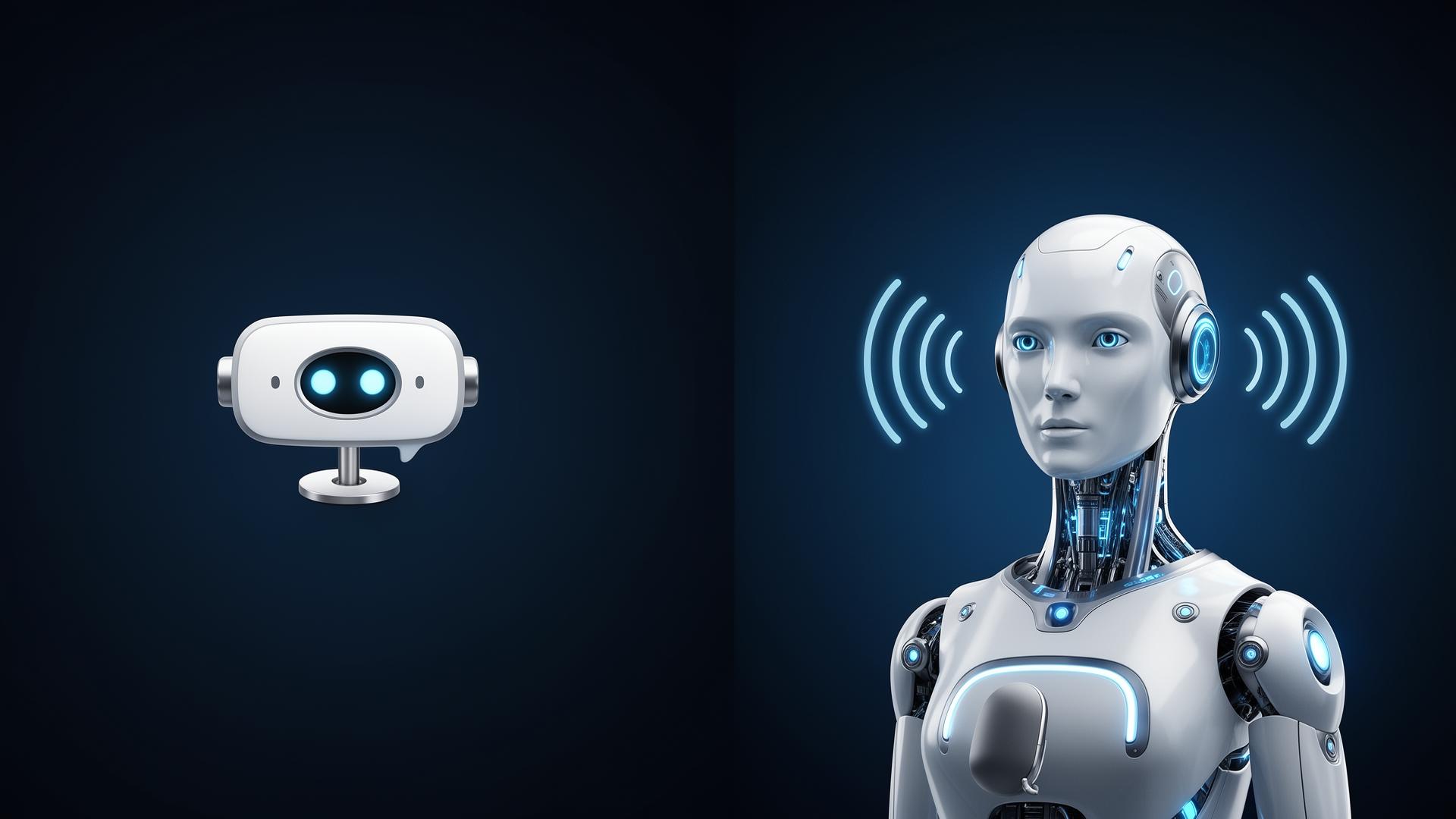
If you search online for “Chatbot vs. Conversational AI”, you’ll often find the terms used interchangeably. For many businesses, they still feel like the same thing: a box that talks to customers.
But in 2026, this distinction is no longer semantic; it’s strategic.
The difference between a chatbot and true conversational AI can determine whether your customer experience feels like a dead-end form or a human-like interaction that actually gets things done. And as voice, autonomy, and AI agents redefine how customers engage with brands, choosing the wrong approach can quietly cap your growth.
Let’s break it down clearly.
What Is a Chatbot?
A chatbot is the earliest and simplest form of automated conversation.
At its core, a chatbot is:
- Rule-based or script-driven
- Designed to answer predefined questions
- Limited to static decision trees
- Reactive, not proactive
Chatbots typically work by matching keywords or button selections to predefined responses. If the conversation goes outside those boundaries, the experience quickly breaks.
A Simple Example
A customer asks:
“What are your support hours?”
The chatbot replies:
“Our support hours are 9 AM to 6 PM, Monday to Friday.”
But when the customer follows up with:
“Can you reschedule my delivery for tomorrow morning?”
The chatbot responds:
“Sorry, I didn’t understand that. Please choose from the menu.”
That’s the ceiling of a chatbot.
Where Chatbots Still Make Sense
- FAQs and static information
- Low-risk internal tools
- Short-lived campaigns
- Very high-volume, low-complexity use cases
They’re inexpensive, fast to deploy, and easy to control, but fundamentally limited.
What Is Conversational AI?
Conversational AI represents the next evolution.
It combines:
- Natural Language Understanding (NLU)
- Large Language Models (LLMs)
- Contextual memory
- Reasoning and decision-making
- Integration with business systems (CRM, ERP, payments, scheduling)
Unlike chatbots, conversational AI systems understand intent, not just keywords. They can manage multi-turn conversations, adapt tone and structure, and complete tasks instead of deflecting them.
A Conversational AI Example
A customer says:
“I need to change my delivery because I won’t be home tomorrow.”
The conversational AI:
- Understands the intent (reschedule delivery)
- Identifies the user from context or voice
- Checks delivery availability
- Offers alternatives
- Confirms and executes the change
All in one natural interaction, no menus, no scripts.
This is not just a conversation. This is execution.
Chatbot vs. Conversational AI: Key Differences
Intelligence vs. Instructions
- Chatbots follow instructions
- Conversational AI applies intelligence
A chatbot waits for the “right” input. Conversational AI figures out what the user means, even if they phrase it imperfectly.
Static Flows vs. Dynamic Conversations
Chatbots operate inside rigid flows.
Conversational AI:
- Handles interruptions
- Understands follow-up questions
- Maintains long-term context
- Adapts responses in real time
This is critical in voice interactions, where conversations are naturally non-linear.
Answers vs. Outcomes
Chatbots are optimized for answers.
Conversational AI is optimized for outcomes:
- Booking appointments
- Processing refunds
- Updating records
- Closing sales
- Resolving issues end-to-end
That difference directly impacts ROI.
English-Only vs. Real-World Language
Most traditional chatbots struggle with:
- Accents
- Dialects
- Code-mixing (e.g., Hinglish)
Modern conversational AI systems are trained on diverse linguistic data and can fluidly switch between languages mid-conversation, essential for markets like India, Southeast Asia, and LATAM.
Cost Center vs. Growth Engine
Chatbots reduce ticket volume.
Conversational AI:
- Increases conversion
- Improves retention
- Reduces handle time
- Enables 24/7 revenue operations
That’s why businesses are moving from “support automation” to AI-powered frontline teams.
Why the Difference Matters More in 2026
In 2026, customers no longer compare you to your competitor; they compare you to their best digital experience.
Voice assistants, AI agents, and multimodal interfaces have reshaped expectations:
- Conversations must feel human
- Tasks must be completed instantly
- Context must persist across channels
A chatbot that says “Please contact support” feels broken in this world.
Conversational AI feels normal.
Chatbot vs. Conversational AI in Voice-First Experiences
The limitations of chatbots become even more obvious in voice.
Voice is:
- Real-time
- High-trust
- Emotion-rich
- Unforgiving to delays or confusion
A voice chatbot that pauses, repeats itself, or fails to understand intent erodes trust immediately.
Conversational AI voice agents:
- Respond in under a second
- Detect emotion and urgency
- Adjust tone and pace dynamically
- Escalate only when truly necessary
That’s why the future of customer interaction is voice + conversational AI, not voice + chatbots.
Where Ello Fits In
Ello is built on conversational AI, not chatbot logic.
Our voice agents are designed to:
- Reason and take action (Agentic AI)
- Handle complex, multi-step workflows
- Switch languages and dialects naturally
- Maintain deep conversational memory
- Integrate securely with enterprise systems
This allows businesses to move beyond automation theater and deploy AI agents that actually work like digital employees.
In short: Ello doesn’t just talk to your customers. It gets things done.
Which One Should Your Business Choose?
Ask yourself one question:
Do you want to answer questions or drive conversations that lead to outcomes?
If your goal is to:
- Reduce tickets → a chatbot may suffice
- Improve CX, revenue, and scale → conversational AI is essential
In 2026, the gap between the two will only widen.
Final Thoughts
The debate around Chatbot vs. Conversational AI isn’t about technology labels; it’s about business maturity.
Chatbots were the first step.
Conversational AI is the future.
As AI agents become more autonomous, multilingual, and emotionally aware, businesses that cling to chatbot-era tools will feel increasingly outdated.
The real question is no longer “Do we need AI?”
It’s “Are we deploying the right kind of AI to lead our market?”
FAQ: Chatbot vs. Conversational AI
Q1: Is conversational AI more expensive than chatbots?
Initially, yes, but the ROI is significantly higher because conversational AI resolves more interactions end-to-end and reduces human escalation.
Q2: Can conversational AI replace chatbots entirely?
In most customer-facing use cases, yes. Chatbots may still exist for simple internal or informational tasks.
Q3: Is conversational AI harder to control?
No, modern platforms use guardrails, domain-specific models, and enterprise governance to ensure accuracy and compliance.
Q4: Does conversational AI work for voice and chat?
Yes. The same intelligence layer can power voice calls, chat widgets, WhatsApp, and other channels seamlessly.
Leave a Reply