Every customer conversation is an opportunity to build trust, resolve an issue, or close a sale. As businesses handle increasing call volumes across sales, support, and operations, many are moving beyond traditional IVR systems toward AI-powered voice interactions.
The challenge is no longer whether to adopt voice AI, but choosing the right AI voice agent platform that fits your business needs. With numerous solutions available, selecting a platform requires looking beyond feature lists to evaluate how well it supports real-world customer conversations and long-term business growth.
Why AI Voice Agents Are Becoming a Business Priority
Enterprise investments in conversational AI continue to grow as organizations seek faster, more personalized customer interactions. According to research, the global conversational AI market is projected to reach USD 49.80 billion by 2031, driven by increasing demand for intelligent customer engagement and automation.
Businesses are adopting Voice AI not only to improve efficiency but also to deliver consistent customer experiences across every interaction. As expectations for 24/7 availability and instant responses continue to rise, an AI voice agent platform is becoming a critical part of modern customer engagement strategies.
What Is an AI Voice Agent Platform?
An AI voice agent platform enables businesses to automate voice conversations using conversational AI, speech recognition, and natural language understanding. Rather than relying on predefined call flows, these platforms understand customer intent, respond naturally, and take action by connecting to enterprise systems.
Organizations use an AI voice agent platform to support:
- Customer support
- Lead qualification
- Appointment scheduling
- Payment reminders
- Order status updates
- Outbound customer engagement
The ability to manage conversations while integrating with existing workflows makes these platforms valuable across industries.
Key Factors to Consider Before Choosing a Platform
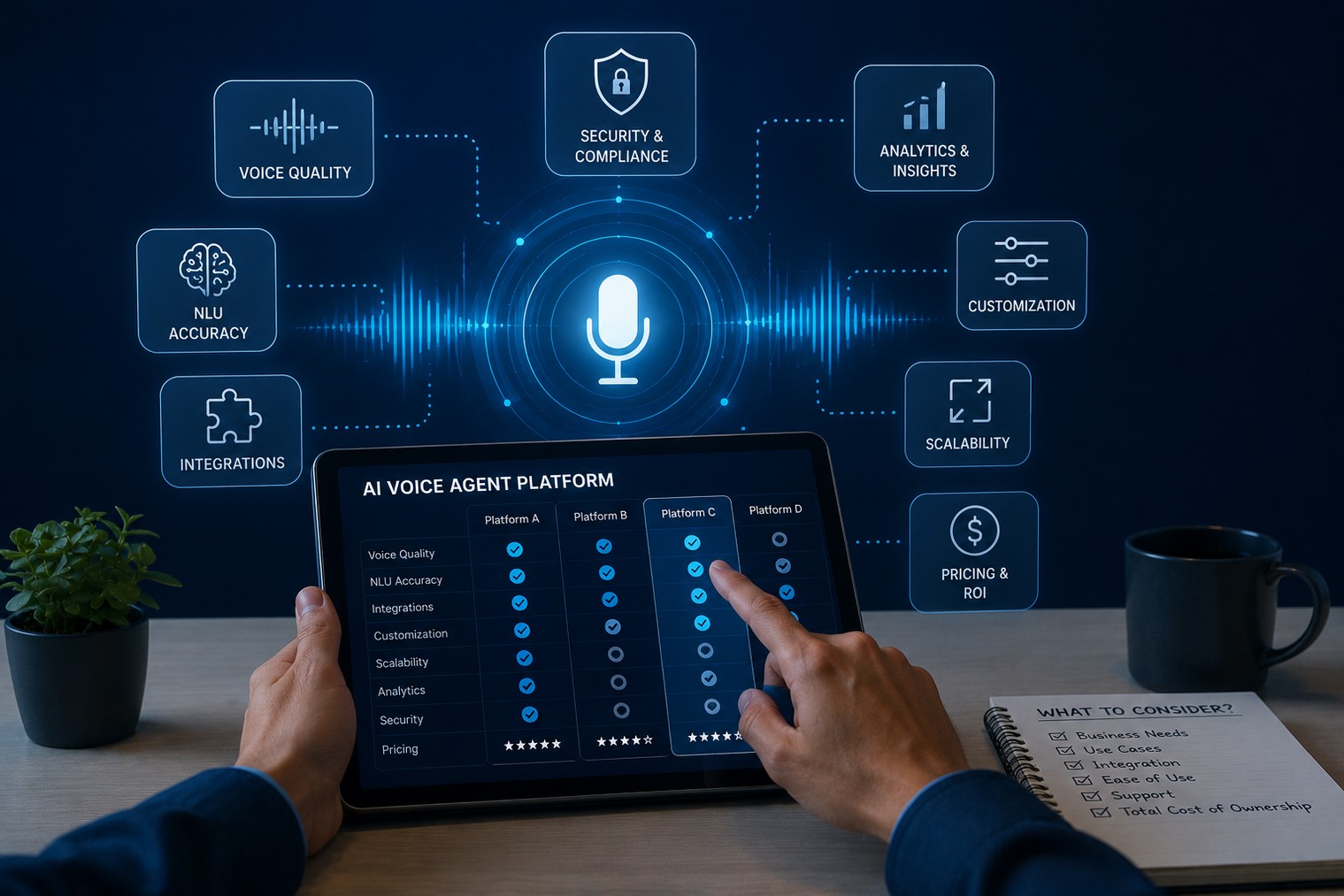
Choosing the right AI voice agent platform starts with understanding your operational requirements, not by comparing feature checklists.
Natural Conversations
Customers expect conversations that sound human and adapt to different situations. A strong conversational AI voice agent platform should understand intent, manage interruptions, and maintain context throughout the interaction.
Enterprise Integrations
Your platform should connect easily with CRM systems, contact center software, scheduling tools, and business applications. Without seamless integrations, automation cannot extend beyond the conversation itself.
Multilingual Capabilities
For businesses serving diverse customer groups, multilingual support is essential. The best AI voice agent platforms should support multiple languages and regional accents while maintaining conversation quality.
Scalability
As your business grows, your AI voice agent platform should handle increasing call volumes without compromising performance or customer experience.
Security and Compliance
Customer conversations often involve sensitive information. Choosing a platform with enterprise-grade security, compliance controls, and data privacy measures is critical.
Should You Build or Buy?
Many organizations evaluating voice AI face another important decision: should they build AI voice agents internally or adopt an existing platform?
Building a solution offers greater customization but often requires significant investment in AI models, infrastructure, integrations, maintenance, and ongoing optimization.
An enterprise-ready AI phone agent platform enables businesses to deploy more quickly, reduce development effort, and focus on delivering customer value rather than managing complex AI infrastructure.
The right choice depends on available resources, implementation timelines, and long-term business objectives.
Choosing a Platform That Grows With Your Business
The best AI voice agent platform should continue delivering value as customer expectations and business needs evolve.
Platforms such as Ello combine conversational intelligence, multilingual support, enterprise integrations, and workflow automation to help organizations manage customer interactions at scale. From inbound support and appointment scheduling to outbound engagement and lead qualification, businesses can automate routine conversations while maintaining a natural customer experience.
Beyond today’s requirements, organizations should evaluate whether a platform can support future automation initiatives, new communication channels, and expanding customer engagement strategies.
Conclusion
Choosing the right AI voice agent platform is about finding a solution that fits both your current operations and your long-term growth plans.
By focusing on conversation quality, scalability, enterprise integrations, security, and automation capabilities, businesses can confidently invest in a platform that improves customer engagement and operational efficiency.
As voice AI adoption continues to accelerate, organizations that select a flexible, enterprise-ready platform today will be better positioned to deliver smarter, faster, and more personalized customer experiences.
FAQs
Q1. What is an AI voice agent platform?
An AI voice agent platform enables businesses to automate voice conversations using conversational AI, speech recognition, and natural language understanding, delivering more natural customer interactions.
Q2. What should businesses look for in an AI voice agent platform?
Key considerations include conversation quality, multilingual support, enterprise integrations, scalability, security, analytics, and ease of deployment.
Q3. Should businesses build AI voice agents or use an existing platform?
Organizations with extensive technical resources may choose to build AI voice agents, while many businesses prefer enterprise-ready platforms to accelerate deployment and reduce maintenance complexity.
Q4. What is an AI phone agent platform?
An AI phone agent platform automates inbound and outbound phone conversations, enabling businesses to handle customer support, scheduling, reminders, and lead qualification through AI-powered voice interactions.
Q5. Which industries benefit most from AI voice agent platforms?
Healthcare, banking, insurance, retail, logistics, telecommunications, and customer service organizations commonly use AI voice agent platforms to improve operational efficiency and customer engagement.