
Tag: outbound calling

  • AI Voice Agents for Loan Collections and EMI Reminders in Indian BFSI

    AI Voice Agents for Loan Collections and EMI Reminders in Indian BFSI

    Missing an EMI doesn’t always mean a borrower is unwilling to pay. More often than not, it’s a missed reminder, a busy schedule, or a payment that slipped through the cracks.

    For banks, NBFCs, and digital lenders, these missed payments create a different challenge. As loan portfolios grow, so does the effort required to remind borrowers, follow up on overdue accounts, and maintain consistent communication. Manual collection calls become difficult to scale, while delayed outreach can affect recovery rates and customer relationships.

    This is why financial institutions are adopting an AI voice agent for BFSI India to automate EMI reminders and early-stage collections. By engaging borrowers through timely, natural voice conversations, lenders can improve operational efficiency while creating a more seamless repayment experience.

    Financial institutions are rethinking how they manage borrower communication as lending portfolios continue to grow. According to Gartner, nearly 80% of organizations plan to expand frontline agents responsibilities as AI automates routine interactions, highlighting how enterprises are using AI to handle repetitive customer interactions while allowing teams to focus on higher-value ones.

    Collections Start Before a Payment Is Missed

    Loan collections often begin long before an account becomes overdue.

    A reminder a few days before an EMI due date, a confirmation call on the payment day, or a follow-up after a missed installment can significantly improve repayment outcomes. These conversations are repetitive, but they remain essential for maintaining borrower engagement.

    An AI voice agent for BFSI India helps lenders automate these interactions without compromising consistency or personalization. Borrowers receive timely reminders, can confirm payment commitments, ask basic loan-related questions, or request assistance through natural conversations instead of one-way notifications.

    This allows collection teams to focus their efforts where human expertise creates the greatest value.

    Supporting Every Stage of the Borrower Journey

    Borrower communication changes as the repayment cycle progresses. Voice AI can support each stage with context-aware conversations.

    Before the EMI due date

    Automated reminder calls help borrowers stay informed about upcoming payments, reducing the likelihood of missed installments.

    On the due date

    Voice AI can confirm payment intentions, answer common questions, and guide borrowers toward available payment options.

    After a missed payment

    The conversation shifts from reminders to follow-ups. Borrowers can explain delays, commit to a repayment date, or request to speak with a collection representative if additional support is required.

    By adapting conversations to each stage, an AI voice agent for BFSI India helps financial institutions maintain consistent communication throughout the loan lifecycle.
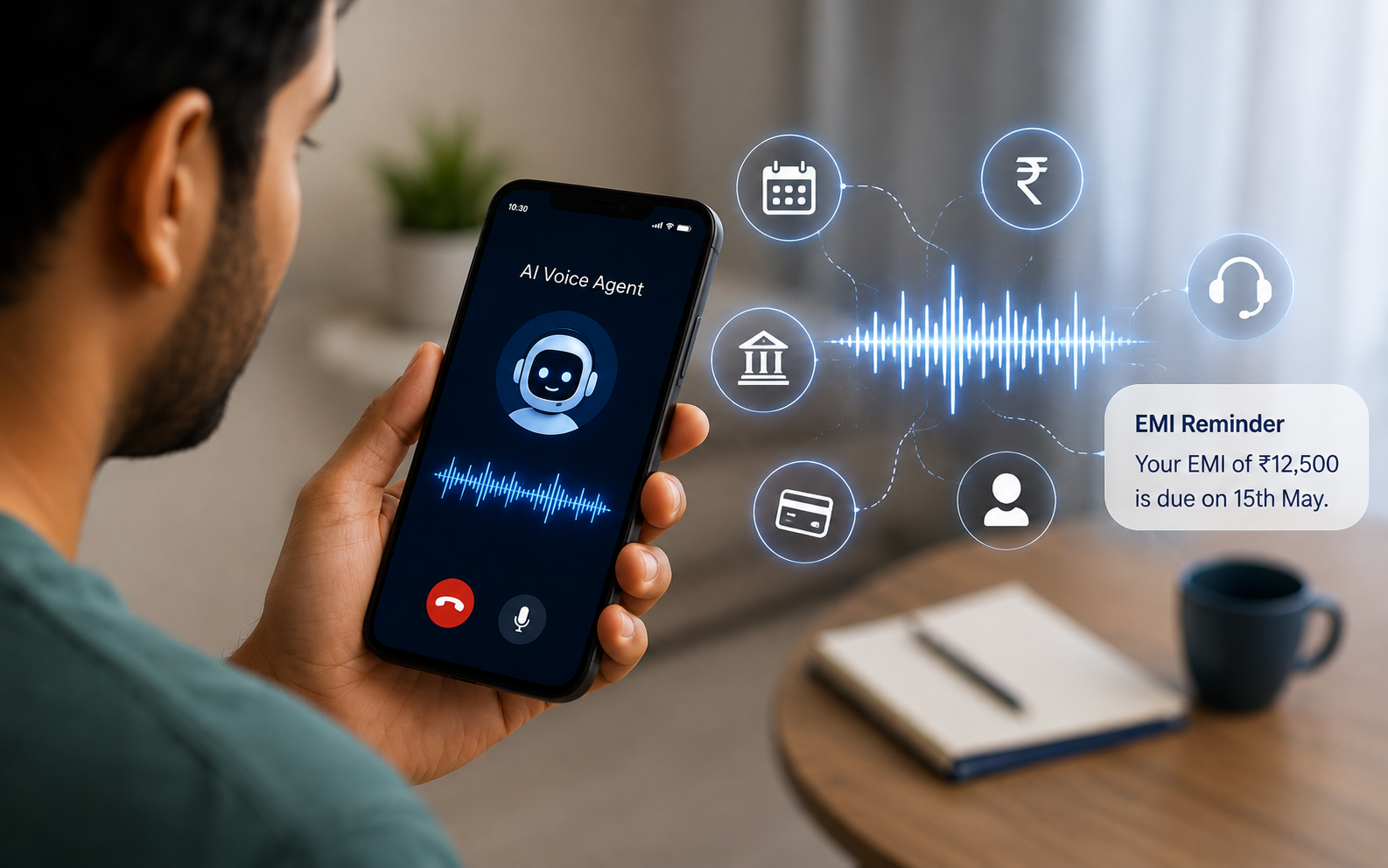
    A person holding a smartphone displaying an AI Voice Agent interface with an EMI reminder notification

    Where Voice AI Delivers the Greatest Value

    The impact of Voice AI extends beyond reducing outbound calling volumes. Routine borrower interactions can be handled automatically, allowing collection teams to spend more time resolving complex repayment cases. Support teams gain better visibility into borrower responses, while managers receive consistent records of every interaction.

    Voice AI also enables lenders to:

    • Deliver EMI reminders at scale
    • Automate payment follow-ups
    • Handle high outbound call volumes
    • Maintain multilingual borrower communication
    • Escalate sensitive conversations to collection teams
    • Improve operational efficiency without proportionally increasing staffing

    These improvements help create a more structured and proactive collections process.

    Built for the Indian BFSI Landscape

    Customer communication in India presents unique operational challenges.

    Borrowers often prefer conversations in regional languages and may switch between languages during the same interaction. Financial institutions also need to integrate customer communication with loan management systems, CRMs, payment platforms, and compliance processes.

    An effective AI voice agent for BFSI India should support multilingual conversations, understand natural speech, maintain detailed interaction records, and integrate seamlessly with existing enterprise systems. These capabilities help lenders deliver consistent borrower experiences while supporting operational and regulatory requirements.

    Choosing the Right AI Voice Platform for Loan Collections

    Automating collection calls is only one part of the solution. Financial institutions should evaluate whether a platform can support the broader lending workflow.

    Key considerations include:

    • Multilingual voice conversations
    • Integration with loan management and CRM platforms
    • Personalized borrower interactions
    • Secure authentication and compliance
    • Workflow automation for collections
    • Real-time analytics and reporting
    • Seamless escalation to collection teams

    Platforms that combine these capabilities enable lenders to modernize borrower engagement while maintaining operational control.

    How Ello Supports Loan Collections and EMI Reminders

    Ello helps banks, NBFCs, and lending organizations automate borrower communication with enterprise-grade Voice AI.

    Its AI voice agents can deliver proactive EMI reminders, manage payment follow-ups, answer routine borrower inquiries, and route complex collection conversations to the appropriate teams with full interaction context. By integrating with enterprise systems and supporting multilingual conversations, Ello enables financial institutions to improve outreach, reduce manual effort, and maintain a consistent borrower experience throughout the repayment lifecycle.

    Conclusion

    Successful loan collections depend as much on timely communication as on repayment strategies.

    An AI voice agent for BFSI India helps financial institutions consistently engage borrowers, automate routine collection activities, and free collection teams to focus on complex customer interactions. As India’s lending ecosystem continues to grow, Voice AI is becoming an essential capability for improving operational efficiency while creating a better borrower experience.

    FAQs

    Q1. What is an AI voice agent for BFSI India?

    An AI voice agent for BFSI India is a conversational Voice AI solution that automates borrower interactions, including EMI reminders, payment follow-ups, loan servicing inquiries, and early-stage collections, for banks, NBFCs, and other lending institutions.

    Q2. How can AI voice agents improve loan collections?

    Voice AI automates routine borrower communication, delivers timely reminders, captures payment commitments, and escalates complex cases to collection teams when human intervention is needed.

    Q3. Can AI voice agents support multiple Indian languages?

    Yes. Modern Voice AI platforms support multilingual conversations, enabling lenders to engage borrowers in their preferred language while maintaining a natural conversational experience.

    Q4. Why are AI voice agents important for Indian BFSI?

    Growing loan portfolios, higher customer expectations, and increasing outbound communication requirements make automation essential. AI voice agents help financial institutions scale borrower engagement while improving operational efficiency.

    Q5. What should lenders consider when selecting a Voice AI platform?

    Key factors include multilingual capabilities, enterprise integrations, workflow automation, compliance, analytics, secure authentication, and support for the complete borrower communication lifecycle.

  • AI Calling Agent vs. AI Voice Agent: Which Does Your Enterprise Need?

    AI Calling Agent vs. AI Voice Agent: Which Does Your Enterprise Need?

    Customer conversations are no longer limited to human agents and traditional IVR systems. Today, enterprises are increasingly adopting AI-powered voice technologies to automate customer interactions, improve responsiveness, and scale operations without adding headcount.

    But as organizations evaluate these solutions, one question often arises: Should you invest in an AI calling agent or a broader AI voice agent?

    While the terms are often used interchangeably, they serve different business needs. Understanding the distinction can help enterprises choose the right solution and maximize ROI.

    Why Enterprises Are Investing in Voice AI

    The demand for voice-driven automation continues to accelerate. The global call center AI market is expected to grow to approximately $7 billion by 2030, reflecting the increasing adoption of AI across customer engagement operations.

    This trend extends to the broader conversational AI market, projected to reach USD 49.80 billion by 2031. As customer expectations for instant, personalized interactions rise, enterprises are increasingly adopting intelligent voice technologies to automate conversations and improve operational efficiency.

    What Is an AI Calling Agent?

    An AI calling agent is designed specifically to make, receive, and manage phone-based conversations at scale. Its primary focus is telephony-driven interactions such as:

    • Lead qualification
    • Appointment scheduling
    • Payment reminders
    • Customer follow-ups
    • Surveys and feedback collection
    • Customer support calls

    An AI calling agent can engage customers in natural conversations, understand intent, and take predefined actions while integrating with CRM, ERP, and business systems.

    For organizations managing high call volumes, an AI calling agent provides a direct way to automate repetitive conversations while maintaining a personalized customer experience.

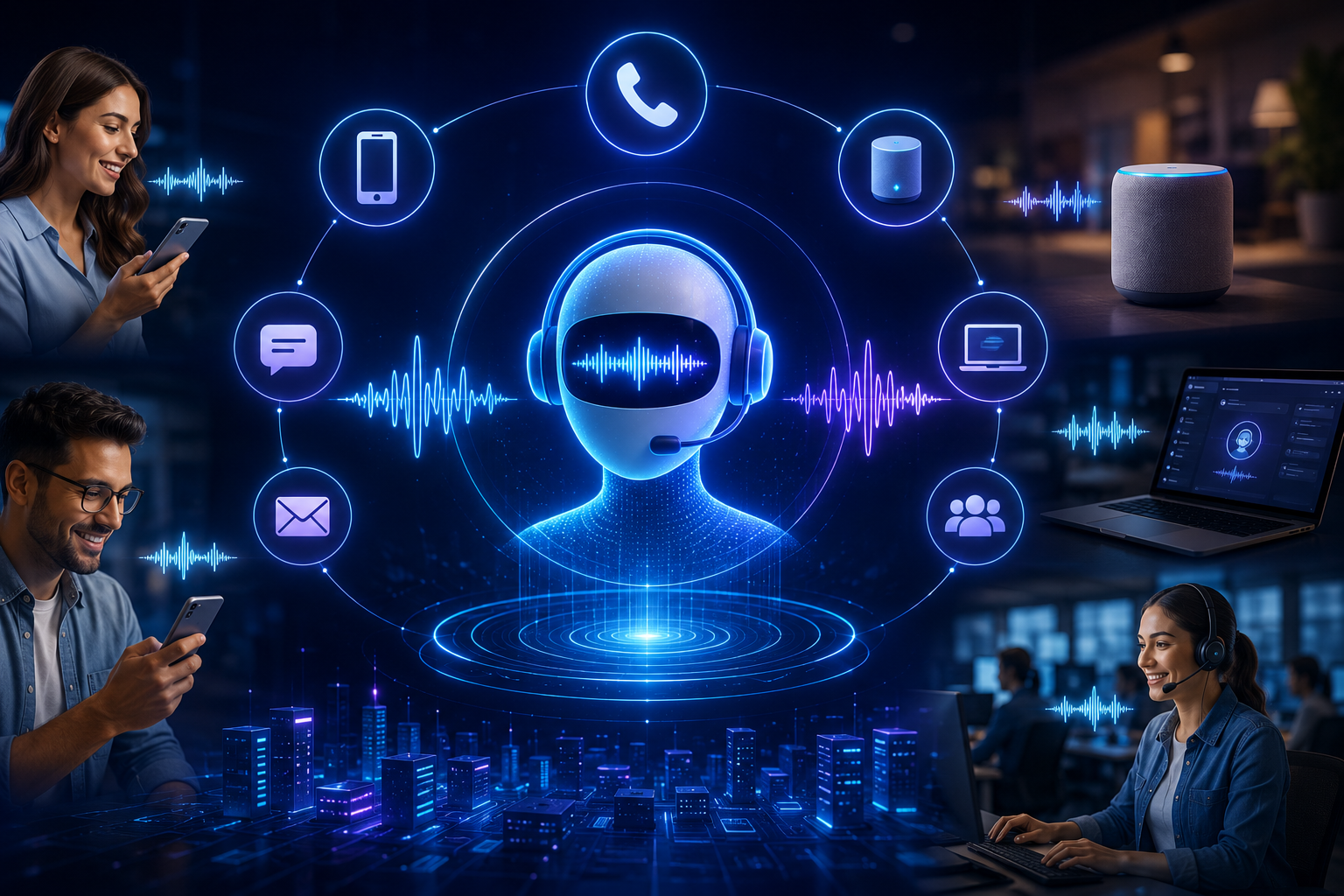
    AI voice agent connecting phone, smartphone, smart speaker, laptop and email channels

    What Is an AI Voice Agent?

    An AI voice agent is a broader category of conversational AI that interacts through voice across multiple channels and touchpoints.

    Unlike an AI calling agent, which is focused primarily on phone conversations, AI voice agents can operate across:

    • Contact centers
    • Mobile applications
    • Smart devices
    • Internal enterprise systems
    • Customer self-service platforms

    Modern voice AI agents combine speech recognition, natural language understanding, and workflow automation to support more complex conversational experiences.

    Think of an AI calling agent as a specialized solution for managing phone interactions, while an AI voice agent can serve as a wider conversational layer across your organization.

    AI Calling Agent vs. AI Voice Agent: Key Differences

    Feature AI Calling Agent AI Voice Agent
    Primary Purpose Phone-based conversations Multi-channel voice interactions
    Deployment Focus Inbound and outbound calls Enterprise-wide voice experiences
    Best For Sales, collections, reminders, support Customer service, employee assistance, self-service
    Complexity Task-oriented workflows Broader conversational capabilities
    Channels Telephone networks Phone, apps, devices, and digital platforms

    If your primary objective is automating customer calls, an AI calling agent often delivers faster implementation and measurable business outcomes.


    However, if you want voice interactions integrated across multiple customer and employee touchpoints, a broader AI voice-agent strategy may be a better fit.

    When Does an Enterprise Need an AI Calling Agent?

    An AI calling agent is typically the right choice when your organization relies heavily on structured phone conversations.

    Common use cases include:

    • High-Volume Outbound Campaigns — Businesses running outreach programs can use AI outbound calling agents to contact thousands of customers simultaneously for promotions, renewals, collections, or follow-ups.
    • Appointment and Service Scheduling — Healthcare providers, service organizations, and financial institutions often use an AI voice-calling agent to automate scheduling and reduce manual workload.
    • Customer Support Automation — An AI calling agent can resolve routine inquiries, route customers intelligently, and reduce call center congestion.
    • Payment and Collections — Banks, lenders, and utility providers use an AI calling agent to handle payment reminders and collection workflows while maintaining compliance and consistency.

    When Does an Enterprise Need an AI Voice Agent?

    Organizations pursuing broader digital transformation initiatives often benefit more from AI-powered voice automation.

    These solutions are ideal when businesses need:

    • Omnichannel customer experiences
    • Internal employee assistance
    • Voice-enabled self-service
    • Enterprise workflow automation
    • Personalized conversations across multiple platforms

    In such scenarios, voice AI agents become part of a larger automation ecosystem rather than serving only telephony use cases.

    Making the Right Choice

    The decision ultimately comes down to business objectives.

    Choose an AI calling agent if your priority is to automate inbound or outbound phone conversations, improve call efficiency, and reduce operational costs.

    Choose an AI voice agent if your organization requires voice-enabled experiences across multiple channels and enterprise systems.

    For many enterprises, the journey starts with an AI calling agent because it addresses immediate operational challenges while delivering measurable value quickly. As requirements evolve, businesses can expand into broader AI voice agent capabilities.

    Conclusion

    The choice between an AI calling agent and an AI voice agent depends on how and where your business needs to engage customers.

    If your focus is call automation, customer outreach, appointment scheduling, or support operations, an AI calling agent provides a targeted and scalable solution. If you’re building a larger conversational AI ecosystem, AI voice agents offer broader enterprise-wide capabilities.

    The key is to start with the problem you’re solving and choose the technology that delivers the greatest business impact.

    FAQs

    Q1. What is an AI calling agent?

    An AI calling agent is an AI-powered system that automates phone conversations, handling inbound and outbound calls for tasks such as customer support, lead qualification, appointment scheduling, and follow-ups.

    Q2. How is an AI calling agent different from an AI voice agent?

    An AI calling agent focuses specifically on telephone-based interactions, while AI voice agents support voice conversations across multiple channels, devices, and enterprise applications.

    Q3. What industries benefit most from AI calling agents?

    Healthcare, banking, insurance, retail, logistics, telecommunications, and service-based businesses commonly use AI calling agents to automate customer communication.

    Q4. Can AI outbound calling agents handle large-scale campaigns?

    Yes. AI outbound calling agents can simultaneously manage thousands of calls, making them ideal for outreach campaigns, reminders, collections, and customer engagement initiatives.

    Q5. Is voice automation suitable for enterprise customer support?

    Absolutely. Voice automation helps reduce wait times, improve response consistency, enable 24/7 customer support, and lower operational costs.