
Tag: NLP

  • How Voice-Based Conversational AI is Redefining Customer Support in India

    How Voice-Based Conversational AI is Redefining Customer Support in India

    India has always been a nation of voices. From the bustling chai stalls of Chandni Chowk to the digital-first startup corridors, conversations drive commerce.

    It was inevitable, then, that artificial intelligence would eventually learn to listen and respond in every accent, dialect, and regional tongue that defines this vast subcontinent.

    Today, voice-based conversational AI is rapidly becoming the bridge between technology and accessibility in India. With millions of users more comfortable speaking than typing, especially in regional languages, voice interfaces are helping businesses reach customers who were previously underserved by digital platforms.

    The Indian Customer Support Problem

    Before understanding the solution, it is essential to appreciate the scale and complexity of the problem. India’s customer support landscape is one of the most demanding in the world. With a population of 1.4 billion spanning rural villages and metropolitan megacities, companies must serve customers across wildly different literacy levels, digital comfort zones, and linguistic preferences.

    Traditional customer support in India relied on massive call centres, and for good reason. Many Indian consumers, particularly those in semi-urban and rural areas, trust voice-based interaction far more than text-based alternatives. They find typing in English cumbersome and typing in regional scripts even harder on smartphones. Speaking, however, feels natural and immediate.

    But human-led call centres come with enormous operational costs, high attrition rates, and an inability to scale during sudden demand spikes, think festivals, IPL seasons, or government scheme launches that trigger millions of simultaneous queries. The industry needed a smarter solution, and voice-based conversational AI arrived at precisely the right moment.

    What is Voice-based Conversational AI?

    Voice-based conversational AI refers to technology that enables machines to understand spoken natural language, process it intelligently, and reply in a way that feels human. Unlike the robotic IVR systems of the early 2000s that frustrated callers into pressing “0” desperately to reach a human agent, today’s voice AI can hold nuanced, context-aware dialogues.

    And in India, where over 19,500 languages and dialects coexist, this technology is not merely a convenience, it is rapidly becoming a necessity.

    Why Voice-Based Conversational AI Fits India Perfectly?

    The Oral Communication Preference

    India has deep oral traditions. Storytelling, instructions, transactions, much of everyday life, especially outside metros, still flow through verbal exchange. When WhatsApp voice notes overtook typed messages in rural India long before they did in Western markets, it signalled something important: Indian users prefer speaking. Voice-based conversational AI aligns perfectly with this cultural reality, meeting users where they naturally are.

    Low Literacy Barriers Are Dissolved

    According to census estimates, India has hundreds of millions of citizens with limited literacy or low digital literacy. For these users, text-based chatbots are essentially inaccessible. Voice-based conversational AI dramatically lowers the barrier to accessing services, whether it is checking a bank balance, filing a complaint about a car service, or inquiring about an insurance plan. The technology democratises access in ways no text interface ever could.

    The Multilingual Imperative

    Perhaps nowhere else in the world does language diversity present as acute a challenge as it does in India. A telecom company serving customers across Gujarat, Tamil Nadu, West Bengal, and Punjab is essentially serving four entirely different linguistic communities. Modern voice-based conversational AI platforms are being trained on massive multilingual datasets to handle not just formal language but colloquial mixing, “Hinglish” (Hindi-English blend), “Tanglish” (Tamil-English blend), and dozens of other combinations that are simply how Indians speak in practice.
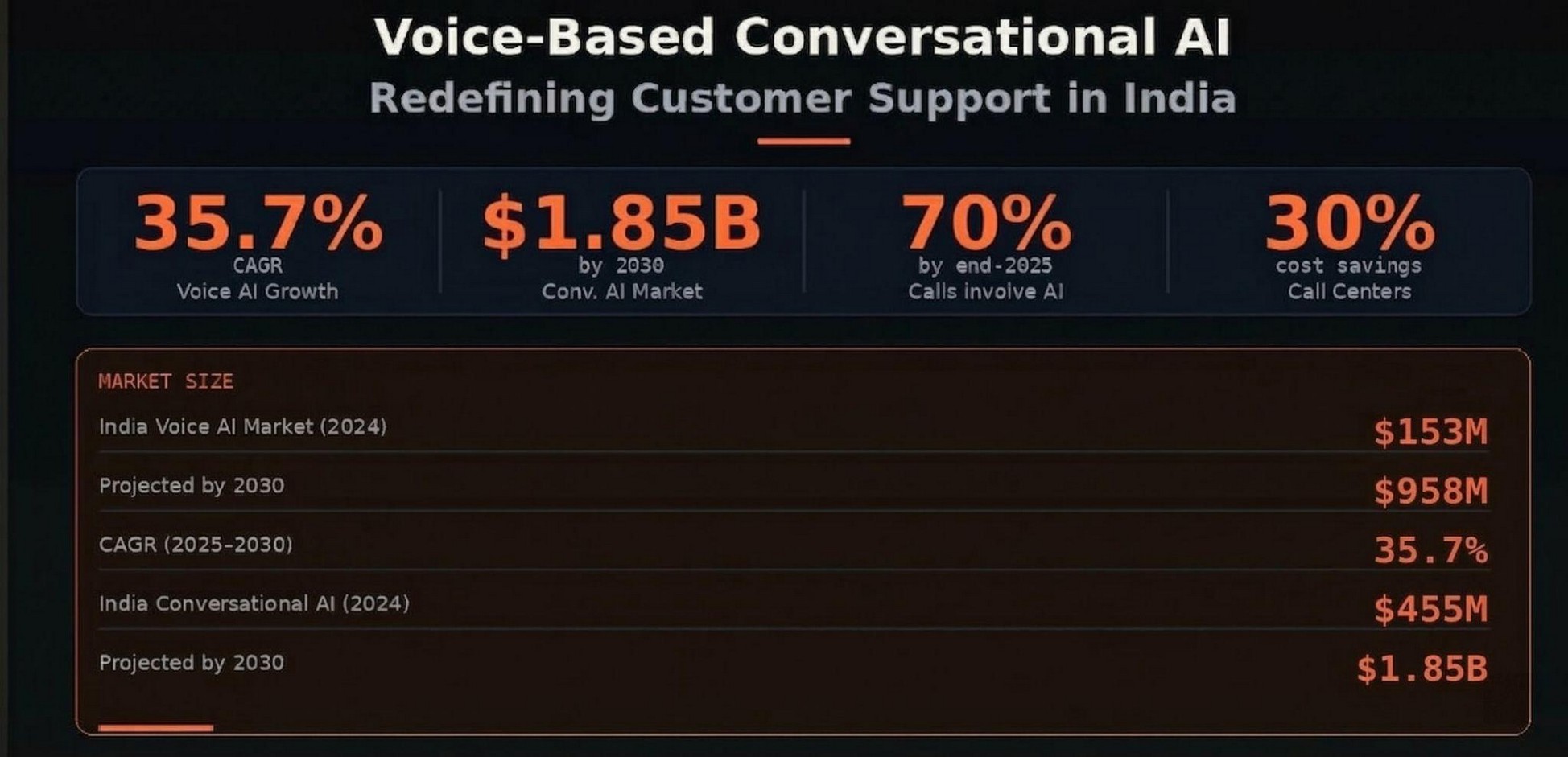
    Voice-Based Conversational AI Redefining Customer Support in India

    Sectors Leading the Voice AI Revolution in India

    Banking, Financial Services, and Insurance (BFSI)

    The BFSI sector has become one of the most aggressive adopters of voice-based conversational AI in India.

    Large public and private sector banks are deploying voice AI agents capable of handling account queries, loan status checks, fraud alerts, and even preliminary loan eligibility assessments.

    For a first-time bank account holder in a small town in Jharkhand with little familiarity with app navigation, simply saying “mera balance batao” (tell me my balance) in Hindi and receiving an instant, accurate response is transformative.

    Insurance companies use voice AI to help customers file claims in local languages. This reduces drop-off rates and dependence on human agents for routine tasks.

    As a result, the key benefits are faster claim resolutions, lower operational costs, and customers who feel acknowledged and supported.

    Telecom

    India’s telecom giants handle hundreds of millions of support calls each year. Voice-based conversational AI is now autonomously managing a growing share of queries, including recharge requests, plan comparisons, SIM requests, and complaints, without human intervention. Key takeaway: Voice AI enables telecoms to scale support and improve customer self-service.

    Ecommerce and Quick Commerce

    As ecommerce expands in Tier 2, 3, and 4 cities, supporting customers in their preferred language around the clock is essential. Voice-based AI enables personalized, instant resolution without navigating complex interfaces. For many first-time online shoppers, a voice-first approach reduces anxiety and builds trust.

    Telemarketing

    Telemarketing in India has long relied on thousands of agents making scripted calls, hoping for conversions. Voice-based conversational AI is changing this model. Companies deploy AI-powered outbound voice agents that initiate contextual, personalized conversations at scale, without the fatigue or inconsistency of human teams.

    Beyond outbound selling, voice AI transforms inbound telemarketing, handling product enquiries, eligibility checks, and upselling with a naturalness that keeps prospects engaged. In sectors such as mutual funds, credit cards, insurance, and real estate, where a well-timed conversation can convert a customer, AI-assisted telemarketing is becoming a competitive advantage.

    The Human-AI Partnership Model

    Contrary to fears of mass replacement, the most successful deployments of voice-based conversational AI in India operate on a human-AI collaboration model.

    The Human-AI Partnership in Customer Support

    The AI handles high volumes of routine, repetitive queries autonomously, freeing human agents to focus on complex, emotionally sensitive, or high-value interactions that genuinely benefit from human empathy and judgment.

    Key takeaway: The human-AI partnership increases both operational efficiency and agent job satisfaction.

    When a customer’s voice signals rising frustration or the query involves a sensitive personal situation, such as a bereavement affecting an insurance claim, or a disputed transaction causing financial distress, a well-designed voice AI system recognises the emotional cues and seamlessly transfers the interaction to a human agent, preserving full context.

    This orchestration of AI efficiency and human warmth is where Indian customer support is heading.

    The result is better outcomes across multiple dimensions: faster resolution for most customers, more meaningful work for human agents, lower operational costs for businesses, and a customer support experience that actually feels respectful of the customer’s time and dignity.

    Conclusion

    Voice-based conversational AI is transforming customer support in India, redefining who can access services, in which language, at what hour, and at what cost. For a country that values spoken dialogue, AI that truly listens feels like technology aligning with the people’s needs.

    For businesses in India, the challenge is to deploy voice-based conversational AI quickly and thoughtfully. For millions who struggled due to language barriers or unfamiliar digital interfaces, voice AI offers the promise of being heard.

    How Ello Powers Customer Support?

    Adaptive Prompt Technology: Our agents don’t just follow a script; they rewrite their own playbook in real-time to optimize outcomes, embodying the true spirit of Agentic AI.

    Multi-Agent Networks: Ello utilizes specialized sub-agents to audit and improve conversations at machine speed, ensuring accuracy and continuous learning.

    Low-Latency Infrastructure: We understand that in a voice-first world, speed is trust. Our infrastructure is built for sub-second responses, ensuring conversations feel natural and human.

    Enterprise-Grade Security: With SOC 2 and HIPAA compliance, Ello provides the governance and safety required for the next generation of AI deployment.

    True Multilingual & Dialect Mastery: In a linguistically diverse market like India, businesses traditionally had to hire separate support teams for regional languages. With Ello, you don’t need that. Our agents can switch naturally between languages mid-conversation (e.g., from Hindi to English) just as a native speaker.

    This massive consolidation significantly reduces hiring effort and operational costs, allowing a single AI workforce to serve the entire country.

    FAQs

    1. What is voice-based conversational AI?

    Voice-based conversational AI enables users to interact with systems via spoken language. It uses speech recognition and natural language processing to understand and respond to customer queries.

    2. Why is voice AI important for customer support in India?

    India has diverse languages, and many users prefer speaking over typing. Voice AI helps businesses serve customers in their preferred language and improves accessibility.

    3. How does voice AI improve customer service efficiency?

    Voice AI automates routine queries, gives instant responses, and works 24/7. This reduces wait times and allows human agents to handle complex issues.

    4. Can voice-based AI understand regional languages in India?

    Yes. Modern voice AI systems are trained on multiple Indian languages and dialects, enabling natural interactions across regions.

    5. Which industries benefit the most from voice-based AI in India?

    Banking, healthcare, telecom, e-commerce, and travel benefit most. These industries manage high volumes of customer queries that voice AI can automate.


  • Ello: The Voice AI for Customer Support of the Future

    Ello: The Voice AI for Customer Support of the Future

    Talking of enterprise operations, scalability has always been limited by the “human bottleneck.” As call volumes spike and customer expectations for 24/7 service become non-negotiable, traditional call centers are hitting a breaking point.

    Voice AI for customer support is no longer a futuristic “nice-to-have”, it is the primary driver of operational resilience in 2026. With the ability to handle thousands of concurrent queries with zero latency and at a fraction of the cost of traditional systems, AI voice agents for customer support are redefining the bottom line.

    It’s time to move past the era of “automated responses” and embrace a future where voice agents execute complex tasks, resolve issues in seconds, and free your human talent for the work that truly requires a heartbeat.

    Let’s take an in-depth look at why voice AI for customer support is positioned as the future of service operations, the measurable impact it delivers, and real-world applications.

    What is Voice AI?

    Voice AI, or Voice Artificial Intelligence, refers to intelligent systems that understand, interpret, and respond to human speech using natural language processing (NLP), machine learning, and speech recognition technologies.

    Unlike traditional automated voice menus or IVR (Interactive Voice Response), modern voice AI can carry out conversations, detect user intent, and even recognize emotional cues.

    When we talk about voice AI for customer support, we mean using voice-enabled AI to handle customer queries, resolve issues, or guide users through conversational interactions that feel natural and human.

    Today, businesses increasingly rely on AI voice agents for customer support to manage large call volumes, automate routine conversations, and deliver faster responses without increasing operational costs.

    How Voice AI Works in Customer Support

    Voice AI in customer support usually uses three main technologies to function effectively:

    Automatic Speech Recognition (ASR)

    ASR converts a customer’s spoken words into text as they are spoken. This allows the voice AI system to understand exactly what the user is saying.

    Modern ASR technology is also the backbone of top AI voice transcription for customer support, enabling businesses to generate precise transcripts for analytics, compliance, and training.

    Natural Language Understanding (NLU)

    NLU helps the system understand the meaning and purpose behind what a customer is saying. It enables the AI to accurately grasp the customer’s request, even when the language is informal or conversational.

    This capability powers a highly responsive AI voice agent for customer support, enabling it to interpret context, intent, and conversational nuance.

    Text-to-Speech (TTS)

    After the AI has understood the customer’s intent, TTS transforms its response back into spoken words that sound natural and close to what a human would say.

    Together, these technologies enable voice AI to have smooth and intelligent conversations, making it a great choice for customer support that values both efficiency and a personal touch.

    Why Voice AI Is the Future of Customer Support?

    The reasons Voice AI is poised to become the future of customer support are multifaceted. From elevated customer experience to business scalability, Voice AI offers advantages that traditional support systems cannot match.

    Why Voice AI Is the Future of Customer Support

    24/7 Availability

    One of the most significant limitations of human-only support is availability. Customers expect answers immediately, regardless of time zones or business hours.

    Voice AI systems operate around the clock, ensuring customers can access support anytime. With AI voice agents for customer support, businesses can deliver instant assistance even during peak demand or outside working hours.

    This continuous availability significantly improves customer satisfaction and trust.

    Scale Without Additional Costs

    Traditionally, scaling customer support requires hiring more agents, increasing infrastructure costs, and managing growing queues. Voice AI eliminates this dependency.

    Whether a business receives 100 or 10,000 calls a day, Voice AI systems can scale automatically without requiring a proportional increase in staffing or resources. It’s this cost-efficient scalability that positions Voice AI as the future of support operations.

    Faster Resolution Times

    Customers don’t want to be kept waiting, nor do they want to repeat themselves to multiple agents. Voice AI can process queries quickly and provide instant or near-instant answers.

    As AI models learn from interactions, the system continuously improves. Over time, AI voice agents for customer support become more capable of handling complex conversations, further reducing resolution times.

    Personalized Conversations at Scale

    Voice AI systems can access customer history, preferences, and account context in real time. This means they can deliver personalized support experiences to new customers as well.

    Voice AI doesn’t just provide scripted responses; it adapts its answers to the customer’s context, creating a personalized experience that traditional automated systems cannot match.

    Reduced Human Error and Consistency

    Human agents are valuable, but they are also prone to fatigue, miscommunication, or inconsistency. Voice AI adheres to the highest standards of accuracy, delivering consistent responses every time.

    Furthermore, voice AI stays up to date with product changes, policy updates, and new service offerings, ensuring customers always receive the latest information.

    Better Data, Better Insights

    Every interaction with Voice AI generates valuable data. Businesses can analyze trends, customer pain points, language patterns, and feedback to optimize products and services.

    Traditional call center data is often unstructured and difficult to interpret. With voice AI for customer support, insights become structured, searchable, and actionable, accelerating business intelligence and decision-making.

    Multilingual Support Without Extra Staff

    Global companies often face language barriers in customer support. Hiring multilingual agents can be expensive and limited in reach.

    Voice AI systems can communicate in multiple languages, dialects, and accents. This allows businesses to expand globally without operational complexity.

    For global brands, AI voice agents for customer support make multilingual service both efficient and cost-effective.

    Real-World Applications of Voice AI in Customer Support

    Voice AI agents are already transforming customer support across industries. Here are some powerful, real-world use cases:

    eCommerce and Retail

    Voice AI handles order tracking, shipping status, return requests, and product recommendations, offering a conversational experience that mimics speaking with a support agent.

    Banking and Financial Services

    In financial support, Voice AI authenticates users, answers balance inquiries, assists with payments, and supports fraud detection, all while maintaining security and compliance.

    Healthcare

    Healthcare providers leverage voice AI to offer appointment scheduling, basic symptom checks, prescription refill reminders, and patient follow-ups, thereby improving patient engagement while reducing staffing burden.

    Telecommunications

    Voice AI resolves network issues, handles bill inquiries, handles plan changes, and resolves service outages, enhancing the customer experience while reducing call center load.

    Travel and Hospitality

    From flight updates to hotel booking queries, Voice AI supports customers at every step of their journey, making travel navigation smoother and more efficient.

    Best AI Voice Agents for Customer Support 2026

    As voice AI adoption accelerates, several platforms are emerging as leaders in the space. Businesses looking to implement intelligent support solutions often evaluate the best AI voice agents for customer support in 2026 based on scalability, conversational accuracy, and integration capabilities.

    Among the leading companies in voice AI customer support, platforms like Ello are gaining strong recognition for their ability to automate complex conversations while maintaining a natural, human-like experience.

    Ello’s voice AI agents are designed to manage inbound and outbound calls, qualify leads, handle support queries, and integrate seamlessly with existing CRM and business systems. By combining conversational intelligence with automation, Ello enables organizations to transform customer support into a scalable and efficient operation.

    The Future: AI and Humans as a “Unified Team”

    The narrative that AI will replace humans is shifting toward one of augmentation. In 2026, we see the rise of the “Super Agent.”When a Voice AI encounters a situation it cannot handle, perhaps a distraught customer or a highly technical legal query, it doesn’t just “drop” the call. It performs a “warm handoff” to a human agent.

    AI and Humans as a Unified Team

    The human receives a real-time transcript and a summary of what has already happened, allowing them to step in with full context. This collaboration ensures that the customer experience remains seamless while empowering human workers to do what they do best: connect emotionally.

    Conclusion

    Voice AI for customer support is more than an upgrade to automated support, it’s a paradigm shift. It improves response times, delivers personalized experiences, and empowers businesses to scale with intelligence.

    As consumers seek faster, smarter, and more conversational support, voice AI will become an essential differentiator for brands. Organizations that adopt solutions from leading companies for voice AI customer support, such as Ello, will gain a competitive edge by delivering faster, smarter, and more efficient customer experiences. Organizations that adopt solutions from leading companies for voice AI customer support, such as Ello, will gain a competitive edge by delivering faster, smarter, and more efficient customer experiences.

    The future of customer support isn’t human-only or robot-only; it’s intelligent, conversational, and powered by voice AI agents.

    How Ello Powers Customer Support?

    Adaptive Prompt Technology

    Our agents don’t just follow a script; they rewrite their own playbook in real-time to optimize outcomes, embodying the true spirit of Agentic AI.

    Multi-Agent Networks

    Ello utilizes specialized sub-agents to audit and improve conversations at machine speed, ensuring accuracy and continuous learning.

    Low-Latency Infrastructure

    We understand that in a voice-first world, speed is trust. Our infrastructure is built for sub-second responses, ensuring conversations feel natural and human.

    Enterprise-Grade Security

    With SOC 2 and HIPAA compliance, Ello provides the governance and safety required for the next generation of AI deployment.

    True Multilingual & Dialect Mastery

    In a linguistically diverse market like India, businesses traditionally had to hire separate support teams for regional languages. With Ello, you don’t need that. Our agents can switch naturally between languages mid-conversation (e.g., from Hindi to English) just as a native speaker.

    This massive consolidation significantly reduces hiring effort and operational costs, allowing a single AI workforce to serve the entire country.

    FAQs

    1. What is Voice AI for Customer Support?

    Voice AI for customer support is an AI-powered system that understands and responds to customer queries via natural-language conversations. It uses speech recognition and natural language processing to deliver real-time assistance.

    2. How is Voice AI different from traditional IVR systems?

    Unlike traditional IVR, which relies on fixed menus and keypad inputs, Unlike traditional IVR, which relies on fixed menus and keypad inputs, voice AI agents understand natural speech and context. It enables dynamic, human-like conversations instead of scripted responses.

    3. Can Voice AI handle complex customer queries?

    Yes, modern voice AI agents can handle multi-step, context-aware conversations. For highly complex issues, they can seamlessly transfer the call to a human agent with full context.

    4. Can Voice AI provide multilingual support?

    Yes, Voice AI systems can support multiple languages and accents. This makes it easier for businesses to serve global customers without expanding large multilingual teams.

    5. How does Voice AI improve customer satisfaction?

    Voice AI reduces wait times, provides instant responses, and delivers consistent service. Faster resolution and personalization significantly enhance the customer experience.

  • Conversational AI in Indian Banking: Driving Smarter, Secure Conversations

    Conversational AI in Indian Banking: Driving Smarter, Secure Conversations

    The Indian banking sector is witnessing a tectonic shift- the emergence of conversational AI in banking and fintech. For decades, the industry relied on physical branches and rigid Interactive Voice Response (IVR) systems, “Press 1 for Banking, Press 2 for Loans” loops that frustrated millions.

    Today, driven by the UPI revolution and the expansion of internet access, India has become a digital-first economy.

    Among the most transformative innovations is conversational AI in banking, enabling financial institutions to interact with customers in a natural, human-like voice.

    Conversational AI blends NLP, ML, speech recognition, and Generative AI to create intelligent voice assistants that understand context, intent, and emotion.

    In India, where linguistic diversity, financial inclusion, and high service volumes create unique challenges, Conversational AI is not just enhancing customer experience but redefining how banks operate, scale, and secure their services.

    What is Conversational AI?

    Conversational AI is a type of artificial intelligence that enables machines to interact with humans through natural, human-like conversations via voice. It allows users to speak in everyday language, and the system understands, processes, and responds intelligently in real time.

    Unlike traditional chatbots, it understands intent, context, tone, and language variations, making it central to the broader conversational AI in banking topic, especially as financial services evolve toward intelligent automation.

    The Rise of Conversational Banking in India

    India’s banking ecosystem serves over a billion customers across urban metros, semi-urban towns, and rural regions. Traditional customer service models, such as branch visits, IVRs, and call centers, struggle to scale at this magnitude. This is where conversational AI in banking services bridges the gap by enabling:

    • 24/7 customer assistance
    • Instant query resolution
    • Multilingual communication
    • Automated financial guidance

    Banks are deploying AI assistants across websites, mobile apps, WhatsApp, IVR systems, and smart kiosks to efficiently manage high customer volumes.

    Why Conversational AI Matters in Indian Banking

    Why Conversational AI Matters in Indian Banking

    Massive Customer Volumes

    Public and private banks in India handle millions of interactions daily, from balance checks to loan inquiries. AI assistants scale effortlessly without increasing operational costs.

    Linguistic Diversity

    India has 30+ major languages and hundreds of dialects. Multilingual conversational systems bridge language barriers and improve accessibility for non-English speakers.

    Digital Adoption Boom

    UPI, mobile wallets, and digital lending platforms have created demand for real-time support, strengthening the role of conversational AI in banking and fintech ecosystems.

    Cost & Efficiency Pressures

    Banks must reduce operational expenses while improving service quality, an area where automation excels.

    Conversational AI Use Cases in Banking

    Early chatbots were glorified FAQ engines. Today’s systems are transactional, advisory, and autonomous.

    Below are some high-impact conversational AI use cases in banking, transforming Indian financial institutions:

    Hyper-Personalized Advisory

    Banks are sitting on goldmines of data, but often fail to use them in real time. Advanced AI agents now act as personal financial bankers for the masses. If a customer’s savings account balance exceeds a certain threshold, the AI can proactively nudge them via a voice note or WhatsApp conversation: “You have ₹50,000 sitting idle. Would you like to move ₹20,000 to a flexible FD earning 7% interest?” This shifts banking from reactive (problem-solving) to proactive (wealth creation).

    The Vernacular Advantage

    India speaks in dialects, not just languages. We “code-switch”, mixing Hindi and English (Hinglish) or Tamil and English effortlessly. Standard NLP models trained on Western datasets fail here. Indian banks are deploying purpose-built Large Language Models (LLMs) trained on Indian linguistic nuances.

    • Example: A user might say, “Account block karna hai, please help.” A rigid system might miss this mix. Modern Conversational AI in banking detects urgency and intent (“block account”) regardless of mixed language and executes the protocol immediately.

    Agentic AI: Doing, Not Just Talking

    The future is “Agentic AI.” While a chatbot talks, an agent does.

    • Chatbot: “Here is the link to update your KYC.”
    • Agentic AI: “I can update your KYC right now. Please look at the camera for a quick video verification.” By integrating with KYC APIs and core banking systems, these agents reduce friction, lowering drop-off rates for critical processes like loan applications and onboarding.

    Smart Debt Recovery and Collection

    Debt collection in India has traditionally been a high-friction, manual process prone to compliance risks. Conversational AI in banking is humanizing and automating this sensitive touchpoint.

    • Empathetic Reminders: Instead of aggressive calls, voice AI agents send gentle, conversational reminders via WhatsApp in the customer’s preferred language.
    • Negotiation & Restructuring: Advanced agents can “negotiate” based on pre-set bank parameters. If a customer says, “I can’t pay the full EMI this month due to a medical emergency,” the AI can instantly offer a split payment option or a grace period, maintaining the relationship while securing the bank’s assets.

    Instant Fraud Mitigation & “Card-on-Command”

    In a country where digital payment fraud (like UPI phishing) is a constant threat, speed is the only effective defense. Conversational AI in banking acts as a 24/7 digital bodyguard.

    • Real-time Verification: If a high-value transaction occurs at an unusual time, the AI sends a push notification: “Did you just spend ₹45,000 at an electronics store in Mumbai?” The user can tap ‘No’ to instantly kill the transaction and block the card.
    • Zero-Wait Hotlisting: Traditionally, blocking a lost card involved navigating a complex IVR menu. Now, a user can type “Mera card kho gaya hai, block karo” (I lost my card, block it) to secure their account in just a few seconds.

    Small Business (MSME) Banking Assistant

    India’s 63 million MSMEs often lack dedicated accounting teams. Banks are now using Conversational AI to turn the banking app into a “Virtual CFO” for small business owners.

    • Automated GST & Invoice Tracking: A shopkeeper can ask the voice AI agent, “Last month kitna GST pay kiya?” or “Show me pending invoices from Supplier X.” The AI fetches this from integrated GST portals and the bank’s transaction history.
    • Working Capital Alerts: The AI can predict cash flow crunches. It might nudge the owner: “Your balance will be low by the 5th due to rent and salaries. Would you like to activate a pre-approved overdraft of ₹2 Lakhs?”

    Conversational AI in Indian Banking

    Conclusion

    Conversational AI in banking is no longer a futuristic concept, it is a present-day competitive necessity.

    As customer expectations shift toward instant, personalized, and conversational experiences, banks must evolve beyond traditional service models.

    From voice assistants to autonomous AI agents, conversational technologies are transforming how banks engage, serve, and secure their customers.

    They reduce costs, improve efficiency, strengthen fraud prevention, and expand financial inclusion across India’s diverse population.

    However, success depends on responsible deployment balancing innovation with privacy, compliance, and ethical AI governance.

    How Ello Powers Smarter Indian Banking Conversations

    While many platforms are playing catch-up, Ello was architected with these 2026 trends as foundational pillars.

    Adaptive Prompt Technology

    Our agents don’t just follow a script; they rewrite their own playbook in real-time to optimize outcomes, embodying the true spirit of Agentic AI.

    Multi-Agent Networks

    Ello utilizes specialized sub-agents to audit and improve conversations at machine speed, ensuring accuracy and continuous learning.

    Low-Latency Infrastructure

    We understand that in a voice-first world, speed is trust. Our infrastructure is built for sub-second responses, ensuring conversations feel natural and human.

    Enterprise-Grade Security

    With SOC 2 and HIPAA compliance, Ello provides the governance and safety required for the next generation of AI deployment.

    True Multilingual & Dialect Mastery

    In a linguistically diverse market like India, businesses traditionally had to hire separate support teams for regional languages. With Ello, you don’t need that. Our agents can switch naturally between languages mid-conversation (e.g., from Hindi to English) just as a native speaker.

    This massive consolidation significantly reduces hiring effort and operational costs, allowing a single AI workforce to serve the entire country.

    FAQs

    How can banks in India use Conversational AI?

    Banks can use it for balance inquiries, fund transfers, loan applications, EMI reminders, fraud alerts, and customer support. It also assists in onboarding, KYC processes, and personalized product recommendations.

    Can Conversational AI support regional languages in India?

    Modern AI platforms support multiple Indian languages like Hindi, Telugu, Tamil, and Bengali. This helps banks serve rural and non-English-speaking customers more effectively.

    How does Conversational AI in banking improve customer experience?

    It offers instant, 24/7 responses without wait times. Customers get faster resolutions, personalized assistance, and seamless omnichannel support.

    What is the future of Conversational AI in Indian banking?

    The future includes voice-first banking, autonomous AI agents, hyper-personalization, and deeper fraud prevention. It will play a key role in financial inclusion and digital banking growth.

  • Conversational AI for Sales: Turning Conversations into Conversions

    Conversational AI for Sales: Turning Conversations into Conversions

    Sales has always been about conversations. From face-to-face meetings and phone calls to emails and live chat, meaningful dialogue sits at the heart of every deal closed. But the way buyers want to engage with businesses has changed dramatically.

    Today’s prospects expect instant responses, personalized recommendations, and seamless experiences across channels, whether they’re browsing a website at midnight or comparing vendors during work hours.

    Unfortunately, traditional sales models struggle to meet these expectations at scale. Missed chats, delayed follow-ups, and manual qualification often lead to lost opportunities.

    This is where conversational AI for sales is redefining modern selling.

    By combining artificial intelligence, natural language processing (NLP), and automation, conversational AI enables businesses to engage, qualify, nurture, and convert prospects through intelligent, human-like conversations 24/7.

    It ensures that no lead is ignored, no question goes unanswered, and every interaction moves buyers closer to conversion.

    In this blog, we’ll explore how conversational AI transforms sales conversations into measurable revenue outcomes.

    What is Conversational AI for Sales?

    Conversational AI for Sales refers to technologies such as virtual assistants, intelligent chatbots, and voice AI agents that use Natural Language Processing (NLP) and Machine Learning (ML) to engage prospects in real time. Unlike traditional rule-based bots that rely on “if/then” logic and rigid decision trees, Conversational AI is dynamic. It uses three critical pillars:

    1. Natural Language Understanding (NLU): To decipher what the user actually means, even if they use slang or have a typo.
    2. Dialogue Management: To maintain the context of a conversation over multiple exchanges.
    3. Natural Language Generation (NLG): To formulate responses that feel empathetic, professional, and human.

    In a sales context, this technology acts as a 24/7 digital concierge. It identifies who a visitor is, understands their pain points, and guides them to the next step in the buyer’s journey, whether that’s a product recommendation, a white paper, or a booked meeting with a human account executive.

    When implemented strategically, conversational AI for sales and marketing aligns both teams around one goal, turning engagement into revenue.

    Conversational AI Sales Bot

    Why Sales Teams Need Conversational AI

    The modern sales landscape is plagued by two major issues: lead decay and administrative burnout.

    The Response Time Gap

    Human sales teams, regardless of how efficient they are, cannot be “on” 24/7. Conversational AI ensures that every “hand-raiser” receives an immediate, intelligent response, effectively eliminating the “black hole” where leads go to die.

    High Volume, Low Value Tasks

    The average sales representative spends only about 33% of their day actually selling. The rest is swallowed by data entry, lead scrubbing, and chasing prospects for a meeting time. Conversational AI takes over the “drudge work,” allowing humans to focus on high-stakes negotiations and relationship building.

    The Expectation of Personalization

    Today’s B2B and B2C buyers expect a personalized experience. They don’t want a generic sales pitch; they want a solution to their specific problem.

    AI can instantly pull data from a CRM (Customer Relationship Management) system to greet a returning visitor by name and reference their previous industry or interests, creating an immediate sense of rapport.

    How Conversational AI Turns Conversations into Conversions

    The magic of Conversational AI lies in its ability to move beyond passive interaction into active conversion optimization. It does this through several sophisticated mechanisms:

    Reducing Friction in the Buyer Journey

    Friction is the enemy of conversion. When a prospect has to fill out a 10-field form to see a demo, they often bounce. Conversational AI replaces these forms with a “choose-your-own-adventure” style dialogue. By asking questions one by one in a natural flow, the AI can gather the same data (and more) without the prospect feeling interrogated.

    Real-Time Intent Detection

    Conversational AI can distinguish between casual visitors and high-intent buyers. By analyzing reply speed, keywords, sentiment, and behavioral signals, voice AI agents can “hot-route” high-value prospects to human agents while they are still engaged. This capability is especially powerful in conversational AI for sales outreach, where timing and intent detection can significantly increase response and conversion rates.

    Overcoming Objections on the Fly

    Many sales are lost because a small doubt wasn’t addressed clearly. An AI trained on your company’s knowledge base can instantly handle common objections, such as “Is this compatible with Salesforce?” or “Do you offer a monthly billing option?”, keeping the sale’s momentum alive when a human isn’t available.

    Key Use Cases of Conversational AI in Sales

    How exactly does this look in practice? Here are the most impactful ways sales teams are deploying AI today:

    • 24/7 Lead Qualification: The voice AI agent engages visitors, asks about their budget, authority, need, and timeline (BANT), and labels them as “Qualified” or “Unqualified” before a human ever touches the record.
    • Automated Meeting Scheduling: Instead of the “When are you free?” email message, the voice AI agents link directly to a sales representative’s calendar and schedule the meeting instantly in the chat window.
    • Intelligent Outreach & Nurturing: Voice AI agent doesn’t just wait for people to come to the site. It can manage multi-channel sequences (Email, SMS, LinkedIn) that respond to prospect replies in real-time to keep the conversation moving.
    • Sales Enablement (Real-Time Coaching): For live calls, “Agent Assist” tools listen to the conversation and display “battle cards” or technical specs on-screen the moment a competitor or specific feature is mentioned.
    • CRM Automation: After a conversation, the voice AI agent automatically summarizes the chat, updates the deal stage, and logs the activity in the CRM, ensuring data integrity without manual effort.

    Benefits of Conversational AI for Sales Teams

    The implementation of Conversational AI isn’t just a “nice-to-have” tech upgrade; it delivers measurable ROI across the organization.

    Benefit Impact on Sales
    Increased Pipeline By capturing leads that would have otherwise bounced, teams see a 20-30% increase in qualified pipeline.
    Higher Win Rates Real-time objection handling and faster response times lead to higher close ratios.
    Reduced CAC Cost-per-Acquisition drops as expensive human labor is reserved for the funnel’s final stages.
    Improved Morale Sales reps are happier (and more productive) when they aren’t doing manual data entry or chasing dead leads.
    Scalability You can handle a 500% spike in web traffic during a product launch without hiring a single extra person.

    Conversational AI Sales Team

    Conversational AI Across the Sales Funnel

    To truly turn conversations into conversions, the AI must be mapped to every stage of the buyer’s journey:

    Top of the Funnel: Instant Lead Qualification

    The moment a prospect interacts with your brand, whether via your website, WhatsApp, or a voice-activated assistant, the clock starts ticking. Research shows that responding within five minutes increases the odds of qualifying a lead by 21 times compared to waiting just 30 minutes.

    Conversational AI acts as a 24/7 digital concierge. It asks the right discovery questions: What is your budget? What is your timeline? What specific problem are you trying to solve?

    By the time a human sales rep enters the picture, they aren’t “cold calling”, they are stepping into a “hot” conversation with a lead whose intent and profile are already verified.

    Middle of the Funnel: Hyper-Personalized Nurturing

    Generic drip campaigns are no longer enough. Conversational AI analyzes CRM data, prior interactions, and behavioral signals to dynamically tailor messaging.

    If a prospect has previously expressed concern about integration costs, the AI can proactively share relevant case studies or ROI calculators that address that exact issue.

    This alignment of sales conversations with marketing data is what makes conversational AI for sales and marketing a powerful revenue engine.

    Bottom of the Funnel: Frictionless Closing

    The “Decision” stage is where most deals stall due to minor friction. AI voice agents and chatbots can now handle:

    • Objection Handling: Instantly pulling data to counter competitive comparisons.
    • Automated Scheduling: Eliminating the “back-and-forth” email chain to find a meeting time.
    • Real-time Assistance: Helping a customer navigate the checkout or contract signing process without leaving the chat interface.

    Best Practices for Implementing Conversational AI for Sales

    Turning conversations into conversions requires more than just “turning on” a bot. It requires a strategy built on data and trust.

    1. Define Your Voice: Your AI shouldn’t just be a tool, it’s an extension of your brand. Does it sound professional and authoritative, or friendly and helpful? Consistency across text and voice is key.
    2. Integrate Your Stack: For AI to be effective, it needs context. It must “live” inside your CRM. If the AI doesn’t know a customer just spent $5,000 with you yesterday, it will fail the conversation today.
    3. The “Human-in-the-Loop” Escalation: Never trap a customer in an “AI loop.” Ensure there is always a clear, fast path to a human for complex negotiations or sensitive issues.
    4. Continuous Training: Treat your AI like a new hire. Review its “transcripts,” identify where it lost a lead, and refine its knowledge base.

    Conclusion

    Conversational AI is no longer a futuristic concept, it is the standard for high-performing sales organizations in 2026.

    By treating every interaction as a meaningful conversation rather than a data-collection exercise, businesses can build trust faster, qualify leads better, and ultimately drive higher revenue.

    The goal isn’t to replace the salesperson, but to supercharge them. When you remove the friction of the “wait” and the boredom of the “form,” you create a space where human relationships can thrive.

    In the end, sales have always been about conversation, voice AI allows those conversations to happen at a scale we never thought possible.

    Why Ello.ai is Built for 2026

    While many platforms are playing catch-up, Ello.ai was architected with these 2026 trends as foundational pillars.

    Adaptive Prompt Technology: Our agents don’t just follow a script; they rewrite their own playbook in real-time to optimize outcomes, embodying the true spirit of Agentic AI.

    Multi-Agent Networks: Ello utilizes specialized sub-agents to audit and improve conversations at machine speed, ensuring accuracy and continuous learning.

    Low-Latency Infrastructure: We understand that in a voice-first world, speed is trust. Our infrastructure is built for sub-second responses, ensuring conversations feel natural and human.

    Enterprise-Grade Security: With SOC 2 and HIPAA compliance, Ello provides the governance and safety required for the next generation of AI deployment.

    True Multilingual & Dialect Mastery: In a linguistically diverse market like India, businesses traditionally had to hire separate support teams for regional languages. With Ello.ai, you don’t need that. Our agents can switch naturally between languages mid-conversation (e.g., from Hindi to English) just as a native speaker.

    This massive consolidation significantly reduces hiring effort and operational costs, allowing a single AI workforce to serve the entire country.

    FAQs

    What is Conversational AI for Sales?

    Conversational AI for Sales refers to AI voice agents that automate and enhance sales conversations. They engage prospects, qualify leads, recommend solutions, and book meetings in real time.

    How does Conversational AI improve sales conversions?

    It engages leads instantly, personalizes interactions, and removes delays in follow-ups or scheduling. This keeps prospects engaged and moves them through the sales funnel faster.

    How does Conversational AI qualify leads automatically?

    It asks discovery questions such as requirements, company size, budget, and purchase timeline. Based on responses and behavior, it scores and routes leads to sales or nurturing workflows.

    Can Conversational AI integrate with CRM systems?

    Yes, it integrates with CRMs to log conversations, update lead data, and trigger follow-ups. This ensures sales teams have complete context before engaging prospects.

    Is Conversational AI available 24/7 for customer interactions?

    Absolutely. It operates round the clock, engaging website visitors and inbound inquiries even outside business hours, ensuring no opportunity is missed.

  • Conversational AI vs. Generative AI: What’s the Difference?

    Conversational AI vs. Generative AI: What’s the Difference?

    The terminology surrounding artificial intelligence has evolved so rapidly that even seasoned tech professionals often find themselves caught in a semantic tangle.

    Two terms, in particular, are frequently used interchangeably despite having distinct architectures and purposes: Conversational AI and Generative AI.

    In 2026, understanding the nuances of Conversational AI vs. Generative AI is no longer just for developers: it is a critical requirement for business leaders looking to deploy effective, secure, and ROI-driven automation. While one focuses on the interface of communication, the other focuses on the creation of content.

    This deep dive will clarify the differences between conversational AI and generative AI, explore how they overlap, and explain why the most powerful modern solutions, like Ello, leverage both to create truly “agentic” workflows.

    What is Conversational AI?

    At its core, Conversational AI is a subset of artificial intelligence dedicated to enabling computers to simulate human-like conversation. It is the “bridge” between human language and machine logic.

    The Mechanics of Conversation

    Conversational AI relies on three primary pillars:

    • Natural Language Processing (NLP): Breaking down human speech into machine-readable data.
    • Natural Language Understanding (NLU): Deciphering the intent behind the words (e.g., understanding that “my card is gone” means the customer needs to report a stolen credit card).
    • Automatic Speech Recognition (ASR): Translating spoken audio into text in real-time.

    The Primary Goal

    The goal of Conversational AI is utility and task completion. It is designed to be a “doer”, taking a user’s request, processing it against a set of rules or data, and providing a specific, helpful outcome.

    Conversational AI Task Flow

    Whether it’s booking a hotel room or checking a bank balance, Conversational AI is about the transaction.

    What is Generative AI?

    Generative AI is a broader category of AI capable of creating new content.

    Unlike traditional AI, which analyzes existing data to make a prediction or classification, Generative AI uses its training to synthesize something that didn’t exist before.

    The Mechanics of Creation

    Generative AI is built on Large Language Models (LLMs) or diffusion models. It uses deep learning to understand patterns, styles, and structures from massive datasets.

    When prompted, it predicts the next most logical sequence (of words, pixels, or notes) to create:

    • Text: Essays, code, poetry, or emails.
    • Images: Photorealistic art or technical diagrams.
    • Audio: Synthetic voices or musical compositions.

    The Primary Goal

    The goal of Generative AI is creation and synthesis. It is designed to be a “creator,” taking a prompt and generating a novel output that mimics human creativity.

    Conversational AI vs. Generative AI: Key Differences

    While the lines are blurring, the fundamental differences can be broken down into five categories:

    Feature Conversational AI Generative AI
    Primary Focus Interaction & Task Execution Content Creation & Synthesis
    Input Type Direct queries or commands Detailed “prompts” or instructions
    Output Type Predicted responses or actions New, original content (Text, Image, etc.)
    Logic Foundation Intent-based (NLU/NLP) Probabilistic-based (LLMs)
    Typical Use Case Customer support, scheduling Writing blogs, generating code, design

    1. Intent vs. Innovation

    When it comes to conversational vs. generative AI, conversational AI is focused on Intent. It asks: “What does the user want me to do?” Generative AI is focused on Innovation. It asks: “How can I create what the user is describing?”

    2. Predictability vs. Variety

    In a business setting, Conversational AI is often preferred for its predictability. You want your banking bot to give the same accurate answer every time someone asks about interest rates. Generative AI, however, is prized for its variety; it can write ten different versions of a marketing email from a single prompt.

    3. Integration with Systems

    Conversational AI is typically deeply integrated with backend systems (CRMs, PMS, ERPs). It needs to “talk” to your database to pull your specific flight details. Generative AI often operates more independently, relying on its vast pre-trained internal knowledge to generate a response.

    The 2026 Shift: The Convergence into “Agentic AI”

    In the past, these were two separate silos. Today, the most sophisticated AI products are Hybrid Systems.

    When you combine the interface of Conversational AI with the intelligence of Generative AI, you get Agentic AI. This is an AI that doesn’t just talk or create; it reasons.

    Example: A customer calls a hotel.

    • Conversational AI hears the voice and understands the intent: “The guest wants to cancel.”
    • Generative AI analyzes the guest’s loyalty status and the current room occupancy. It then generates a personalized, persuasive counter-offer in real-time to encourage the guest to reschedule instead of canceling.

    Why Ello.ai is the Perfect Hybrid

    At Ello.ai, we don’t believe in choosing between Conversational AI vs. Generative AI. Our platform is built on the intersection of both.

    Adaptive Prompting: The Generative Edge

    Most legacy voice bots use rigid scripts. Ello.ai uses adaptive prompting, a Generative AI technique. This allows our voice agents to understand the “vibe” of a conversation. If a customer is frustrated, the AI detects the sentiment and generates a more empathetic tone on the fly. It doesn’t just read a script; it responds to the moment.

    Task-Oriented Reliability: The Conversational Core

    While our agents are powered by generative intelligence, they are grounded by a conversational core that prioritizes accuracy and security.

    • Enterprise Guardrails: We ensure the Generative AI doesn’t “hallucinate” (make things up). Our agents are strictly tethered to your company’s data and policies.
    • Real-Time Execution: Through deep API integrations, Ello doesn’t just talk about solving a problem; it actually executes the task in your system of record.

    FAQ: Conversational AI vs. Generative AI

    Is ChatGPT Conversational or Generative?

    It is both. It uses a Generative AI model (GPT) but is delivered through a Conversational AI interface (a chatbot).

    Which one is better for customer service?

    Given the generative vs. conversational AI debate for 2026 standards, you need a hybrid. Pure Conversational AI feels robotic and limited. Pure Generative AI can be unpredictable or provide inaccurate info. A hybrid like Ello.ai provides the warmth of Generative AI with the reliability of Conversational AI.

    Is Generative AI more expensive to implement?

    Historically, yes, due to high computing costs. However, by using specialized, smaller models for specific industries (like hospitality or banking), Ello.ai makes this technology accessible and cost-effective for enterprise-scale deployment.

    Can Generative AI “hallucinate” during a voice call?

    Without proper guardrails, yes. This is why Ello.ai uses a “Retrieval-Augmented Generation” (RAG) framework. This forces the AI to check your specific business data before speaking, ensuring every word is factual and on-brand.

    Experience the Future of Voice AI

    The debate of Conversational AI vs. Generative AI is over. The future belongs to those who use both. Whether you are looking to automate guest services in a hotel or streamline collections in a bank, your customers deserve an agent that is as smart as it is helpful.

    Ello.ai provides the enterprise-grade reliability you need with the human-like intelligence your customers expect.

    Get a FREE DEMO. Visit https://getello.ai/in

  • Conversational AI for Customer Service: Use Cases and Future Trends

    Conversational AI for Customer Service: Use Cases and Future Trends

    The pace at which customer expectations are evolving is nothing short of relentless. Just a few years ago, customers were satisfied if a chatbot could understand “Where is my order?” Fast forward to 2026, and the landscape has shifted dramatically. Today, customers don’t just want an answer—they want empathy, immediate resolution, and an experience that feels intuitively human, yet digitally efficient.

    As we step into 2026, we are witnessing the transition from “Reactive AI” systems that wait for a prompt to “Agentic AI” systems that think, plan, and act. For businesses, this is no longer just about cost-cutting; it is about survival and differentiation in a saturated market. Whether you are a retail giant or a growing tech firm, the way you deploy conversational AI for customer service will define your brand reputation this year.

    In this blog, we’ll explore what conversational AI for customer service is, the key types and use cases, and the major trends that will define the space in 2026.

    What is Conversational AI?

    Conversational AI is the set of technologies that enables computers to simulate real human conversation. It serves as the bridge between human language and machine logic. Unlike traditional software, where you click buttons or fill out static forms, conversational AI allows you to speak or type in natural, everyday language. It combines several advanced disciplines:

    • Natural Language Processing (NLP): This allows the AI to parse speech and text to understand structure and syntax.
    • Natural Language Understanding (NLU): This goes deeper, helping the machine decipher the intent and meaning behind words (e.g., recognizing that “I’m unhappy with this” is a complaint that requires empathy).
    • Machine Learning (ML): This enables the system to get smarter over time, learning from past interactions to improve future accuracy.

    What is Conversational AI for Customer Service?

    Conversational AI for customer services creates a virtual workforce that never sleeps. It is the application of these technologies specifically to handle customer inquiries, support tickets, and service requests.

    When conversational AI is applied to customer service, it becomes a powerful tool for automating support interactions, streamlining operations, and improving customer satisfaction.

    Historically, customer service relied on scripted chatbots that could only respond to specific, preprogrammed inputs. Today’s conversational AI systems can handle ambiguity, pull information from multiple sources, and provide personalized, relevant responses in real time, making them a core part of customer experience (CX) strategies for organizations of all sizes.

    Types of Conversational AI for Customer Service

    1. Rule-Based Chatbots (The Legacy Model)

    These are the simplest forms, operating on “if/then” logic. They utilize button-based menus and are strictly limited to pre-defined paths. While reliable for simple FAQs, they fail when a customer asks a complex or nuanced question.

    Customer service agents using AI technology

    2. NLP-Powered Virtual Assistants

    These agents use NLU to understand open-ended text. A customer can type “My package is damaged,” and the bot recognizes the intent “Report Damage” regardless of how it was phrased. These are significantly more flexible than rule-based bots.

    3. Voice AI Agents

    Voice is the fastest-growing segment in 2026. These voice AI agents handle phone calls with natural-sounding voices, pause for interruptions, and manage tone. They replace the dreaded “Press 1 for Sales” IVR systems with “How can I help you today?”

    4. Agentic AI (The 2026 Standard)

    The most advanced type, “Agentic AI,” does not just converse; it acts. It has permission to access your internal tools (CRM, ERP, Billing) to actually perform the task, like changing a flight seat or upgrading a subscription, completely autonomously.

    5. Hybrid AI + Human Models

    Some systems automatically assist or augment human agents by offering real-time suggestions, summarizing conversations, or routing complex issues to human specialists at precisely the right time.

    How Conversational AI Improves Customer Service

    Implementing conversational AI for customer service fundamentally changes the mechanics of your support operations.

    • Eliminating Wait Times: The concept of “holding” is obsolete. AI can handle thousands of concurrent inquiries instantly.
    • 24/7 Availability: AI doesn’t sleep. Customers get immediate answers at any hour, reducing frustration and abandoned contact attempts. This is vital for global brands serving customers across time zones.
    • Instant Scalability: During peak seasons (like Black Friday), human teams get overwhelmed. AI scales up instantly to handle traffic spikes without the need for temporary hiring.
    • Removing Language Barriers: Modern AI translates in real time, allowing a local support team to serve a global audience in over 100 languages.
    • Cost and Efficiency Gains: Replacing or augmenting human support with AI can lead to substantial cost savings. Gartner projects that conversational AI could cut contact center labor costs by $80 billion in 2026.

    Key Conversational AI Use Cases and Examples for Customer Service

    To visualize the impact, let’s look at how industries are deploying this technology:

    Retail & E-commerce

    • Order Tracking: “Where is my package?” is instantly answered with real-time map data.
    • Returns: The AI generates a return shipping label and emails it to the customer instantly.

    Banking & Finance

    • Fraud Alerts: Voice AI calls a customer immediately upon detecting suspicious activity to verify the transaction.
    • Balance Checks: Customers can ask, “How much did I spend on groceries last month?” and get an instant breakdown.

    Travel & Hospitality

    • Booking Management: “Change my flight to tomorrow morning” is processed by the agent, who checks availability and reissues the ticket.
    • Concierge Services: Guests can request fresh towels or a late checkout via a smart speaker in their room.

    Healthcare

    • Appointment Scheduling: Patients can book or reschedule visits by talking to a voice agent that syncs directly with the doctor’s calendar.

    1. The Rise of “Agentic” Workflows

    In 2025, we marveled at AI that could write text. In 2026, we demand AI that does work. We are moving from “Informational” bots to “Transactional” agents. These agents are given goals (e.g., “Help the customer return the shoe”) and have the autonomy to navigate the inventory system, process the refund, and update the CRM without human hand-holding.

    2. Hyper-Personalization via “Memory”

    Customers are tired of treating every interaction like a first date. The trend for 2026 is Long-Term Memory. The AI remembers that you called last week about a faulty router and will start the conversation with, “Hi, are you calling about the router issue we discussed last Tuesday?” This level of context builds immense trust and reduces friction.

    3. Multimodal Interactions

    Voice and text are merging with visuals. A customer struggling to assemble a product can now send a photo to the support bot. The AI, equipped with vision capabilities, analyzes the image and says, “It looks like you have that bracket upside down. Try flipping it.” This “Show, Don’t Just Tell” approach is revolutionizing technical support.

    4. Proactive “Invisible” Support

    The best support is the one you didn’t know you needed. AI is becoming predictive. If an airline’s AI detects a flight delay, it proactively calls the passenger to offer alternative booking options before the passenger even arrives at the airport. This shifts the dynamic from “Customer Support” to “Customer Success.”

    5. Verified Identity and Trust

    With the rise of deepfakes, trust is paramount. 2026 sees the adoption of “Verified Brand profiles” on communication channels (such as RCS and WhatsApp) and of voice signatures for authentication. Customers need to know they are speaking with the official AI agent of the brand, ensuring the security of sensitive transactions.

    6. Real-Time Sentiment & Quality Monitoring

    AI is now analyzing not just what customers say, but how they say it in real time. This allows systems to detect frustration or urgency and escalate to human agents when needed, improving service outcomes and preventing negative experiences.

    7. Generative AI for Agent Assist and Knowledge Management

    Conversational AI is becoming deeply integrated with knowledge systems that summarize previous interactions, draft responses for human agents, automatically update help articles, and synthesize insights.

    Conclusion

    The era of simple chatbots is over. 2026 is the year of the intelligent, empathetic, and autonomous agent. Conversational AI for customer services has graduated from a “nice-to-have” feature to a critical infrastructure component.

    By embracing trends such as Agentic workflows, multimodal support, and hyper-personalization, businesses can turn their support centers from cost centers into profit centers. The technology is ready; the question is, are you?

    Why Ello.ai is Built for 2026

    While many platforms are playing catch-up, Ello.ai was architected with these 2026 trends as foundational pillars.

    • Adaptive Prompt Technology: Our agents don’t just follow a script; they rewrite their own playbook in real-time to optimize outcomes, embodying the true spirit of Agentic AI.
    • Multi-Agent Networks: Ello utilizes specialized sub-agents to audit and improve conversations at machine speed, ensuring accuracy and continuous learning.
    • Low-Latency Infrastructure: We understand that in a voice-first world, speed is trust. Our infrastructure is built for sub-second responses, ensuring conversations feel natural and human.
    • Enterprise-Grade Security: With SOC 2 and HIPAA compliance, Ello provides the governance and safety required for the next generation of AI deployment.
    • True Multilingual & Dialect Mastery: In a linguistically diverse market like India, businesses traditionally had to hire separate support teams for regional languages. With Ello.ai, you don’t need that. Our agents can switch naturally between languages mid-conversation (e.g., from Hindi to English) just as a native speaker.

    FAQs

    What’s the difference between a chatbot and conversational AI?

    Traditional chatbots typically follow rigid, rule-based scripts that require users to click specific buttons. Conversational AI uses Natural Language Processing (NLP) to understand context and intent, allowing for fluid, human-like dialogue that isn’t limited to a pre-set path.

    Which industries benefit most from conversational AI?

    Retail, banking, telecom, healthcare, travel, and utilities are among the top adopters, but businesses in virtually any sector can benefit from conversational AI to improve customer service.

    How does the AI handle angry customers?

    Conversational AI is trained to recognize emotional cues such as urgency, repeated complaints, and negative language patterns. When a conversation shows signs of frustration, the AI adjusts its tone, responds with empathy, offers faster solutions, and prioritizes resolution.

    Can conversational AI handle voice and text queries?

    Absolutely. Today’s conversational AI platforms are built to understand and respond to both spoken and written inputs, ensuring consistent, context-aware support across chat, calls, and messaging channels.

  • What is Conversational AI? The Ultimate Guide for 2026

    What is Conversational AI? The Ultimate Guide for 2026

    Imagine calling a customer support line and, instead of the dreaded “Please listen carefully as our menu options have changed,” you are greeted by a warm, instantly recognizing voice that asks, “Hi Alexa, are you calling about the order you placed yesterday?”

    You reply naturally, “Yes, it hasn’t arrived yet. Can you check where it is?”

    The voice pauses for a microsecond. “I see it’s currently out for delivery and should be with you by 4:00 PM today. Would you like me to text you the driver’s tracking link?”

    This isn’t a sci-fi movie; this is Conversational AI in action.

    In the last decade, we have moved from clunky chatbots that broke at the slightest typo to sophisticated “digital agents” capable of nuance, humor, and complex problem-solving. The demand for this technology is exploding. The global conversational AI market in 2025 is estimated at around $14.8 billion, and it’s projected to grow to approximately $61.6 billion by 2032 at a compound annual growth rate (CAGR) exceeding 23%. In fact, 90% of customers now expect an “immediate” response to their service questions, a benchmark that is physically difficult for human teams to meet on their own.

    This blog delves deep into the architecture, evolution, and future of Conversational AI.

    What is Conversational AI

    Conversational AI is a set of technologies that enables computers to simulate real human conversation. It serves as the synthetic brain that bridges the gap between human language (which is messy, emotional, and context-heavy) and machine instructions (which are binary, rigid, and logical).

    Unlike a standard computer program, where you click a button to execute a command, Conversational AI allows you to speak or type in natural language. It’s the difference between navigating a website’s search bar using keywords (“shoes red running”) and asking a shop assistant, “Do you have those red running shoes in a size 10?”

    More Than Just Chatbots

    It is crucial to distinguish between a basic chatbot and true Conversational AI.

    • Rule-Based Chatbots: Think of these as interactive FAQs. They follow a strict decision tree (if user says X, reply with Y). If you deviate from the script, they fail.
    • Conversational AI: This system uses Machine Learning (ML) and Natural Language Processing (NLP) to understand intent. It learns from every interaction, handles interruptions, and manages context (remembering what you said two minutes ago).

    The Anatomy of a Conversation: How It Works

    For a machine to hold a conversation, it must perform a complex “relay race” of data processing in milliseconds. This process is often referred to as the NLP Pipeline. Here is the step-by-step breakdown of what happens when you ask a voice assistant a question:

    NLP Pipeline Diagram

    Automatic Speech Recognition (ASR)

    • The Ear: If you are speaking to an AI (like Siri or Alexa), the first step is converting sound waves into text.
    • The Tech: ASR models filter out background noise (a passing car, a TV) to isolate the user’s voice and transcribe the phonemes into written words.

    Natural Language Understanding (NLU)

    • The Brain (Comprehension): This is the most critical component. Once the AI has the text, it must understand its meaning. NLU breaks down the sentence into two key parts:

    – Intents: What does the user want to do? (e.g., Book a flight, Check balance, Reset password)
    – Entities: What are the specific details? (e.g., London to New York, $500, Account ending in 4321)

    • Sentiment Analysis: Advanced NLU also detects how the user is feeling—angry, confused, or happy—allowing the AI to adjust its tone.

    Dialog Management

    • The Memory: This component decides the best action. It holds the conversation’s “state”.
    • Example: If you say “Book it,” the Dialog Manager knows “it” refers to the flight to London discussed in the previous turn. It determines whether the AI has enough information to proceed or needs to ask a clarifying question.

    Natural Language Generation (NLG)

    • The Voice Writer: Once the AI knows the answer (e.g., “The flight is booked”), NLG constructs a human-like sentence.
    • Evolution: Previously, this was a pre-written script. Today, Generative AI constructs unique, fluid sentences on the fly, making the interaction feel less robotic.

    Text-to-Speech (TTS)

    • The Mouth: Finally, if this is a voice interaction, TTS synthesizes the text back into audio. Modern “Neural TTS” can mimic human breath pauses, pitch changes, and intonation, making the voice nearly indistinguishable from a human.

    The Evolution: From Scripts to “Brains”

    To understand where we are, we must look at the rapid evolution of this technology.

    Generation 1: The Button Era (2010s)

    Early “chatbots” were essentially clickable menus inside a chat window. They offered “Decision Tree” logic.

    • User: “I have a problem.”
    • Bot: “Is it regarding: A) Billing or B) Technical Support?”

    Limitation: Zero flexibility. If you typed a sentence, the bot crashed.

    Generation 2: The Keyword Era (2016-2020)

    The rise of platforms such as Dialogflow and Watson enabled bots to recognize keywords.

    • User: “My bill is wrong.”
    • Bot: I see the word ‘bill’. Here is a link to your billing page.

    Limitation: It often misses context. “I don’t want to pay my bill” might trigger the same response as “I want to pay my bill.”

    Generation 3: The Generative Era (2023-Present)

    The introduction of Large Language Models (LLMs) like GPT-4 and Claude changed everything.

    • Contextual Mastery: These models don’t just look for keywords; they “read” the entire conversation.
    • Reasoning: They can infer missing information.
    • Creativity: They can explain complex topics, summarize documents, and even empathize with a frustrated user.

    Generative AI vs. Conversational AI: What’s the Difference?

    This is a common point of confusion. Conversational AI is the interface—the system is designed to talk to you. Generative AI is the engine—the technology that creates new content. Think of it this way: Conversational AI is the car; Generative AI is the new turbo engine inside it.

    • Traditional Conversational AI focuses on specific tasks: “Book a meeting,” “Show me the weather.”
    • Generative AI focuses on creation and broad knowledge: “Write a poem about the weather,” “Draft an email to my boss.”

    Modern businesses are combining them. They use conversational AI control (to ensure the bot doesn’t say anything offensive) with the fluidity of Generative AI (to make the conversation smooth).

    Conversational AI Key Use Cases and Applications

    Customer Experience & Support

    The market is moving from answering questions to solving problems autonomously.

    • Autonomous Issue Resolution: Instead of just explaining how to process a refund, the AI agent accesses the CRM, validates the claim, processes the refund, and emails the receipt—all via voice or text without human intervention.
    • Proactive Friction Detection: AI analyzes ongoing calls/chats to detect when a user is frustrated (sentiment analysis) and dynamically routes them to a senior retention specialist before they churn.
    • Multilingual Voice Support: Replacing legacy IVR (press 1 for English) with natural, human-like voice agents that understand dialects and switch languages mid-conversation.

    Customer Experience Use Cases

    Sales & Revenue Generation

    • Inbound Lead Qualification: AI Voice Agents handle thousands of concurrent inbound leads, qualifying them by asking budget/authority questions, and then booking meetings directly into the sales team’s calendar.
    • Abandoned Cart Recovery: Instead of a generic email, an AI sends a personalized WhatsApp voice note or text offering a specific incentive based on the items left in the cart.
    • Upselling/Cross-selling: During a support interaction, the AI analyzes purchase history and suggests relevant add-ons (e.g., “I see you bought the camera; we actually have a discount on the lens kit today, would you like me to add that?”).

    Banking & Financial Services

    • Fraud Detection & Identity Verification: Voice AI analyzes voice biometrics in real time to verify identity, eliminating tedious security questions like “What is your mother’s maiden name?”
    • Payment Collections: Empathetic but persistent AI voice agents handle early-stage debt collection calls, which often yield higher success rates because customers feel less judged speaking to a bot than a human.
    • Smart Advisory: “How much did I spend on dining last month?” — The AI queries the transaction database and gives a precise answer, followed by budgeting advice.

    Healthcare

    • Patient Triage & Appointment Booking: Voice AI screens patients for symptoms (“How high is your fever?”) and books them into the correct slot (Urgent Care vs. General Practitioner) based on urgency.
    • Post-Discharge Follow-up: AI agents call patients 24 hours after surgery to check on recovery progress, ensure medication adherence, and flag complications to doctors immediately.

    The Future: Agentic AI and Beyond

    Where is this going next? The future of Conversational AI is Agentic. Currently, most AI is Passive—you ask it a question, and it answers. The future is Active (Agentic)—you give the AI a goal, and it goes and executes it.

    Current State: “Alexa, what time is my flight?” (AI reads data).

    Agentic Future: “Alexa, my flight was cancelled. Please find me the next best option, rebook it using my saved card, and email my boss to say I’ll be late.” (AI performs actions across multiple websites).

    Multimodal Interaction

    We are also moving away from just text or just voice. Future assistants will see what we see. Imagine pointing your phone camera at a broken boiler, and the AI agent analyzing the video feed to guide you through fixing it, step by step, voice-to-voice.

    Final Thoughts: Why Conversational AI Matters

    Conversational AI represents a significant leap toward seamless human-computer interaction. By understanding language, context, and intent, these systems bring efficiency, convenience, and personalization to users and businesses alike. As the technology continues to evolve, it will help redefine digital communication, making it more intuitive, accessible, and intelligent. As consumer expectations rise and technology advances, conversational AI will continue shaping the future of customer service, enterprise automation, and everyday digital experiences.

    Why Ello.ai is Built for 2026

    While many platforms are playing catch-up, Ello.ai was architected with these 2026 trends as foundational pillars.

    • Adaptive Prompt Technology: Our agents don’t just follow a script; they rewrite their own playbook in real-time to optimize outcomes, embodying the true spirit of Agentic AI.
    • Multi-Agent Networks: Ello utilizes specialized sub-agents to audit and improve conversations at machine speed, ensuring accuracy and continuous learning.
    • Low-Latency Infrastructure: We understand that in a voice-first world, speed is trust. Our infrastructure is built for sub-second responses, ensuring conversations feel natural and human.
    • Enterprise-Grade Security: With SOC 2 and HIPAA compliance, Ello provides the governance and safety required for the next generation of AI deployment.
    • True Multilingual & Dialect Mastery: In a linguistically diverse market like India, businesses traditionally had to hire separate support teams for regional languages. With Ello.ai, you don’t need that. Our agents can switch naturally between languages mid-conversation (e.g., from Hindi to English) just as a native speaker.

    This massive consolidation significantly reduces hiring effort and operational costs, allowing a single AI workforce to serve the entire country.

    FAQs

    1. What is the difference between a traditional chatbot and Conversational AI?

    Traditional chatbots typically follow rigid, rule-based scripts that require users to click specific buttons. Conversational AI uses Natural Language Processing (NLP) to understand context and intent, allowing for fluid, human-like dialogue that isn’t limited to a pre-set path.

    2. How does Conversational AI actually understand what I say?

    It combines NLP with Machine Learning to break down your sentences, identify the underlying intent (what you want to do), and extract key details. It then generates a natural response or performs an action based on that understanding.

    3. Will Conversational AI completely replace human support agents?

    No, it is designed to augment humans, not replace them. AI handles repetitive tasks and FAQs instantly, freeing your human team to focus on complex, sensitive issues that require genuine empathy and critical thinking.

    4. Can Conversational AI support multiple languages?

    Yes, modern Conversational AI can instantly understand and speak dozens of languages and regional dialects. This allows businesses to provide native-level support to a global audience 24/7 without hiring separate teams for every region.

    5. Is Conversational AI difficult to integrate with my current software?

    Most modern platforms are built to be “plug-and-play” with popular CRMs and support tools. They use APIs to seamlessly connect with your existing data, allowing the AI to access customer history and perform tasks without complex coding.