
For decades, the IVR system was the backbone of customer service.
Whether customers wanted to check an account balance, reach a support team, or make a payment, Interactive Voice Response helped businesses handle growing call volumes without adding more agents. It introduced automation when efficiently routing calls was the primary challenge.
Today, customers expect voice interactions to do more than route their calls. They want to explain their request naturally and complete tasks such as updating information, scheduling appointments, tracking orders, or resolving issues without having to navigate multiple menu options.
According to Gartner, 36% of customers still rely on the phone as their primary customer service channel despite the growing availability of digital self-service options. As a result, enterprises are replacing traditional IVR systems with conversational voice AI that understands intent, completes tasks, and delivers a more seamless customer experience.
Why the IVR System Worked for So Long
The IVR System addressed one of the biggest customer service challenges of its time.
As businesses expanded, customer support teams struggled to manage increasing call volumes. IVR introduced a structured way to answer calls, route customers to the correct department, provide self-service for simple requests, and reduce the workload on live agents.
This model worked well because customer requests were predictable and followed structured workflows.
Typical requests included:
- Checking account balances
- Listening to business hours
- Making utility payments
- Connecting to a department
- Confirming basic account information
These predictable interactions aligned well with the structured design of traditional IVR systems.
Why Legacy IVR Struggles to Meet Modern Customer Expectations
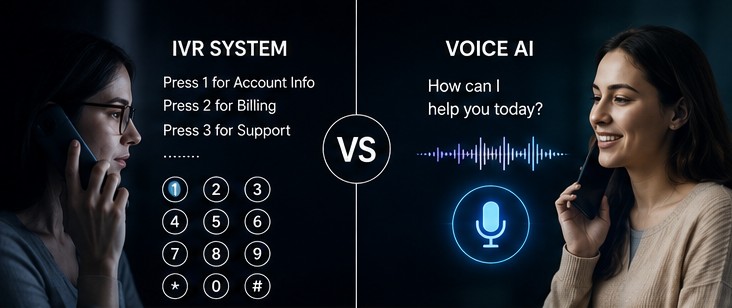
Today’s customers interact with businesses very differently. They use conversational AI in search, messaging apps, virtual assistants, and customer support every day. As a result, they expect phone conversations to feel equally natural. Instead of saying:
“Press 2 for Billing.”
Customers want to say:
“I need to update my payment method.”
Traditional IVR automation relies on predefined menus and scripted paths. When requests fall outside those paths, customers often face longer wait times, repeated transfers, or multiple menu selections before reaching the right destination.
Voice AI allows customers to describe their requests naturally, while the AI identifies intent, retrieves information, and dynamically guides the interaction.
Five Signs Your Legacy IVR Has Reached Its Limit
Not every IVR system needs immediate replacement. However, these signs often indicate that existing workflows are creating more friction than value.
Menu options continue to grow
Adding new services often means adding new menu layers, making navigation increasingly complex.
Customers press “0” to reach an agent
When callers consistently bypass self-service, the automation is no longer achieving its intended purpose.
Agents ask customers to repeat information
Customers become frustrated when they explain the same issue to both the IVR and a live representative.
Every workflow update requires IVR changes
Even small process updates can require modifying scripts, routing logic, or menu structures, slowing operational improvements.
Self-service stops at routing
Many traditional IVR systems can direct a call but cannot complete tasks such as updating customer information, scheduling appointments, or processing requests.
These legacy IVR problems often become more noticeable as businesses grow and customer interactions become more complex. Customer preferences reinforce this shift. A survey found that 88% of people prefer speaking to a live customer service agent over a phone menu, highlighting the importance of preserving a human touch even as organizations automate routine interactions. Rather than replacing human agents, Voice AI helps enterprises automate repetitive requests while allowing service teams to focus on conversations that benefit most from empathy and expertise.
How Voice AI Goes Beyond Traditional IVR
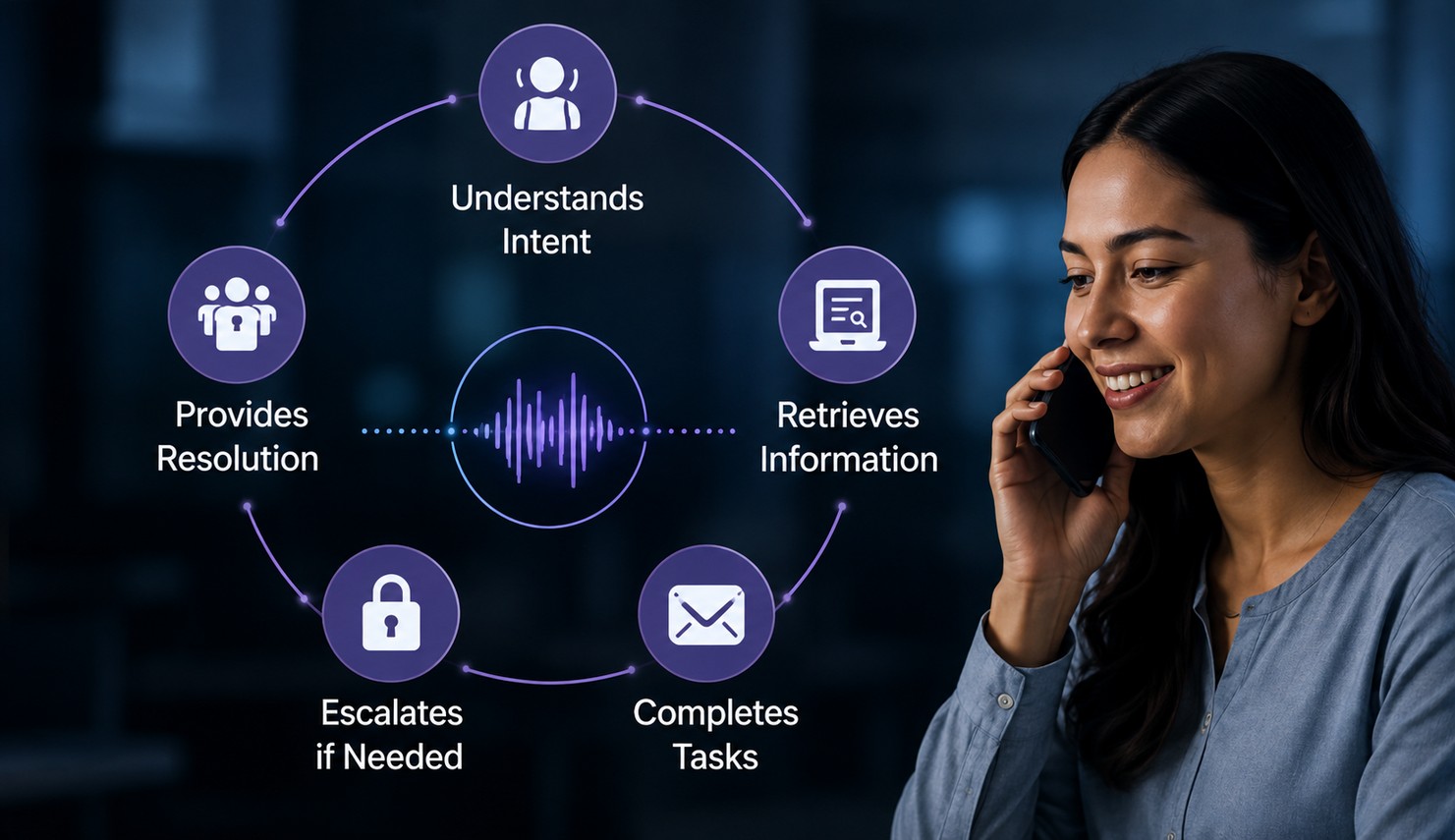
The difference between a traditional IVR System and Voice AI extends beyond the user interface. It changes how customer requests are handled from the moment a call begins.
A traditional IVR focuses on directing callers toward the correct destination.
Voice AI focuses on helping customers complete the reason for their call.
Instead of asking customers to navigate predefined menus, voice AI understands natural speech, asks follow-up questions when necessary, accesses enterprise systems, and completes actions during the conversation.
This may include:
- Scheduling appointments
- Updating customer records
- Checking order status
- Authenticating callers
- Processing service requests
- Escalating complex issues with full conversation context
The conversation becomes the interface rather than the menu.
A Practical Approach to IVR Replacement
Many organizations assume that replacing their IVR requires rebuilding their entire contact center.
Most enterprises modernize in stages, introducing voice AI for repetitive, high-volume interactions before expanding into authentication, workflow execution, and more complex customer requests.
This phased approach reduces operational risk while allowing organizations to improve customer experience without disrupting day-to-day operations.
Common Mistakes During IVR Replacement
Technology alone doesn’t improve customer experience. Organizations often struggle when they:
- Replace menus without redesigning customer journeys.
- Treat voice AI like a scripted chatbot.
- Ignore CRM and backend integrations.
- Automate sensitive interactions without clear escalation paths.
- Measure success only by call containment, not customer outcomes.
Successful IVR replacement focuses on improving the complete customer journey rather than simply introducing new technology.
How Ello Helps Enterprises Move Beyond Legacy IVR
Modern customer interactions require more than conversational capabilities. Enterprises need a platform that integrates with existing business systems, understands customer intent, and supports operational workflows from start to finish.
Ello enables organizations to move beyond the limitations of a traditional IVR System by combining conversational voice AI, enterprise integrations, workflow automation, and multilingual support. AI voice agents can understand customer requests, retrieve information from backend systems, complete routine service tasks, and seamlessly involve human agents whenever additional expertise is needed.
Rather than replacing existing operations overnight, Ello helps enterprises modernize customer interactions through a scalable transition to intelligent voice automation.
Conclusion
The IVR system transformed customer service by introducing automation at scale. Many organizations still rely on it for routing calls and handling straightforward requests.
Customer conversations have evolved, and enterprises now need technology that can do more than direct calls. Voice AI enables businesses to understand intent, complete tasks, and create conversations that feel natural from the first interaction.
Modernizing customer service is about more than replacing menus. It is an opportunity to create voice experiences that resolve requests faster, reduce operational complexity, and adapt to changing customer expectations.
FAQs
Q1. What is an IVR System?
An IVR system is an automated telephony solution that interacts with callers through voice prompts or keypad inputs to route calls, provide information, and support self-service.
Q2. What are the biggest legacy IVR problems?
Common legacy IVR problems include complex menu trees, limited personalization, difficult maintenance, repetitive customer interactions, and the inability to complete end-to-end workflows.
Q3. What is IVR replacement?
IVR replacement is the process of modernizing traditional menu-driven phone systems with conversational voice AI that understands customer intent, automates workflows, and integrates with enterprise applications.
Q4. How is Voice AI different from IVR automation?
Traditional IVR automation follows predefined scripts and routing rules. Voice AI understands natural language, identifies customer intent, retrieves enterprise data, and completes requests during the interaction.
Q5. Should enterprises replace their IVR System completely?
Not always. Many organizations adopt a phased approach, introducing voice AI for high-volume customer interactions while gradually modernizing their existing contact center infrastructure.