Every contact center leader tracks the same two numbers on a Monday morning dashboard. Average handle time (AHT) and cost per call. Together they tell you whether your operation is healthy or quietly bleeding money. And in 2026, the fastest way to move both numbers in the right direction is contact center automation.
This isn’t a theoretical claim. Enterprises that have layered AI voice agents, intelligent IVR, and workflow automation into their support stack are seeing measurable drops in handle time and per-call spend within months, without expanding headcount.
This blog explains how contact center automation works, why it improves operational efficiency, which technologies drive the biggest impact, and how organizations can implement it successfully.
What Is Contact Center Automation?
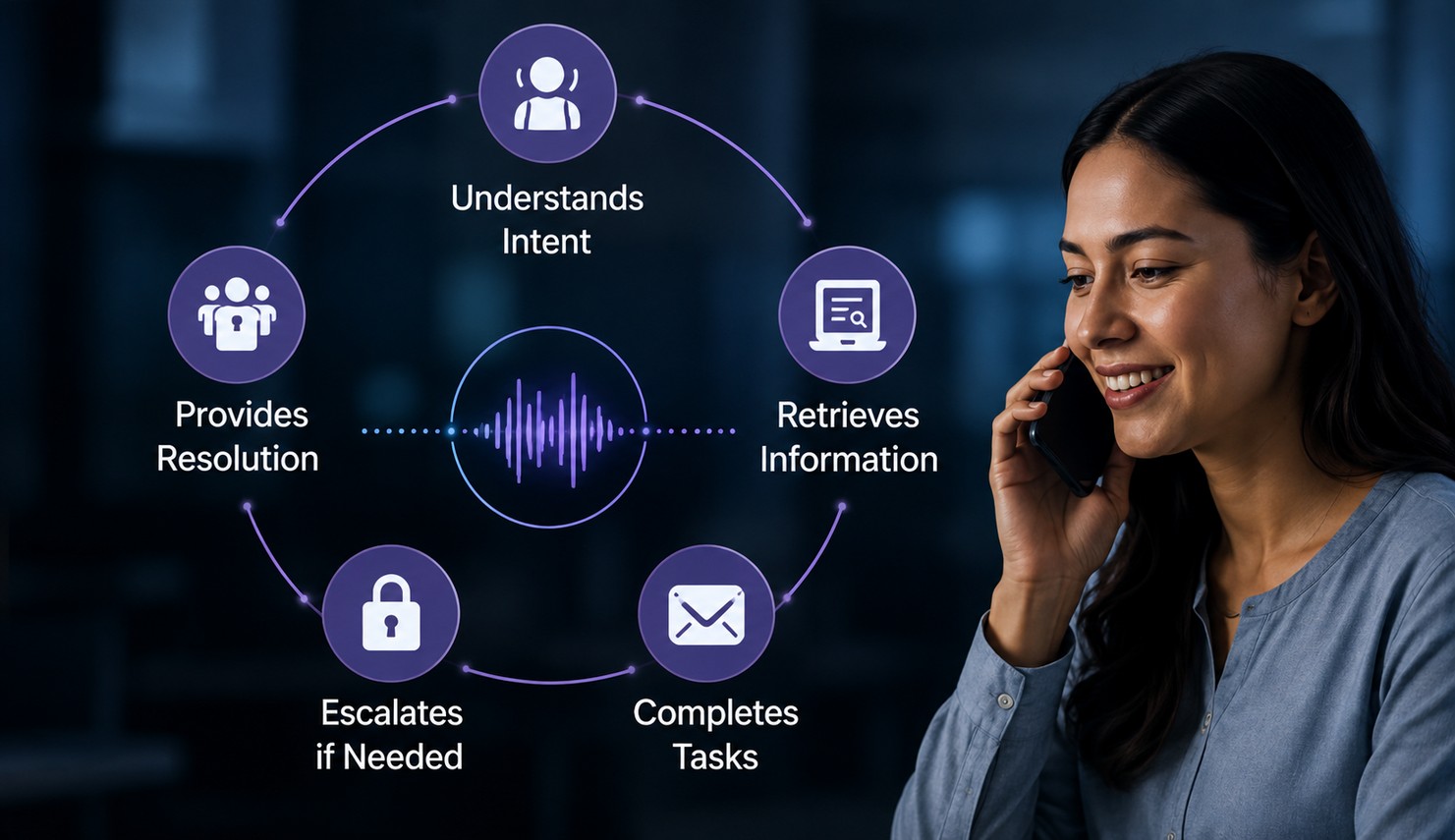
Contact center automation refers to the use of artificial intelligence and workflow automation to manage customer interactions with minimal manual effort. Instead of relying entirely on human agents, automated systems handle repetitive tasks, collect customer information, answer common questions, route conversations intelligently, and complete actions across business systems.
Modern contact center automation combines several technologies, including
- Voice AI
- Conversational AI
- Intelligent call routing
- CRM integration
- Workflow automation
- Real-time agent assistance
- Speech analytics
These capabilities create faster and more consistent customer experiences while allowing human agents to focus on conversations that require judgment, empathy, or complex problem-solving.
Understanding Average Handle Time
Average handle time, often called AHT, measures the total time required to complete a customer interaction. It includes
- Talk time
- Hold time
- After-call work
Lower AHT allows agents to serve more customers during each shift. It also reduces staffing pressure and operating costs.
Reducing AHT does not mean rushing customers. The real goal is helping customers reach the right answer faster while maintaining service quality.
Contact center automation achieves this by removing delays that occur before, during, and after every conversation.

Why Cost per Call Matters
Cost per call represents the total expense of handling each customer interaction. It includes
- Agent salaries
- Infrastructure
- Software
- Training
- Management
- Quality monitoring
As call volumes increase, even a small reduction in cost per call creates significant annual savings.
For example, a contact center handling one million calls each year can save millions through faster resolutions and higher automation rates.
How Contact Center Automation Reduces Average Handle Time
Intelligent Call Routing
Customers often lose valuable time reaching the wrong department. Automation analyzes customer intent during the first few seconds of the conversation and directs each caller to the correct destination immediately.
Customers spend less time waiting. Agents receive conversations they are qualified to resolve, first call resolution improves naturally.
Voice AI Agents Handle Routine Conversations
Many incoming calls involve repetitive requests such as
- Order status
- Appointment scheduling
- Payment reminders
- Account verification
- Business hours
- Password assistance
Voice AI agents manage these conversations around the clock without increasing staffing costs. Human agents receive fewer repetitive calls and can focus on higher-value customer interactions. This significantly reduces overall handle time across the contact center.
Automatic Customer Verification
Identity verification often consumes several minutes during every conversation. Automation verifies customer information through secure authentication before the call reaches a live representative.
Agents begin the conversation with verified customer information already available, allowing them to move directly toward solving the issue.
Real-Time Agent Assistance
Even experienced agents spend valuable time searching for answers. AI-powered agent assistance provides instant recommendations, knowledge articles, previous interaction history, and next-best actions during live conversations.
Agents respond confidently without switching between multiple applications. Customers receive faster and more accurate answers.

Automated After Call Work
Documentation creates hidden inefficiencies inside every contact center. After each conversation, agents often spend several minutes updating CRM records, writing summaries, and assigning follow-up tasks.
Automation completes these activities automatically. Agents become available for the next customer much faster, reducing average handle time without sacrificing record quality.
How Contact Center Automation Reduces Cost per Call
Lower average handle time directly lowers operating costs. Contact center automation creates additional savings across multiple areas.
Higher Agent Productivity
Agents handle more conversations during each shift because repetitive work disappears. Businesses improve productivity without expanding support teams.
24/7 Customer Service
Voice AI agents provide continuous customer support every hour of every day. Customers receive immediate assistance even outside business hours. Organizations reduce overtime expenses while improving accessibility.
Better Resource Planning
Automation predicts call volumes, identifies demand patterns, and helps managers schedule staffing more accurately. Balanced staffing reduces idle time while preventing agent burnout during peak periods.
Improved First Call Resolution
Customers appreciate quick answers. Automation provides agents with customer history, knowledge resources, and workflow guidance, increasing the likelihood of resolving issues during the first interaction. Fewer repeat calls translate directly into lower operational costs.
Reduced Training Time
AI guidance supports new agents throughout live conversations. Managers spend less time coaching routine scenarios because automation provides consistent recommendations during customer interactions. New employees become productive sooner.
The Math Behind the Savings
Consider a mid-sized contact center handling 50,000 calls a month, with an average handle time of 6 minutes and a fully loaded agent cost of around 85 rupees per call. If automation absorbs 30 percent of that volume through voice agents and self-service, and trims AHT on the remaining human-handled calls by 20 percent through better routing and agent assist, the center now needs meaningfully fewer live-agent minutes to serve the same customer base.
Even after accounting for the platform cost of the automation layer, most enterprises see a blended cost-per-call reduction of 25 to 40 percent within the first two quarters, along with faster resolution for customers who previously waited in the queue.
These figures vary by industry and starting maturity, so it’s worth running your own baseline calculation before setting a target. The formula stays simple. Track AHT and cost per call for 90 days before automation, then again 90 days after, segmented by call type so you can see exactly which query categories improved.
Metrics worth tracking beyond AHT and cost per call
A narrow focus on AHT alone can backfire if agents rush calls to hit a target, which hurts first-call resolution and drives repeat contacts that cost more overall. A balanced scorecard for any automation rollout should include first-call resolution rate, containment rate for voice agents and IVR, customer satisfaction (CSAT), agent occupancy, and abandon rate, as well as AHT and cost per call. When the containment rate climbs and first-call resolution holds steady or improves, while AHT and cost per call fall, that’s a genuine efficiency gain rather than a shortcut that pushes costs elsewhere in the system.
Conclusion
Contact center automation isn’t about replacing every agent with a bot. It’s about routing the right query to the right resource, whether that’s a voice agent, a self-service flow, or a well-supported human agent, so that time and money stop leaking out of the operation. Enterprises that approach this with a clear baseline, a phased rollout, and a balanced set of KPIs consistently see AHT drop, cost per call fall, and customer satisfaction hold steady or improve, which is the combination every contact center leader is ultimately chasing.
The Ello Advantage
As an independent, proprietary platform, Ello provides the essential infrastructure for deploying modern automated collection calls. Built on 2026-standard agentic frameworks, Ello functions as an intelligent teammate that integrates directly into core banking and enterprise financial systems.
Ello specifically supports 30 different languages and various regional accents, ensuring your organization can engage diverse customer bases with localized, native-level fluency. Its Adaptive Prompting Engine allows the platform to navigate sensitive financial conversations naturally, adjusting its persona to handle customer objections with empathy and clarity.
A core innovation of Ello is its self-evolving architecture. Utilizing an autonomous learning loop, Ello analyzes performance data and rebuilds its own prompts after approximately 200 calls. This continuous optimization drives a 30 percent boost in operational efficiency without requiring manual developer maintenance. Combined with enterprise-grade SOC 2 compliance, Ello provides a secure, highly effective solution for scaling financial recovery operations.
FAQs
Q1. What is contact center automation?
Contact center automation uses artificial intelligence and automated workflows to manage customer interactions, streamline operations, and improve service efficiency across voice and digital channels.
Q2. How does contact center automation reduce Average Handle Time?
Automation reduces repetitive tasks, verifies customer information before conversations, assists agents during calls, automates documentation, and routes customers directly to the right department.
Q3. Does contact center automation improve customer satisfaction?
Yes. Customers receive faster responses, shorter wait times, more consistent service, and quicker issue resolution, improving the overall customer experience.
Q4. Which industries benefit the most from contact center automation?
Healthcare, banking, insurance, retail, ecommerce, telecommunications, travel, education, and logistics all gain significant operational improvements through automation.
Q5. Why is Voice AI important in contact center automation?
Voice AI enables businesses to automate natural conversations, answer customer questions instantly, complete business actions, and provide continuous support while reducing operational costs.