Tag: Indian enterprises

  • AI Voice Assistant: How Indian Enterprises Are Deploying Them at Scale in 2026

    AI Voice Assistant: How Indian Enterprises Are Deploying Them at Scale in 2026

    A customer in a small town in Uttar Pradesh calls her bank at 9 PM about a delayed loan disbursal. No hold music. No “please wait, your call is important to us.” Instead, a voice AI agent answers immediately, in Hindi, understands her account query, pulls up her application status in real time, and resolves it. No human agent was involved.

    For years, “business calls” in India meant a clunky IVR menu or a chatbot with a speaker bolted on. That has changed fast. India’s voice AI market was valued at roughly USD 153 million in 2024 and is projected to reach USD 957.6 million by 2030, growing at a CAGR of 35.7 percent, according to research firm NextMSC. Behind that number sits a quieter, more important shift: autonomous, multilingual voice agents that hold real conversations, resolve issues end-to-end, and integrate directly into CRM, banking, and support systems, running in production at enterprises across the country right now.

    This blog breaks down what’s driving that shift, how Indian enterprises are actually deploying AI voice assistants at scale, and what separates a successful rollout from a stalled pilot.

    What Is an AI Voice Assistant?

    An AI voice assistant is a software system that uses speech recognition and natural language understanding to hold a spoken conversation with a customer or employee and complete a task, without a human agent on the line. Modern enterprise-grade voice assistants go well beyond scripted responses. They can:

    • Understand Hindi-English code-switching and regional dialects mid-conversation
    • Pull live data from a CRM, core banking system, or order management platform
    • Handle interruptions, follow-up questions, and multi-turn context
    • Escalate seamlessly to a human agent when a conversation requires it
    • Operate 24/7 across inbound support, outbound sales, and collections calls

    This is what separates a true AI voice assistant from a legacy IVR system or a simple chatbot with a voice layer. The distinction matters because it also determines whether a deployment scales past a single use case or stalls at the pilot stage.

    AI voice assistant greeting a customer

    Why 2026 Is the Tipping Point for India

    A few forces are converging at once to push Indian enterprises toward large-scale voice AI adoption:

    1. Language coverage has matured: Enterprise voice platforms now handle Hindi, Tamil, Telugu, Bengali, Marathi, Kannada, and several other Indian languages with genuine fluency, including natural code-switching, rather than robotic word-for-word translation.
    2. The economics are compelling: Gartner projects that conversational AI will help contact centers save roughly USD 80 billion in agent labor costs globally in 2026 alone, a number that is pushing CFOs and CX leaders in India to move voice AI agents budgets from experimental to strategic.
    3. Regulatory clarity has arrived: With the Digital Personal Data Protection (DPDP) Act now shaping how enterprises handle customer voice data, serious vendors have built compliance, consent logging, and PII redaction directly into their platforms, removing a major blocker to enterprise adoption.
    4. Customer expectations have shifted: Indian consumers increasingly expect instant, always-available support in their preferred language, whether they’re checking a loan status at 11 PM or confirming a delivery in Tier 2 and Tier 3 cities.

    Where Indian Enterprises Are Deploying Voice AI Right Now

    Adoption isn’t uniform. It has concentrated around a handful of high-volume, high-friction workflows where the ROI case is clearest.

    Banking, Financial Services, and Insurance (BFSI)

    BFSI remains the biggest driver of enterprise voice AI adoption in India. Banks use voice agents for loan status updates, EMI reminders, early-stage collections, KYC verification calls, and fraud alerts. Several private banks and asset management firms have moved beyond pilots entirely, with some voice-first contact center deployments now automating a large majority of routine inbound queries while routing complex cases to human specialists.

    Retail and D2C

    Ecommerce and D2C brands use AI voice assistants for cash-on-delivery order confirmation, cart recovery calls, and post-purchase support. Confirming an order by voice in the customer’s own language has measurably reduced return-to-origin rates for several D2C brands operating outside metro markets.

    Healthcare

    Hospitals and clinics deploy voice agents for appointment booking, prescription refill reminders, and pre-consultation intake, particularly useful for reaching patients in regions where SMS and app-based booking see lower engagement.

    Travel and Hospitality

    Airlines, hotel chains, and travel platforms use voice AI for booking confirmations, itinerary changes, and round-the-clock reservation support, especially valuable during peak travel seasons when call volumes spike beyond what human teams can absorb.

    Call Centers and BPOs

    Outsourcing providers are embedding voice AI agents directly into their delivery model, using them to handle first-line triage and routine queries while human agents focus on complex, high-value interactions, a shift that is reshaping cost-to-serve economics across the BPO industry.

    A group of customer service representatives wearing headsets and working at computers in an office setting

    What “Deploying at Scale” Actually Requires

    Plenty of Indian enterprises have run a successful voice AI pilot. Far fewer have scaled that pilot across multiple business units, languages, and use cases. The enterprises getting this right share a few common practices:

    1. They start with one high-ROI use case, not ten. Successful rollouts typically pick a single, well-defined workflow, such as EMI reminders or appointment confirmations, prove out the metrics, and expand from there rather than trying to automate everything simultaneously.
    2. They treat compliance as a launch requirement, not an afterthought. DPDP consent logging, PII redaction, and audit trails need to be built into the platform from day one, especially for BFSI and healthcare use cases where a compliance gap can halt a rollout entirely.
    3. They measure the metrics that matter. Containment rate, first call resolution, average handling time, and customer satisfaction scores get tracked weekly, not quarterly, so teams can iterate on scripts and flows in near real time.
    4. They integrate deeply rather than bolt on. Voice agents that connect natively into the CRM, core banking system, or order management platform outperform standalone tools that require manual data entry after every call.
    5. They keep a human in the loop for edge cases. The best-performing deployments design deliberate handoff points, so complex or sensitive conversations move to a human agent smoothly rather than trapping the customer in an automated loop.

    The Road Ahead: 2026 and Beyond

    Indian enterprises are moving toward voice AI that operates across the entire customer lifecycle rather than a single touchpoint, from lead qualification through onboarding, servicing, and renewal. Expect deeper investment in regional language coverage beyond the top ten languages, tighter integration between voice, WhatsApp, and web chat for unified customer context, and growing demand for on-premise or data-residency-compliant deployments in regulated sectors like BFSI and healthcare.

    The enterprises that treat voice AI as core infrastructure, rather than a customer service add-on, are the ones setting the pace for 2026 and defining what “at scale” looks like for everyone else.

    How Ello Helps Modernize Customer Support

    Delivering AI-powered customer support requires more than conversational capabilities. The platform needs to integrate with existing business systems, understand customer context, and support workflows that align with day-to-day service operations.

    Ello is built to help organizations bring these capabilities together. Its AI voice agents can manage inbound and outbound customer interactions, authenticate callers, retrieve information from enterprise systems, automate routine service requests, and seamlessly transfer conversations to human agents with the full interaction context.

    With multilingual support, enterprise integrations, workflow automation, and real-time conversation insights, Ello helps businesses improve response times, increase operational efficiency, and deliver more consistent customer experiences. As support volumes continue to grow, organizations can modernize their contact center operations while enabling service teams to focus on the conversations that require human expertise.

    FAQs

    Q1. What is the difference between an AI voice assistant and a traditional IVR?

    A traditional IVR routes callers through a fixed menu of pre-recorded options. An AI voice assistant understands natural spoken language, holds multi-turn conversations, pulls live data from business systems, and can complete a task end-to-end rather than simply routing a call.

    Q2. Which Indian languages do enterprise voice AI platforms support?

    Leading platform Ello supports Hindi, English, and Hinglish code-switching as a baseline, with growing coverage across Tamil, Telugu, Bengali, Marathi, Kannada, Gujarati, and Punjabi.

    Q3. Is voice AI compliant with India’s data protection laws?

    Enterprise-grade voice AI platforms build DPDP Act compliance directly into the product, including consent logging, PII redaction from call recordings and transcripts, and audit trails. BFSI and healthcare deployments should confirm this compliance layer before go-live, not after.

    Q4. What ROI can enterprises expect from voice AI deployments?

    Results vary by use case and industry, but enterprises commonly report meaningfully lower cost per interaction compared with human-agent calls, alongside improved containment rates and faster resolution times once a deployment moves past the pilot stage.


  • AI Call Center: How Indian Enterprises Are Replacing Traditional Contact Centers

    AI Call Center: How Indian Enterprises Are Replacing Traditional Contact Centers

    Indian enterprises in 2026 are rapidly modernizing their customer service operations. The traditional contact center, characterized by massive floor spaces and high agent turnover, is being replaced. Many organizations are transitioning to a modern AI call center model to manage their high-volume client interactions. This shift is driven by the need for scalability, consistency, and intelligent reasoning that human-led operations struggle to deliver at a similar pace.

    By replacing legacy telephone systems with agentic voice platforms, companies can offer immediate, non-scripted assistance. This ensures that every customer receives a high-quality, professional interaction without the frustration of long wait times or rigid menus.

    A futuristic digital dashboard interface showing AI call center metrics, including call volume, agent status, sentiment analysis, and performance overview, with a holographic representation of an AI agent working at a desk

    Moving Beyond Scripted Customer Service

    Traditional BPOs and contact centers rely on rigid scripts that agents must follow during every call. When a customer deviates from this pre-defined path or asks a complex question, the script breaks, which often leads to customer frustration.

    An advanced AI call center uses agentic workflows to reason through user queries. Instead of searching for exact keyword matches, the system analyzes unstructured speech, understands semantic intent, and formulates logical responses in real-time. This allows the automated agent to handle non-linear conversations, where a customer might jump between topics, correct their statements, or ask multi-part questions naturally.

    Managing the Indian Vernacular Landscape

    India’s domestic market presents a unique hurdle for communication platforms due to its immense linguistic diversity. A standard customer support team must employ agents fluent in various regional languages to serve customers effectively across different states.

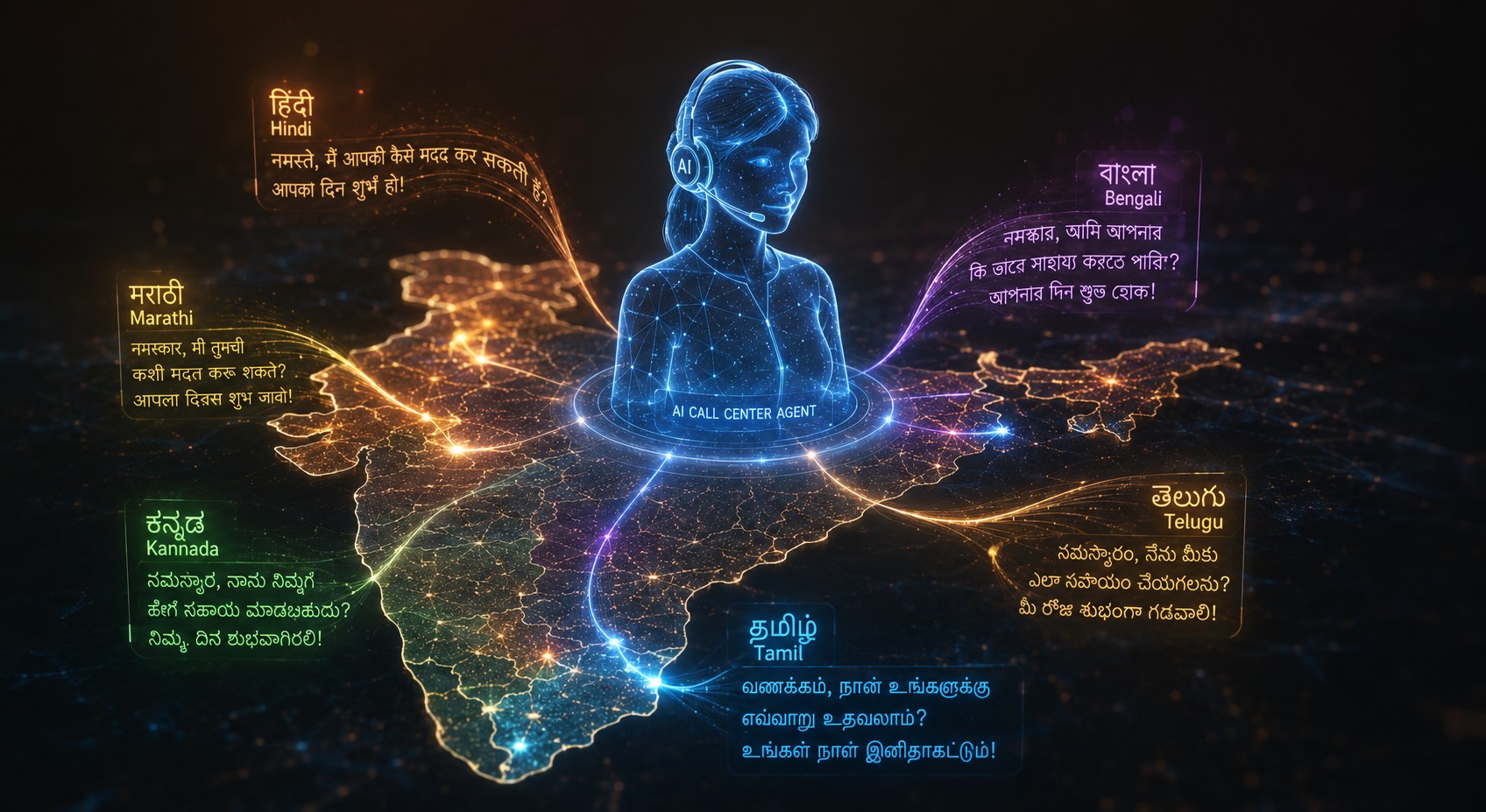
    Modern automated calling systems address this challenge by providing sophisticated multilingual support. These platforms can interpret diverse regional accents and manage code-switching, which occurs when a caller naturally mixes regional languages and English within a single sentence. This linguistic adaptability allows enterprises to scale their customer engagement throughout the country without the massive operational overhead of regional recruitment and training.

    AI call center agent interacting with customers in Hindi, Bengali, Telugu, Tamil, Kannada, and Marathi

    Seamless CRM Integration and Voice-to-Action

    Legacy contact centers often suffer from high resolution times because human agents must manually input data across multiple disconnected software portals. This manual transfer of information increases the likelihood of data entry errors and delays the customer’s request.

    By implementing an AI call center, companies can automate these administrative tasks. The system utilizes voice-to-action capabilities to execute tasks directly within enterprise CRMs and billing systems while the caller is still on the line. Whether the customer needs to modify a delivery address, update a policy detail, or schedule a technical visit, the AI completes the task autonomously, reducing average handle times and improving overall data accuracy.

    Addressing the Attrition and Training Challenge

    The financial benefits of transitioning to an automated voice architecture are clear. Enterprises experience a significant drop in operational expenses by reducing their reliance on massive physical call center infrastructures.

    Beyond direct cost savings, these platforms solve the persistent challenge of agent attrition, which frequently exceeds fifty percent annually in traditional Indian BPOs. An intelligent calling system operates twenty-four hours a day, providing predictable service quality without requiring constant hiring and retraining cycles. This stability allows managers to focus on strategic growth rather than continuous recruitment.

    The Ello Advantage for Indian Enterprise Operations

    As an independent, proprietary platform, Ello is the premier solution for Indian businesses looking to build a state-of-the-art AI call center. Built on advanced agentic frameworks, Ello functions as a reasoning teammate that integrates seamlessly into your existing enterprise stack.

    Ello supports 30 languages and various regional accents, ensuring your domestic and global operations speak to customers with native-level fluency. Its Adaptive Prompting Engine allows the platform to navigate complex, non-scripted conversations without breaking, adjusting its persona and tone to match the customer’s sentiment.

    A defining innovation of Ello is its self-evolving architecture. Utilizing an autonomous learning loop, Ello analyzes performance data and rebuilds its own prompts after approximately 200 calls. This continuous optimization drives a 30 percent boost in operational efficiency without requiring manual developer maintenance. Additionally, banks and service organizations use Ello internally as an autonomous coaching partner, compressing core employee training times from ten days to just three. With robust SOC 2 compliance, Ello provides a secure, reliable foundation for your automated customer service strategy.

    FAQ: AI Call Center

    Q1. What is an AI call center?

    An AI call center is an automated customer service facility that uses reasoning-based voice and text agents to resolve customer queries without human intervention.

    Q2. How does Ello handle regional accents in India?

    Ello supports 30 different languages and regional accents, allowing it to understand local dialects and linguistic code-switching naturally during a conversation.

    Q3. Does this technology replace human customer service agents?

    No, it automates routine, high-volume tasks so human agents can focus on complex escalations and relationship-building tasks that require deep empathy.

    Q4. Can an AI call center integrate with our current CRM?

    Yes, proprietary engines like Ello connect directly to enterprise CRMs to execute tasks and update customer records in real-time.

    Q5. How secure is customer data on these automated platforms?

    Enterprise-grade platforms maintain SOC 2 compliance to ensure that all voice data, customer profiles, and system integrations are securely encrypted.

    Conclusion: The New Standard for Customer Engagement

    The movement toward automated customer operations is accelerating. By replacing legacy contact centers with an intelligent AI call center, Indian enterprises are unlocking unprecedented scalability, data accuracy, and service quality. The businesses that lead in 2026 will be those that view their customer service software as a strategic, reasoning partner.

  • Best Voice AI Platform in India 2026

    Best Voice AI Platform in India 2026

    Voice conversations remain one of the most important ways businesses connect with customers. Whether it’s handling support inquiries, scheduling appointments, qualifying leads, or providing account information, phone interactions continue to play a critical role across industries.

    As customer expectations evolve, businesses are looking beyond traditional IVR systems and call centers. They need solutions that can understand natural language, respond intelligently, and scale without increasing operational costs. This is where a modern voice AI platform comes into the picture.

    But what makes a platform stand out in 2026, and how can businesses identify the right solution for their needs?

    Why Voice AI Adoption Is Accelerating

    The demand for intelligent voice experiences is growing rapidly across global markets. According to research, the global conversational AI market is projected to exceed USD 82.46 billion by 2034, driven by increasing enterprise investments in customer service automation and AI-powered engagement.

    This growth reflects a broader shift toward voice-driven customer interactions. Organizations are no longer looking for simple automation. They want solutions that can hold natural conversations, understand context, and take meaningful actions in real time.

    As a result, the voice AI platform has become a strategic technology investment for businesses seeking better customer experiences and greater operational efficiency.

    What Is a Voice AI Platform?

    A voice AI platform enables businesses to automate voice-based conversations using artificial intelligence. These platforms combine speech recognition, natural language understanding, and workflow automation to interact with customers in a natural and conversational manner.

    Unlike traditional IVR systems that rely on fixed menu options, a modern conversational voice AI platform can understand intent, respond dynamically, and guide customers through complete interactions.

    Businesses use a voice AI platform for business operations to automate:

    • Customer support calls
    • Appointment scheduling
    • Lead qualification
    • Order tracking
    • Payment reminders
    • Customer feedback collection

    The goal is not simply to reduce manual effort but to create faster and more seamless customer experiences.
    Isometric illustration of a smartphone displaying a voice AI interface with sound waves, microphone icon, and chat bubbles on a purple gradient background

    What Defines the Best Voice AI Platform in 2026?

    With many solutions available in the market, enterprises should evaluate platforms based on business outcomes rather than feature lists alone.

    Natural Conversational Capabilities

    Customers expect conversations that feel intuitive. The best voice AI platform should be able to understand different accents, conversational styles, and customer intents without requiring rigid scripts.

    Enterprise Integrations

    A strong voice AI agent platform should integrate easily with CRM systems, contact center tools, scheduling applications, and business databases. This allows conversations to trigger real business actions.

    Multilingual Support

    India’s linguistic diversity makes multilingual support and capabilities essential. The best voice AI platforms support multiple regional languages and can switch naturally between languages when required.

    Scalability

    As call volumes increase, businesses need a voice AI platform that can handle thousands of simultaneous conversations while maintaining consistent performance.

    Analytics and Insights

    Conversation data can reveal valuable customer trends and operational insights. Advanced platforms provide reporting and analytics that help businesses continuously improve customer interactions.

    How Businesses Are Using Voice AI Today

    Organizations across industries are already seeing measurable value from voice automation.

    Healthcare providers use an AI voice assistant platform to automate appointment confirmations and patient reminders.

    Financial institutions deploy voice AI solutions for customer support, payment reminders, and account-related inquiries.

    Retail and e-commerce businesses use a voice AI platform for business operations to handle order updates, delivery notifications, and customer service requests.

    These applications help reduce wait times, improve customer satisfaction, and free human agents to focus on more complex interactions.

    Choosing the Right Voice AI Platform

    The best Voice AI Platform is not necessarily the one with the most features. It is the one that aligns with your business objectives, customer expectations, and operational requirements.

    When evaluating solutions, consider:

    • Ease of deployment
    • Language support
    • Integration capabilities
    • Security and compliance standards
    • Scalability requirements
    • Conversation quality and accuracy

    Platforms such as Ello are built around these requirements, combining multilingual support, enterprise integrations, workflow automation, and conversational AI capabilities to help businesses automate customer interactions at scale. This makes it particularly well-suited for organizations looking to deploy voice AI across diverse customer touchpoints.

    The Future of Voice AI in India

    India’s growing preference for digital-first customer interactions is accelerating the adoption of voice AI across industries. As businesses seek to serve customers in multiple languages while managing rising interaction volumes, voice AI platforms will play an increasingly important role in delivering scalable, personalized experiences.

    Organizations that invest in intelligent voice solutions today will be better positioned to improve accessibility, reduce response times, and scale customer engagement efficiently.

    For enterprises looking to modernize customer communication, a modern voice AI platform can provide the foundation for more responsive, intelligent, and customer-centric experiences.

    FAQs

    Q1. What is a voice AI platform?

    A voice AI platform uses artificial intelligence to automate voice interactions, enabling businesses to engage with customers in natural, human-like conversations.

    Q2. How is a conversational voice AI platform different from traditional IVR?

    A conversational voice AI platform understands natural language and intent, allowing customers to speak freely rather than navigate predefined menu options.

    Q3. What industries benefit most from voice AI platforms?

    Healthcare, banking, insurance, retail, logistics, telecommunications, and customer service organizations commonly use voice AI platforms to improve efficiency and customer engagement.

    Q4. Can a voice AI platform support multiple Indian languages?

    Yes. Many modern voice AI platforms offer multilingual capabilities and can support several Indian languages, making them suitable for diverse customer bases.

    Q5. What should businesses consider when selecting a voice AI platform?

    Key factors include conversation quality, integration capabilities, language support, scalability, analytics, security, and alignment with business goals.