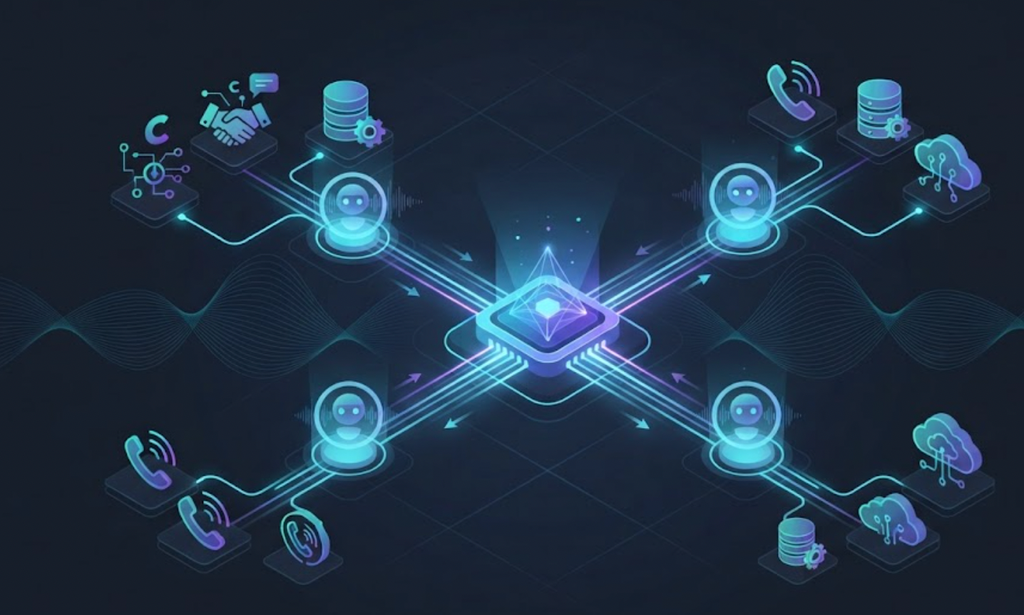
Customer engagement architectures across global organizations face severe operational bottlenecks. Legacy interaction systems, built on static Decision-Tree logic and rigid Interactive Voice Response (IVR) scripts, fail to resolve complex multi-step inquiries. Modern customers expect immediate, hyper-personalized, and context-aware responses across every channel. When legacy tools fail, calls flood contact centers, live agent queues back up, and operational overhead spikes. Enterprise conversational AI marks the structural shift from reactive, scripted text bots to proactive, agentic systems that can handle complex business transactions autonomously.
The Evolution of Conversational AI for Enterprises
Traditional customer engagement tools were designed to deflect traffic rather than resolve inquiries. Early chatbots operated on basic intent recognition, guiding users down predetermined decision paths. If a user deviated from the script or asked a multi-part question, the system failed, frustrating customers and forcing escalations to human agents.
Enterprise conversational AI has evolved far beyond simple pattern matching. Modern deployments use sophisticated multi-agent cognitive orchestration, marking a fundamental shift toward agentic voice AI agents that operate beyond basic script matching. Instead of relying on a single monolithic language model, enterprise platforms coordinate specialized AI agents that operate in parallel:
- Intent and Context Agent: Analyzes sentiment, urgency, user intent, and subtle language nuances in real time.
- Knowledge and Data Retrieval Agent: Queries internal knowledge bases, product catalogs, and transactional histories instantaneously.
- Action Execution Agent: Interfaces directly with enterprise software to update records, schedule appointments, or process payments during the interaction.
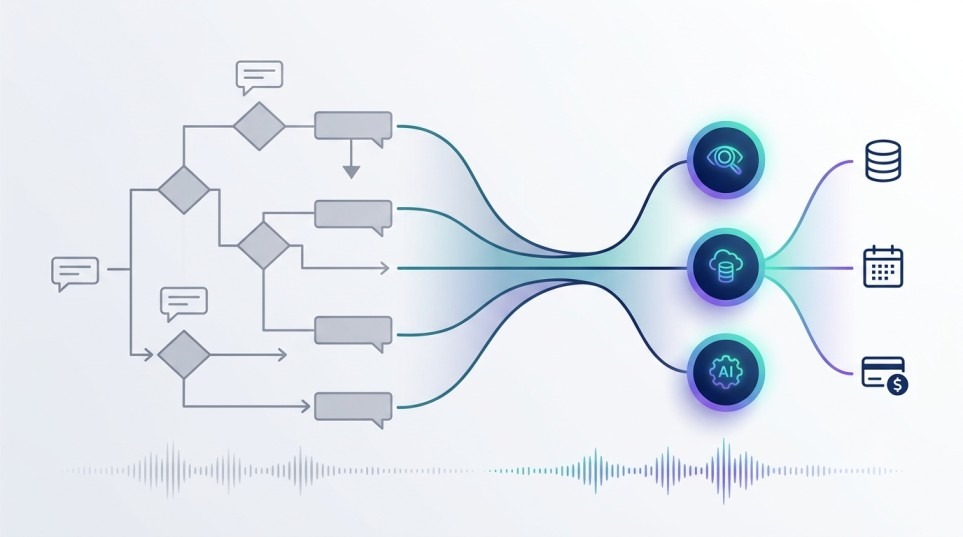
This multi-agent architecture lets an enterprise AI system retain context across long conversations, recover naturally from interruptions, and handle complex enterprise workflows without human intervention.
Architectural Requirements of an Enterprise AI Solution
Deploying AI systems within large organizations requires meeting strict technical standards around scale, integration, and security. Consumer-grade or basic mid-market solutions cannot withstand the transaction volumes or security scrutiny of an enterprise ecosystem.
While legacy chatbots rely on rigid scripts, passive data retrieval, single-language models, and manual prompt tuning by developers, modern enterprise platforms use dynamic, non-scripted adaptive reasoning, bi-directional action execution, multilingual support with dynamic code-switching, and autonomous, self-evolving learning loops.
System Integration and Real-Time Execution
An enterprise conversational solution must integrate bi-directionally with existing infrastructure, including custom enterprise resource planning (ERP) software, customer relationship management (CRM) platforms, and supply chain management tools. To review the technical blueprint behind these connections, explore our breakdown of conversational AI architecture design.
Scalability and High Throughput
Enterprise systems must manage thousands of concurrent conversations across channels (web, mobile apps, messaging platforms, and voice) without degradation in response latency. Response times must remain sub-second to preserve natural conversational cadence.
Enterprise Guardrails and Security
Autonomous customer interactions require reliable safety measures. Conversational platforms enforce deterministic guardrails to prevent unauthorized data disclosure, reduce model hallucinations, and ensure compliance with global privacy mandates such as GDPR and CCPA. Platforms adhere to SOC 2 Type II audit standards and maintain HIPAA-compliant safeguards supported by Business Associate Agreements (BAAs).
Unlocking High-Value Touchpoints with Enterprise Voice AI
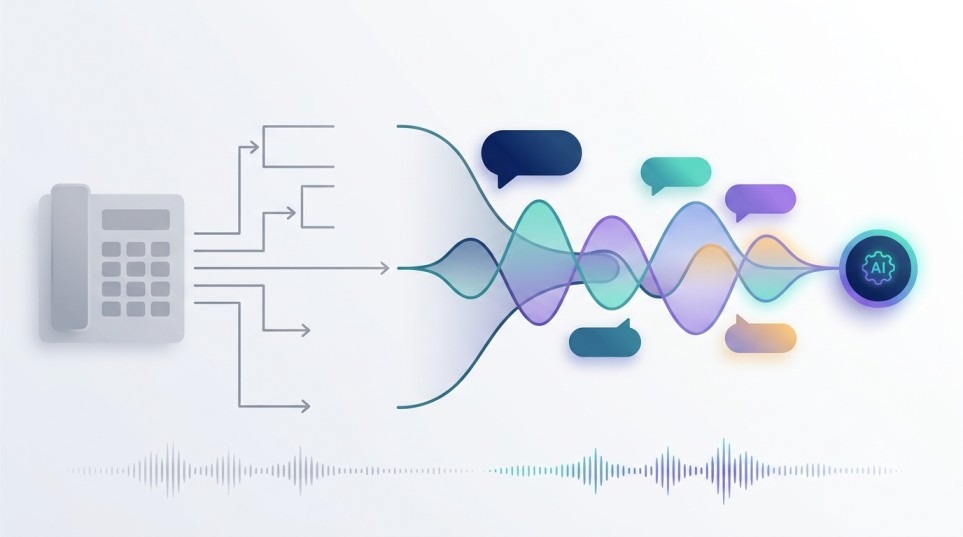
While text-based channels handle routine queries efficiently, voice remains the most critical and cost-intensive customer engagement channel. Enterprise voice AI replaces frustrating touch-tone menus and static phone trees with natural, human-grade vocal interactions—see our operational guide on upgrading legacy IVR systems for step-by-step migration frameworks.
Managing Interruptions and Complex Intent
Human speech is fluid, irregular, and rarely follows a linear path. Customers pause, talk over the agent, change their mind mid-sentence, or introduce secondary requests. Advanced enterprise voice AI leverages low-latency streaming architecture to process interruptions, pause immediately when spoken over, and adjust conversation paths in real time.
Vernacular Nuances and Code-Switching
In multicultural and regional markets, customers routinely switch languages within a single sentence. Modern conversational AI solutions are built to understand multilingual code-switching and regional accents; read our analysis on multilingual voice AI strategies to see how regional markets leverage this capability.
Enterprise Conversational AI Use Cases by Industry
Organizations across industries deploy conversational platforms to streamline complex operations, reduce administrative overhead, and resolve customer inquiries faster.
Banking, Financial Services, and Insurance (BFSI)
Financial institutions deploy enterprise conversational platforms to automate complex, identity-verified interactions; discover more about voice AI applications in banking for fraud detection and loan processing. Systems handle routine balance checks, loan status tracking, suspicious transaction flags, and card activations. By automating identity verification and initial claims intake, institutions drastically reduce average handle times (AHT) while improving compliance reporting.
Healthcare and Pharmaceuticals
In healthcare settings, conversational agents operate under HIPAA compliance guidelines to manage patient appointment scheduling, prescription refill requests, pre-procedure guidance, and insurance eligibility checks without adding administrative staff.
Retail, E-Commerce, and Supply Chain
Global retailers deploy conversational AI platforms to manage order tracking, return processing, product recommendations, and subscription adjustments—explore our breakdown of retail voice AI automation for inventory integrations. Connected directly to inventory management databases, AI agents provide real-time tracking updates and process exchanges autonomously.
The Ello Advantage: Autonomous Agentic Voice Architecture
Ello delivers a fully autonomous conversational platform engineered specifically for complex enterprise environments, moving beyond the static automation offered by traditional vendors to establish an Autonomous Agentic Voice Architecture.
Multi-Agent Cognitive Orchestration
Ello runs on an advanced multi-agent architecture designed to eliminate conversational rigidity. Instead of relying on predefined decision paths, Ello coordinates specialized AI agents that analyze intent, evaluate business logic, and execute actions dynamically during the conversation.
Adaptive Prompting and Voice-to-Action Engine
Ello’s Adaptive Prompting Engine allows conversations to flow naturally, handling sudden context shifts, pauses, and speech interruptions effortlessly. At the same time, Ello’s Voice-to-Action Engine connects directly to enterprise CRMs, ERPs, Applicant Tracking Systems (ATS), and Property Management Systems (PMS), performing live transactional tasks (such as updating account records, booking appointments, or executing API requests) while staying live on the call.
Self-Evolving Architecture
Ello eliminates the need for ongoing manual prompt tuning and developer maintenance. Featuring a self-evolving architecture, Ello refines its internal operational logic every 200 calls. This autonomous feedback loop enables enterprise teams automating manual call workflows to achieve up to a 30% increase in operational efficiency over early deployment cycles without continuous developer intervention.
Global Linguistic Capabilities
Engineered for global deployment, Ello natively supports 30 languages, plus hundreds of regional dialects and accents. It handles fluid, real-time code-switching, allowing callers to mix languages mid-sentence while maintaining complete comprehension and accurate task execution.
Compliance and Regulatory Assurance
Ello meets strict enterprise standards with built-in SOC 2 Type II compliance, robust data encryption protocols, and automated regulatory guardrails. The platform enforces regional calling hour restrictions and respects global Do Not Call (DNC) and Do Not Disturb (DND) registries to protect enterprise brand reputation.
Frequently Asked Questions
1) What is Enterprise Conversational AI?
Enterprise conversational AI is an advanced architecture utilizing multi-agent orchestration, dynamic reasoning, and real-time backend integrations to automate complex, multi-step customer interactions across voice and text channels.
2) How does Enterprise Conversational AI differ from basic chatbots?
Basic chatbots rely on rigid decision trees and predefined scripts to handle simple, linear queries. Enterprise conversational AI leverages autonomous reasoning, natural language understanding, and direct system integrations to resolve complex, non-linear business transactions.
3) How does enterprise voice AI handle customer interruptions during a call?
Enterprise voice AI uses low-latency, real-time audio processing to detect human speech instantly. When a customer speaks over the system, the AI pauses its output immediately, re-evaluates the user’s new input, and adapts its response without breaking the conversation flow.
4) How do conversational AI solutions integrate with existing enterprise systems?
Conversational AI solutions connect directly to enterprise CRMs, ERPs, core banking databases, and ticketing software via secure APIs. This bi-directional integration enables AI agents to retrieve data and execute actions autonomously during live customer sessions.
5) Can enterprise AI platforms handle multiple languages and regional accents?
Yes, sophisticated enterprise AI platforms support multilingual processing across dozens of languages. Systems like Ello natively comprehend diverse regional accents and handle colloquial code-switching, allowing users to mix languages naturally within a single conversation.
Conclusion
The shift from simple script-based call deflection to cognitive, agentic workflows marks a permanent transformation in how large institutions approach customer operations. Legacy tools that rely on decision trees can no longer keep pace with modern customer expectations or the operational realities of complex enterprise environments. By adopting platforms built on multi-agent cognitive orchestration, real-time voice-to-action execution, and continuous self-learning loops, forward-thinking leaders eliminate persistent operational bottlenecks while protecting brand reputation.
Modern customer engagement requires an architecture that can handle fluid context, regional code-switching, and live transactional execution directly inside enterprise systems. Deploying autonomous conversational capabilities helps organizations reduce support friction, let human teams focus on high-value initiatives, and deliver immediate, personalized interactions at enterprise scale. To learn how Ello can transform your customer operations, explore Ello’s enterprise voice solutions today.