
Tag: Ello.ai

  • How Voice-Based Conversational AI is Redefining Customer Support in India

    How Voice-Based Conversational AI is Redefining Customer Support in India

    India has always been a nation of voices. From the bustling chai stalls of Chandni Chowk to the digital-first startup corridors, conversations drive commerce.

    It was inevitable, then, that artificial intelligence would eventually learn to listen and respond in every accent, dialect, and regional tongue that defines this vast subcontinent.

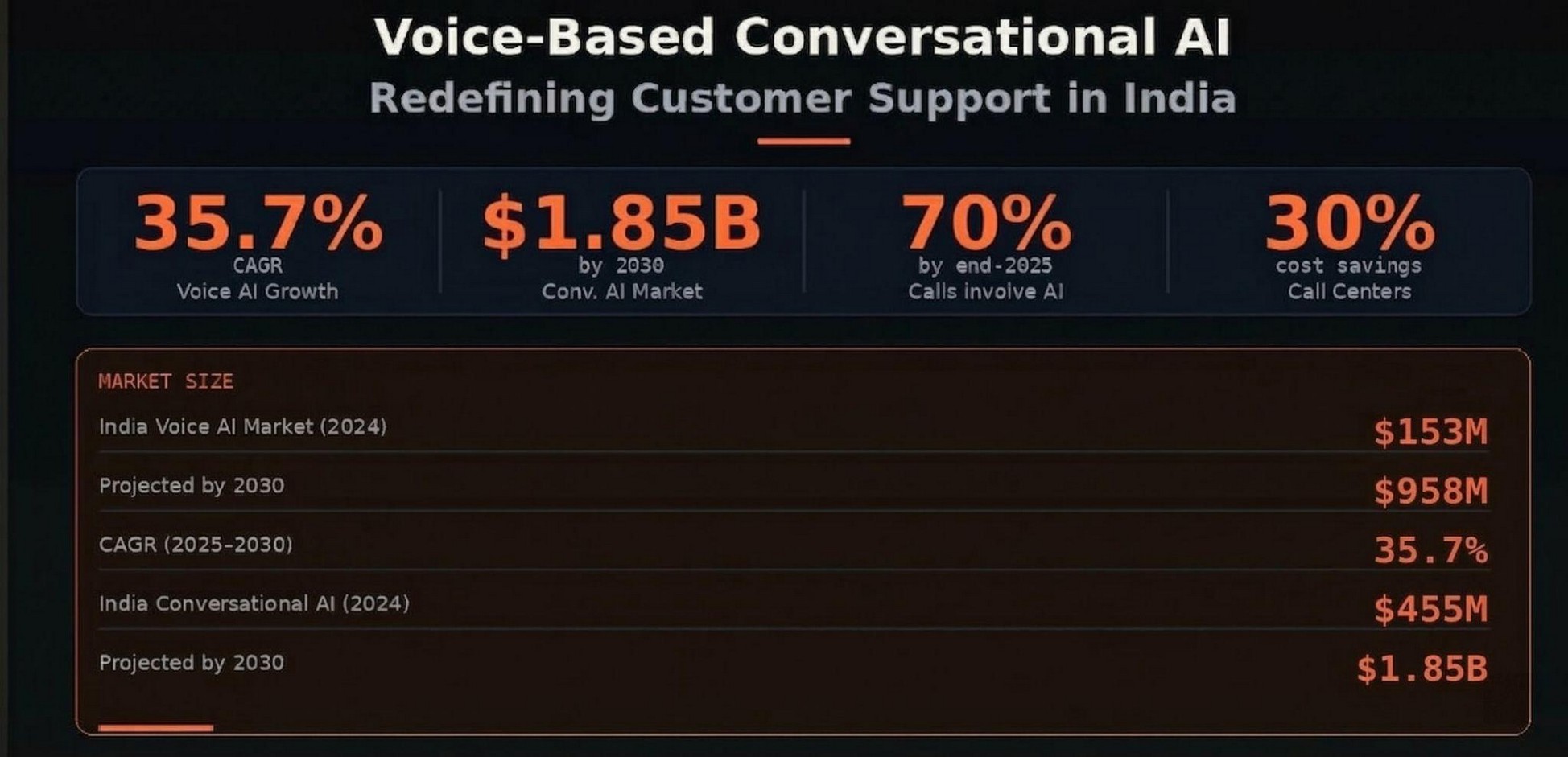
    Today, voice-based conversational AI is rapidly becoming the bridge between technology and accessibility in India. With millions of users more comfortable speaking than typing, especially in regional languages, voice interfaces are helping businesses reach customers who were previously underserved by digital platforms.

    The Indian Customer Support Problem

    Before understanding the solution, it is essential to appreciate the scale and complexity of the problem. India’s customer support landscape is one of the most demanding in the world. With a population of 1.4 billion spanning rural villages and metropolitan megacities, companies must serve customers across wildly different literacy levels, digital comfort zones, and linguistic preferences.

    Traditional customer support in India relied on massive call centres, and for good reason. Many Indian consumers, particularly those in semi-urban and rural areas, trust voice-based interaction far more than text-based alternatives. They find typing in English cumbersome and typing in regional scripts even harder on smartphones. Speaking, however, feels natural and immediate.

    But human-led call centres come with enormous operational costs, high attrition rates, and an inability to scale during sudden demand spikes, think festivals, IPL seasons, or government scheme launches that trigger millions of simultaneous queries. The industry needed a smarter solution, and voice-based conversational AI arrived at precisely the right moment.

    What is Voice-based Conversational AI?

    Voice-based conversational AI refers to technology that enables machines to understand spoken natural language, process it intelligently, and reply in a way that feels human. Unlike the robotic IVR systems of the early 2000s that frustrated callers into pressing “0” desperately to reach a human agent, today’s voice AI can hold nuanced, context-aware dialogues.

    And in India, where over 19,500 languages and dialects coexist, this technology is not merely a convenience, it is rapidly becoming a necessity.

    Why Voice-Based Conversational AI Fits India Perfectly?

    The Oral Communication Preference

    India has deep oral traditions. Storytelling, instructions, transactions, much of everyday life, especially outside metros, still flow through verbal exchange. When WhatsApp voice notes overtook typed messages in rural India long before they did in Western markets, it signalled something important: Indian users prefer speaking. Voice-based conversational AI aligns perfectly with this cultural reality, meeting users where they naturally are.

    Low Literacy Barriers Are Dissolved

    According to census estimates, India has hundreds of millions of citizens with limited literacy or low digital literacy. For these users, text-based chatbots are essentially inaccessible. Voice-based conversational AI dramatically lowers the barrier to accessing services, whether it is checking a bank balance, filing a complaint about a car service, or inquiring about an insurance plan. The technology democratises access in ways no text interface ever could.

    The Multilingual Imperative

    Perhaps nowhere else in the world does language diversity present as acute a challenge as it does in India. A telecom company serving customers across Gujarat, Tamil Nadu, West Bengal, and Punjab is essentially serving four entirely different linguistic communities. Modern voice-based conversational AI platforms are being trained on massive multilingual datasets to handle not just formal language but colloquial mixing, “Hinglish” (Hindi-English blend), “Tanglish” (Tamil-English blend), and dozens of other combinations that are simply how Indians speak in practice.
    Voice-Based Conversational AI Redefining Customer Support in India

    Sectors Leading the Voice AI Revolution in India

    Banking, Financial Services, and Insurance (BFSI)

    The BFSI sector has become one of the most aggressive adopters of voice-based conversational AI in India.

    Large public and private sector banks are deploying voice AI agents capable of handling account queries, loan status checks, fraud alerts, and even preliminary loan eligibility assessments.

    For a first-time bank account holder in a small town in Jharkhand with little familiarity with app navigation, simply saying “mera balance batao” (tell me my balance) in Hindi and receiving an instant, accurate response is transformative.

    Insurance companies use voice AI to help customers file claims in local languages. This reduces drop-off rates and dependence on human agents for routine tasks.

    As a result, the key benefits are faster claim resolutions, lower operational costs, and customers who feel acknowledged and supported.

    Telecom

    India’s telecom giants handle hundreds of millions of support calls each year. Voice-based conversational AI is now autonomously managing a growing share of queries, including recharge requests, plan comparisons, SIM requests, and complaints, without human intervention. Key takeaway: Voice AI enables telecoms to scale support and improve customer self-service.

    Ecommerce and Quick Commerce

    As ecommerce expands in Tier 2, 3, and 4 cities, supporting customers in their preferred language around the clock is essential. Voice-based AI enables personalized, instant resolution without navigating complex interfaces. For many first-time online shoppers, a voice-first approach reduces anxiety and builds trust.

    Telemarketing

    Telemarketing in India has long relied on thousands of agents making scripted calls, hoping for conversions. Voice-based conversational AI is changing this model. Companies deploy AI-powered outbound voice agents that initiate contextual, personalized conversations at scale, without the fatigue or inconsistency of human teams.

    Beyond outbound selling, voice AI transforms inbound telemarketing, handling product enquiries, eligibility checks, and upselling with a naturalness that keeps prospects engaged. In sectors such as mutual funds, credit cards, insurance, and real estate, where a well-timed conversation can convert a customer, AI-assisted telemarketing is becoming a competitive advantage.

    The Human-AI Partnership Model

    Contrary to fears of mass replacement, the most successful deployments of voice-based conversational AI in India operate on a human-AI collaboration model.

    The Human-AI Partnership in Customer Support

    The AI handles high volumes of routine, repetitive queries autonomously, freeing human agents to focus on complex, emotionally sensitive, or high-value interactions that genuinely benefit from human empathy and judgment.

    Key takeaway: The human-AI partnership increases both operational efficiency and agent job satisfaction.

    When a customer’s voice signals rising frustration or the query involves a sensitive personal situation, such as a bereavement affecting an insurance claim, or a disputed transaction causing financial distress, a well-designed voice AI system recognises the emotional cues and seamlessly transfers the interaction to a human agent, preserving full context.

    This orchestration of AI efficiency and human warmth is where Indian customer support is heading.

    The result is better outcomes across multiple dimensions: faster resolution for most customers, more meaningful work for human agents, lower operational costs for businesses, and a customer support experience that actually feels respectful of the customer’s time and dignity.

    Conclusion

    Voice-based conversational AI is transforming customer support in India, redefining who can access services, in which language, at what hour, and at what cost. For a country that values spoken dialogue, AI that truly listens feels like technology aligning with the people’s needs.

    For businesses in India, the challenge is to deploy voice-based conversational AI quickly and thoughtfully. For millions who struggled due to language barriers or unfamiliar digital interfaces, voice AI offers the promise of being heard.

    How Ello Powers Customer Support?

    Adaptive Prompt Technology: Our agents don’t just follow a script; they rewrite their own playbook in real-time to optimize outcomes, embodying the true spirit of Agentic AI.

    Multi-Agent Networks: Ello utilizes specialized sub-agents to audit and improve conversations at machine speed, ensuring accuracy and continuous learning.

    Low-Latency Infrastructure: We understand that in a voice-first world, speed is trust. Our infrastructure is built for sub-second responses, ensuring conversations feel natural and human.

    Enterprise-Grade Security: With SOC 2 and HIPAA compliance, Ello provides the governance and safety required for the next generation of AI deployment.

    True Multilingual & Dialect Mastery: In a linguistically diverse market like India, businesses traditionally had to hire separate support teams for regional languages. With Ello, you don’t need that. Our agents can switch naturally between languages mid-conversation (e.g., from Hindi to English) just as a native speaker.

    This massive consolidation significantly reduces hiring effort and operational costs, allowing a single AI workforce to serve the entire country.

    FAQs

    1. What is voice-based conversational AI?

    Voice-based conversational AI enables users to interact with systems via spoken language. It uses speech recognition and natural language processing to understand and respond to customer queries.

    2. Why is voice AI important for customer support in India?

    India has diverse languages, and many users prefer speaking over typing. Voice AI helps businesses serve customers in their preferred language and improves accessibility.

    3. How does voice AI improve customer service efficiency?

    Voice AI automates routine queries, gives instant responses, and works 24/7. This reduces wait times and allows human agents to handle complex issues.

    4. Can voice-based AI understand regional languages in India?

    Yes. Modern voice AI systems are trained on multiple Indian languages and dialects, enabling natural interactions across regions.

    5. Which industries benefit the most from voice-based AI in India?

    Banking, healthcare, telecom, e-commerce, and travel benefit most. These industries manage high volumes of customer queries that voice AI can automate.


  • How Voice AI Agents are Modernizing India’s Digital Insurance Ecosystem

    How Voice AI Agents are Modernizing India’s Digital Insurance Ecosystem

    India is currently navigating a pivotal era in its financial history. As we move through 2026, the Insurance Regulatory and Development Authority of India (IRDAI) has set ambitious goals for “Insurance for All” by 2047.

    Achieving this vision requires more than just policy reform; it requires a radical leap in how insurers interact with a population of 1.4 billion people.

    The traditional barriers to insurance adoption in India, such as complex jargon, linguistic diversity, and slow claims processing, are being systematically dismantled by Voice AI for Insurance.

    The ecosystem is shifting from a mobile-first approach to a voice-first paradigm. This transition is driven by the realization that while digital literacy is rising, the most natural way for the Indian consumer to manage their financial security is through conversation.

    Today, agentic voice AI is not just a customer service tool; it is becoming the primary operational engine for India’s digital insurance renaissance.

    The Indian Context: Beyond Traditional Automation

    The Indian insurance market presents unique challenges that legacy automation could never fully address. High linguistic diversity, varying levels of financial literacy, and a deep-seated preference for human-like reassurance have often made static chatbots feel inadequate.

    Bridging the Language Gap

    In 2026, the most significant modernization in India’s insurance sector is the mastery of vernacular speech.

    Voice AI for Insurance has evolved to understand not just the 22 scheduled languages of India, but hundreds of regional dialects.

    This is crucial for penetration into Tier 2 and Tier 3 cities, where consumers may be comfortable with digital payments but prefer discussing life or health coverage in their native tongue.

    Voice AI Bridging the Language Gap in India

    Modern voice agents now utilize advanced Natural Language Understanding (NLU) to handle code-switching, a common practice in India where speakers switch between languages mid-sentence.

    By providing a “human-level” understanding of these nuances, insurers are building the trust necessary to close the protection gap in rural and semi-urban markets.

    The Move to Agentic Reasoning

    Previous iterations of voice technology relied on rigid scripts that often left customers frustrated. In the current 2026 landscape, the industry has transitioned to agentic workflows.

    An agentic system does not just follow a path; it reasons through a problem. If a farmer in Maharashtra calls to inquire about crop insurance after a weather event, the AI understands the context, queries live weather data, and initiates the claim process without needing a human to intervene.

    This ability to reason and execute makes Voice AI for Insurance a formidable tool for operational scale.

    Multi-Agent Frameworks in Policy Management

    One of the most profound shifts in the digital ecosystem is the deployment of multi-agent frameworks. Instead of a single bot trying to do everything, insurance companies now use a coordinated fleet of specialized AI agents.

    The Claims Coordination Agent

    Claims are the “moment of truth” in insurance. A specialized claims agent can now handle the First Notice of Loss (FNOL) via voice, capturing emotional cues and urgent needs. It then coordinates with an evidence-gathering agent that might send the customer a secure link for photo uploads or even pull data from IoT sensors in a connected vehicle or smart home.

    The Underwriting and Risk Agent

    During a voice interaction for a new policy, a specialized risk agent can analyze the data provided by the customer in real-time.

    By the time the conversation ends, the AI has already cross-referenced the customer’s history and external risk databases to provide a personalized premium quote.

    This synergy between different AI agents ensures that the customer experience is seamless while the internal business logic remains rigorous.

    Industry Projections and Economic Impact

    The economic case for Voice AI for Insurance in India is supported by compelling market data. Projections for late 2026 suggest that AI-driven interactions will reduce the cost of customer acquisition for Indian insurers by up to 30%.

    • Increased Penetration: Voice-enabled agents are expected to contribute to a 15% increase in insurance density across rural India by 2027.
    • Reduction in TAT: The Turnaround Time (TAT) for simple health and motor claims has been reduced from days to minutes in organizations that have fully integrated voice-to-action workflows.
    • Fraud Mitigation: AI-driven voice analysis is now a standard part of the Indian fraud detection toolkit, identifying inconsistencies in verbal reports that might be missed in written forms.

    Trust, Transparency, and Regulation

    As the technology becomes more prevalent, the focus has shifted toward ethical AI and data sovereignty. The Indian government’s focus on Digital Public Infrastructure (DPI) has paved the way for secure, interoperable AI systems.

    In 2026, transparency is a mandate. Voice agents are required to be clear about their nature, and data privacy frameworks ensure that the voice biometrics and personal details of Indian citizens are protected under the latest Digital Personal Data Protection (DPDP) standards.

    This regulatory clarity has given insurers the confidence to deploy Voice AI for Insurance at a massive scale, knowing that the guardrails are firmly in place.

    Trust, Transparency and Regulation in Voice AI Insurance

    The Ello Advantage in the Indian Market

    While the broader industry moves toward automation, Ello provides the specific cognitive infrastructure required to excel in India’s complex environment.

    Built on 2026-standard agentic frameworks, Ello goes beyond conversation to provide a Voice-to-Action engine that integrates directly with India’s emerging digital insurance platforms and Bima Sugam portals.

    Its Adaptive Prompting Engine is specifically designed to handle the linguistic diversity and cultural nuances of the Indian consumer, allowing insurers to deploy intelligent agents that don’t just talk, but execute tasks: from real-time policy modifications to complex claims orchestration.

    By providing an enterprise-ready, SOC 2 compliant platform, Ello allows Indian insurers to scale their operations globally while maintaining a local, empathetic touch.

    FAQ: Voice AI for Insurance

    Q1: Can Voice AI for Insurance handle the wide variety of Indian accents?

    Yes. In 2026, advanced speech-to-text engines are trained on massive datasets representing India’s diverse linguistic landscape. This ensures that a speaker from Kerala and a speaker from Punjab receive the same high level of comprehension.

    Q2: Is it possible to file a claim entirely through a voice agent?

    For many routine claims, such as motor glass or certain health benefits, the entire process can be completed via voice. The AI gathers the details, verifies the policy, and triggers the payout workflow autonomously.

    Q3: How does this technology help with the “Bima Sugam” initiative?

    Bima Sugam aims to be a one-stop shop for all insurance needs in India. Voice AI acts as the natural interface for this platform, allowing users to query, compare, and buy policies using simple voice commands in their preferred language.

    Q4: Will voice AI replace local insurance agents in India?

    No. Voice AI for Insurance is a tool for augmentation. It handles the high-volume, routine queries, allowing human agents and advisors to focus on providing deep financial advice and building long-term relationships with their clients.

    Q5: Is voice data secure under the new Indian data laws?

    Yes. Leading platforms utilize end-to-end encryption and adhere to the Digital Personal Data Protection (DPDP) Act, ensuring that voice recordings and transcripts are processed securely and deleted or anonymized according to strict compliance rules.

    Conclusion: A Conversational Future for Indian Insurance

    The modernization of India’s insurance ecosystem is inextricably linked to the evolution of voice technology.

    By moving away from the friction of digital forms and rigid menus, the industry is finally speaking the language of its customers.

    The goal for 2026 and beyond is to make insurance as accessible as a simple conversation, ensuring that every citizen has the protection they need through the power of agentic Voice AI for Insurance.

    Transform your insurance operations today. Visit Ello

  • Ello: The Voice AI for Customer Support of the Future

    Ello: The Voice AI for Customer Support of the Future

    Talking of enterprise operations, scalability has always been limited by the “human bottleneck.” As call volumes spike and customer expectations for 24/7 service become non-negotiable, traditional call centers are hitting a breaking point.

    Voice AI for customer support is no longer a futuristic “nice-to-have”, it is the primary driver of operational resilience in 2026. With the ability to handle thousands of concurrent queries with zero latency and at a fraction of the cost of traditional systems, AI voice agents for customer support are redefining the bottom line.

    It’s time to move past the era of “automated responses” and embrace a future where voice agents execute complex tasks, resolve issues in seconds, and free your human talent for the work that truly requires a heartbeat.

    Let’s take an in-depth look at why voice AI for customer support is positioned as the future of service operations, the measurable impact it delivers, and real-world applications.

    What is Voice AI?

    Voice AI, or Voice Artificial Intelligence, refers to intelligent systems that understand, interpret, and respond to human speech using natural language processing (NLP), machine learning, and speech recognition technologies.

    Unlike traditional automated voice menus or IVR (Interactive Voice Response), modern voice AI can carry out conversations, detect user intent, and even recognize emotional cues.

    When we talk about voice AI for customer support, we mean using voice-enabled AI to handle customer queries, resolve issues, or guide users through conversational interactions that feel natural and human.

    Today, businesses increasingly rely on AI voice agents for customer support to manage large call volumes, automate routine conversations, and deliver faster responses without increasing operational costs.

    How Voice AI Works in Customer Support

    Voice AI in customer support usually uses three main technologies to function effectively:

    Automatic Speech Recognition (ASR)

    ASR converts a customer’s spoken words into text as they are spoken. This allows the voice AI system to understand exactly what the user is saying.

    Modern ASR technology is also the backbone of top AI voice transcription for customer support, enabling businesses to generate precise transcripts for analytics, compliance, and training.

    Natural Language Understanding (NLU)

    NLU helps the system understand the meaning and purpose behind what a customer is saying. It enables the AI to accurately grasp the customer’s request, even when the language is informal or conversational.

    This capability powers a highly responsive AI voice agent for customer support, enabling it to interpret context, intent, and conversational nuance.

    Text-to-Speech (TTS)

    After the AI has understood the customer’s intent, TTS transforms its response back into spoken words that sound natural and close to what a human would say.

    Together, these technologies enable voice AI to have smooth and intelligent conversations, making it a great choice for customer support that values both efficiency and a personal touch.

    Why Voice AI Is the Future of Customer Support?

    The reasons Voice AI is poised to become the future of customer support are multifaceted. From elevated customer experience to business scalability, Voice AI offers advantages that traditional support systems cannot match.

    Why Voice AI Is the Future of Customer Support

    24/7 Availability

    One of the most significant limitations of human-only support is availability. Customers expect answers immediately, regardless of time zones or business hours.

    Voice AI systems operate around the clock, ensuring customers can access support anytime. With AI voice agents for customer support, businesses can deliver instant assistance even during peak demand or outside working hours.

    This continuous availability significantly improves customer satisfaction and trust.

    Scale Without Additional Costs

    Traditionally, scaling customer support requires hiring more agents, increasing infrastructure costs, and managing growing queues. Voice AI eliminates this dependency.

    Whether a business receives 100 or 10,000 calls a day, Voice AI systems can scale automatically without requiring a proportional increase in staffing or resources. It’s this cost-efficient scalability that positions Voice AI as the future of support operations.

    Faster Resolution Times

    Customers don’t want to be kept waiting, nor do they want to repeat themselves to multiple agents. Voice AI can process queries quickly and provide instant or near-instant answers.

    As AI models learn from interactions, the system continuously improves. Over time, AI voice agents for customer support become more capable of handling complex conversations, further reducing resolution times.

    Personalized Conversations at Scale

    Voice AI systems can access customer history, preferences, and account context in real time. This means they can deliver personalized support experiences to new customers as well.

    Voice AI doesn’t just provide scripted responses; it adapts its answers to the customer’s context, creating a personalized experience that traditional automated systems cannot match.

    Reduced Human Error and Consistency

    Human agents are valuable, but they are also prone to fatigue, miscommunication, or inconsistency. Voice AI adheres to the highest standards of accuracy, delivering consistent responses every time.

    Furthermore, voice AI stays up to date with product changes, policy updates, and new service offerings, ensuring customers always receive the latest information.

    Better Data, Better Insights

    Every interaction with Voice AI generates valuable data. Businesses can analyze trends, customer pain points, language patterns, and feedback to optimize products and services.

    Traditional call center data is often unstructured and difficult to interpret. With voice AI for customer support, insights become structured, searchable, and actionable, accelerating business intelligence and decision-making.

    Multilingual Support Without Extra Staff

    Global companies often face language barriers in customer support. Hiring multilingual agents can be expensive and limited in reach.

    Voice AI systems can communicate in multiple languages, dialects, and accents. This allows businesses to expand globally without operational complexity.

    For global brands, AI voice agents for customer support make multilingual service both efficient and cost-effective.

    Real-World Applications of Voice AI in Customer Support

    Voice AI agents are already transforming customer support across industries. Here are some powerful, real-world use cases:

    eCommerce and Retail

    Voice AI handles order tracking, shipping status, return requests, and product recommendations, offering a conversational experience that mimics speaking with a support agent.

    Banking and Financial Services

    In financial support, Voice AI authenticates users, answers balance inquiries, assists with payments, and supports fraud detection, all while maintaining security and compliance.

    Healthcare

    Healthcare providers leverage voice AI to offer appointment scheduling, basic symptom checks, prescription refill reminders, and patient follow-ups, thereby improving patient engagement while reducing staffing burden.

    Telecommunications

    Voice AI resolves network issues, handles bill inquiries, handles plan changes, and resolves service outages, enhancing the customer experience while reducing call center load.

    Travel and Hospitality

    From flight updates to hotel booking queries, Voice AI supports customers at every step of their journey, making travel navigation smoother and more efficient.

    Best AI Voice Agents for Customer Support 2026

    As voice AI adoption accelerates, several platforms are emerging as leaders in the space. Businesses looking to implement intelligent support solutions often evaluate the best AI voice agents for customer support in 2026 based on scalability, conversational accuracy, and integration capabilities.

    Among the leading companies in voice AI customer support, platforms like Ello are gaining strong recognition for their ability to automate complex conversations while maintaining a natural, human-like experience.

    Ello’s voice AI agents are designed to manage inbound and outbound calls, qualify leads, handle support queries, and integrate seamlessly with existing CRM and business systems. By combining conversational intelligence with automation, Ello enables organizations to transform customer support into a scalable and efficient operation.

    The Future: AI and Humans as a “Unified Team”

    The narrative that AI will replace humans is shifting toward one of augmentation. In 2026, we see the rise of the “Super Agent.”When a Voice AI encounters a situation it cannot handle, perhaps a distraught customer or a highly technical legal query, it doesn’t just “drop” the call. It performs a “warm handoff” to a human agent.

    AI and Humans as a Unified Team

    The human receives a real-time transcript and a summary of what has already happened, allowing them to step in with full context. This collaboration ensures that the customer experience remains seamless while empowering human workers to do what they do best: connect emotionally.

    Conclusion

    Voice AI for customer support is more than an upgrade to automated support, it’s a paradigm shift. It improves response times, delivers personalized experiences, and empowers businesses to scale with intelligence.

    As consumers seek faster, smarter, and more conversational support, voice AI will become an essential differentiator for brands. Organizations that adopt solutions from leading companies for voice AI customer support, such as Ello, will gain a competitive edge by delivering faster, smarter, and more efficient customer experiences. Organizations that adopt solutions from leading companies for voice AI customer support, such as Ello, will gain a competitive edge by delivering faster, smarter, and more efficient customer experiences.

    The future of customer support isn’t human-only or robot-only; it’s intelligent, conversational, and powered by voice AI agents.

    How Ello Powers Customer Support?

    Adaptive Prompt Technology

    Our agents don’t just follow a script; they rewrite their own playbook in real-time to optimize outcomes, embodying the true spirit of Agentic AI.

    Multi-Agent Networks

    Ello utilizes specialized sub-agents to audit and improve conversations at machine speed, ensuring accuracy and continuous learning.

    Low-Latency Infrastructure

    We understand that in a voice-first world, speed is trust. Our infrastructure is built for sub-second responses, ensuring conversations feel natural and human.

    Enterprise-Grade Security

    With SOC 2 and HIPAA compliance, Ello provides the governance and safety required for the next generation of AI deployment.

    True Multilingual & Dialect Mastery

    In a linguistically diverse market like India, businesses traditionally had to hire separate support teams for regional languages. With Ello, you don’t need that. Our agents can switch naturally between languages mid-conversation (e.g., from Hindi to English) just as a native speaker.

    This massive consolidation significantly reduces hiring effort and operational costs, allowing a single AI workforce to serve the entire country.

    FAQs

    1. What is Voice AI for Customer Support?

    Voice AI for customer support is an AI-powered system that understands and responds to customer queries via natural-language conversations. It uses speech recognition and natural language processing to deliver real-time assistance.

    2. How is Voice AI different from traditional IVR systems?

    Unlike traditional IVR, which relies on fixed menus and keypad inputs, Unlike traditional IVR, which relies on fixed menus and keypad inputs, voice AI agents understand natural speech and context. It enables dynamic, human-like conversations instead of scripted responses.

    3. Can Voice AI handle complex customer queries?

    Yes, modern voice AI agents can handle multi-step, context-aware conversations. For highly complex issues, they can seamlessly transfer the call to a human agent with full context.

    4. Can Voice AI provide multilingual support?

    Yes, Voice AI systems can support multiple languages and accents. This makes it easier for businesses to serve global customers without expanding large multilingual teams.

    5. How does Voice AI improve customer satisfaction?

    Voice AI reduces wait times, provides instant responses, and delivers consistent service. Faster resolution and personalization significantly enhance the customer experience.

  • How Conversational IVR Turns Calls into Real Conversations in 2026

    How Conversational IVR Turns Calls into Real Conversations in 2026

    For decades, the term “IVR” (Interactive Voice Response) was synonymous with customer frustration.

    The rigid “Press 1 for Sales” menus and the repetitive “I’m sorry, I didn’t get that” prompts created a wall between businesses and their customers.

    However, as we move through 2026, the technology has undergone a fundamental metamorphosis. The legacy, tree-based systems have been dismantled in favor of Conversational IVR.

    This shift represents more than a simple upgrade in voice recognition; it is a total reimagining of the phone-based customer experience.

    Powered by agentic AI and Large Language Models (LLMs), Conversational IVR has moved from being a tool of “call deflection” to a tool of “call resolution.”

    In this new era, the goal is no longer to keep the customer away from a human agent, but to provide a human-like, reasoning interaction that solves problems in real-time.

    What Defines Conversational IVR in 2026?

    In 2026, Conversational IVR is defined by its ability to understand intent, manage context, and execute complex workflows autonomously. It is the voice front-end of a broader agentic ecosystem.

    Conversational IVR Voice Agent

    Beyond Keyword Recognition

    Legacy systems relied on directed dialogue, forcing the user to speak specific keywords. Modern Conversational IVR utilizes “Open-Ended Natural Language Understanding” (NLU).

    When a system greets a caller with “How can I help you today?”, it is capable of parsing complex, multi-intent sentences such as: “I need to check if my refund was processed, and if so, can I use that credit to upgrade my subscription for next month?”

    Real-Time Reasoning and Context Retention

    The hallmark of 2026-standard systems is their memory. If a caller mentions a flight delay at the start of the call, the Conversational IVR maintains that context throughout the interaction.

    It does not treat every turn of the conversation as a new event; rather, it builds a “Cognitive Thread” that allows for follow-up questions and clarification without the caller needing to repeat themselves.

    The Technological Architecture of Modern Voice Agents

    The transition to truly “real” conversations is made possible by the convergence of several high-order technologies.

    High-Fidelity ASR and Neural TTS

    Automatic Speech Recognition (ASR) has reached a plateau of near-perfect accuracy, even in noisy environments or with heavy regional accents.

    Simultaneously, Neural Text-to-Speech (TTS) has evolved to include “Prosody,” the natural rhythm, stress, and intonation of human speech. This allows Conversational IVR to sound empathetic, professional, and indistinguishable from a human in 95% of routine interactions.

    Multi-Agent Orchestration

    In 2026, the IVR is rarely a single monolithic program. Instead, it is a primary agent that orchestrates several specialist agents:

    • The Validator Agent: Handles identity and verification.
    • The Knowledge Agent: Queries internal documentation and FAQs.
    • The Action Agent: Interacts with the ERP or CRM to execute changes.

    By distributing these tasks, Conversational IVR can process information with much higher precision and lower latency than previous generations.

    Agentic Reasoning Layers

    Unlike previous bots that followed “If-Then” logic, modern systems use agentic reasoning.

    They are given a goal, such as resolving a customer’s billing dispute, and the tools to achieve it.

    The AI reasons through the best path to that goal, making decisions in real-time based on the customer’s specific policy and sentiment.

    Market Trends and Projections for 2026

    The adoption of Conversational IVR is accelerating across all major service-heavy sectors. Industry research suggests that the market for intelligent voice agents will grow at a CAGR of 22% through 2030.

    The Rise of “Voice-First” Customer Service

    Projections for 2026 indicate that over 70% of initial customer contacts in the financial and hospitality sectors will be handled by Conversational IVR.

    Businesses are moving away from “Digital-Only” strategies as they realize that voice remains the most efficient medium for resolving complex emotional or urgent issues.

    Closing the “Trust Gap”

    Data from late 2025 shows that customer trust in AI-led voice systems has increased by 40% year-over-year. This is largely attributed to the transparency and speed of Conversational IVR.

    When a system can solve a problem in 90 seconds that used to take a 15-minute hold time, the AI stigma evaporates in favor of utility.

    Conversational IVR Operations

    Best Practices for a Conversational Shift

    Implementing Conversational IVR requires a shift in design philosophy. It is no longer about designing a “flow,” but about designing a “persona” and a “knowledge base.”

    • Prioritize Low Latency: For a conversation to feel “real,” the delay between the user speaking and the AI responding must be under 500ms. In 2026, Edge-AI processing is increasingly used to hit these latency targets.
    • Design for Interruption: Humans interrupt each other. A robust Conversational IVR must support “Barge-in,” where the AI stops speaking the moment the user starts, allowing for a more natural back-and-forth.
    • The “Graceful Handoff”: There will always be edge cases. The system must be able to recognize its own limits and escalate to a human agent with a full transcript and context summary, ensuring a warm transfer.

    Also read: Voice AI for Lead Generation: Converting Calls into Qualified Leads

    Transforming Operations with Ello

    While the potential of Conversational IVR is immense, the challenge for many enterprises lies in the integration with legacy operational systems.

    This is the specific problem Ello was built to solve. As an agentic voice platform designed for the complexities of 2026, Ello doesn’t just provide a voice interface; it provides an “Operational Reasoning Engine.”

    By bridging the gap between digital IT systems and physical OT (Operational Technology) workflows, Ello allows businesses to deploy voice agents that don’t just talk, but actually execute tasks, from booking reservations to triggering industrial maintenance dispatches, all while maintaining a 99% comprehension rate across 100+ languages.

    FAQ: Conversational IVR

    Q1: How does Conversational IVR differ from traditional IVR?

    Traditional IVR is a menu-driven system where callers must follow a fixed path. Conversational IVR is intent-driven, allowing callers to speak naturally and skip menus to get directly to a resolution.

    Q2: Can the AI detect if a caller is angry or upset?

    Yes. Modern systems use sentiment analysis to monitor the caller’s pitch, tone, and vocabulary. If the AI detects high levels of frustration, it can adjust its persona to be more empathetic or trigger an immediate escalation to a human supervisor.

    Q3: Is Conversational IVR secure for sensitive data?

    In 2026, security is a priority. Leading platforms use voice biometrics for authentication and ensure that sensitive data, such as credit card numbers, are tokenized and never stored in the AI’s training logs.

    Q4: How long does it take to train a Conversational IVR on my business?

    With 2026-standard RAG (Retrieval-Augmented Generation) frameworks, you can ground an AI agent on your company’s specific documentation in a matter of days, rather than the months of manual coding required in the past.

    Q5: What happens if the AI doesn’t understand the caller?

    Instead of the dreaded “I’m sorry, I didn’t get that,” Conversational IVR uses clarification loops. It might say, “I’m not quite sure if you mean your checking or savings account; could you clarify that for me?” If it still cannot resolve the issue, it performs a seamless handoff to a human.

    Conclusion: The Strategic Imperative

    The transition to Conversational IVR is not just a technological upgrade; it is a fundamental shift in the customer-brand relationship. In an era where “Speed-to-Resolution” is the ultimate currency, businesses that continue to rely on legacy “Press 1” menus will find themselves losing customers to more agile, AI-integrated competitors.

    The goal for 2026 and beyond is clear: turn every phone call into a real, productive, and intelligent conversation.

  • What’s Next in AI Voice Agents: Trends to Watch in 2026

    What’s Next in AI Voice Agents: Trends to Watch in 2026

    The trajectory of artificial intelligence is moving at breakneck speed. If 2024 was the year of experimentation and 2025 the year of adoption, 2026 will be defined by autonomy.

    We are witnessing a fundamental shift in how businesses interact with AI voice agents. No longer just passive responders to simple queries, these systems are evolving into proactive, decision-making partners that drive revenue and operational resilience.

    As we look toward 2026, the technology is moving beyond simple conversation to execution.

    For business leaders, staying ahead of this curve is not just about competitive advantage—it’s about survival. Here are the critical trends reshaping the landscape of AI voice agents in the coming year.

    1. The Rise of “Agentic AI”: From Talkers to Doers

    The most significant shift for 2026 is the transition from Generative AI to Agentic AI.

    While traditional voicebots could answer questions based on a script, Agentic AI has the ability to reason, plan, and execute multi-step workflows autonomously.

    Gartner has identified Agentic AI as a top strategic trend, predicting that by 2028, at least 15% of everyday business decisions will be made autonomously by AI agents—up from nearly 0% in 2024.

    In 2026, we will see this manifest in voice agents that don’t just say, “I can help with that,” but actually do it.

    • The Shift: Instead of just checking hotel availability (Generative), an Agentic voice agent will check availability, negotiate a room upgrade based on loyalty status, book the reservation, and schedule a car for pickup—all in one fluid voice interaction.
    • Business Impact: This moves AI voice agents from being a cost-saving support tool to a revenue-generating asset capable of closing sales and managing complex logistics without human intervention. The global market for Agentic AI is projected to reach $10.86 billion in 2026, growing at a staggering CAGR of over 40%.

    2. Multi-Agent Systems (MAS): The Digital Workforce

    In 2026, businesses will move away from relying on a single, “know-it-all” AI model. Instead, we will see the deployment of Multi-Agent Systems (MAS).

    This involves a network of specialized agents working together to solve complex problems.

    Just as a human team has a sales specialist, a technical expert, and a billing coordinator, advanced platforms are now architecting AI voice agents similarly.

    • How it Works: When a customer calls, a “Dispatcher Agent” analyzes the intent. If the customer asks a technical question, it’s routed to a “Technical Agent.” If they then ask for a refund, the context is seamlessly passed to a “Billing Agent.”
    • The Benefit: Specialized agents are more accurate, faster, and easier to govern. Gartner predicts that adopting multi-agent systems gives organizations a practical way to automate complex business processes and upskill teams.

    3. Hyper-Personalization via Emotion AI and Biometrics

    The “one-size-fits-all” script is dead. The next generation of AI voice agents will leverage advanced Emotion AI (Sentiment Analysis) and voice biometrics to deliver hyper-personalized experiences in real-time.

    By analyzing vocal cues—pitch, tone, speed, and pauses—AI agents in 2026 will be able to detect user frustration or hesitation instantly. If a customer sounds confused, the agent will automatically slow down and simplify its language. If a customer sounds in a hurry, the agent will switch to a concise, bullet-point style of communication.

    Emotion AI and Hyper-Personalization

    • Voice Biometrics: Secure voice biometrics will replace clunky security questions. A customer’s voice will be their password, allowing AI voice agents to authenticate users in seconds, reducing friction and enhancing security protocols for sensitive industries like banking and healthcare.
    • Memory & Context: Agents will utilize “infinite context windows” to remember not just the current conversation, but every interaction a customer has ever had with the brand, picking up exactly where they left off months ago.

    4. Multimodal Native Interfaces

    While “voice” is the primary medium, 2026 will see the mainstreaming of Multimodal AI. This means AI voice agents will not exist in a vacuum; they will be aware of visual and textual context simultaneously.

    Imagine a customer calling support while looking at a broken washing machine. In a multimodal interaction, the customer can point their phone camera at the device while speaking to the agent.

    The AI “sees” the error code on the screen and “hears” the customer’s description, diagnosing the issue instantly.

    This convergence of voice and vision is accelerating, with IDC predicting that 80% of enterprise AI systems will be capable of processing multiple types of input by 2028.

    5. Sovereign AI and Domain-Specific Models (DSLMs)

    As AI regulation tightens globally, businesses in 2026 will increasingly turn to Domain-Specific Language Models (DSLMs) rather than generic public models.

    Generic models are great for general knowledge, but they lack the nuance of specific industries. AI voice agents for healthcare need to understand complex medical terminology and HIPAA compliance, while those in law need to understand statutes and privilege.

    • The Trend: Enterprises will deploy “Small Language Models” (SLMs) that are trained exclusively on their own proprietary data. This ensures that the voice agent speaks the company’s specific language and adheres to strict AI governance platforms to prevent hallucinations and data leakage.
    • Data Sovereignty: Especially in regions like Europe and India, data sovereignty will drive the adoption of local, on-premise, or private cloud AI solutions to ensure customer data never crosses borders.

    6. The Vernacular Revolution: Breaking Language Barriers

    For global businesses, and particularly for the Indian market, 2026 is the year voice AI breaks the “English-only” barrier. We are moving toward native-level fluency in regional dialects.

    • Code-Mixing: In markets like India, users often speak “Hinglish” (a mix of Hindi and English). By 2026, voice agents will seamlessly handle code-mixing without latency or confusion.
    • Market Growth: The voice AI market in India alone is projected to reach nearly $1 billion by 2030, driven largely by this vernacular adoption. This democratization allows businesses to reach the “next billion users” who are coming online with voice as their primary interface.

    7. Why Ello.ai is Built for 2026

    While many platforms are playing catch-up, Ello.ai was architected with these 2026 trends as foundational pillars.

    • Adaptive Prompt Technology: Our agents don’t just follow a script; they rewrite their own playbook in real-time to optimize outcomes, embodying the true spirit of Agentic AI.
    • Multi-Agent Networks: Ello utilizes specialized sub-agents to audit and improve conversations at machine speed, ensuring accuracy and continuous learning.

    Ello.ai Built for 2026

    Low-Latency Infrastructure

    We understand that in a voice-first world, speed is trust. Our infrastructure is built for sub-second responses, ensuring conversations feel natural and human.

    Enterprise-Grade Security

    With SOC 2 and HIPAA compliance, Ello provides the governance and safety required for the next generation of AI deployment.

    True Multilingual & Dialect Mastery

    In a linguistically diverse market like India, businesses traditionally had to hire separate support teams for regional languages. With Ello.ai, you don’t need that. Our agents can switch naturally between languages mid-conversation (e.g., from Hindi to English) just as a native speaker would. This massive consolidation significantly reduces hiring effort and operational costs, allowing a single AI workforce to serve the entire country.

    Conclusion

    The market for AI voice agents is exploding, with the global agentic AI market projected to reach $45.4 billion by 2029.

    For businesses, the window to adopt this technology as a differentiator is closing; soon, it will be a standard expectation.

    The trends for 2026—autonomy, specialization, empathy, and security—point toward a future where AI agents are not just tools, but trusted digital employees.

    The question for leaders is no longer “Should we adopt Voice AI?” but “How quickly can we deploy Agentic AI to lead our market?”

    FAQ: Common Questions About AI Voice Agents in 2026

    Q1: What is the difference between a chatbot and an Agentic AI voice agent?

    A chatbot typically follows a rigid decision tree to answer FAQs. An Agentic AI voice agent can reason, plan, and autonomously execute tasks—like navigating a CRM to update a record, negotiating a scheduling conflict, or processing a refund—without human intervention.

    Q2: Will AI agents replace my human support team?

    AI agents are designed to augment, not replace. By handling 100% of routine and transactional calls (Tier-1 support), they free up your human experts to focus on high-value, complex, and emotionally sensitive interactions that require a human touch. This shift often leads to higher job satisfaction for human agents.

    Q3: Is my business data secure with AI voice agents?

    Yes, if you choose the right partner. Enterprise-grade platforms utilize AI Security Platforms and Domain-Specific Models to ensure data never leaves your secure environment. Compliance standards like SOC 2, GDPR, and HIPAA are now baseline requirements for top-tier providers like Ello.ai.

    Q4: Can AI voice agents handle complex accents and dialects?

    Absolutely. Modern AI voice agents are trained on vast, diverse datasets. In markets like India, for example, advanced agents can handle “code-mixing” (switching between English and Hindi) and understand regional nuances with high accuracy, opening up markets in Tier-2 and Tier-3 cities.

    Q5: How expensive is it to deploy an AI voice agent?

    The cost has dropped significantly while capabilities have risen. Platforms like Ello.ai offer flexible pricing models that allow businesses of all sizes to deploy enterprise-class AI without massive upfront infrastructure investments. This is significantly cheaper than traditional BPO costs.

    Q6: What industries will see the biggest impact in 2026?

    While all sectors will benefit, Healthcare (for patient intake and triage), Retail (for conversational commerce), and BFSI (for fraud detection and secure banking) are expected to see the fastest adoption and highest ROI in 2026.

  • 5 Ways Conversational AI Boosts eCommerce Sales and Conversions

    5 Ways Conversational AI Boosts eCommerce Sales and Conversions

    Retail in 2026 has shifted from static websites to interactive, reasoning-based storefronts. In the past, shoppers had to navigate frustrating product grids and complex filters to find what they needed. Today, the strategic use of Conversational AI in Ecommerce has replaced those old barriers with a digital environment that actually understands and anticipates customer needs. This change is turning the online shopping journey into a faster, more personalized experience that directly increases sales.

    Today, the AI-first economy has introduced a conversational paradigm where the software understands the shopper.

    At the heart of this shift is the strategic deployment of Conversational AI in Ecommerce, which has transformed the online shopping journey into a personalized, high-conversion experience.

    Modern retailers are moving away from simple automated scripts toward agentic workflows. These systems do not just answer questions: they reason through customer needs and execute complex tasks.

    By creating a more natural and efficient path to purchase, businesses are seeing significant improvements in their bottom line.

    Personalized Product Discovery through Reasoning

    Traditional search bars rely on exact keyword matches, which often lead to “zero results” pages or irrelevant suggestions.

    Conversational AI in Ecommerce solves this by using natural language understanding to act as a digital personal shopper.

    Instead of browsing through hundreds of items, a customer can simply state their requirements. A shopper might say, “I need a durable hiking boot for a rainy climate that fits a wider foot.”

    The AI reasoning engine evaluates the entire inventory, cross-references customer reviews for durability, and presents the best options instantly. This targeted approach reduces the cognitive load on the shopper and significantly increases the likelihood of a sale by presenting the right product at the right moment.

    A person using a laptop with a holographic interface showing various digital icons like a shopping cart, globe, and mobile phone

    Frictionless Task Execution with Voice-to-Action

    One of the biggest hurdles to conversion is the complexity of the checkout and modification process.

    In 2026, leading ecommerce platforms will utilize a voice-to-action engine to streamline these tasks. This technology allows customers to manage their orders using simple verbal commands.

    A user can modify a shipping address, add a last-minute item to a pending order, or apply a promotional code without navigating through multiple account pages.

    By removing the technical friction associated with manual data entry, Conversational AI in Ecommerce makes the purchasing process feel effortless.

    When the barrier to completing a task is lowered, conversion rates naturally rise.

    Proactive Cart Abandonment Recovery

    Cart abandonment remains a persistent challenge for digital retailers. However, the introduction of agentic voice agents has provided a new way to recover lost revenue. Instead of sending a generic follow-up email that may go unread, an intelligent system can engage the customer through a proactive, helpful outreach.

    The AI analyzes the abandonment trigger. If a customer stopped at the shipping page, the agent might reach out to offer a delivery estimate or clarify shipping costs.

    By identifying and resolving the specific blocker that prevented the checkout, Conversational AI in Ecommerce turns a lost lead into a completed transaction.

    This proactive engagement shows the customer that the brand is attentive to their needs, fostering trust and long-term loyalty.

    Multilingual and Vernacular Support for Global Scale

    In a global economy, the ability to communicate in a customer’s native tongue is a competitive necessity. Modern voice AI has dismantled linguistic barriers by providing sophisticated support for diverse languages and regional accents.

    This capability allows ecommerce brands to scale their operations into new territories without the massive overhead of hiring localized support teams.

    Whether a customer is shopping in a metropolitan hub or a regional town, they receive high-quality, reasoning-based assistance.

    This linguistic inclusivity ensures that the brand’s sales message is understood clearly by a diverse global audience, which directly drives international growth.

    This shift toward vernacular intelligence is a defining characteristic of the 2026 digital marketplace.

    Cognitive Orchestration for Post-Purchase Loyalty

    Sales growth is not just about the first transaction: it is about the lifetime value of the customer. Multi-agent frameworks are now used to manage the entire post-purchase journey.

    One agent might handle the tracking and delivery notifications, while another specializes in product setup or returns.

    This coordinated effort ensures that the customer experience remains high even after the payment is made.

    If a customer needs to return an item, they can do so through a quick voice conversation rather than a frustrating form-filling process.

    By making the post-purchase experience as smooth as the initial sale, Conversational AI in Ecommerce encourages repeat business and turns one-time buyers into brand advocates.

    The Ello Advantage in Digital Retail

    As an independent, proprietary agentic voice platform, Ello provides the essential infrastructure for modern ecommerce success.

    Built on 2026-standard frameworks, Ello goes beyond simple chat to provide a true Voice-to-Action engine that integrates with your existing retail stack.

    Ello specifically supports 30 different languages and various regional accents: ensuring your global audience receives native-level service.

    Its Adaptive Prompting Engine allows you to deploy intelligent, reasoning agents that understand customer sentiment and regional nuances in real-time.

    Ello features a self-evolving architecture that learns from every interaction. After approximately 200 calls, the system analyzes performance data to rebuild its own prompts, often driving a 30 percent boost in operational efficiency autonomously.

    If you are looking to solve your conversion challenges and provide a superior shopping experience, we have the answer already.

    A woman sitting at a desk looking at multiple computer screens displaying code and an AI interface labeled Ai Assist with a waveform visualization

    FAQ: Conversational AI in Ecommerce

    How does Conversational AI in Ecommerce improve sales?

    It improves sales by providing personalized product recommendations, reducing checkout friction through voice commands, and proactively resolving customer issues that lead to cart abandonment.

    Can a voice agent handle complex product questions?

    Yes, modern agents use a reasoning engine to access your entire product knowledge base and provide detailed, context-aware answers to specific customer inquiries.

    How many languages does Ello support for ecommerce?

    Ello supports 30 different languages and regional accents, allowing you to provide a localized shopping experience to a global audience.

    Does this technology integrate with my existing ecommerce platform?

    Yes, proprietary platforms like Ello are designed to integrate directly with enterprise CRMs and digital storefronts to ensure a seamless data flow.

    Is Conversational AI in Ecommerce secure for processing payments?

    Enterprise-grade platforms maintain SOC 2 and HIPAA-level compliance to ensure that all customer data and transaction details are encrypted and protected.

    Conclusion: The Future of Digital Sales

    The shift toward a conversational economy is permanent. By embracing Conversational AI in Ecommerce, retailers are moving beyond the limitations of traditional web interfaces and meeting their customers in a natural, helpful, and efficient way.

    The businesses that thrive in 2026 will be those that treat their software not as a static tool, but as a reasoning teammate that drives every sale.

  • AI Telemarketing: How Voice AI Is Transforming Sales Outreach in India

    AI Telemarketing: How Voice AI Is Transforming Sales Outreach in India

    India’s sales landscape is currently undergoing a structural transformation as we move through 2026. For years, outbound sales were defined by high-volume, low-intent calling patterns that often resulted in brand fatigue and low conversion rates. Now, AI telemarketing is here to change everything.

    Telemarketing AI evolution represents a move away from repetitive, scripted interactions toward intelligent, reasoning-based conversations that respect the prospect’s time and specific needs.

    The emergence of agentic voice technology allows businesses to conduct outreach at a massive scale without sacrificing the quality of the interaction.

    By leveraging sophisticated natural language understanding, organizations are now able to engage with prospects across the subcontinent in a way that feels natural and helpful.

    This shift is not merely about increasing call volume: it is about enhancing the relevance and effectiveness of every single interaction.

    The Shift Toward Intent-Driven Outreach in 2026

    The primary difference between legacy outbound calling and modern AI telemarketing lies in the concept of intent. In 2026, sales outreach is no longer a game of chance. Intelligent agents use predictive data to initiate conversations with prospects who have already demonstrated a high likelihood of interest.

    Cognitive Discovery and Qualification

    Instead of a standard pitch, an agentic voice system conducts a cognitive discovery session. The AI listens to the prospect’s responses, identifies their unique pain points, and adjusts the conversation in real-time.

    This level of adaptability ensures that the outreach is perceived as a consultation rather than a generic solicitation. When a prospect raises a specific concern, the AI reasons through the best possible response based on the company’s internal knowledge base: providing immediate value and building trust during the very first touchpoint.

    Eliminating the “Speed to Lead” Gap

    Research from the Indian sales sector indicates that the probability of qualifying a lead increases significantly when the contact happens within the first minute of an inquiry.

    AI telemarketing enables this zero-latency response. As soon as a digital trigger occurs, an intelligent voice agent can initiate a follow-up call, ensuring the brand engages the prospect while their interest is at its peak.

    AI telemarketing call center

    Cognitive Orchestration: The Multi-Agent Advantage

    A defining trend of 2026 is the use of multi-agent frameworks to manage the sales funnel. This approach involves several specialized agents working together to ensure a seamless prospect journey.

    • The Prospecting Agent: This agent handles the initial outbound call, conducts the primary discovery, and verifies the prospect’s intent.
    • The Scheduling Agent: Once a lead is qualified, this specialist manages the calendar coordination, offering available slots and confirming the meeting for a human account executive.
    • The Intelligence Agent: Throughout the process, this agent structures the conversation data and updates the CRM with detailed notes, ensuring no information is lost during the handoff.

    This coordinated effort ensures that the sales outreach is professional and highly efficient, allowing the human sales team to walk into every meeting with a comprehensive understanding of the client’s requirements.

    Solving the Vernacular Challenge in Indian Sales

    The Indian market presents a unique linguistic challenge that has historically limited the reach of centralized sales teams. AI telemarketing provides a solution through vernacular intelligence.

    Modern systems can interact with prospects in 30 different languages and various regional accents, ensuring that the message is delivered in the tongue the prospect feels most comfortable using.

    This capability is particularly vital for expanding into Tier 2 and Tier 3 cities. The AI can handle code-switching, where a prospect might use a mix of their regional language and English.

    By understanding these cultural and linguistic nuances, businesses can achieve national scale without the overhead of training and managing localized human calling teams for every region.

    The Ello Solution for Modern Sales Teams

    As an independent agentic voice platform, Ello provides the critical infrastructure required to excel in India’s competitive sales environment.

    Built on 2026-standard frameworks, Ello goes beyond simple automation to provide a Voice-to-Action engine that integrates directly with existing enterprise sales stacks.

    Its Adaptive Prompting Engine allows businesses to deploy intelligent, reasoning agents that handle sentiment and linguistic variety in real-time.

    By providing an enterprise-ready, SOC 2-compliant platform, Ello allows organizations to scale their sales outreach globally while maintaining a localized, empathetic touch.

    It provides the answer for businesses looking to fix their lead decay problems and drive higher conversion rates through intelligent, self-evolving interactions.

    AI telemarketing vernacular sales

    FAQ: AI Telemarketing

    1. What is the primary advantage of AI telemarketing over traditional methods?

    The primary advantage is the ability to conduct personalized, intent-driven outreach at scale without the labor costs and training requirements of a manual calling team.

    2. How does AI telemarketing in sales improve conversion rates?

    AI telemarketing calls improve conversions by reducing response times to under a minute and using agentic reasoning to provide relevant, helpful information tailored to the prospect’s specific needs.

    3. Can AI telemarketing agents handle common sales objections?

    Yes, modern agents use adaptive prompting to identify objections and provide data-driven responses based on a company’s approved sales playbook.

    4. Is AI telemarketing compliant with Indian telecommunications regulations?

    Yes, enterprise platforms are designed to adhere to the latest TRAI guidelines and data protection laws, ensuring all outreach is conducted legally and ethically.

    5. How many languages does Ello support for sales outreach?

    Ello supports 30 different languages and various regional accents, allowing businesses to engage with prospects across the diverse linguistic landscape of India.

    Conclusion: The Path to Scalable Growth

    The future of sales outreach in India is inextricably linked to the evolution of voice intelligence. By moving away from the friction of manual dialing and rigid scripts, the industry is finally embracing a model that prioritizes both efficiency and the customer experience.

    The goal for 2026 is clear: turn every outbound interaction into an intelligent conversation that drives growth and builds long-term brand value.

  • Conversational AI Architecture: From Intent Detection to Intelligent Execution

    Conversational AI Architecture: From Intent Detection to Intelligent Execution

    Every time you ask a virtual assistant a question and receive a precise, context-aware answer in seconds, something remarkable has happened behind the scenes. A cascade of interconnected systems fired in sequence, listening, interpreting, reasoning, and responding faster than you could blink. What makes that possible is far more sophisticated than most people realize.

    At the heart of these intelligent systems lies Conversational AI Architecture, the framework that enables machines to understand human language, interpret user intent, maintain context, and execute meaningful actions. Without a well-designed architecture, conversational AI systems would struggle to deliver accurate responses or perform useful tasks.

    This blog unpacks every significant layer of conversational AI architecture, from the first moment a user types a message to the final moment an action is executed or a response is delivered.

    What Is Conversational AI Architecture?

    Conversational AI architecture is an engineering blueprint. It allows a machine to receive, process, understand, and respond to human language. The goal is to create responses that are contextually relevant and operationally useful.

    Think of it as a multi-stage refinery. Raw data, such as human speech or text, enters at one end. Through several layers of processing, the system refines this data into “intent,” then “reasoning,” and finally “execution.”

    Modern architecture is no longer a linear flowchart. Instead, it is a modular, interconnected ecosystem. Often, these systems use Large Language Models (LLMs), specialized Small Language Models (SLMs), and strong API orchestration layers.

    The Core Layers of Conversational AI Architecture

    A production-grade conversational AI system can be conceptually organized into six primary layers. Each layer performs a distinct function, yet all are deeply interdependent. A failure in any one layer cascades through the others.

    The Foundation: Understanding the Evolution

    To understand modern architecture, we must look at where we started. Traditional systems relied heavily on Natural Language Understanding (NLU) models that were “closed.” They could only recognize intents they were specifically trained on.

    Modern Conversational AI Architecture is “open.” It leverages Large Language Models (LLMs) to understand nuance, sarcasm, and complex multi-part queries that would have crashed a system five years ago.

    However, the challenge remains: how do you harness that “unconstrained” intelligence into a “constrained” business process? The answer lies in a modular, layered approach.

    The Perception Layer: NLU in the Era of LLMs

    The journey begins at the Perception Layer. This is where the raw input—be it text, voice, or even an image, is converted into a format the “brain” can process.

    Conversational AI Perception Layer

    Intent Detection 2.0

    In legacy systems, intent detection required thousands of training phrases. In modern architecture, we use Semantic Search and Few-Shot Learning. Instead of hard-coding “I want to pay my bill,” the system uses vector embeddings to understand the meaning behind the sentence. Whether a user says “Take my money” or “Settle my outstanding balance,” the system maps both to the same semantic space.

    Entity Extraction and Slot Filling

    Understanding the intent is only half the battle. The system must also extract the “entities”, the variables required to act.

    • User: “Book a flight to London for next Tuesday.”
    • Intent: book_flight
    • Entities: destination: London, date: 2026-04-07

    Modern architectures use Named Entity Recognition (NER) powered by transformer models, allowing the system to identify entities even if they’ve never seen that specific name or date format before.

    The Cognitive Engine: The Reasoning Center

    Once the system understands the user’s intent, it passes it to the Cognitive Engine. This is the most complex part of the Conversational AI Architecture. It’s where the system decides how to respond based on context, history, and available data.

    Dialogue Management and State Tracking

    A conversation is not a single exchange, it’s a series of turns. The “State” is the system’s memory. It tracks what has been settled and what remains outstanding. If the user says, “Actually, make that Wednesday,” the state tracker must know that “that” refers to the flight booking mentioned in the previous turn.

    Retrieval-Augmented Generation (RAG)

    An LLM is a generalist. To make it a specialist, we use RAG. When a query comes in, the system searches a private vector database (containing your company’s manuals, FAQs, or real-time data) and injects that information into the prompt. This ensures the AI isn’t hallucinating; it’s grounding its response in verified facts.

    The Reasoning Loop (ReAct)

    The most advanced systems use a Reasoning and Acting (ReAct) framework. Instead of jumping straight to an answer, the AI follows a loop:

    1. Thought: “The user wants to check their order status, but I don’t have their email.”
    2. Action: Ask the user for their email address.
    3. Observation: The user provided Jack@gmail.com.
    4. Final Response: “I’ve found your order! It’s currently out for delivery.”

    Intelligent Execution: The Move Toward Agency

    The “Execution” phase is what separates a chatbot from a true AI Agent. This is where the architecture interfaces with the real world through APIs and internal systems.

    The Tool-Calling Framework

    Modern LLMs feature “Function Calling,” enabling the architecture to define tools (e.g., check_inventory, process_refund, send_email). When the Cognitive Engine needs to act, it outputs a structured JSON object instead of plain text.

    Example: {“function”: “cancel_subscription”, “parameters”: {“user_id”: “12345”, “reason”: “too_expensive”}}

    The backend receives this JSON, executes the code in a secure environment, and feeds the result back to the AI to communicate to the user.

    Orchestration and Multi-Agent Systems

    In complex enterprise environments, a single “master” AI often isn’t enough. We use an Orchestrator Pattern.

    • The Router: A lightweight model that identifies if the query is for Technical Support, Billing, or Sales.
    • Specialized Agents: Separate “mini-brains” optimized for specific tasks. A Billing Agent might have strict access to financial APIs, while a Support Agent has access to the Knowledge Base.

    Guardrails and Governance: The Safety Layer

    When an AI can execute code and talk to customers, safety is paramount. The Conversational AI Architecture must include “interceptors” that sit between the user and the model.

    • Input Guardrails: Screening for personal information (such as names, addresses, or phone numbers), preventing prompt injection attacks (attempts to manipulate the system using crafted inputs), and filtering out toxic or harmful language before it is processed by the large language model (LLM).
    • Output Guardrails: These checks ensure the AI doesn’t make promises it can’t keep (e.g., “I’ll give you a 90% discount”) or use an inappropriate tone.
    • Deterministic Overrides: In certain high-stakes scenarios (such as account closure), the architecture should bypass the AI’s creative “voice” and use a pre-approved, legally vetted script.

    Observability and Continuous Improvement

    The architecture is never truly “finished.” It is a living system that requires constant monitoring through an Analytics & Feedback Loop.

    Key Metrics

    • Containment Rate: What percentage of users solved their problem without needing a human?
    • CSAT (Customer Satisfaction): Did the user feel understood?
    • Hallucination Rate: How often did the AI provide factually incorrect information?

    Human-in-the-Loop (HITL)

    A robust architecture includes a “graceful handoff.” If the AI detects high frustration or reaches a reasoning dead end, it must pass the conversation transcript to a human agent. This ensures the user doesn’t have to repeat themselves, maintaining a seamless experience.

    The Future: Towards Fully Autonomous Systems

    As we look toward the future of Conversational AI Architecture, we are seeing a move toward Long-Term Memory. Currently, most systems “forget” you once the session ends. Future architectures will maintain a persistent user profile (with strict privacy controls) that understands your preferences, past issues, and communication style across years of interaction.

    Furthermore, we are seeing the rise of Self-Correcting Execution. If an API call fails, the AI won’t just say “Error”; it will analyze the error code, realize it missed a parameter, and try the call again with the corrected data.

    Conclusion

    Designing a Conversational AI Architecture is no longer just about text-in/text-out. It is about building a system that can perceive intent, reason through complex constraints, and execute actions with the precision of a human expert.

    By layering NLU, RAG-driven reasoning, and robust tool-calling frameworks, businesses can move beyond simple “FAQ bots” and deploy true digital employees. The journey from intent to execution is where the value lies, turning conversation into conversion and talk into task completion.

    Strategic Implementation: The Role of Ello

    While the potential of these technologies is vast, successful implementation requires a bridge between digital intelligence and physical execution. This is where Ello provides a definitive advantage.

    As a Voice-to-Action engine built for 2026 standards, Ello moves beyond mere conversation to provide true operational orchestration.

    Its Adaptive Prompting Engine allows businesses to deploy intelligent agents that understand sentiment and linguistic variety while maintaining native-level fluency in over 100 languages.

    By integrating directly with existing enterprise stacks, Ello ensures that Voice AI Technology is a practical, enterprise-ready solution that drives 20 to 30 percent gains in efficiency through its self-evolving architecture.

    FAQs

    1. What is Conversational AI Architecture?

    Conversational AI Architecture refers to the system design that enables machines to understand, process, and respond to human language. To achieve this, it combines technologies like NLP, dialogue management, and backend integrations to deliver intelligent conversations.

    2. Why is Conversational AI Architecture important for businesses?

    Building on this, a well-designed conversational AI architecture allows businesses to automate customer interactions, reduce response times, and improve service efficiency. Additionally, it enables scalable communication across multiple channels, including chat, voice, and messaging apps.

    3. What is intent detection in conversational AI?

    Intent detection is the process of identifying the purpose behind a user’s message. It helps the AI system understand what the user wants to achieve and determines the appropriate response or action.

    4. What is dialogue management in Conversational AI Architecture?

    Dialogue management controls the flow of conversation between the user and the AI system. It maintains context, manages multi-turn conversations, and determines the next best response during an interaction.

    5. How does conversational AI connect with business systems?

    Conversational AI integrates with backend systems through APIs and cloud services. This allows it to access customer data, retrieve information, update records, and perform automated tasks.

  • The Rise of AI Call Automation in India’s BPO Sector

    The Rise of AI Call Automation in India’s BPO Sector

    The BPO industry in India has long been the “back office to the world.” For decades, the sound of thousands of voices filling sprawling call centers in Bengaluru, Pune, and Gurugram defined India’s dominance in service exports. However, as we move through 2026, those voices are increasingly being supplemented and, in many cases, replaced by a new technological force: AI call automation.

    The shift from manual dialing and scripted human responses to autonomous, emotionally intelligent voice AI agents is not just an incremental update, it is a total reinvention of the sector. Today, AI call automation is the primary driver of a “Hybrid CX” model that balances machine speed with human empathy.

    Understanding AI Call Automation

    AI call automation refers to the use of machine learning, natural language processing (NLP), large language models (LLMs), and voice synthesis technologies to manage inbound and outbound telephone conversations, either entirely without human agents or alongside them in a supervisory capacity.

    At its simplest, AI call automation includes the interactive voice response (IVR) systems that have existed for decades. But modern iterations are orders of magnitude more sophisticated. Today’s AI-powered call systems can carry on full, contextually aware conversations, understand regional accents and colloquialisms, access real-time customer data, make decisions within defined parameters, seamlessly hand off to human agents when complexity escalates, and even analyze the caller’s emotional tone to adjust their communication style accordingly.

    Key technologies driving this capability include large language models such as GPT-4 class systems and India-built alternatives, automatic speech recognition (ASR) tuned for Indian English and regional languages, real-time sentiment analysis engines, and conversational AI platforms that integrate with CRM and ERP systems via APIs.

    The Evolution: From IVR to AI Call Automation

    To understand the rise of AI Call Automation, we must first look at what it replaced. Traditional Interactive Voice Response (IVR) systems, the “press 1 for billing” menus, were often a source of customer frustration. They were rigid, unable to handle accents, and lacked context.

    AI Call BPO Center

    In contrast to the limitations of IVR, by 2026, the landscape will be teeming with innovation. Modern AI Call Automation harnesses Large Language Models and Generative AI to create voice agents that:

    • Understand Context: These smart agents don’t just listen for keywords, they get what you mean, grasping the real intent behind each question.
    • Manage Accents: Now, advanced NLP helps bots effortlessly chat in regional Indian dialects and a variety of global English accents.
    • Respond in Real-Time: With response times under 0.8 seconds, conversations now flow smoothly, so naturally, it feels like you’re talking to a real person.

    Why India is the Epicenter of the AI Call Automation Revolution

    India’s BPO sector, valued at approximately $55 billion, now leads this transformation. The country has evolved from being seen mainly as a source of ‘cost-effective labor’ to a center of ‘intelligent automation’.

    1. The Need for Massive Scalability

    India handles nearly 40% of the global outsourced CX market. During peak seasons, such as the Diwali shopping rush or global holiday sales, call volumes can spike by 10x. Traditional hiring cannot keep up with this volatility. AI Call Automation allows BPOs to scale from 1,000 to 10,000 concurrent sessions instantly without the overhead of training new staff.

    2. Significant Cost Reductions

    In the traditional BPO model, employees account for the vast majority of operational costs. Reports from 2026 suggest that implementing AI Call Automation can reduce operational spending by 50% to 80%. By automating routine “Tier-1” queries, such as order tracking, password resets, and appointment scheduling, companies are slashing their Average Handling Time (AHT) and increasing First-Call Resolution (FCR) rates by over 20%.

    3. Language and Accent Adaptation

    One of the historical hurdles for Indian call centers was the “accent gap.” Today, AI tools like Real-Time Accent Neutralization help agents speak more clearly to international clients, while outbound AI Call Automation bots can switch effortlessly between English, Hindi, and “Hinglish,” making them highly effective for the domestic Indian market.

    How AI Call Automation Is Being Deployed in Indian BPOs Today

    1. Fully Automated Outbound Calling Campaigns

    Outbound operations, follow-up calls, payment reminders, appointment confirmations, and survey collection are the fastest-moving frontiers for AI call automation in India. AI voice agents can dial thousands of numbers simultaneously, deliver personalized messages using customer data, respond to common queries or objections in real time, and log outcomes directly into CRM systems.

    Leading players in the Indian BFSI (banking, financial services, and insurance) sector have been among the earliest adopters, deploying AI-driven outbound campaigns to send loan repayment reminders and insurance renewal notices.

    2. AI-Assisted Inbound Support (Agent Assist)

    Perhaps the most prevalent deployment model today is the “agent assist” paradigm, in which AI call-automation tools run in the background while a human agent handles the call.

    The AI listens in real time, surfaces relevant knowledge base articles, suggests compliant responses, flags compliance risks, tracks sentiment, and auto-fills CRM fields after the call ends. This hybrid model improves first-call resolution rates, reduces average handle time, and helps newly hired agents perform at the level of experienced professionals far more quickly.

    3. Fully Conversational AI for Tier-1 Support

    For high-volume, low-complexity interactions such as password resets, order tracking, balance inquiries, and basic troubleshooting, full AI call automation is now operational in several Indian BPO environments. These deployments typically handle a defined “intent library” of 50 to 150 common call reasons, resolving them without any human involvement.

    When a caller’s need falls outside these parameters, an intelligent escalation hands them off to a live agent with full context already loaded.

    4. Multilingual and Regional Language Automation

    One of the most transformative and uniquely Indian applications of AI call automation is its expansion into regional languages. Conversational AI systems now handle customer calls in Hindi, Tamil, Telugu, Kannada, Bengali, and Marathi, among others. This capability has historically required large, specialized human-agent pools.

    AI call-automation tools, trained on vast multilingual datasets, are beginning to close this gap, enabling BPOs to serve India’s domestic market far more efficiently while also showcasing multilingual AI capabilities to global clients.

    The Future: Toward “Agentic” Outsourcing

    As we look toward the end of the decade, the BPO industry is moving toward Agentic Outsourcing (APO). In this phase, AI agents won’t just talk; they will act. They will have the authority to issue refunds, update contracts, and coordinate with other AI agents across companies to solve problems end-to-end.

    For India, the rise of AI Call Automation is an opportunity to move up the value chain. By embracing these tools, Indian BPOs are shedding their image as “low-cost hubs” and emerging as the world’s most sophisticated “technology-first service partners.”

    AI Call Automation Future

    Conclusion

    AI call automation is redefining customer service in India’s BPO sector. By handling routine inquiries and managing complex workflows, AI-driven voice systems are transforming traditional call centers into intelligent engagement platforms. With cost savings, faster responses, scalability, and better customer experiences, it’s clear why businesses are adopting this technology so quickly.

    Ultimately, the success of the BPO industry will depend on how well organizations leverage AI call automation while actively harnessing human expertise, ensuring both innovation and resilience in a rapidly changing landscape.

    Strategic Implementation: The Role of Ello

    While the potential of these technologies is vast, successful implementation requires a bridge between digital intelligence and physical execution. This is where Ello provides a definitive advantage.

    As a Voice-to-Action engine built for 2026 standards, Ello moves beyond mere conversation to provide true operational orchestration.

    Its Adaptive Prompting Engine allows businesses to deploy intelligent agents that understand sentiment and linguistic variety while maintaining native-level fluency in over 100 languages.

    By integrating directly with existing enterprise stacks, Ello ensures that Voice AI Technology is a practical, enterprise-ready solution that drives 20 to 30 percent gains in efficiency through its self-evolving architecture.

    FAQs

    1. What is AI Call Automation?

    Artificial intelligence technologies like speech recognition and natural language processing automatically handle phone conversations. These systems answer customer queries, route calls, and complete tasks without human agents.

    2. Why is AI Call Automation growing in India’s BPO sector?

    The growth is driven by increasing call volumes, demand for 24/7 customer support, and the need to reduce operational costs. AI helps BPO companies handle large numbers of calls efficiently.

    3. How does AI Call Automation improve customer experience?

    AI systems reduce wait times, provide instant responses, and handle multiple calls simultaneously. This allows customers to get faster resolutions for common issues.

    4. Can AI Call Automation support multiple languages?

    Yes, modern AI voice systems can support multiple languages and accents. This is especially useful in diverse markets like India, where customers speak different regional languages.

    5. What is the future of AI Call Automation in the BPO industry?

    AI call automation is expected to become a core part of customer service operations. Future systems will be more conversational, personalized, and capable of handling complex tasks autonomously.

  • Why Multilingual Voice AI is India’s Biggest CX Opportunity

    Why Multilingual Voice AI is India’s Biggest CX Opportunity

    India’s linguistic diversity is unmatched by that of almost any other country on Earth, with 22 official languages and over 1,600 dialects. And yet, for decades, businesses serving Indian customers have largely defaulted to one of two options: English or Hindi. Everyone else, the Kannada-speaking shopkeeper in Mysuru, the Bengali farmer in Murshidabad, the Gujarati homemaker in Rajkot, was expected to adapt, to struggle through menus they barely understood, and to accept support that never quite spoke their language.

    That compromise has quietly cost businesses billions in trust, loyalty, and revenue they never knew they lost.

    Now, voice AI agents are rewriting that story. Thanks to the rapid maturation of Multilingual Voice AI, businesses can now provide customer support that truly understands and communicates in each customer’s preferred language, making interactions smoother, resolving issues faster, and improving customer satisfaction. Businesses are finally able to engage meaningfully with every customer, regardless of their native language.

    Multilingual Voice AI Diversity

    What Is Multilingual Voice AI?

    Multilingual Voice AI is an AI-powered system that understands, processes, and responds to human speech in multiple languages, including regional dialects and code-mixed speech.

    • Automatic Speech Recognition (ASR): Converts spoken language into text with accuracy across accents and dialects.
    • Natural Language Understanding (NLU): Interprets and identifies the speaker’s intent and context.
    • Text-to-Speech (TTS): Produces natural, human-like voice responses in the user’s preferred language.
    • Large Language Models (LLMs): Enable conversational depth, multi-turn dialogue, and context retention.

    The key difference between modern multilingual voice AI and earlier IVR systems is more than just broader language coverage, it’s advanced conversational fluency.

    Earlier systems operated in a rigid, menu-driven way that limited how naturally users could interact.

    In contrast, today’s AI voice agents can engage in nuanced conversations across languages such as Telugu, Bengali, Kannada, or Gujarati, adapting flexibly to code-mixed speech and switching languages mid-conversation as users do.

    Why Multilingual Voice AI is India’s Defining CX Opportunity

    India’s vast market makes Multilingual Voice AI a crucial growth opportunity. With over 1.4 billion people and a rapidly rising mobile penetration.

    The “Next Billion Users” experience the internet vocally rather than through text or English interfaces.

    Over 70% of consumers prefer to buy from brands that provide information in their native language. In a market where trust is the primary currency, speaking the customer’s language isn’t just a courtesy. It’s a necessity now.

    By using Multilingual Voice AI, brands can win in three main ways:

    • Hyper-Scalability Without the Overhead: Traditionally, providing support in 12+ regional languages required hiring and training 12 separate teams, resulting in high costs. Multilingual Voice AI allows a single platform to handle thousands of concurrent calls across multiple languages. In fact, enterprises adopting Voice AI in India have already reported a 30-40% reduction in operational costs compared to traditional human-only call centers.
    • Deep Penetration into Tier 2 and Tier 3 Markets: Purchasing power is rising in cities like Nagpur, Madurai, and Patna, where many face language barriers with English interfaces. Voice AI enables seamless access to services in local languages, eliminating the need for translation. The key benefit: unlock underserved markets and enhance brand connection with genuine language accessibility.
    • 24/7 Empathetic Support: Customer issues don’t follow a 9-to-5 schedule. Voice AI provides consistent, around-the-clock support in every regional dialect without the logistical headache of night-shift staffing. Modern systems even detect customer sentiment, allowing the AI to respond with human-like empathy or escalate to a supervisor if it detects frustration.

    Multilingual Voice AI Speech

    Sector-by-Sector: Where the Opportunity Is Largest

    1. Financial Services and Fintech

    India’s financial inclusion drive has brought hundreds of millions of first-time users into banking and insurance. Many of them live in Tier-2, Tier-3, and rural areas where Hindi or English support is inadequate. Multilingual voice AI can handle KYC queries, loan status updates, EMI reminders, and fraud alerts in the language the customer actually understands.

    2. Healthcare

    Telemedicine and health helplines saw explosive growth post-pandemic. But a patient describing symptoms in Bhojpuri or Tulu cannot be served effectively by a bot trained only on English data. Multilingual voice AI can triage, schedule, and follow up with patients in their own language.

    3. Ecommerce and Quick Commerce

    India’s ecommerce boom is increasingly being driven by Tier-2 and Tier-3 cities. Customers calling about delayed deliveries, return policies, or payment failures need a quick, clear resolution. An AI voice agent that responds fluently in Marathi or Kannada, rather than defaulting to broken Hindi, dramatically improves first-call resolution and customer satisfaction scores.

    4. Agriculture and Rural Markets

    Agri-input companies, commodity exchanges, and rural fintech players serve millions of farmers who are far more comfortable speaking in Odia, Chhattisgarhi, or Maithili than in any other language. Voice AI that communicates crop advisories, weather alerts, or loan repayment reminders in the farmer’s own language is not just better CX, it is transformative.

    5. BPO and Contact Centres

    India’s BPO industry is the backbone of global customer support, employing over 1.3 million agents and handling billions of interactions annually across industries. But here lies a quiet irony, the very sector built to serve customers at scale has long struggled with one of CX’s most fundamental gaps: language.

    Multilingual Voice AI fundamentally changes the unit economics of the BPO model. An AI voice agent can handle thousands of simultaneous calls in dozens of Indian languages, without fatigue, without attrition, and without the six-to-eight week ramp time a new human agent requires.

    The Economic Ripple Effect

    Conclusion: The Language of Trust Is the Language of the Customer

    India’s greatest CX challenge has always been the same: scale without sacrifice. How do you serve a billion diverse customers, each with different languages, dialects, literacy levels, and expectations, with any consistency and quality?

    Multilingual Voice AI changes that equation fundamentally by enabling businesses to offer personalized, consistent, and accessible customer experiences at scale, regardless of language, literacy, or location.

    Strategic Implementation: The Role of Ello

    While the potential of these technologies is vast, successful implementation requires a bridge between digital intelligence and physical execution. This is where Ello provides a definitive advantage.

    As a Voice-to-Action engine built for 2026 standards, Ello moves beyond mere conversation to provide true operational orchestration.

    Its Adaptive Prompting Engine allows businesses to deploy intelligent agents that understand sentiment and linguistic variety while maintaining native-level fluency in over 100 languages.

    By integrating directly with existing enterprise stacks, Ello ensures that Voice AI Technology is a practical, enterprise-ready solution that drives 20 to 30 percent gains in efficiency through its self-evolving architecture.

    FAQs

    1. What is Multilingual Voice AI?

    Multilingual Voice AI is AI that understands and responds to voice conversations in multiple languages, enabling businesses to communicate with customers in their preferred language.

    2. Why is Multilingual Voice AI important in India?

    India has 22 official languages and thousands of dialects, making communication a major CX challenge. Multilingual Voice AI helps businesses serve diverse audiences by enabling customer support in regional languages.

    3. How does Multilingual Voice AI improve customer experience?

    By allowing customers to speak in their native language, Multilingual Voice AI reduces misunderstandings and speeds up issue resolution. This leads to more natural interactions and higher customer satisfaction.

    4. Which industries benefit the most from Multilingual Voice AI?

    Industries like banking, healthcare, ecommerce, telecom, and education benefit significantly. These sectors handle large volumes of customer interactions and can use voice AI to automate support across multiple languages.

    5. Is Multilingual Voice AI better than traditional IVR systems?

    Yes. Traditional IVR systems rely on fixed menus and button inputs, while Multilingual Voice AI enables natural conversations. Customers can simply speak their queries instead of navigating complex menu options.