
Tag: customer support automation

  • How Helpdesk Automation Is Reshaping Enterprise Support

    How Helpdesk Automation Is Reshaping Enterprise Support

    Modern enterprise support operations face a persistent paradox: ticket volumes scale faster than headcount. Traditional support tiers are buckling under repetitive Tier-0 and Tier-1 requests, causing resolution times to balloon and operational costs to surge. Organizations can no longer scale their support teams by simply adding more human agents to the queue. Intelligent helpdesk automation provides the structural remedy needed to absorb unbounded ticket volume while protecting gross margins and maintaining high service level agreements.

    The transition from reactive ticketing systems to proactive automation marks a fundamental shift in how organizations manage internal IT service desks and external customer operations. Legacy macros and rigid, rule-based routing trees fail when faced with nuanced customer queries or complex, multi-step technical troubleshooting. Modern support infrastructures require systems that can handle ambiguity and execute tasks autonomously, a trend Ello’s voice AI insights explore in greater depth.

    The Architectural Limits of Legacy Support Systems

    Traditional support desks rely on static knowledge bases, keyword-matching bots, and manual ticket triage workflows. These legacy tools create friction rather than resolution. When an enterprise customer or employee encounters a multifaceted issue, legacy systems typically route them through frustrating menu trees before dumping them into an overflowing human queue. This architecture produces high abandonment rates, excessive average handle times, and inflated operational expenditures.

    Traditional interactive voice response structures often exacerbate this bottleneck. Examining how modern channels surpass legacy setups highlights why forward-thinking enterprises are actively retiring legacy IVR systems in favor of intelligent frameworks. Scaling human-only support teams linearly against revenue growth creates unsustainable margin compression. Enterprise leaders must decouple support volume from headcount requirements by moving past basic string-matching bots toward architectures capable of true conversational comprehension and backend execution.
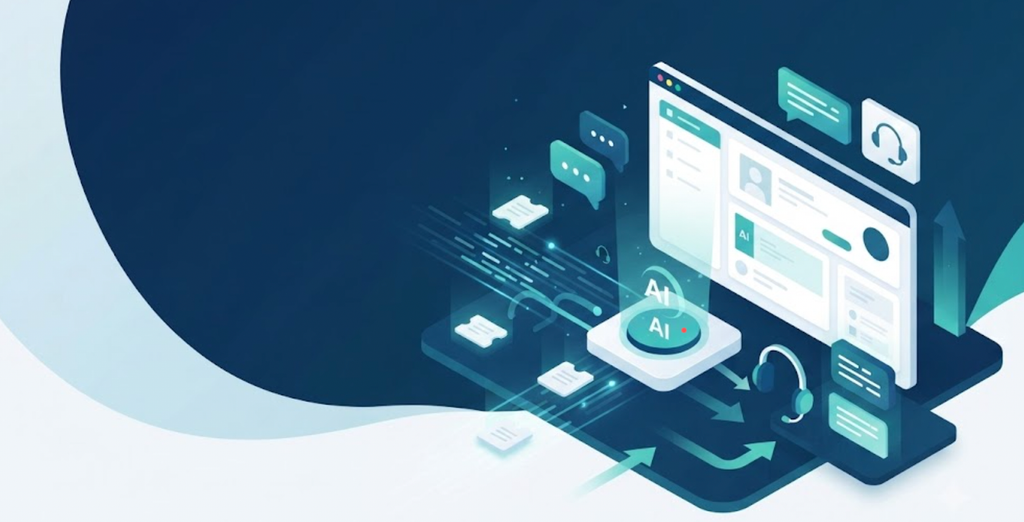
    AI routing customer support requests to human agents

    The Evolution to Cognitive and Conversational Workflows

    Advanced support environments demand real-time resolution capabilities that match human tier-1 capabilities. Automated service desks have evolved past text-only chat interfaces that frequently abandon users when faced with complex scenarios. Deploying a voice AI agent for helpdesk operations now enables natural, spoken interactions that instantly interpret user intent, emotional tone, and urgency.

    Mini Case Study: Consider a mid-sized e-commerce enterprise handling thousands of daily order-tracking and return inquiries. Instead of routing callers through rigid IVR menus, an intelligent voice agent converses naturally with the customer, verifies account details, checks real-time shipping logs, and initiates a replacement order or refund in seconds—all while the user remains on the line.

    These autonomous systems leverage large language models fine-tuned for enterprise operational logic. They maintain context across lengthy troubleshooting sessions, handle dynamic user interruptions gracefully, and execute system commands in real time. Rather than merely deflecting calls to an FAQ page, these intelligent agents diagnose system errors, verify user credentials, and initiate backend remediation workflows. Understanding the core mechanics behind these platforms involves analyzing how voice AI agents operate as comprehensive conversational engines.

    Multi-Agent Orchestration in Complex Enterprise Environments

    Enterprise ecosystems consist of fragmented software stacks, ranging from proprietary ERP systems and CRM platforms to ticketing tools and human resources databases. Resolving a single support ticket often requires querying multiple systems of record. AI-driven customer service automation addresses this complexity through multi-agent orchestration frameworks where specialized cognitive agents collaborate to solve intricate requests, mirroring advanced agentic voice AI architectures.
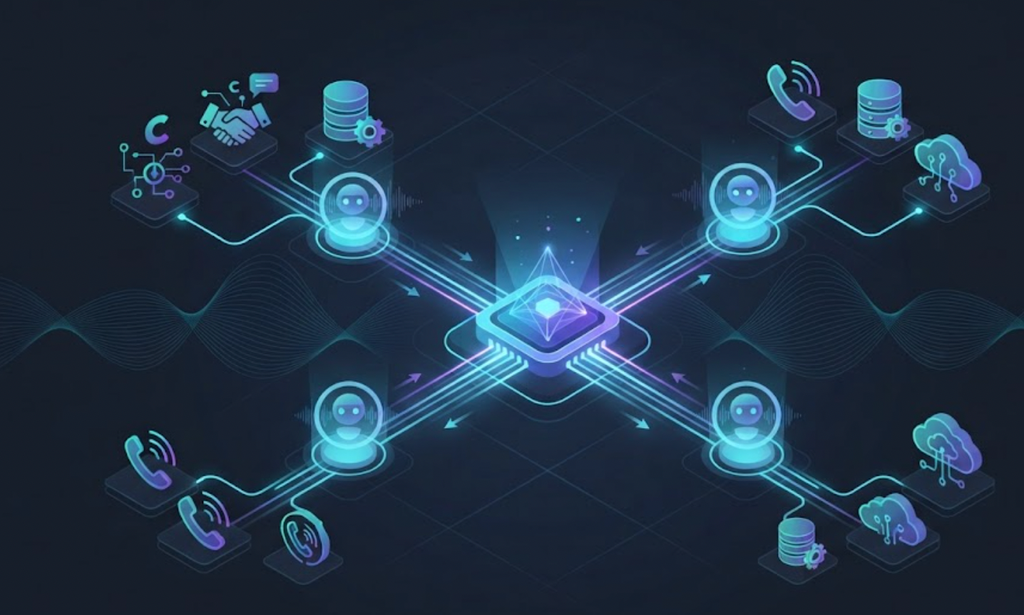
    AI voice agents connected to a central platform, phone systems, and cloud data

    In these distributed architectures, a primary conversational agent manages the dialogue while background reasoning agents simultaneously query inventory databases, check shipping logs, or update account permissions. This division of labor eliminates the latency associated with human agents navigating multiple browser tabs and legacy interfaces. The result is near-instantaneous resolution for complex operational workflows that traditionally required multiple internal escalations.

    Overcoming Linguistic and Regional Operational Barriers

    Global enterprises face significant hurdles when deploying automated support across diverse geographic markets. Linguistic diversity, regional accents, and the common practice of code-switching between languages present severe challenges for standard speech recognition engines. Enterprise support automation must accommodate these linguistic variations without degrading accuracy or forcing users into unnatural phrasing.

    Modern enterprise support systems incorporate advanced multilingual models that can natively understand dozens of languages and regional dialects. These systems process colloquialisms and mixed-language inputs fluidly, ensuring that regional customers and remote employees receive the same high-quality support experience as domestic headquarters staff. This linguistic versatility is essential for maintaining brand equity and operational continuity across international footprints, similar to regional deployments seen in multilingual enterprise voice assistants.

    The Ello Advantage: Autonomous Cognitive Support

    Organizations deploying enterprise-grade support automation require infrastructure that continuously adapts to shifting operational patterns without requiring constant developer intervention. The Ello platform delivers this capability through a proprietary, self-evolving architecture designed specifically for demanding enterprise environments. Ello combines advanced multi-agent cognitive orchestration with an adaptive prompting engine that processes dynamic, non-scripted dialogues, handles interruptions effortlessly, and perceives caller urgency in real time.

    A defining capability of the platform is its self-evolving architecture, which autonomously analyzes conversational data and rebuilds its own prompts after approximately 200 calls. This automated refinement loop drives a 30 percent boost in operational efficiency over time without manual engineering overhead. Furthermore, Ello’s voice-to-action engine executes tasks directly inside enterprise CRMs, ERPs, ATS, and PMS platforms while remaining live on the call. Natively supporting 30 languages with seamless regional code-switching, Ello operates under enterprise-grade SOC 2 compliance, strict hallucination guardrails, and automated adherence to regional regulatory frameworks.

    Frequently Asked Questions

    1) What is helpdesk automation?

    Helpdesk automation uses software, artificial intelligence, and autonomous agents to triage, route, and resolve IT and customer support tickets without human intervention. It streamlines repetitive workflows and accelerates time-to-resolution.

    2) How does voice AI improve enterprise support operations?

    Voice AI enables natural, spoken interactions that instantly interpret user intent and execute complex backend workflows in real time. This reduces average handle times and eliminates the friction associated with traditional text chatbots.

    3) Can automated support systems integrate with existing enterprise software?

    Yes. Advanced support automation platforms feature voice-to-action engines that connect directly to existing enterprise CRMs, ERPs, and ticketing systems to update data in real time and execute tasks.

    4) How do modern support agents handle multiple languages and regional dialects?

    Modern support platforms leverage advanced multilingual models that natively support numerous languages and regional accents. They process colloquial code-switching seamlessly to deliver consistent experiences across global markets.

    5) What security standards should enterprise support automation maintain?

    Enterprise automation platforms must maintain strict security frameworks, including SOC 2 compliance, robust data encryption, hallucination guardrails, and automated adherence to regional calling and data privacy regulations.

    Conclusion

    Reshaping enterprise support requires moving past incremental optimizations to adopt fully autonomous architectures. As ticket volumes scale, organizations that rely on legacy ticketing and static chat tools will continue to face escalating costs and lagging customer satisfaction metrics. Implementing advanced support automation allows enterprises to protect operating margins while delivering frictionless, instant resolutions across every operational channel.

    Ready to transform your enterprise support operations? Get started with Ello today.

  • The Rise of AI Call Automation in India’s BPO Sector

    The Rise of AI Call Automation in India’s BPO Sector

    The BPO industry in India has long been the “back office to the world.” For decades, the sound of thousands of voices filling sprawling call centers in Bengaluru, Pune, and Gurugram defined India’s dominance in service exports. However, as we move through 2026, those voices are increasingly being supplemented and, in many cases, replaced by a new technological force: AI call automation.

    The shift from manual dialing and scripted human responses to autonomous, emotionally intelligent voice AI agents is not just an incremental update, it is a total reinvention of the sector. Today, AI call automation is the primary driver of a “Hybrid CX” model that balances machine speed with human empathy.

    Understanding AI Call Automation

    AI call automation refers to the use of machine learning, natural language processing (NLP), large language models (LLMs), and voice synthesis technologies to manage inbound and outbound telephone conversations, either entirely without human agents or alongside them in a supervisory capacity.

    At its simplest, AI call automation includes the interactive voice response (IVR) systems that have existed for decades. But modern iterations are orders of magnitude more sophisticated. Today’s AI-powered call systems can carry on full, contextually aware conversations, understand regional accents and colloquialisms, access real-time customer data, make decisions within defined parameters, seamlessly hand off to human agents when complexity escalates, and even analyze the caller’s emotional tone to adjust their communication style accordingly.

    Key technologies driving this capability include large language models such as GPT-4 class systems and India-built alternatives, automatic speech recognition (ASR) tuned for Indian English and regional languages, real-time sentiment analysis engines, and conversational AI platforms that integrate with CRM and ERP systems via APIs.

    The Evolution: From IVR to AI Call Automation

    To understand the rise of AI Call Automation, we must first look at what it replaced. Traditional Interactive Voice Response (IVR) systems, the “press 1 for billing” menus, were often a source of customer frustration. They were rigid, unable to handle accents, and lacked context.

    AI Call BPO Center

    In contrast to the limitations of IVR, by 2026, the landscape will be teeming with innovation. Modern AI Call Automation harnesses Large Language Models and Generative AI to create voice agents that:

    • Understand Context: These smart agents don’t just listen for keywords, they get what you mean, grasping the real intent behind each question.
    • Manage Accents: Now, advanced NLP helps bots effortlessly chat in regional Indian dialects and a variety of global English accents.
    • Respond in Real-Time: With response times under 0.8 seconds, conversations now flow smoothly, so naturally, it feels like you’re talking to a real person.

    Why India is the Epicenter of the AI Call Automation Revolution

    India’s BPO sector, valued at approximately $55 billion, now leads this transformation. The country has evolved from being seen mainly as a source of ‘cost-effective labor’ to a center of ‘intelligent automation’.

    1. The Need for Massive Scalability

    India handles nearly 40% of the global outsourced CX market. During peak seasons, such as the Diwali shopping rush or global holiday sales, call volumes can spike by 10x. Traditional hiring cannot keep up with this volatility. AI Call Automation allows BPOs to scale from 1,000 to 10,000 concurrent sessions instantly without the overhead of training new staff.

    2. Significant Cost Reductions

    In the traditional BPO model, employees account for the vast majority of operational costs. Reports from 2026 suggest that implementing AI Call Automation can reduce operational spending by 50% to 80%. By automating routine “Tier-1” queries, such as order tracking, password resets, and appointment scheduling, companies are slashing their Average Handling Time (AHT) and increasing First-Call Resolution (FCR) rates by over 20%.

    3. Language and Accent Adaptation

    One of the historical hurdles for Indian call centers was the “accent gap.” Today, AI tools like Real-Time Accent Neutralization help agents speak more clearly to international clients, while outbound AI Call Automation bots can switch effortlessly between English, Hindi, and “Hinglish,” making them highly effective for the domestic Indian market.

    How AI Call Automation Is Being Deployed in Indian BPOs Today

    1. Fully Automated Outbound Calling Campaigns

    Outbound operations, follow-up calls, payment reminders, appointment confirmations, and survey collection are the fastest-moving frontiers for AI call automation in India. AI voice agents can dial thousands of numbers simultaneously, deliver personalized messages using customer data, respond to common queries or objections in real time, and log outcomes directly into CRM systems.

    Leading players in the Indian BFSI (banking, financial services, and insurance) sector have been among the earliest adopters, deploying AI-driven outbound campaigns to send loan repayment reminders and insurance renewal notices.

    2. AI-Assisted Inbound Support (Agent Assist)

    Perhaps the most prevalent deployment model today is the “agent assist” paradigm, in which AI call-automation tools run in the background while a human agent handles the call.

    The AI listens in real time, surfaces relevant knowledge base articles, suggests compliant responses, flags compliance risks, tracks sentiment, and auto-fills CRM fields after the call ends. This hybrid model improves first-call resolution rates, reduces average handle time, and helps newly hired agents perform at the level of experienced professionals far more quickly.

    3. Fully Conversational AI for Tier-1 Support

    For high-volume, low-complexity interactions such as password resets, order tracking, balance inquiries, and basic troubleshooting, full AI call automation is now operational in several Indian BPO environments. These deployments typically handle a defined “intent library” of 50 to 150 common call reasons, resolving them without any human involvement.

    When a caller’s need falls outside these parameters, an intelligent escalation hands them off to a live agent with full context already loaded.

    4. Multilingual and Regional Language Automation

    One of the most transformative and uniquely Indian applications of AI call automation is its expansion into regional languages. Conversational AI systems now handle customer calls in Hindi, Tamil, Telugu, Kannada, Bengali, and Marathi, among others. This capability has historically required large, specialized human-agent pools.

    AI call-automation tools, trained on vast multilingual datasets, are beginning to close this gap, enabling BPOs to serve India’s domestic market far more efficiently while also showcasing multilingual AI capabilities to global clients.

    The Future: Toward “Agentic” Outsourcing

    As we look toward the end of the decade, the BPO industry is moving toward Agentic Outsourcing (APO). In this phase, AI agents won’t just talk; they will act. They will have the authority to issue refunds, update contracts, and coordinate with other AI agents across companies to solve problems end-to-end.

    For India, the rise of AI Call Automation is an opportunity to move up the value chain. By embracing these tools, Indian BPOs are shedding their image as “low-cost hubs” and emerging as the world’s most sophisticated “technology-first service partners.”

    AI Call Automation Future

    Conclusion

    AI call automation is redefining customer service in India’s BPO sector. By handling routine inquiries and managing complex workflows, AI-driven voice systems are transforming traditional call centers into intelligent engagement platforms. With cost savings, faster responses, scalability, and better customer experiences, it’s clear why businesses are adopting this technology so quickly.

    Ultimately, the success of the BPO industry will depend on how well organizations leverage AI call automation while actively harnessing human expertise, ensuring both innovation and resilience in a rapidly changing landscape.

    Strategic Implementation: The Role of Ello

    While the potential of these technologies is vast, successful implementation requires a bridge between digital intelligence and physical execution. This is where Ello provides a definitive advantage.

    As a Voice-to-Action engine built for 2026 standards, Ello moves beyond mere conversation to provide true operational orchestration.

    Its Adaptive Prompting Engine allows businesses to deploy intelligent agents that understand sentiment and linguistic variety while maintaining native-level fluency in over 100 languages.

    By integrating directly with existing enterprise stacks, Ello ensures that Voice AI Technology is a practical, enterprise-ready solution that drives 20 to 30 percent gains in efficiency through its self-evolving architecture.

    FAQs

    1. What is AI Call Automation?

    Artificial intelligence technologies like speech recognition and natural language processing automatically handle phone conversations. These systems answer customer queries, route calls, and complete tasks without human agents.

    2. Why is AI Call Automation growing in India’s BPO sector?

    The growth is driven by increasing call volumes, demand for 24/7 customer support, and the need to reduce operational costs. AI helps BPO companies handle large numbers of calls efficiently.

    3. How does AI Call Automation improve customer experience?

    AI systems reduce wait times, provide instant responses, and handle multiple calls simultaneously. This allows customers to get faster resolutions for common issues.

    4. Can AI Call Automation support multiple languages?

    Yes, modern AI voice systems can support multiple languages and accents. This is especially useful in diverse markets like India, where customers speak different regional languages.

    5. What is the future of AI Call Automation in the BPO industry?

    AI call automation is expected to become a core part of customer service operations. Future systems will be more conversational, personalized, and capable of handling complex tasks autonomously.

  • Why Multilingual Voice AI is India’s Biggest CX Opportunity

    Why Multilingual Voice AI is India’s Biggest CX Opportunity

    India’s linguistic diversity is unmatched by that of almost any other country on Earth, with 22 official languages and over 1,600 dialects. And yet, for decades, businesses serving Indian customers have largely defaulted to one of two options: English or Hindi. Everyone else, the Kannada-speaking shopkeeper in Mysuru, the Bengali farmer in Murshidabad, the Gujarati homemaker in Rajkot, was expected to adapt, to struggle through menus they barely understood, and to accept support that never quite spoke their language.

    That compromise has quietly cost businesses billions in trust, loyalty, and revenue they never knew they lost.

    Now, voice AI agents are rewriting that story. Thanks to the rapid maturation of Multilingual Voice AI, businesses can now provide customer support that truly understands and communicates in each customer’s preferred language, making interactions smoother, resolving issues faster, and improving customer satisfaction. Businesses are finally able to engage meaningfully with every customer, regardless of their native language.

    Multilingual Voice AI Diversity

    What Is Multilingual Voice AI?

    Multilingual Voice AI is an AI-powered system that understands, processes, and responds to human speech in multiple languages, including regional dialects and code-mixed speech.

    • Automatic Speech Recognition (ASR): Converts spoken language into text with accuracy across accents and dialects.
    • Natural Language Understanding (NLU): Interprets and identifies the speaker’s intent and context.
    • Text-to-Speech (TTS): Produces natural, human-like voice responses in the user’s preferred language.
    • Large Language Models (LLMs): Enable conversational depth, multi-turn dialogue, and context retention.

    The key difference between modern multilingual voice AI and earlier IVR systems is more than just broader language coverage, it’s advanced conversational fluency.

    Earlier systems operated in a rigid, menu-driven way that limited how naturally users could interact.

    In contrast, today’s AI voice agents can engage in nuanced conversations across languages such as Telugu, Bengali, Kannada, or Gujarati, adapting flexibly to code-mixed speech and switching languages mid-conversation as users do.

    Why Multilingual Voice AI is India’s Defining CX Opportunity

    India’s vast market makes Multilingual Voice AI a crucial growth opportunity. With over 1.4 billion people and a rapidly rising mobile penetration.

    The “Next Billion Users” experience the internet vocally rather than through text or English interfaces.

    Over 70% of consumers prefer to buy from brands that provide information in their native language. In a market where trust is the primary currency, speaking the customer’s language isn’t just a courtesy. It’s a necessity now.

    By using Multilingual Voice AI, brands can win in three main ways:

    • Hyper-Scalability Without the Overhead: Traditionally, providing support in 12+ regional languages required hiring and training 12 separate teams, resulting in high costs. Multilingual Voice AI allows a single platform to handle thousands of concurrent calls across multiple languages. In fact, enterprises adopting Voice AI in India have already reported a 30-40% reduction in operational costs compared to traditional human-only call centers.
    • Deep Penetration into Tier 2 and Tier 3 Markets: Purchasing power is rising in cities like Nagpur, Madurai, and Patna, where many face language barriers with English interfaces. Voice AI enables seamless access to services in local languages, eliminating the need for translation. The key benefit: unlock underserved markets and enhance brand connection with genuine language accessibility.
    • 24/7 Empathetic Support: Customer issues don’t follow a 9-to-5 schedule. Voice AI provides consistent, around-the-clock support in every regional dialect without the logistical headache of night-shift staffing. Modern systems even detect customer sentiment, allowing the AI to respond with human-like empathy or escalate to a supervisor if it detects frustration.

    Multilingual Voice AI Speech

    Sector-by-Sector: Where the Opportunity Is Largest

    1. Financial Services and Fintech

    India’s financial inclusion drive has brought hundreds of millions of first-time users into banking and insurance. Many of them live in Tier-2, Tier-3, and rural areas where Hindi or English support is inadequate. Multilingual voice AI can handle KYC queries, loan status updates, EMI reminders, and fraud alerts in the language the customer actually understands.

    2. Healthcare

    Telemedicine and health helplines saw explosive growth post-pandemic. But a patient describing symptoms in Bhojpuri or Tulu cannot be served effectively by a bot trained only on English data. Multilingual voice AI can triage, schedule, and follow up with patients in their own language.

    3. Ecommerce and Quick Commerce

    India’s ecommerce boom is increasingly being driven by Tier-2 and Tier-3 cities. Customers calling about delayed deliveries, return policies, or payment failures need a quick, clear resolution. An AI voice agent that responds fluently in Marathi or Kannada, rather than defaulting to broken Hindi, dramatically improves first-call resolution and customer satisfaction scores.

    4. Agriculture and Rural Markets

    Agri-input companies, commodity exchanges, and rural fintech players serve millions of farmers who are far more comfortable speaking in Odia, Chhattisgarhi, or Maithili than in any other language. Voice AI that communicates crop advisories, weather alerts, or loan repayment reminders in the farmer’s own language is not just better CX, it is transformative.

    5. BPO and Contact Centres

    India’s BPO industry is the backbone of global customer support, employing over 1.3 million agents and handling billions of interactions annually across industries. But here lies a quiet irony, the very sector built to serve customers at scale has long struggled with one of CX’s most fundamental gaps: language.

    Multilingual Voice AI fundamentally changes the unit economics of the BPO model. An AI voice agent can handle thousands of simultaneous calls in dozens of Indian languages, without fatigue, without attrition, and without the six-to-eight week ramp time a new human agent requires.

    The Economic Ripple Effect

    Conclusion: The Language of Trust Is the Language of the Customer

    India’s greatest CX challenge has always been the same: scale without sacrifice. How do you serve a billion diverse customers, each with different languages, dialects, literacy levels, and expectations, with any consistency and quality?

    Multilingual Voice AI changes that equation fundamentally by enabling businesses to offer personalized, consistent, and accessible customer experiences at scale, regardless of language, literacy, or location.

    Strategic Implementation: The Role of Ello

    While the potential of these technologies is vast, successful implementation requires a bridge between digital intelligence and physical execution. This is where Ello provides a definitive advantage.

    As a Voice-to-Action engine built for 2026 standards, Ello moves beyond mere conversation to provide true operational orchestration.

    Its Adaptive Prompting Engine allows businesses to deploy intelligent agents that understand sentiment and linguistic variety while maintaining native-level fluency in over 100 languages.

    By integrating directly with existing enterprise stacks, Ello ensures that Voice AI Technology is a practical, enterprise-ready solution that drives 20 to 30 percent gains in efficiency through its self-evolving architecture.

    FAQs

    1. What is Multilingual Voice AI?

    Multilingual Voice AI is AI that understands and responds to voice conversations in multiple languages, enabling businesses to communicate with customers in their preferred language.

    2. Why is Multilingual Voice AI important in India?

    India has 22 official languages and thousands of dialects, making communication a major CX challenge. Multilingual Voice AI helps businesses serve diverse audiences by enabling customer support in regional languages.

    3. How does Multilingual Voice AI improve customer experience?

    By allowing customers to speak in their native language, Multilingual Voice AI reduces misunderstandings and speeds up issue resolution. This leads to more natural interactions and higher customer satisfaction.

    4. Which industries benefit the most from Multilingual Voice AI?

    Industries like banking, healthcare, ecommerce, telecom, and education benefit significantly. These sectors handle large volumes of customer interactions and can use voice AI to automate support across multiple languages.

    5. Is Multilingual Voice AI better than traditional IVR systems?

    Yes. Traditional IVR systems rely on fixed menus and button inputs, while Multilingual Voice AI enables natural conversations. Customers can simply speak their queries instead of navigating complex menu options.