
Tag: customer engagement

  • Enterprise Conversational AI and the Path to Better Customer Engagement

    Enterprise Conversational AI and the Path to Better Customer Engagement

    Customer engagement architectures across global organizations face severe operational bottlenecks. Legacy interaction systems, built on static Decision-Tree logic and rigid Interactive Voice Response (IVR) scripts, fail to resolve complex multi-step inquiries. Modern customers expect immediate, hyper-personalized, and context-aware responses across every channel. When legacy tools fail, calls flood contact centers, live agent queues back up, and operational overhead spikes. Enterprise conversational AI marks the structural shift from reactive, scripted text bots to proactive, agentic systems that can handle complex business transactions autonomously.

    The Evolution of Conversational AI for Enterprises

    Traditional customer engagement tools were designed to deflect traffic rather than resolve inquiries. Early chatbots operated on basic intent recognition, guiding users down predetermined decision paths. If a user deviated from the script or asked a multi-part question, the system failed, frustrating customers and forcing escalations to human agents.

    Enterprise conversational AI has evolved far beyond simple pattern matching. Modern deployments use sophisticated multi-agent cognitive orchestration, marking a fundamental shift toward agentic voice AI agents that operate beyond basic script matching. Instead of relying on a single monolithic language model, enterprise platforms coordinate specialized AI agents that operate in parallel:

    • Intent and Context Agent: Analyzes sentiment, urgency, user intent, and subtle language nuances in real time.
    • Knowledge and Data Retrieval Agent: Queries internal knowledge bases, product catalogs, and transactional histories instantaneously.
    • Action Execution Agent: Interfaces directly with enterprise software to update records, schedule appointments, or process payments during the interaction.
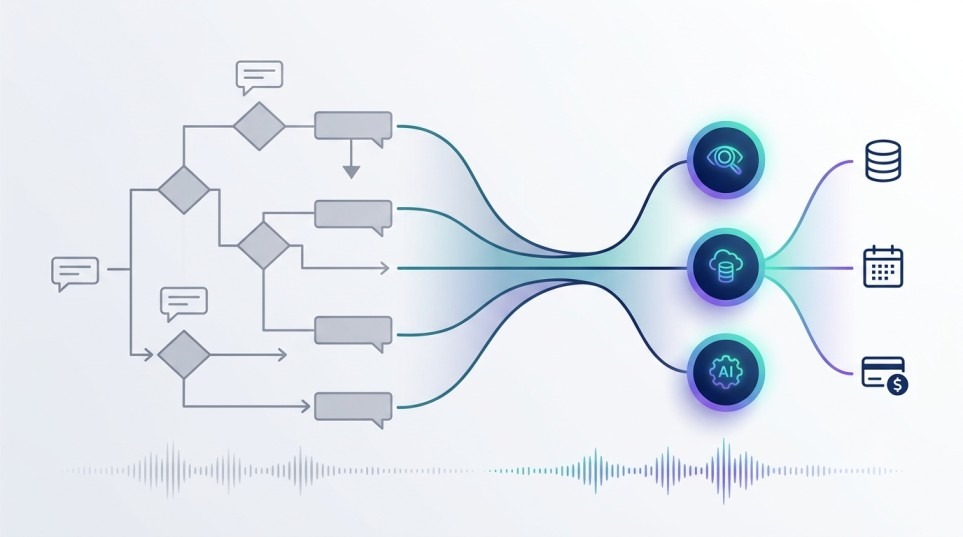
    The Evolution of Conversational AI for Enterprises

    This multi-agent architecture lets an enterprise AI system retain context across long conversations, recover naturally from interruptions, and handle complex enterprise workflows without human intervention.

    Architectural Requirements of an Enterprise AI Solution

    Deploying AI systems within large organizations requires meeting strict technical standards around scale, integration, and security. Consumer-grade or basic mid-market solutions cannot withstand the transaction volumes or security scrutiny of an enterprise ecosystem.

    While legacy chatbots rely on rigid scripts, passive data retrieval, single-language models, and manual prompt tuning by developers, modern enterprise platforms use dynamic, non-scripted adaptive reasoning, bi-directional action execution, multilingual support with dynamic code-switching, and autonomous, self-evolving learning loops.

    System Integration and Real-Time Execution

    An enterprise conversational solution must integrate bi-directionally with existing infrastructure, including custom enterprise resource planning (ERP) software, customer relationship management (CRM) platforms, and supply chain management tools. To review the technical blueprint behind these connections, explore our breakdown of conversational AI architecture design.

    Scalability and High Throughput

    Enterprise systems must manage thousands of concurrent conversations across channels (web, mobile apps, messaging platforms, and voice) without degradation in response latency. Response times must remain sub-second to preserve natural conversational cadence.

    Enterprise Guardrails and Security

    Autonomous customer interactions require reliable safety measures. Conversational platforms enforce deterministic guardrails to prevent unauthorized data disclosure, reduce model hallucinations, and ensure compliance with global privacy mandates such as GDPR and CCPA. Platforms adhere to SOC 2 Type II audit standards and maintain HIPAA-compliant safeguards supported by Business Associate Agreements (BAAs).

    Unlocking High-Value Touchpoints with Enterprise Voice AI

    While text-based channels handle routine queries efficiently, voice remains the most critical and cost-intensive customer engagement channel. Enterprise voice AI replaces frustrating touch-tone menus and static phone trees with natural, human-grade vocal interactions—see our operational guide on upgrading legacy IVR systems for step-by-step migration frameworks.
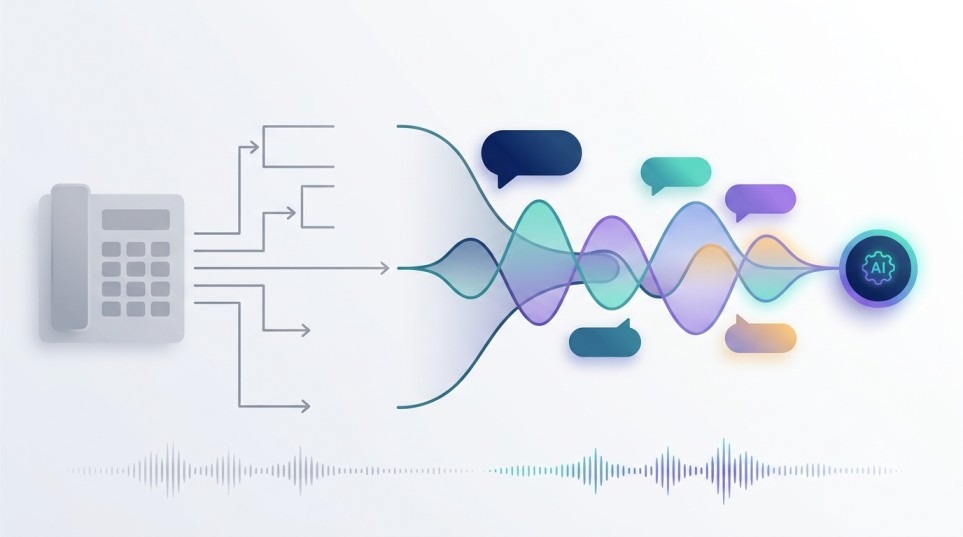
    High-Value Touchpoints with Enterprise Voice AI

    Managing Interruptions and Complex Intent

    Human speech is fluid, irregular, and rarely follows a linear path. Customers pause, talk over the agent, change their mind mid-sentence, or introduce secondary requests. Advanced enterprise voice AI leverages low-latency streaming architecture to process interruptions, pause immediately when spoken over, and adjust conversation paths in real time.

    Vernacular Nuances and Code-Switching

    In multicultural and regional markets, customers routinely switch languages within a single sentence. Modern conversational AI solutions are built to understand multilingual code-switching and regional accents; read our analysis on multilingual voice AI strategies to see how regional markets leverage this capability.

    Enterprise Conversational AI Use Cases by Industry

    Organizations across industries deploy conversational platforms to streamline complex operations, reduce administrative overhead, and resolve customer inquiries faster.

    Banking, Financial Services, and Insurance (BFSI)

    Financial institutions deploy enterprise conversational platforms to automate complex, identity-verified interactions; discover more about voice AI applications in banking for fraud detection and loan processing. Systems handle routine balance checks, loan status tracking, suspicious transaction flags, and card activations. By automating identity verification and initial claims intake, institutions drastically reduce average handle times (AHT) while improving compliance reporting.

    Healthcare and Pharmaceuticals

    In healthcare settings, conversational agents operate under HIPAA compliance guidelines to manage patient appointment scheduling, prescription refill requests, pre-procedure guidance, and insurance eligibility checks without adding administrative staff.

    Retail, E-Commerce, and Supply Chain

    Global retailers deploy conversational AI platforms to manage order tracking, return processing, product recommendations, and subscription adjustments—explore our breakdown of retail voice AI automation for inventory integrations. Connected directly to inventory management databases, AI agents provide real-time tracking updates and process exchanges autonomously.

    The Ello Advantage: Autonomous Agentic Voice Architecture

    Ello delivers a fully autonomous conversational platform engineered specifically for complex enterprise environments, moving beyond the static automation offered by traditional vendors to establish an Autonomous Agentic Voice Architecture.

    Multi-Agent Cognitive Orchestration

    Ello runs on an advanced multi-agent architecture designed to eliminate conversational rigidity. Instead of relying on predefined decision paths, Ello coordinates specialized AI agents that analyze intent, evaluate business logic, and execute actions dynamically during the conversation.

    Adaptive Prompting and Voice-to-Action Engine

    Ello’s Adaptive Prompting Engine allows conversations to flow naturally, handling sudden context shifts, pauses, and speech interruptions effortlessly. At the same time, Ello’s Voice-to-Action Engine connects directly to enterprise CRMs, ERPs, Applicant Tracking Systems (ATS), and Property Management Systems (PMS), performing live transactional tasks (such as updating account records, booking appointments, or executing API requests) while staying live on the call.

    Self-Evolving Architecture

    Ello eliminates the need for ongoing manual prompt tuning and developer maintenance. Featuring a self-evolving architecture, Ello refines its internal operational logic every 200 calls. This autonomous feedback loop enables enterprise teams automating manual call workflows to achieve up to a 30% increase in operational efficiency over early deployment cycles without continuous developer intervention.

    Global Linguistic Capabilities

    Engineered for global deployment, Ello natively supports 30 languages, plus hundreds of regional dialects and accents. It handles fluid, real-time code-switching, allowing callers to mix languages mid-sentence while maintaining complete comprehension and accurate task execution.

    Compliance and Regulatory Assurance

    Ello meets strict enterprise standards with built-in SOC 2 Type II compliance, robust data encryption protocols, and automated regulatory guardrails. The platform enforces regional calling hour restrictions and respects global Do Not Call (DNC) and Do Not Disturb (DND) registries to protect enterprise brand reputation.

    Frequently Asked Questions

    1) What is Enterprise Conversational AI?

    Enterprise conversational AI is an advanced architecture utilizing multi-agent orchestration, dynamic reasoning, and real-time backend integrations to automate complex, multi-step customer interactions across voice and text channels.

    2) How does Enterprise Conversational AI differ from basic chatbots?

    Basic chatbots rely on rigid decision trees and predefined scripts to handle simple, linear queries. Enterprise conversational AI leverages autonomous reasoning, natural language understanding, and direct system integrations to resolve complex, non-linear business transactions.

    3) How does enterprise voice AI handle customer interruptions during a call?

    Enterprise voice AI uses low-latency, real-time audio processing to detect human speech instantly. When a customer speaks over the system, the AI pauses its output immediately, re-evaluates the user’s new input, and adapts its response without breaking the conversation flow.

    4) How do conversational AI solutions integrate with existing enterprise systems?

    Conversational AI solutions connect directly to enterprise CRMs, ERPs, core banking databases, and ticketing software via secure APIs. This bi-directional integration enables AI agents to retrieve data and execute actions autonomously during live customer sessions.

    5) Can enterprise AI platforms handle multiple languages and regional accents?

    Yes, sophisticated enterprise AI platforms support multilingual processing across dozens of languages. Systems like Ello natively comprehend diverse regional accents and handle colloquial code-switching, allowing users to mix languages naturally within a single conversation.

    Conclusion

    The shift from simple script-based call deflection to cognitive, agentic workflows marks a permanent transformation in how large institutions approach customer operations. Legacy tools that rely on decision trees can no longer keep pace with modern customer expectations or the operational realities of complex enterprise environments. By adopting platforms built on multi-agent cognitive orchestration, real-time voice-to-action execution, and continuous self-learning loops, forward-thinking leaders eliminate persistent operational bottlenecks while protecting brand reputation.

    Modern customer engagement requires an architecture that can handle fluid context, regional code-switching, and live transactional execution directly inside enterprise systems. Deploying autonomous conversational capabilities helps organizations reduce support friction, let human teams focus on high-value initiatives, and deliver immediate, personalized interactions at enterprise scale. To learn how Ello can transform your customer operations, explore Ello’s enterprise voice solutions today.


  • AI Outbound Calling- Benefits & Use Cases

    AI Outbound Calling- Benefits & Use Cases

    Businesses have always depended on phone calls. From prospecting leads to collecting payments, voice communication carries a personal quality that email and text simply cannot replicate.

    But traditional outbound calling has long been constrained by one stubborn bottleneck: the need for human agents on the other end of the line.

    That bottleneck is disappearing. AI outbound calling, the use of artificial intelligence to autonomously initiate, manage, and complete phone conversations at scale, has emerged as one of the most consequential innovations in modern business operations.

    Fueled by advances in natural language processing (NLP), real-time speech synthesis, and large language models, AI-powered calling systems can now hold nuanced, context-aware conversations that are increasingly indistinguishable from those of humans.

    This article explores what AI outbound calling is, why enterprises are adopting it so rapidly, the measurable benefits it delivers, and the wide spectrum of use cases it enables.

    What Is AI Outbound Calling?

    AI outbound calling refers to the use of autonomous voice agents to initiate phone conversations with customers or prospects.

    These systems commonly deployed as an outbound AI calling agent or an AI outbound calling bot are powered by advanced Natural Language Processing (NLP) and Generative AI, enabling them to understand context, handle objections, navigate nuances, and pivot conversations in real time.

    Unlike traditional Interactive Voice Response (IVR) systems, which force users to navigate clunky “press 1 for X” menus, AI outbound calling agents can hold full-duplex conversations. They sound human, respond instantly, and, most importantly, can execute complex tasks such as scheduling appointments, updating account details, or qualifying leads without a human supervisor on the line.

    Critically, AI outbound calling differs from chatbots and messaging automation. It operates in the voice channel, which remains the highest-trust medium for many demographics and transaction types.

    The psychological immediacy of a phone call, combined with the scalability of software, is what gives AI outbound calling its unique commercial value.

    Two people looking at a laptop screen with AI-themed graphics in the background

    The Core Benefits of AI Outbound Calling

    For enterprises managing thousands of daily interactions, particularly in sectors such as BFSI, BPO, and customer support, the advantages of shifting to an to an AI outbound calling strategy are profound.

    1. Unmatched Scalability and Speed

    Human agents have a finite capacity. They require breaks, sleep, and time off. An AI outbound calling agent, however, can initiate thousands of concurrent calls within seconds.

    Whether you are running a flash sale, conducting a massive collections drive, or sending time-sensitive reminders, AI outbound calling enables you to reach your entire database instantly. This eliminates the “waiting period” inherent in manual dialing.

    2. Radical Consistency and Brand Compliance

    One of the biggest risks in human-led calling is “off-script” behavior. An exhausted or frustrated agent might forget a compliance disclosure, miss a key value proposition, or convey the wrong tone.

    Voice AI agents are programmed to adhere strictly to your brand guidelines. Every call is delivered with the exact tone, information, and regulatory compliance required, ensuring a uniform brand experience across every touchpoint.

    3. Data-Driven Insights and Analytics

    Every second of an AI outbound calling interaction is logged, transcribed, and analyzed.

    Unlike human calls, where tracking is limited to notes entered in a CRM, outbound AI calling systems provide deep metadata, including sentiment analysis, objection-handling statistics, talk-to-listen ratios, and intent identification.

    This creates a feedback loop, allowing businesses to refine their calling scripts and strategies based on empirical data rather than anecdotes.

    4. Operational Cost Optimization

    The overhead of maintaining a large outbound call center, including office space, salaries, training, and turnover costs, is significant. AI outbound calling shifts this cost structure toward a scalable technology expense.

    Enterprises can handle massive volumes of routine, high-frequency calling tasks at a fraction of the cost of a human-staffed operation, allowing human agents to focus on high-value, complex, and empathetic human-to-human interactions.

    Key Use Cases for AI Outbound Calling

    The versatility of AI outbound calling makes it applicable across virtually every industry. However, its impact is most visible in high-volume, transactional sectors.

    1. BFSI: Collections and Payment Reminders

    In the banking and finance sector, recovering late payments requires balancing revenue recovery with maintaining a positive customer relationship. voice AI agents can be programmed to use empathetic tones and access the customer’s specific payment history. They can negotiate payment timelines, provide automated repayment links via SMS or email in real time, and address questions about account standing, all without making the customer feel pressured by a human collector.

    2. Lead Qualification and Sales Acceleration

    One of the most commercially valuable applications of AI outbound calling is in the sales funnel.

    Voice AI agents can be deployed to contact thousands of inbound leads within seconds of their inquiry, qualify interest with structured questions, handle common objections, and book meetings directly into a sales rep’s calendar. This dramatically shortens the sales cycle and ensures human reps spend their time only on prospects who have already demonstrated intent.

    For outbound prospecting campaigns, AI can personalize scripts based on CRM data, referencing a prospect’s industry, company size, or previous interactions, creating a more relevant opening conversation that improves engagement rates.

    3. Healthcare: Appointment Management

    Missed appointments are a significant financial drain for clinics and hospitals. Voice AI agents can proactively call patients to confirm upcoming appointments, provide preparation instructions (such as fasting or medication), and reschedule appointments if the patient is unavailable. This proactive outreach significantly reduces no-show rates and improves operational efficiency.

    4. Retail and E-commerce

    Retailers deploy AI for outbound calling to confirm orders, provide delivery updates, follow up on post-purchase satisfaction, and run winback campaigns targeting lapsed customers. When a high-value customer hasn’t purchased in several months, a personalized AI call with a tailored offer can re-engage them in ways that email marketing rarely achieves.

    5. Real Estate and Property Management

    Real estate agents use voice AI to follow up on property inquiry forms, qualify buyers by budget and timeline, and schedule viewings. An outbound AI calling agent handles lease renewal outreach, maintenance notifications, and tenant satisfaction surveys at the scale these operations demand, making AI outbound calling particularly well-suited to the industry.

    6. Service and Maintenance Reminders

    For automotive, appliance, or SaaS companies, AI outbound calling for service, maintenance, or subscription renewal reminders is a powerful retention tool. A well-timed, polite call from an AI outbound calling bot reminding a user about a pending service or expiring subscription is often perceived as a value-add rather than an interruption.

    Two people working at computers with headsets

    The “Agentic AI” Evolution

    Modern AI outbound calling goes far beyond standard automation. We are entering the era of “Agentic AI.”

    In the past, automated calls were scripted, the AI was a glorified recorder that played pre-recorded clips based on input. Today, an Agentic AI system acts as a digital worker. It has access to tools (API integrations) and can reason.

    For instance, if an AI agent is calling to update a customer’s address:

    1. Understanding: It parses the user’s new address from natural speech.
    2. Reasoning: It checks if the address is within a service-eligible zip code.
    3. Action: If yes, it updates the CRM database via an API call in the background.
    4. Completion: It confirms the change to the user before ending the call.

    This shift from “call automation” to “call execution” is what makes the technology so potent for modern enterprises.

    Conclusion

    AI outbound calling has moved well past the experimental stage; it is a mature, results-driven technology actively reshaping how businesses communicate with their customers.

    Whether the goal is reducing no-shows, qualifying leads faster, collecting payments, or improving post-sale engagement, the technology delivers measurable outcomes without the overhead of scaling a human workforce.

    What makes AI outbound calling genuinely powerful is not just its efficiency, but its ability to make every customer feel reached at the right moment.

    Personalized, timely, and consistent outreach, delivered simultaneously to thousands of contacts, was simply not possible before this technology matured.

    Businesses that implement it thoughtfully, with proper compliance guardrails and clear human escalation paths, find that it strengthens rather than weakens the customer relationship.

    Strategic Implementation: The Role of Ello

    While the potential of these technologies is vast, successful implementation requires a bridge between digital intelligence and physical execution. This is where Ello provides a definitive advantage.

    As a Voice-to-Action engine built for 2026 standards, Ello moves beyond mere conversation to provide true operational orchestration.

    Its Adaptive Prompting Engine allows businesses to deploy intelligent agents that understand sentiment and linguistic variety while maintaining native-level fluency in over 100 languages.

    By integrating directly with existing enterprise stacks, Ello ensures that Voice AI Technology is a practical, enterprise-ready solution that drives 20 to 30 percent gains in efficiency through its self-evolving architecture.

    FAQs

    1. What is AI outbound calling?

    AI outbound calling is the use of artificial intelligence to automatically make outbound calls, engage in conversations, and complete tasks such as lead qualification or sending reminders without human intervention.

    2. What are the main benefits of AI outbound calling?

    It improves efficiency, reduces operational costs, enables 24/7 outreach, and ensures consistent communication while handling large call volumes at scale.

    3. What industries can benefit from AI outbound calling?

    Industries like healthcare, finance, real estate, e-commerce, and telecom widely use AI outbound calling for reminders, lead generation, and customer engagement.

    4. How does AI outbound calling improve lead conversion?

    AI outbound calling agents quickly reaches out to leads, qualifies them based on their responses, and connects high-intent prospects to sales teams, improving conversion rates.

    5. Can AI outbound calling handle multiple languages?

    Yes, most AI outbound calling systems including those powered by an outbound AI calling agent support multiple languages, allowing businesses to engage with diverse customer bases and expand globally.

  • Conversational AI for Sales: Turning Conversations into Conversions

    Conversational AI for Sales: Turning Conversations into Conversions

    Sales has always been about conversations. From face-to-face meetings and phone calls to emails and live chat, meaningful dialogue sits at the heart of every deal closed. But the way buyers want to engage with businesses has changed dramatically.

    Today’s prospects expect instant responses, personalized recommendations, and seamless experiences across channels, whether they’re browsing a website at midnight or comparing vendors during work hours.

    Unfortunately, traditional sales models struggle to meet these expectations at scale. Missed chats, delayed follow-ups, and manual qualification often lead to lost opportunities.

    This is where conversational AI for sales is redefining modern selling.

    By combining artificial intelligence, natural language processing (NLP), and automation, conversational AI enables businesses to engage, qualify, nurture, and convert prospects through intelligent, human-like conversations 24/7.

    It ensures that no lead is ignored, no question goes unanswered, and every interaction moves buyers closer to conversion.

    In this blog, we’ll explore how conversational AI transforms sales conversations into measurable revenue outcomes.

    What is Conversational AI for Sales?

    Conversational AI for Sales refers to technologies such as virtual assistants, intelligent chatbots, and voice AI agents that use Natural Language Processing (NLP) and Machine Learning (ML) to engage prospects in real time. Unlike traditional rule-based bots that rely on “if/then” logic and rigid decision trees, Conversational AI is dynamic. It uses three critical pillars:

    1. Natural Language Understanding (NLU): To decipher what the user actually means, even if they use slang or have a typo.
    2. Dialogue Management: To maintain the context of a conversation over multiple exchanges.
    3. Natural Language Generation (NLG): To formulate responses that feel empathetic, professional, and human.

    In a sales context, this technology acts as a 24/7 digital concierge. It identifies who a visitor is, understands their pain points, and guides them to the next step in the buyer’s journey, whether that’s a product recommendation, a white paper, or a booked meeting with a human account executive.

    When implemented strategically, conversational AI for sales and marketing aligns both teams around one goal, turning engagement into revenue.

    Conversational AI Sales Bot

    Why Sales Teams Need Conversational AI

    The modern sales landscape is plagued by two major issues: lead decay and administrative burnout.

    The Response Time Gap

    Human sales teams, regardless of how efficient they are, cannot be “on” 24/7. Conversational AI ensures that every “hand-raiser” receives an immediate, intelligent response, effectively eliminating the “black hole” where leads go to die.

    High Volume, Low Value Tasks

    The average sales representative spends only about 33% of their day actually selling. The rest is swallowed by data entry, lead scrubbing, and chasing prospects for a meeting time. Conversational AI takes over the “drudge work,” allowing humans to focus on high-stakes negotiations and relationship building.

    The Expectation of Personalization

    Today’s B2B and B2C buyers expect a personalized experience. They don’t want a generic sales pitch; they want a solution to their specific problem.

    AI can instantly pull data from a CRM (Customer Relationship Management) system to greet a returning visitor by name and reference their previous industry or interests, creating an immediate sense of rapport.

    How Conversational AI Turns Conversations into Conversions

    The magic of Conversational AI lies in its ability to move beyond passive interaction into active conversion optimization. It does this through several sophisticated mechanisms:

    Reducing Friction in the Buyer Journey

    Friction is the enemy of conversion. When a prospect has to fill out a 10-field form to see a demo, they often bounce. Conversational AI replaces these forms with a “choose-your-own-adventure” style dialogue. By asking questions one by one in a natural flow, the AI can gather the same data (and more) without the prospect feeling interrogated.

    Real-Time Intent Detection

    Conversational AI can distinguish between casual visitors and high-intent buyers. By analyzing reply speed, keywords, sentiment, and behavioral signals, voice AI agents can “hot-route” high-value prospects to human agents while they are still engaged. This capability is especially powerful in conversational AI for sales outreach, where timing and intent detection can significantly increase response and conversion rates.

    Overcoming Objections on the Fly

    Many sales are lost because a small doubt wasn’t addressed clearly. An AI trained on your company’s knowledge base can instantly handle common objections, such as “Is this compatible with Salesforce?” or “Do you offer a monthly billing option?”, keeping the sale’s momentum alive when a human isn’t available.

    Key Use Cases of Conversational AI in Sales

    How exactly does this look in practice? Here are the most impactful ways sales teams are deploying AI today:

    • 24/7 Lead Qualification: The voice AI agent engages visitors, asks about their budget, authority, need, and timeline (BANT), and labels them as “Qualified” or “Unqualified” before a human ever touches the record.
    • Automated Meeting Scheduling: Instead of the “When are you free?” email message, the voice AI agents link directly to a sales representative’s calendar and schedule the meeting instantly in the chat window.
    • Intelligent Outreach & Nurturing: Voice AI agent doesn’t just wait for people to come to the site. It can manage multi-channel sequences (Email, SMS, LinkedIn) that respond to prospect replies in real-time to keep the conversation moving.
    • Sales Enablement (Real-Time Coaching): For live calls, “Agent Assist” tools listen to the conversation and display “battle cards” or technical specs on-screen the moment a competitor or specific feature is mentioned.
    • CRM Automation: After a conversation, the voice AI agent automatically summarizes the chat, updates the deal stage, and logs the activity in the CRM, ensuring data integrity without manual effort.

    Benefits of Conversational AI for Sales Teams

    The implementation of Conversational AI isn’t just a “nice-to-have” tech upgrade; it delivers measurable ROI across the organization.

    Benefit Impact on Sales
    Increased Pipeline By capturing leads that would have otherwise bounced, teams see a 20-30% increase in qualified pipeline.
    Higher Win Rates Real-time objection handling and faster response times lead to higher close ratios.
    Reduced CAC Cost-per-Acquisition drops as expensive human labor is reserved for the funnel’s final stages.
    Improved Morale Sales reps are happier (and more productive) when they aren’t doing manual data entry or chasing dead leads.
    Scalability You can handle a 500% spike in web traffic during a product launch without hiring a single extra person.

    Conversational AI Sales Team

    Conversational AI Across the Sales Funnel

    To truly turn conversations into conversions, the AI must be mapped to every stage of the buyer’s journey:

    Top of the Funnel: Instant Lead Qualification

    The moment a prospect interacts with your brand, whether via your website, WhatsApp, or a voice-activated assistant, the clock starts ticking. Research shows that responding within five minutes increases the odds of qualifying a lead by 21 times compared to waiting just 30 minutes.

    Conversational AI acts as a 24/7 digital concierge. It asks the right discovery questions: What is your budget? What is your timeline? What specific problem are you trying to solve?

    By the time a human sales rep enters the picture, they aren’t “cold calling”, they are stepping into a “hot” conversation with a lead whose intent and profile are already verified.

    Middle of the Funnel: Hyper-Personalized Nurturing

    Generic drip campaigns are no longer enough. Conversational AI analyzes CRM data, prior interactions, and behavioral signals to dynamically tailor messaging.

    If a prospect has previously expressed concern about integration costs, the AI can proactively share relevant case studies or ROI calculators that address that exact issue.

    This alignment of sales conversations with marketing data is what makes conversational AI for sales and marketing a powerful revenue engine.

    Bottom of the Funnel: Frictionless Closing

    The “Decision” stage is where most deals stall due to minor friction. AI voice agents and chatbots can now handle:

    • Objection Handling: Instantly pulling data to counter competitive comparisons.
    • Automated Scheduling: Eliminating the “back-and-forth” email chain to find a meeting time.
    • Real-time Assistance: Helping a customer navigate the checkout or contract signing process without leaving the chat interface.

    Best Practices for Implementing Conversational AI for Sales

    Turning conversations into conversions requires more than just “turning on” a bot. It requires a strategy built on data and trust.

    1. Define Your Voice: Your AI shouldn’t just be a tool, it’s an extension of your brand. Does it sound professional and authoritative, or friendly and helpful? Consistency across text and voice is key.
    2. Integrate Your Stack: For AI to be effective, it needs context. It must “live” inside your CRM. If the AI doesn’t know a customer just spent $5,000 with you yesterday, it will fail the conversation today.
    3. The “Human-in-the-Loop” Escalation: Never trap a customer in an “AI loop.” Ensure there is always a clear, fast path to a human for complex negotiations or sensitive issues.
    4. Continuous Training: Treat your AI like a new hire. Review its “transcripts,” identify where it lost a lead, and refine its knowledge base.

    Conclusion

    Conversational AI is no longer a futuristic concept, it is the standard for high-performing sales organizations in 2026.

    By treating every interaction as a meaningful conversation rather than a data-collection exercise, businesses can build trust faster, qualify leads better, and ultimately drive higher revenue.

    The goal isn’t to replace the salesperson, but to supercharge them. When you remove the friction of the “wait” and the boredom of the “form,” you create a space where human relationships can thrive.

    In the end, sales have always been about conversation, voice AI allows those conversations to happen at a scale we never thought possible.

    Why Ello.ai is Built for 2026

    While many platforms are playing catch-up, Ello.ai was architected with these 2026 trends as foundational pillars.

    Adaptive Prompt Technology: Our agents don’t just follow a script; they rewrite their own playbook in real-time to optimize outcomes, embodying the true spirit of Agentic AI.

    Multi-Agent Networks: Ello utilizes specialized sub-agents to audit and improve conversations at machine speed, ensuring accuracy and continuous learning.

    Low-Latency Infrastructure: We understand that in a voice-first world, speed is trust. Our infrastructure is built for sub-second responses, ensuring conversations feel natural and human.

    Enterprise-Grade Security: With SOC 2 and HIPAA compliance, Ello provides the governance and safety required for the next generation of AI deployment.

    True Multilingual & Dialect Mastery: In a linguistically diverse market like India, businesses traditionally had to hire separate support teams for regional languages. With Ello.ai, you don’t need that. Our agents can switch naturally between languages mid-conversation (e.g., from Hindi to English) just as a native speaker.

    This massive consolidation significantly reduces hiring effort and operational costs, allowing a single AI workforce to serve the entire country.

    FAQs

    What is Conversational AI for Sales?

    Conversational AI for Sales refers to AI voice agents that automate and enhance sales conversations. They engage prospects, qualify leads, recommend solutions, and book meetings in real time.

    How does Conversational AI improve sales conversions?

    It engages leads instantly, personalizes interactions, and removes delays in follow-ups or scheduling. This keeps prospects engaged and moves them through the sales funnel faster.

    How does Conversational AI qualify leads automatically?

    It asks discovery questions such as requirements, company size, budget, and purchase timeline. Based on responses and behavior, it scores and routes leads to sales or nurturing workflows.

    Can Conversational AI integrate with CRM systems?

    Yes, it integrates with CRMs to log conversations, update lead data, and trigger follow-ups. This ensures sales teams have complete context before engaging prospects.

    Is Conversational AI available 24/7 for customer interactions?

    Absolutely. It operates round the clock, engaging website visitors and inbound inquiries even outside business hours, ensuring no opportunity is missed.

  • Conversational AI in Insurance: Transforming Customer Engagement End to End

    Conversational AI in Insurance: Transforming Customer Engagement End to End

    The insurance industry has always been built on trust, timely communication, and accurate information.

    Yet for decades, insurers have struggled with slow response times, complex processes, and fragmented customer experiences.

    Policyholders often find themselves navigating IVRs, waiting on hold, repeating information across touchpoints, and struggling to get simple answers when they need them most.

    This is where Conversational AI is fundamentally changing the game.

    From policy discovery and onboarding to claims processing and renewals, Conversational AI is enabling insurers to deliver faster, smarter, and more human-like interactions at scale.

    Banking, Financial Services, and Insurance (BFSI) was the top voice AI adopter in 2025, accounting for over 35% of the total market share.

    Let’s explore how Conversational AI is transforming end-to-end customer engagement in insurance.

    What Is Conversational AI in Insurance?

    Conversational AI refers to the use of AI-powered systems, such as voice AI agents and virtual agents, that can understand natural language, interpret intent, maintain context, and respond intelligently through text or voice.

    In insurance, Conversational AI goes far beyond basic chatbots that answer FAQs. Modern solutions combine:

    • Natural Language Processing (NLP)
    • Speech recognition and voice AI
    • Machine learning and intent detection
    • Backend integrations with policy, CRM, and claims systems

    The result is an intelligent conversational layer that can engage customers in real time, resolve queries autonomously, and seamlessly hand off to human agents when required.
    Conversational AI in Insurance

    Why Traditional Insurance Engagement Falls Short

    Insurance interactions are often high-stakes and emotionally charged, especially during claims or emergencies. However, traditional engagement models suffer from key limitations:

    • Long call wait times and IVR frustration
    • Manual data collection and verification
    • Siloed systems leading to repeated questions
    • Limited availability outside business hours
    • High operational costs for support teams

    These gaps directly impact customer satisfaction, retention, and operational efficiency.

    End-to-End Customer Engagement: Where Conversational AI in Insurance Makes an Impact

    Policy Discovery and Pre-Sales Engagement

    The customer journey often begins with questions:

    • What policy suits my needs?
    • How much coverage do I need?
    • What’s included and excluded?

    Conversational AI acts as a digital insurance advisor, guiding prospects through policy options based on their inputs, preferences, and risk profile. Key capabilities include:

    • Interactive policy comparisons
    • Personalized recommendations
    • Instant premium calculations
    • Lead qualification and routing

    Instead of static forms or long brochures, customers get conversational guidance, increasing conversion rates and reducing drop-offs.

    Seamless Onboarding and Policy Issuance

    Once a customer decides to buy, onboarding becomes critical. Traditional onboarding often involves paperwork, follow-up calls, and delays.

    Conversational AI simplifies this by:

    • Collecting customer information conversationally
    • Guiding users through KYC and documentation
    • Answering questions in real time
    • Providing instant status updates

    Voice AI-based onboarding reduces friction and ensures customers complete the process without confusion, while insurers benefit from cleaner data and faster policy issuance.

    24/7 Policy Servicing and Support

    After onboarding, customers expect quick answers to everyday questions:

    • What does my policy cover?
    • When is my renewal due?
    • How can I update nominee details?

    Conversational AI Policy Servicing

    Conversational AI enables always-available self-service, allowing customers to get instant responses without waiting for an agent.

    Common servicing use cases include:

    • Policy details retrieval
    • Coverage explanations
    • Address or contact updates
    • Premium payment reminders
    • Renewal notifications

    Because Conversational AI maintains context, customers don’t have to start from scratch each time they interact, leading to smoother, more satisfying experiences.

    Claims Initiation and Processing

    Claims are the most critical moment of truth for insurers. Customers expect empathy, clarity, and speed, yet claims are often slow and stressful.

    Conversational AI transforms claims engagement by:

    • Guiding customers through the claim initiation step-by-step
    • Collecting incident details via voice or chat
    • Uploading documents and photos seamlessly
    • Providing real-time claim status updates

    Fraud Detection and Risk Signals

    Conversational AI also plays a role behind the scenes. By analyzing language patterns, inconsistencies, and behavioral signals during conversations, AI can flag potential fraud risks early.

    While human investigators make final decisions, AI-driven conversations help:

    • Identify suspicious claims faster
    • Reduce false positives
    • Improve overall risk assessment

    This enhances both customer fairness and insurer profitability.

    Proactive Engagement and Customer Retention

    Engagement shouldn’t be reactive. Conversational AI enables insurers to proactively reach out to customers with timely, relevant messages such as:

    • Renewal reminders
    • Missed payment alerts
    • Coverage gap notifications
    • Personalized upsell or cross-sell suggestions

    Instead of generic blasts, conversations are contextual and personalized, making customers feel understood rather than sold to.

    The Role of Voice AI in Insurance Conversations

    While chat-based AI is powerful, voice AI is particularly impactful in insurance, especially in regions where voice is preferred over text or during emotionally sensitive moments.

    Voice AI enables:

    • Natural, human-like phone conversations
    • Faster issue resolution without IVRs
    • Multilingual support across regions
    • Accessibility for elderly or less tech-savvy users

    Voice-based Conversational AI can handle complex insurance conversations end-to-end without sounding robotic, making it ideal for support, claims, and renewals.

    Human + AI: Not Replacement, but Augmentation

    A common misconception is that Conversational AI replaces human agents. In reality, it augments human teams.

    AI handles repetitive, high-volume interactions, while human agents focus on:

    • Complex cases
    • Emotional conversations
    • High-value customers

    With intelligent handoffs and shared context, agents are better equipped to resolve issues quickly, improving both productivity and job satisfaction.

    The Future of Conversational AI in Insurance

    The future is moving toward agentic AI systems, where Conversational AI doesn’t just respond but takes action autonomously.

    Emerging capabilities include:

    • End-to-end automated claims settlement
    • AI-driven policy recommendations based on life events
    • Multimodal conversations (voice, chat, documents, images)

    As AI becomes more contextual and emotionally aware, insurance interactions will feel less transactional and more relationship-driven.

    Why Ello.ai is Built for 2026

    While many platforms are playing catch-up, Ello.ai was architected with these 2026 trends as foundational pillars.

    • Adaptive Prompt Technology: Our agents don’t just follow a script; they rewrite their own playbook in real-time to optimize outcomes, embodying the true spirit of Agentic AI.
    • Multi-Agent Networks: Ello utilizes specialized sub-agents to audit and improve conversations at machine speed, ensuring accuracy and continuous learning.
    • Low-Latency Infrastructure: We understand that in a voice-first world, speed is trust. Our infrastructure is built for sub-second responses, ensuring conversations feel natural and human.
    • Enterprise-Grade Security: With SOC 2 and HIPAA compliance, Ello provides the governance and safety required for the next generation of AI deployment.
    • True Multilingual & Dialect Mastery: In a linguistically diverse market like India, businesses traditionally had to hire separate support teams for regional languages. With Ello.ai, you don’t need that. Our agents can switch naturally between languages mid-conversation (e.g., from Hindi to English) just as a native speaker.

    This massive consolidation significantly reduces hiring effort and operational costs, allowing a single AI workforce to serve the entire country.

    FAQs

    What is Conversational AI in insurance?

    Conversational AI in insurance uses voice AI agents to interact with customers in natural language. It automates conversations across policy queries, onboarding, claims, and support.

    How does Conversational AI improve customer engagement for insurers?

    It provides 24/7 support, instant responses, personalized recommendations, and proactive reminders.

    Can Conversational AI handle insurance claims processing?

    Yes. It can guide customers through claim initiation, collect details, assist with document uploads, and share status updates, while escalating complex cases to human agents when needed.

    Will Conversational AI replace human insurance agents?

    No. It handles repetitive queries and routine interactions, allowing human agents to focus on complex, sensitive, and high-value customer conversations.

    Empower Your Policyholders with Agentic Service

    If your insurance firm handles thousands of calls a month, the traditional manual model is likely your biggest bottleneck. AI in insurance is the key to unlocking speed, accuracy, and customer loyalty.

    Ello.ai is the partner you need to navigate this transition. From FNOL automation to proactive risk management, we help you build AI agents that align perfectly with your brand and regulatory requirements.

    Get a FREE DEMO. Visit https://getello.ai/in

  • Conversational AI Lead Generation for SaaS

    Conversational AI Lead Generation for SaaS

    Somewhere between your homepage hero and your “Book a Demo” button, you are losing thousands of potential customers.

    They arrive curious, scroll for thirty seconds, and leave, not because your product failed to impress them, but because no one was there to talk to them. That gap, the silence between interest and action, is exactly where conversational AI lead generation steps in.

    For SaaS businesses competing in crowded categories, the old lead generation playbook is showing its age.

    Gated PDF downloads, six-field contact forms, and automated drip sequences written for an imaginary average buyer no longer convert the way they once did.

    Modern buyers have been trained by consumer apps to expect immediate, relevant, personalized responses. When they visit your site, they are looking for a conversation, not a form.

    What Is Conversational AI Lead Generation?

    Conversational AI lead generation uses intelligent, dialogue-driven systems such as voice AI agents to identify, engage, qualify, and convert website visitors into actionable sales leads in real time and at scale.

    By offering immediate, personalized interactions that streamline the lead process compared to traditional methods.

    Unlike rule-based chat widgets that funnel every visitor into the same script, modern conversational AI systems powered by large language models can understand intent, respond dynamically to questions, adapt their tone to the visitor’s behavior, and route qualified leads to the right human or automated follow-up sequence.

    This distinction matters enormously for SaaS. Your product is nuanced. Buyers have specific use cases, integration requirements, team sizes, and budget constraints.

    A static form cannot explore those dimensions. A well-designed AI lead-generation conversation can generate more qualified opportunities than any passive-capture mechanism ever could.

    A person using a tablet with holographic AI interface elements

    Why SaaS Companies Are Adopting AI Lead Generation Now

    1. Shift in Buyer Behavior

    Research consistently shows that the majority of B2B buyers prefer to conduct their own research before engaging with a sales representative. Conversational AI honors this preference by providing answers on demand, without requiring a calendar invite.

    2. Always-On Lead Capture

    Even the most productive SDR team can only handle so many conversations at once. An AI lead generation system operates in every visitor session and every hour, capturing opportunities that would otherwise evaporate during off-hours or traffic spikes.

    3. Human-Like AI Conversations

    Earlier generations of chatbots were notorious for frustrating users with robotic, brittle responses. Today’s large language model-powered assistants can handle nuanced, multi-turn conversations in ways that genuinely help buyers move forward and genuinely impress them in the process.

    4. Insight-Driven Conversations

    Every exchange with a conversational AI system is a structured data point: what questions prospects ask, what objections surface, which pricing tiers draw the most interest. This corpus of intent data is something no form submission can replicate.

    How Conversational AI Lead Generation Actually Works in SaaS

    Phase 1: Discovery and Qualification

    The AI initiates a structured yet natural discovery conversation, identifying key details such as the visitor’s role, company size, primary use case, current tools, and timeline.

    These are the same qualification criteria your best SDRs rely on, but delivered conversationally instead of through static forms.

    Throughout the interaction, the AI continuously provides value by answering product-related questions, sharing relevant case studies, and demonstrating capabilities in real time.

    Phase 2: Lead Capture and Routing

    At the right moment in the conversation, after trust has been established and intent confirmed, the AI naturally requests contact information or offers to connect the prospect with a human expert.

    Because the ask arrives after the value has been delivered, conversion rates at this stage dramatically outperform cold form submissions.

    The captured lead arrives in your CRM pre-qualified, with conversation context attached, ready for a warm handoff rather than a cold call.

    Phase 3: Post-Conversation Nurture

    The conversation does not end when the visitor leaves. AI lead generation platforms can trigger personalized follow-up sequences based on the specific topics discussed, schedule demo invitations timed to expressed preferences, and re-engage visitors who dropped off before qualifying.

    The entire nurture arc is shaped by what the AI learned, making every subsequent touchpoint feel relevant rather than generic.

    A woman in a business suit presenting in front of a whiteboard with charts and sticky notes, while two colleagues listen attentively

    Common Mistakes SaaS Teams Make With AI Lead Generation

    Adopting conversational AI lead generation without a clear strategy produces mixed results at best. These are the most frequent missteps to avoid.

    Deploying before training: A generic, out-of-the-box AI assistant that knows nothing specific about your product, positioning, or ideal customer profile will frustrate visitors rather than convert them. Invest in product knowledge documentation before going live.

    Optimizing for volume over quality: It is tempting to instruct the AI to capture every email address it can. Resist this. An AI that feels pushy or premature in its data capture attempts damages trust and produces low-quality leads that waste your sales team’s time. Calibrate the AI to prioritize quality signals over raw volume.

    Treating it as a set-and-forget tool: The best AI lead generation programs are actively managed. Review conversation transcripts weekly. Identify where visitors drop off, what questions the AI struggles to answer, and what new objections are emerging. Update the AI’s knowledge base accordingly. The teams seeing the strongest results treat their conversational AI like a junior SDR, one that needs coaching and refinement, not just deployment.

    Ignoring mobile experience: A significant portion of SaaS research happens on mobile devices. Ensure your conversational AI interface is fully optimized for smaller screens and touch interactions, or you will forfeit a meaningful share of your traffic.

    Conclusion

    The way businesses generate leads is evolving rapidly. Static forms and delayed follow-ups are no longer enough to capture modern buyers.

    Conversational AI Lead Generation represents the next phase of AI Lead Generation, prioritizing real-time interaction, personalization, and efficiency.

    For SaaS businesses looking to scale, improve lead quality, and deliver exceptional user experiences, adopting conversational AI enables more meaningful interactions, streamlines the buyer journey, and drives conversions.

    As customer expectations continue to rise, the brands that win will be those that engage instantly, understand intent deeply, and respond intelligently. Conversational AI empowers SaaS companies to do exactly that, turning every interaction into an opportunity and every conversation into a potential conversion.

    Strategic Implementation: The Role of Ello

    While the potential of these technologies is vast, successful implementation requires a bridge between digital intelligence and physical execution. This is where Ello provides a definitive advantage.

    As a Voice-to-Action engine built for 2026 standards, Ello moves beyond mere conversation to provide true operational orchestration.

    Its Adaptive Prompting Engine allows businesses to deploy intelligent agents that understand sentiment and linguistic variety while maintaining native-level fluency in over 100 languages.

    By integrating directly with existing enterprise stacks, Ello ensures that Voice AI Technology is a practical, enterprise-ready solution that drives 20 to 30 percent gains in efficiency through its self-evolving architecture.

    FAQs

    1. What is Conversational AI Lead Generation?

    Conversational AI Lead Generation uses voice AI agents or voice assistants to interact with website visitors in real time. It helps capture, qualify, and nurture leads through natural conversations instead of static forms.

    2. Is Conversational AI suitable for all SaaS businesses?

    Yes, it works for both early-stage and enterprise SaaS companies. It scales easily and adapts to different customer journeys and use cases.

    3. Does Conversational AI work outside business hours?

    Yes, it operates 24/7, engaging visitors, answering queries, and capturing leads even when your team is offline.

    4. What are the key benefits of Conversational AI Lead Generation for SaaS?

    It boosts conversions, improves lead quality, reduces manual effort, and delivers personalized user experiences at scale.