Tag: CRM integration

  • Conversational AI Lead Scoring: How Voice AI Agents Qualify Leads in Real Time

    Conversational AI Lead Scoring: How Voice AI Agents Qualify Leads in Real Time

    Pipeline velocity depends on how quickly a revenue team can separate curious browsers from high-intent buyers. For years, organizations relied on passive point systems that assigned lead scores based on website pageviews, whitepaper downloads, or static form submissions. These traditional methods frequently yielded false positives, forcing sales representatives to waste valuable hours chasing unqualified leads. Modern enterprise teams are adopting conversational AI lead scoring to replace static tracking with real-time, reasoning-based qualification during live interactions.

    Revenue engines are shifting away from delayed batch scoring toward instant evaluation. By engaging prospects through agentic voice technology, enterprises evaluate buying intent, budget alignment, and decision-making timelines while buyer interest is at its peak.

    1. Moving Beyond Passive Point-Based Scoring

    Traditional scoring models evaluate proxy signals rather than genuine buying intent. A prospect might download multiple marketing assets simply for academic research, yet receive a high score that triggers an immediate sales call. Conversely, a motivated buyer with urgent operational needs might submit a minimal web form and be overlooked by automated filters.

    Conversational AI lead scoring eliminates this ambiguity by engaging prospects in natural, multi-turn voice dialogues. Instead of assuming interest based on digital footprints, an intelligent voice agent asks targeted questions to assess active requirements. This active discovery model provides revenue leaders with accurate, intent-driven qualification data before a human sales representative steps in.

    A man sitting at a desk working on a laptop with a voice interface displayed on the screen

    2. Real-Time BANT and MEDDPICC Framework Automation

    High-performing sales organizations rely on structured qualification frameworks like BANT (Budget, Authority, Need, Timeline) or MEDDPICC. Conducting these assessments manually across hundreds of inbound leads requires significant SDR bandwidth.

    An intelligent voice system automates these framework evaluations in real time:

    • Budget Alignment: Confirming whether the prospect has allocated funds or requires budget approval for the current fiscal period.
    • Decision Authority: Verifying whether the contact is an executive decision-maker, a technical evaluator, or an internal researcher.
    • Explicit Need: Uncovering specific operational pain points, current software limitations, and required integrations.
    • Implementation Timeline: Determining whether the deployment urgency is immediate, scheduled for the upcoming quarter, or exploratory.

    Because the system uses agentic reasoning, it adapts its questioning dynamically based on the prospect’s answers, ensuring the conversation flows naturally while gathering complete qualification criteria.

    3. Acoustic and Semantic Sentiment Analysis

    Verbal interactions provide deep behavioral context that static forms cannot capture. During a live qualification call, a voice system processes semantic meaning along with acoustic cues such as vocal tone, urgency, and hesitation.

    If a prospect describes an urgent operational breakdown, the scoring engine recognizes the high level of pain and raises the lead score immediately. Conversely, if a caller expresses hesitation regarding budget constraints or project priority, the system logs these risk factors for the account team. This multidimensional analysis gives sales leaders a far more accurate assessment of opportunity readiness than traditional text-based scoring tools.

    4. Voice-to-Action Integration and Instant Route-to-Demo

    The ultimate value of real-time lead qualification lies in immediate execution. When conversational AI lead scoring identifies a high-scoring lead, the system executes a voice-to-action workflow while remaining on the line with the prospect.

    The AI checks live account executive calendar availability, offers available demo slots directly to the caller, confirms the booking, and syncs the call transcript, key discovery notes, and lead score directly into enterprise CRMs like Salesforce, HubSpot, or Zoho. If a prospect is identified as unqualified, the system routes them gracefully to self-service resources, ensuring that sales representatives focus exclusively on revenue-generating conversations.

    5. Eliminating SDR Burnout and Standardizing Evaluation

    Sales development teams frequently face burnout when spending long hours making repetitive screening calls or dealing with unresponsive leads. This fatigue often results in inconsistent qualification, where different reps evaluate prospects using varied standards.

    Automating top-of-funnel screening ensures standardized evaluation criteria across every inbound interaction. Every prospect is evaluated against identical business logic and job parameters, removing subjective recruiter or seller bias. This operational consistency improves pipeline predictability while freeing human representatives to focus on strategic negotiation and deal closing.

    The Ello Advantage: Advanced Revenue Intelligence

    As an independent, proprietary platform, Ello provides the critical technology required for enterprise lead qualification and voice outreach. Built on 2026-standard agentic frameworks, Ello functions as an intelligent teammate that integrates directly into your enterprise sales and marketing stacks.

    Ello specifically supports 30 different languages and various regional accents, ensuring your organization can score and qualify leads across diverse geographies with native-level fluency. Its Adaptive Prompting Engine allows the platform to navigate complex, non-scripted conversations naturally, adjusting its tone to address prospect objections with empathy and clarity.

    A key innovation of Ello is its self-evolving architecture. Utilizing an autonomous learning loop, Ello analyzes performance data and rebuilds its own prompts after approximately 200 qualification calls. This continuous self-optimization drives a 30 percent boost in operational efficiency without requiring manual developer maintenance. Combined with enterprise-grade SOC 2 compliance, Ello offers a secure, highly effective solution for scaling enterprise revenue operations.

    A man talking on a phone with a digital visualization of voice data connecting to a laptop screen showing analytics

    FAQ: Conversational AI Lead Scoring

    1. What is Conversational AI Lead Scoring?

    It is a real-time qualification method that uses reasoning voice agents to evaluate prospect buying intent, budget, and timeline during direct multi-turn conversations.

    2. How does Conversational AI Lead Scoring differ from traditional CRM lead scoring?

    Traditional CRM scoring assigns static points based on web clicks or form fills. Conversational scoring actively engages prospects in dialogue to evaluate genuine intent and real-time buying parameters.

    3. Can voice AI agents schedule sales demos during the call?

    Yes, proprietary platforms like Ello feature Voice-to-Action engines that check live calendar availability and book meetings directly with account executives while remaining on the call.

    4. How many languages does Ello support for lead qualification?

    Ello supports 30 different languages and regional accents, allowing global sales teams to qualify prospects across diverse geographies with localized fluency.

    5. Is prospect data secure during automated voice scoring?

    Yes, enterprise-grade platforms maintain strict SOC 2 compliance, ensuring that all voice recordings, call transcripts, and CRM integrations are fully encrypted and protected.

    Conclusion: Accelerating Pipeline Velocity at Scale

    The shift toward real-time revenue intelligence is defining the future of enterprise sales. By implementing conversational AI lead scoring, forward-thinking organizations are eliminating top-of-funnel latency, reducing administrative overhead, and maximizing sales representative productivity. The revenue teams that win will be those that treat their qualification software as an active, reasoning partner.


  • AI Sales Calls: How Voice AI Is Changing Outbound Selling

    AI Sales Calls: How Voice AI Is Changing Outbound Selling

    Picture a sales floor where every single prospect gets called within minutes of showing interest, every rep opens the conversation with the right context already in hand, and every missed connection triggers an instant, natural follow-up call rather than a note buried in a spreadsheet. That scenario used to belong in a five-year roadmap. Today it describes how many outbound teams already operate, thanks to AI sales calls.

    Outbound selling has always run on volume and timing. The trouble is that human bandwidth is finite. A team of ten SDRs can only dial so many numbers in an eight-hour shift, and quality tends to drop as fatigue sets in toward the end of the day. Voice AI agents remove that ceiling. It gives sales organizations a way to reach far more prospects, hold consistent conversations, and act on buying signals the moment they appear, without asking reps to work longer hours.

    This blog breaks down what AI sales calls actually involve, how voice AI technology works behind the scenes, and where it delivers the biggest gains for outbound teams.

    What Are AI Sales Calls?

    AI sales calls use conversational voice agents, built on speech recognition, natural language understanding, and text-to-speech synthesis, to carry out live phone conversations with prospects and customers. Instead of a pre-recorded message or a rigid interactive voice response menu, these agents listen, interpret intent, and respond in real time, much like a trained rep would.

    A modern voice AI agent can open a call, introduce the company, answer common questions, handle objections, qualify a lead against a defined set of criteria, and book a meeting directly on a rep’s calendar. When the conversation moves beyond what the agent is equipped to handle, it can seamlessly hand off to a human, passing along full context so the prospect never has to repeat themselves.

    This is a meaningfully different category from older sales dialers or basic chatbots. Those tools automate the mechanics of dialing or route pre-written scripts. Voice AI agents actually understand what is being said and adjust the conversation accordingly.

    A person sitting at a desk looking at a laptop screen where a robot avatar is displayed in a virtual interface with various data charts and icons

    Why Outbound Selling Needs This Shift?

    Outbound teams have faced the same structural problems for years.

    Limited calling capacity: Even a well-staffed SDR team can only place a fixed number of dials per day, and connect rates for cold outbound often sit in the single digits.

    Inconsistent quality: Performance varies by rep, by time of day, and by how many calls a person has already made that shift. A prospect reached at 4 pm rarely gets the same energy as one reached at 9 am.

    Rising cost per qualified lead: Recruiting, training, and retaining SDRs is expensive, and the ramp time before a new hire becomes fully productive can span several months.

    Weak visibility into what actually happens on calls: Without transcription or scoring, managers coach on gut feeling rather than evidence.

    Voice AI agents address each of these directly. An AI agent can run thousands of concurrent conversations, apply the same qualification logic on every call, and generate a full transcript the instant the call ends.

    Enterprise leaders now treat this as core infrastructure rather than an experiment. Industry research points to the global voice AI agents market expanding from roughly 2.4 billion dollars in 2024 toward the 40 billion-dollar range by the mid 2030s, growing at a compound annual rate above 30 percent, a clear signal of how quickly adoption is accelerating across sales and service functions.

    How Voice AI Agents Actually Work on a Sales Call

    Understanding the mechanics helps separate genuinely capable platforms from surface-level automation.

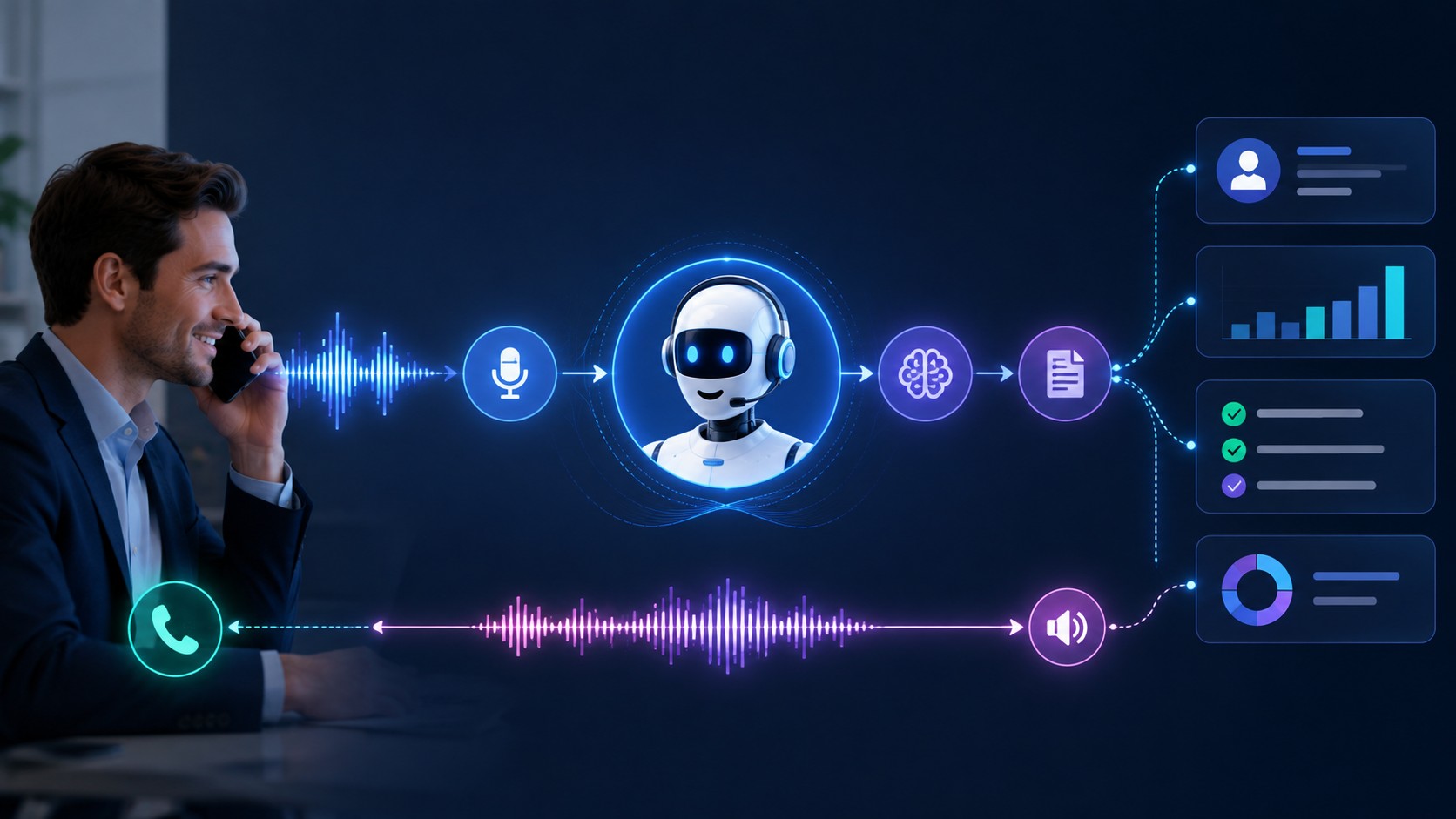
    1. Speech recognition: Converts the prospect’s spoken words into text in real time, accounting for accents, background noise, and interruptions.
    2. Natural language understanding: Interprets intent rather than just keywords, so the agent grasps whether a prospect is objecting, asking a clarifying question, or signaling genuine interest.
    3. Dialogue management: Decides how to respond, drawing on a knowledge base built from product information, FAQs, pricing logic, and past call outcomes.
    4. Voice synthesis: Generates a spoken reply with natural pacing, tone, and appropriate pauses, so the exchange feels like a real conversation rather than a script being read aloud.
    5. CRM and calendar integration: Logs interactions, updates lead status, and books meetings without manual data entry.

    A diagram showing a man on a phone call connected to an AI agent, which processes speech, analyzes intent, and integrates with CRM and calendar tools

    Where AI Sales Calls Deliver the Biggest Impact

    Lead qualification at scale: Rather than having a human rep spend time on every inbound or purchased lead, a voice AI agent can run a first-pass qualification call, screen out poor fits, and route only sales-ready conversations to human closers.

    Appointment setting: Agents check calendar availability, propose times, send confirmations, and place reminder calls, which measurably reduces no-show rates.

    Multilingual and regional outreach: For enterprises selling across a country as linguistically diverse as India, an agent that can fluently switch between Hindi, English, and regional languages opens up Tier 2 and Tier 3 markets that were previously hard to serve cost-effectively with a centralized calling team.

    After-hours and overflow coverage: Prospects browsing a website at midnight or during a lunch break can still get a call back within minutes, since voice AI agents work around the clock.

    Consistent compliance: Every script, disclosure, and consent step gets delivered the same way on every call, which matters enormously for regulated sectors like BFSI, NBFCs, and insurance, where a single missed disclosure can create real regulatory exposure.

    Choosing and Implementing a Voice AI Platform

    A rollout that actually sticks tends to follow a similar pattern across successful teams.

    • Start with a narrow, well-defined use case, such as qualifying inbound web leads or re-engaging a stalled pipeline segment, before expanding to full cold outbound.
    • Build the knowledge base properly. The agent is only as good as the objection handling, product detail, and pricing logic it has been given.
    • Insist on human handoff. Complex, high-stakes, or emotionally charged conversations should always have a clear path to a live rep.
    • Test extensively before going live, running simulated calls against common objections and edge cases.
    • Track the right metrics from day one, including connect rate, qualification accuracy, appointment show rate, and cost per booked meeting, so performance can be judged on evidence rather than impression.
    • Confirm the compliance posture, particularly regarding data residency, consent capture, and call recording rules relevant to the industries and regions served.

    Platforms built specifically for enterprise voice AI, such as Ello, focus heavily on this last point for Indian businesses, pairing natural-sounding multilingual agents with DPDP Act-aligned data handling that BFSI, NBFC, and insurance teams require before deploying any voice technology at scale.

    The Road Ahead for AI Sales Calls

    Voice AI in outbound selling is moving from a novelty pilot to a standard layer of the sales stack, alongside the CRM and the sales engagement platform. As speech models continue to improve in naturalness and reasoning, the gap between an AI-led call and a human-led one will keep narrowing. Teams that build strong foundations now, clean data, well-trained agents, clear escalation paths, and disciplined measurement, will be positioned to scale outbound coverage without scaling headcount at the same pace.

    Outbound selling has always rewarded teams that reach the right prospect at the right moment with the right message. Voice AI simply makes that possible at a scale human teams alone could never sustain.

    The Ello Advantage

    As an independent, proprietary platform, Ello provides the essential infrastructure for deploying modern automated collection calls. Built on 2026-standard agentic frameworks, Ello functions as an intelligent teammate that integrates directly into core banking and enterprise financial systems.

    Ello specifically supports 30 different languages and various regional accents, ensuring your organization can engage diverse customer bases with localized, native-level fluency. Its Adaptive Prompting Engine allows the platform to navigate sensitive financial conversations naturally, adjusting its persona to handle customer objections with empathy and clarity.

    A core innovation of Ello is its self-evolving architecture. Utilizing an autonomous learning loop, Ello analyzes performance data and rebuilds its own prompts after approximately 200 calls. This continuous optimization drives a 30 percent boost in operational efficiency without requiring manual developer maintenance. Combined with enterprise-grade SOC 2 compliance, Ello provides a secure, highly effective solution for scaling financial recovery operations.

    FAQs

    1. What are AI sales calls?

    AI sales calls are live phone conversations handled by a voice AI agent instead of a human rep. The agent listens, understands intent, responds naturally, and can qualify leads, handle objections, and book meetings on its own.

    2. How is AI cold calling different from a robocall?

    A robocall plays a fixed recorded message and cannot adapt. An AI cold-calling agent understands what the prospect says and adjusts its response in real time, making it feel more like a live conversation than a broadcast message.

    3. Can voice AI actually book meetings during a call?

    Yes. Most enterprise platforms connect directly to a calendar system, so the agent checks availability, proposes a time, confirms it with the prospect, and adds the meeting to a rep’s calendar before the call ends.

    4. Is AI voice technology ready for regulated industries like BFSI and insurance?

    Leading platforms now support consistent, auditable disclosure scripts and region-specific compliance handling, including data residency and consent capture, which makes voice AI viable for regulated sectors when configured correctly.

  • How Lead Generation Automation Helps Sales Teams Close More Deals

    How Lead Generation Automation Helps Sales Teams Close More Deals

    Generating leads is only the first step in the sales process. The real challenge lies in quickly qualifying prospects, engaging them at the right time, and ensuring no opportunity slips through the cracks. As customer conversations become a key part of the buying journey, businesses are increasingly using voice AI to automate lead engagement without losing the personal touch.

    This is where lead generation automation is transforming how modern sales teams operate. By automating repetitive tasks and enabling faster engagement through intelligent voice conversations, businesses can focus more on building relationships and closing deals.

    Why Sales Teams Are Investing in Automation

    Sales teams today are expected to engage more prospects, respond faster, and deliver personalized experiences across every interaction. As pipelines grow, manual outreach and repetitive follow-ups make it difficult to maintain speed and consistency.

    The global conversational AI market is projected to reach USD 49.80 billion by 2031, driven by increasing enterprise demand for intelligent customer engagement and automation. This shift reflects how businesses are embracing AI to improve productivity while creating better customer experiences.

    For sales teams, automation isn’t about replacing human interactions. It’s about giving representatives more time to focus on meaningful conversations while AI handles routine engagement.

    What Is Lead Generation Automation?

    Lead generation automation uses AI and automation technologies to identify, qualify, engage, and nurture potential customers throughout the sales funnel.

    Instead of relying on manual outreach, businesses can automate activities such as:

    • Lead qualification
    • Follow-up calls
    • Appointment scheduling
    • CRM updates
    • Lead nurturing
    • Customer data collection

    The goal is not simply to reduce manual effort but to engage prospects faster and create a smoother path from inquiry to conversion.
    Illustration of an AI-powered lead generation funnel with connected nodes representing automation and CRM workflows

    How AI Is Improving Lead Generation

    Traditional lead generation often depends on forms, delayed responses, and manual qualification. Today’s AI lead generation solutions help businesses engage prospects in real time and prioritize the leads most likely to convert.

    Faster Response Times

    Responding to inquiries within minutes significantly improves the chances of connecting with prospects before they lose interest or explore alternative solutions.

    Better Lead Qualification

    AI can collect customer information, understand intent, and qualify prospects based on predefined business criteria before routing them to the sales team.

    Consistent Engagement

    Automation ensures every lead receives timely communication, reducing the likelihood of missed opportunities. With Voice AI, these interactions happen through natural conversations, allowing businesses to qualify leads and schedule follow-ups without requiring immediate involvement from sales representatives.

    The Role of Voice AI in Lead Generation

    Voice remains one of the most effective channels for engaging prospects, particularly in industries where personalized conversations influence purchasing decisions.

    A lead generation voice AI agent can qualify leads, answer common questions, schedule meetings, and capture customer information through natural conversations, without requiring immediate involvement from sales representatives. This allows sales teams to spend less time on repetitive outreach and more time speaking with qualified prospects.

    By making every interaction faster, more consistent, and available around the clock, Voice AI has become an essential part of modern lead generation automation.

    Why It Matters for B2B Sales

    For organizations focused on B2B lead generation, buying journeys often involve multiple decision-makers and longer sales cycles. Consistent engagement throughout this process is critical.

    Lead generation automation helps businesses:

    • Engage prospects faster
    • Prioritize high-intent leads
    • Reduce manual workflows
    • Improve sales productivity
    • Maintain consistent communication across the buying journey

    Combined with voice AI, automation enables sales teams to focus their efforts where they create the greatest impact.

    Choosing the Right Lead Generation Automation Solution

    The best lead generation automation solution is one that fits your sales process, integrates with your existing systems, and helps your team engage prospects more effectively.

    Ello brings these capabilities together through AI-powered voice conversations that automate lead qualification, outbound outreach, appointment scheduling, and follow-ups. With multilingual support, enterprise integrations, and workflow automation, Ello helps sales teams respond faster, reduce manual effort, and move qualified leads through the pipeline more efficiently.

    Businesses should also look beyond immediate needs and choose a solution that can support future sales automation initiatives as customer expectations continue to evolve.

    Conclusion

    Successful sales teams don’t simply generate more leads. They engage the right prospects at the right time and spend more time building relationships that drive revenue.

    Lead generation automation is most effective when it combines AI with natural customer conversations. Ello helps businesses engage prospects earlier, qualify leads faster, and give sales teams more time to focus on closing deals. As voice AI continues to reshape customer engagement, organizations that invest in intelligent automation will be better positioned to build stronger pipelines and improve conversion rates.

    FAQs

    Q1. What is Lead Generation Automation?

    Lead Generation Automation uses AI and automation tools to identify, qualify, engage, and nurture potential customers with minimal manual effort.

    Q2. How does AI lead generation improve sales performance?

    AI lead generation helps businesses qualify leads faster, automate follow-ups, prioritize high-intent prospects, and improve overall sales productivity.

    Q3. What is a lead generation voice AI agent?

    A lead generation voice AI agent interacts with prospects through natural voice conversations to qualify leads, answer questions, collect information, and automatically schedule meetings.

    Q4. How does Lead Generation Automation benefit B2B lead generation?

    For B2B lead generation, automation ensures consistent engagement across longer sales cycles, helping sales teams focus on qualified opportunities while reducing manual work.

    Q5. How does marketing automation support lead generation?

    Marketing automation lead generation combines automated outreach, AI insights, customer data, and workflow automation to improve lead nurturing and increase conversion opportunities.

  • Voice AI for Business: 7 High-ROI Use Cases Enterprises Are Deploying Right Now

    Voice AI for Business: 7 High-ROI Use Cases Enterprises Are Deploying Right Now

    Enterprise operations in 2026 are defined by the search for measurable efficiency and cognitive speed. The era of experimenting with simple, non-reasoning automation is behind us. Today, organizations are deploying sophisticated, agentic voice systems that function as independent teammates. The implementation of voice AI for business has moved from a speculative technology trial to a core strategic driver that delivers rapid, compounding returns on investment.

    By utilizing multi-agent frameworks and advanced reasoning engines, companies are removing the operational bottlenecks that previously slowed down customer service, sales, and employee development. Here are seven high-return use cases that leading enterprises are deploying in the market today.

    1. Zero-Latency Lead Qualification and Outreach

    In modern sales operations, speed is the primary driver of conversion success. When a prospect submits an online inquiry, the probability of qualifying that lead drops significantly with each passing hour.

    Enterprises are using voice AI for business to completely eliminate this lead decay. As soon as a digital trigger occurs on a website or portal, the voice system initiates a personalized, outgoing call to the prospect. The agent conducts a cognitive discovery session, qualifies the prospect based on custom parameters, and syncs the data directly with the enterprise CRM. This immediate response ensures that high-intent prospects are engaged while their interest is at its peak.

    2. Inbound Customer Support and Triage

    Inbound call centers often suffer from high wait times and complex menu structures that frustrate the caller. By integrating agentic voice systems at the front line of inbound support, companies can offer immediate, non-scripted assistance.

    These systems do more than route calls; they resolve queries. A customer can state their problem in natural language, and the AI will reason through the database to provide a precise solution. If the query requires human intervention, the system performs a warm handoff to a live specialist, passing along the full context and transcript of the initial interaction. This reduces average handle times and increases first-contact resolution rates.

    3. First Notice of Loss in Insurance

    Filing an insurance claim is typically a high-friction process for the policyholder. Utilizing voice AI for business allows insurance firms to automate the first notice of loss process, ensuring that claims are registered and validated immediately.

    Voice AI Agent handling a cashless hospitalization request on an insurance call

    The intelligent agent conducts a structured yet empathetic conversation, gathering all necessary incident details, policy numbers, and descriptions of damage. Because the system can reason, it dynamically adjusts its questions based on the answers provided by the caller. Once the details are confirmed, the AI initiates the validation process automatically within the backend systems, reducing claims processing cycles by several days.

    4. High-Volume Billing and Collections

    Automating collection calls requires a delicate balance of firmness, compliance, and empathy. Traditional automated message players or rigid robocalls often damage customer relationships and fail to yield results.

    Modern voice agents handle collections by engaging in polite, collaborative dialogues. The system can explain outstanding balances, clarify billing details, and help the customer set up a payment plan. During the call, the voice-to-action engine can securely process payment details or send a digital payment link to the customer’s mobile device. This approach maintains professional relationships while improving cash flow.

    5. Automated Appointment Scheduling and Coordination

    Managing calendars and coordinating appointments manually consumes significant administrative hours. Enterprises use specialized voice agents to manage scheduling workflows autonomously.

    Whether booking a medical consultation, a service check-up, or a technical sales call, the voice agent communicates with the customer to identify convenient times. It references live calendar availability and updates scheduling systems instantly. This coordination eliminates scheduling conflicts and reduces no-show rates through automated, conversational reminders that allow customers to easily reschedule if their plans change.

    6. Post-Purchase Satisfaction Surveys

    Gathering accurate feedback is essential for long-term customer loyalty, yet traditional email surveys suffer from extremely low response rates. Voice AI for business provides a more engaging way to capture customer sentiment.

    The platform initiates friendly, post-transaction calls to ask about the customer’s experience. Instead of choosing a number on a scale, the customer provides detailed verbal feedback. The AI analyzes the sentiment and tone of the response in real-time, identifying specific areas of frustration or delight. This unstructured feedback is compiled into structured data, allowing product and service teams to make rapid, customer-driven improvements.

    7. Interactive Employee Training and Coaching

    Enterprise learning and development is undergoing a massive shift away from static video modules. Organizations are deploying voice-led simulations to act as personal, always-on coaches for their staff.

    New hires can practice high-stakes scenarios, such as handling customer objections or conducting complex product discovery, with a reasoning-based voice agent. The system plays the role of a customer, reacting naturally to the trainee’s input and introducing realistic challenges. The platform provides immediate, data-driven feedback on sentiment and compliance, allowing employees to master their roles in a safe, self-paced environment before interacting with actual clients.

    Enterprise team practicing high-stakes scenarios with a voice AI training agent

    The Ello Advantage for Enterprise Deployment

    As an independent, proprietary agentic voice platform, Ello is the premier solution for organizations seeking to implement these high-ROI use cases. Designed for the demands of the modern enterprise, Ello goes beyond basic call automation to deliver a fully integrated Voice-to-Action engine.

    Ello supports 30 different languages and regional accents, allowing global enterprises to scale their workflows across diverse demographics with native-level fluency. Its Adaptive Prompting Engine enables deep, reasoning-based dialogues that handle non-linear conversations and customer objections with ease.

    A key innovation of Ello is its self-evolving architecture. Featuring an autonomous learning loop, Ello monitors every interaction and automatically rebuilds its own prompts after approximately 200 calls. This continuous optimization drives a 30 percent boost in operational efficiency without requiring manual programming or development. Combined with SOC 2 compliance, Ello provides a secure, reliable, and intelligent framework for your voice AI for business strategy.

    FAQ: Voice AI for Business

    Q1. What is the typical return on investment for Voice AI for Business?

    Enterprises typically see returns through a significant reduction in operational costs, a compression of training cycles, faster lead qualification, and increased customer satisfaction scores.

    Q2. Can voice agents integrate with our existing enterprise software?

    Yes, proprietary platforms are built with robust integration layers, allowing the Voice-to-Action engine to connect directly to major CRMs, ERPs, and ticketing systems.

    Q3. How does Ello ensure the security of customer interactions?

    Ello meets enterprise-grade security standards, maintaining SOC 2 compliance to ensure that all voice data and system integrations remain encrypted and protected.

    Q4. How do reasoning voice agents handle regional dialects?

    Ello supports 30 languages and various regional accents, utilizing advanced natural language understanding to interpret local nuances, slang, and linguistic code-switching.

    Q5. Does the system require constant developer maintenance?

    No, Ello features a self-evolving architecture that automatically analyzes performance data and updates its own prompts after 200 calls, minimizing manual administrative overhead.

    Conclusion: Turning Voice into a Strategic Asset

    The conversational economy is here, and the transition toward voice-first automation is accelerating. Implementing voice AI for business is no longer a luxury for forward-thinking brands; it is an operational necessity for scaling customer and internal workflows. By deploying reasoning-based agents that can execute tasks and adapt autonomously, enterprises are transforming their voice interactions into a scalable source of competitive advantage.

  • AI Calling Agent vs. AI Voice Agent: Which Does Your Enterprise Need?

    AI Calling Agent vs. AI Voice Agent: Which Does Your Enterprise Need?

    Customer conversations are no longer limited to human agents and traditional IVR systems. Today, enterprises are increasingly adopting AI-powered voice technologies to automate customer interactions, improve responsiveness, and scale operations without adding headcount.

    But as organizations evaluate these solutions, one question often arises: Should you invest in an AI calling agent or a broader AI voice agent?

    While the terms are often used interchangeably, they serve different business needs. Understanding the distinction can help enterprises choose the right solution and maximize ROI.

    Why Enterprises Are Investing in Voice AI

    The demand for voice-driven automation continues to accelerate. The global call center AI market is expected to grow to approximately $7 billion by 2030, reflecting the increasing adoption of AI across customer engagement operations.

    This trend extends to the broader conversational AI market, projected to reach USD 49.80 billion by 2031. As customer expectations for instant, personalized interactions rise, enterprises are increasingly adopting intelligent voice technologies to automate conversations and improve operational efficiency.

    What Is an AI Calling Agent?

    An AI calling agent is designed specifically to make, receive, and manage phone-based conversations at scale. Its primary focus is telephony-driven interactions such as:

    • Lead qualification
    • Appointment scheduling
    • Payment reminders
    • Customer follow-ups
    • Surveys and feedback collection
    • Customer support calls

    An AI calling agent can engage customers in natural conversations, understand intent, and take predefined actions while integrating with CRM, ERP, and business systems.

    For organizations managing high call volumes, an AI calling agent provides a direct way to automate repetitive conversations while maintaining a personalized customer experience.

    AI voice agent connecting phone, smartphone, smart speaker, laptop and email channels

    What Is an AI Voice Agent?

    An AI voice agent is a broader category of conversational AI that interacts through voice across multiple channels and touchpoints.

    Unlike an AI calling agent, which is focused primarily on phone conversations, AI voice agents can operate across:

    • Contact centers
    • Mobile applications
    • Smart devices
    • Internal enterprise systems
    • Customer self-service platforms

    Modern voice AI agents combine speech recognition, natural language understanding, and workflow automation to support more complex conversational experiences.

    Think of an AI calling agent as a specialized solution for managing phone interactions, while an AI voice agent can serve as a wider conversational layer across your organization.

    AI Calling Agent vs. AI Voice Agent: Key Differences

    Feature AI Calling Agent AI Voice Agent
    Primary Purpose Phone-based conversations Multi-channel voice interactions
    Deployment Focus Inbound and outbound calls Enterprise-wide voice experiences
    Best For Sales, collections, reminders, support Customer service, employee assistance, self-service
    Complexity Task-oriented workflows Broader conversational capabilities
    Channels Telephone networks Phone, apps, devices, and digital platforms

    If your primary objective is automating customer calls, an AI calling agent often delivers faster implementation and measurable business outcomes.


    However, if you want voice interactions integrated across multiple customer and employee touchpoints, a broader AI voice-agent strategy may be a better fit.

    When Does an Enterprise Need an AI Calling Agent?

    An AI calling agent is typically the right choice when your organization relies heavily on structured phone conversations.

    Common use cases include:

    • High-Volume Outbound Campaigns — Businesses running outreach programs can use AI outbound calling agents to contact thousands of customers simultaneously for promotions, renewals, collections, or follow-ups.
    • Appointment and Service Scheduling — Healthcare providers, service organizations, and financial institutions often use an AI voice-calling agent to automate scheduling and reduce manual workload.
    • Customer Support Automation — An AI calling agent can resolve routine inquiries, route customers intelligently, and reduce call center congestion.
    • Payment and Collections — Banks, lenders, and utility providers use an AI calling agent to handle payment reminders and collection workflows while maintaining compliance and consistency.

    When Does an Enterprise Need an AI Voice Agent?

    Organizations pursuing broader digital transformation initiatives often benefit more from AI-powered voice automation.

    These solutions are ideal when businesses need:

    • Omnichannel customer experiences
    • Internal employee assistance
    • Voice-enabled self-service
    • Enterprise workflow automation
    • Personalized conversations across multiple platforms

    In such scenarios, voice AI agents become part of a larger automation ecosystem rather than serving only telephony use cases.

    Making the Right Choice

    The decision ultimately comes down to business objectives.

    Choose an AI calling agent if your priority is to automate inbound or outbound phone conversations, improve call efficiency, and reduce operational costs.

    Choose an AI voice agent if your organization requires voice-enabled experiences across multiple channels and enterprise systems.

    For many enterprises, the journey starts with an AI calling agent because it addresses immediate operational challenges while delivering measurable value quickly. As requirements evolve, businesses can expand into broader AI voice agent capabilities.

    Conclusion

    The choice between an AI calling agent and an AI voice agent depends on how and where your business needs to engage customers.

    If your focus is call automation, customer outreach, appointment scheduling, or support operations, an AI calling agent provides a targeted and scalable solution. If you’re building a larger conversational AI ecosystem, AI voice agents offer broader enterprise-wide capabilities.

    The key is to start with the problem you’re solving and choose the technology that delivers the greatest business impact.

    FAQs

    Q1. What is an AI calling agent?

    An AI calling agent is an AI-powered system that automates phone conversations, handling inbound and outbound calls for tasks such as customer support, lead qualification, appointment scheduling, and follow-ups.

    Q2. How is an AI calling agent different from an AI voice agent?

    An AI calling agent focuses specifically on telephone-based interactions, while AI voice agents support voice conversations across multiple channels, devices, and enterprise applications.

    Q3. What industries benefit most from AI calling agents?

    Healthcare, banking, insurance, retail, logistics, telecommunications, and service-based businesses commonly use AI calling agents to automate customer communication.

    Q4. Can AI outbound calling agents handle large-scale campaigns?

    Yes. AI outbound calling agents can simultaneously manage thousands of calls, making them ideal for outreach campaigns, reminders, collections, and customer engagement initiatives.

    Q5. Is voice automation suitable for enterprise customer support?

    Absolutely. Voice automation helps reduce wait times, improve response consistency, enable 24/7 customer support, and lower operational costs.

  • AI Call Center: How Indian Enterprises Are Replacing Traditional Contact Centers

    AI Call Center: How Indian Enterprises Are Replacing Traditional Contact Centers

    Indian enterprises in 2026 are rapidly modernizing their customer service operations. The traditional contact center, characterized by massive floor spaces and high agent turnover, is being replaced. Many organizations are transitioning to a modern AI call center model to manage their high-volume client interactions. This shift is driven by the need for scalability, consistency, and intelligent reasoning that human-led operations struggle to deliver at a similar pace.

    By replacing legacy telephone systems with agentic voice platforms, companies can offer immediate, non-scripted assistance. This ensures that every customer receives a high-quality, professional interaction without the frustration of long wait times or rigid menus.

    A futuristic digital dashboard interface showing AI call center metrics, including call volume, agent status, sentiment analysis, and performance overview, with a holographic representation of an AI agent working at a desk

    Moving Beyond Scripted Customer Service

    Traditional BPOs and contact centers rely on rigid scripts that agents must follow during every call. When a customer deviates from this pre-defined path or asks a complex question, the script breaks, which often leads to customer frustration.

    An advanced AI call center uses agentic workflows to reason through user queries. Instead of searching for exact keyword matches, the system analyzes unstructured speech, understands semantic intent, and formulates logical responses in real-time. This allows the automated agent to handle non-linear conversations, where a customer might jump between topics, correct their statements, or ask multi-part questions naturally.

    Managing the Indian Vernacular Landscape

    India’s domestic market presents a unique hurdle for communication platforms due to its immense linguistic diversity. A standard customer support team must employ agents fluent in various regional languages to serve customers effectively across different states.

    Modern automated calling systems address this challenge by providing sophisticated multilingual support. These platforms can interpret diverse regional accents and manage code-switching, which occurs when a caller naturally mixes regional languages and English within a single sentence. This linguistic adaptability allows enterprises to scale their customer engagement throughout the country without the massive operational overhead of regional recruitment and training.

    AI call center agent interacting with customers in Hindi, Bengali, Telugu, Tamil, Kannada, and Marathi

    Seamless CRM Integration and Voice-to-Action

    Legacy contact centers often suffer from high resolution times because human agents must manually input data across multiple disconnected software portals. This manual transfer of information increases the likelihood of data entry errors and delays the customer’s request.

    By implementing an AI call center, companies can automate these administrative tasks. The system utilizes voice-to-action capabilities to execute tasks directly within enterprise CRMs and billing systems while the caller is still on the line. Whether the customer needs to modify a delivery address, update a policy detail, or schedule a technical visit, the AI completes the task autonomously, reducing average handle times and improving overall data accuracy.

    Addressing the Attrition and Training Challenge

    The financial benefits of transitioning to an automated voice architecture are clear. Enterprises experience a significant drop in operational expenses by reducing their reliance on massive physical call center infrastructures.

    Beyond direct cost savings, these platforms solve the persistent challenge of agent attrition, which frequently exceeds fifty percent annually in traditional Indian BPOs. An intelligent calling system operates twenty-four hours a day, providing predictable service quality without requiring constant hiring and retraining cycles. This stability allows managers to focus on strategic growth rather than continuous recruitment.

    The Ello Advantage for Indian Enterprise Operations

    As an independent, proprietary platform, Ello is the premier solution for Indian businesses looking to build a state-of-the-art AI call center. Built on advanced agentic frameworks, Ello functions as a reasoning teammate that integrates seamlessly into your existing enterprise stack.

    Ello supports 30 languages and various regional accents, ensuring your domestic and global operations speak to customers with native-level fluency. Its Adaptive Prompting Engine allows the platform to navigate complex, non-scripted conversations without breaking, adjusting its persona and tone to match the customer’s sentiment.

    A defining innovation of Ello is its self-evolving architecture. Utilizing an autonomous learning loop, Ello analyzes performance data and rebuilds its own prompts after approximately 200 calls. This continuous optimization drives a 30 percent boost in operational efficiency without requiring manual developer maintenance. Additionally, banks and service organizations use Ello internally as an autonomous coaching partner, compressing core employee training times from ten days to just three. With robust SOC 2 compliance, Ello provides a secure, reliable foundation for your automated customer service strategy.

    FAQ: AI Call Center

    Q1. What is an AI call center?

    An AI call center is an automated customer service facility that uses reasoning-based voice and text agents to resolve customer queries without human intervention.

    Q2. How does Ello handle regional accents in India?

    Ello supports 30 different languages and regional accents, allowing it to understand local dialects and linguistic code-switching naturally during a conversation.

    Q3. Does this technology replace human customer service agents?

    No, it automates routine, high-volume tasks so human agents can focus on complex escalations and relationship-building tasks that require deep empathy.

    Q4. Can an AI call center integrate with our current CRM?

    Yes, proprietary engines like Ello connect directly to enterprise CRMs to execute tasks and update customer records in real-time.

    Q5. How secure is customer data on these automated platforms?

    Enterprise-grade platforms maintain SOC 2 compliance to ensure that all voice data, customer profiles, and system integrations are securely encrypted.

    Conclusion: The New Standard for Customer Engagement

    The movement toward automated customer operations is accelerating. By replacing legacy contact centers with an intelligent AI call center, Indian enterprises are unlocking unprecedented scalability, data accuracy, and service quality. The businesses that lead in 2026 will be those that view their customer service software as a strategic, reasoning partner.

  • AI Voice Agent Platform: How to Pick the Right One?

    AI Voice Agent Platform: How to Pick the Right One?

    Every customer conversation is an opportunity to build trust, resolve an issue, or close a sale. As businesses handle increasing call volumes across sales, support, and operations, many are moving beyond traditional IVR systems toward AI-powered voice interactions.

    The challenge is no longer whether to adopt voice AI, but choosing the right AI voice agent platform that fits your business needs. With numerous solutions available, selecting a platform requires looking beyond feature lists to evaluate how well it supports real-world customer conversations and long-term business growth.

    Why AI Voice Agents Are Becoming a Business Priority

    Enterprise investments in conversational AI continue to grow as organizations seek faster, more personalized customer interactions. According to research, the global conversational AI market is projected to reach USD 49.80 billion by 2031, driven by increasing demand for intelligent customer engagement and automation.

    Businesses are adopting Voice AI not only to improve efficiency but also to deliver consistent customer experiences across every interaction. As expectations for 24/7 availability and instant responses continue to rise, an AI voice agent platform is becoming a critical part of modern customer engagement strategies.

    What Is an AI Voice Agent Platform?

    An AI voice agent platform enables businesses to automate voice conversations using conversational AI, speech recognition, and natural language understanding. Rather than relying on predefined call flows, these platforms understand customer intent, respond naturally, and take action by connecting to enterprise systems.

    Organizations use an AI voice agent platform to support:

    • Customer support
    • Lead qualification
    • Appointment scheduling
    • Payment reminders
    • Order status updates
    • Outbound customer engagement

    The ability to manage conversations while integrating with existing workflows makes these platforms valuable across industries.
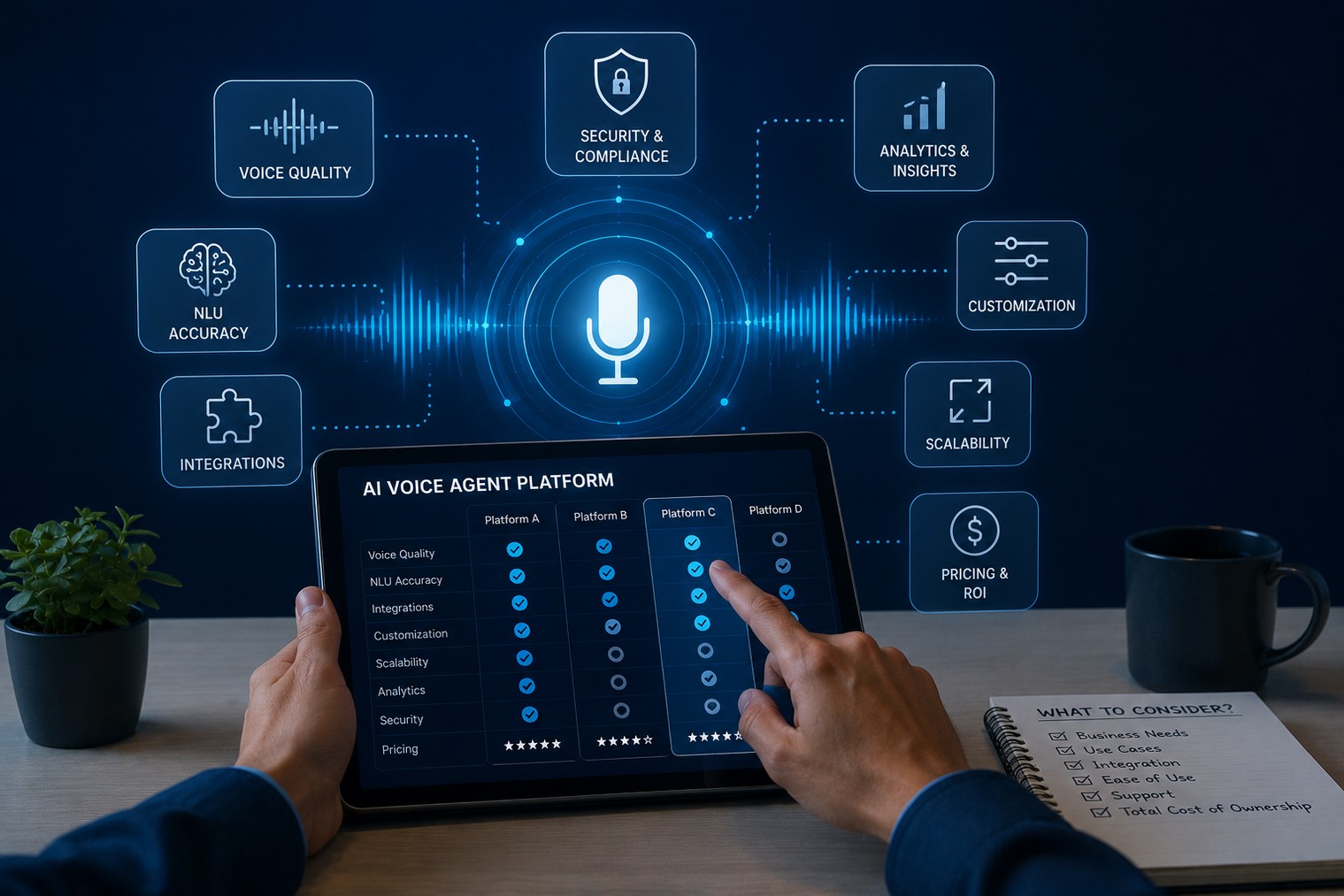
    A person using a tablet to compare AI voice agent platforms, with icons for features like voice quality, security, analytics, NLU accuracy, customization, integrations, scalability, and pricing

    Key Factors to Consider Before Choosing a Platform

    Choosing the right AI voice agent platform starts with understanding your operational requirements, not by comparing feature checklists.

    Natural Conversations

    Customers expect conversations that sound human and adapt to different situations. A strong conversational AI voice agent platform should understand intent, manage interruptions, and maintain context throughout the interaction.

    Enterprise Integrations

    Your platform should connect easily with CRM systems, contact center software, scheduling tools, and business applications. Without seamless integrations, automation cannot extend beyond the conversation itself.

    Multilingual Capabilities

    For businesses serving diverse customer groups, multilingual support is essential. The best AI voice agent platforms should support multiple languages and regional accents while maintaining conversation quality.

    Scalability

    As your business grows, your AI voice agent platform should handle increasing call volumes without compromising performance or customer experience.

    Security and Compliance

    Customer conversations often involve sensitive information. Choosing a platform with enterprise-grade security, compliance controls, and data privacy measures is critical.

    Should You Build or Buy?

    Many organizations evaluating voice AI face another important decision: should they build AI voice agents internally or adopt an existing platform?

    Building a solution offers greater customization but often requires significant investment in AI models, infrastructure, integrations, maintenance, and ongoing optimization.

    An enterprise-ready AI phone agent platform enables businesses to deploy more quickly, reduce development effort, and focus on delivering customer value rather than managing complex AI infrastructure.

    The right choice depends on available resources, implementation timelines, and long-term business objectives.

    Choosing a Platform That Grows With Your Business

    The best AI voice agent platform should continue delivering value as customer expectations and business needs evolve.

    Platforms such as Ello combine conversational intelligence, multilingual support, enterprise integrations, and workflow automation to help organizations manage customer interactions at scale. From inbound support and appointment scheduling to outbound engagement and lead qualification, businesses can automate routine conversations while maintaining a natural customer experience.

    Beyond today’s requirements, organizations should evaluate whether a platform can support future automation initiatives, new communication channels, and expanding customer engagement strategies.

    Conclusion

    Choosing the right AI voice agent platform is about finding a solution that fits both your current operations and your long-term growth plans.

    By focusing on conversation quality, scalability, enterprise integrations, security, and automation capabilities, businesses can confidently invest in a platform that improves customer engagement and operational efficiency.

    As voice AI adoption continues to accelerate, organizations that select a flexible, enterprise-ready platform today will be better positioned to deliver smarter, faster, and more personalized customer experiences.

    FAQs

    Q1. What is an AI voice agent platform?

    An AI voice agent platform enables businesses to automate voice conversations using conversational AI, speech recognition, and natural language understanding, delivering more natural customer interactions.

    Q2. What should businesses look for in an AI voice agent platform?

    Key considerations include conversation quality, multilingual support, enterprise integrations, scalability, security, analytics, and ease of deployment.

    Q3. Should businesses build AI voice agents or use an existing platform?

    Organizations with extensive technical resources may choose to build AI voice agents, while many businesses prefer enterprise-ready platforms to accelerate deployment and reduce maintenance complexity.

    Q4. What is an AI phone agent platform?

    An AI phone agent platform automates inbound and outbound phone conversations, enabling businesses to handle customer support, scheduling, reminders, and lead qualification through AI-powered voice interactions.

    Q5. Which industries benefit most from AI voice agent platforms?

    Healthcare, banking, insurance, retail, logistics, telecommunications, and customer service organizations commonly use AI voice agent platforms to improve operational efficiency and customer engagement.

  • Best Voice AI Platform in India 2026

    Best Voice AI Platform in India 2026

    Voice conversations remain one of the most important ways businesses connect with customers. Whether it’s handling support inquiries, scheduling appointments, qualifying leads, or providing account information, phone interactions continue to play a critical role across industries.

    As customer expectations evolve, businesses are looking beyond traditional IVR systems and call centers. They need solutions that can understand natural language, respond intelligently, and scale without increasing operational costs. This is where a modern voice AI platform comes into the picture.

    But what makes a platform stand out in 2026, and how can businesses identify the right solution for their needs?

    Why Voice AI Adoption Is Accelerating

    The demand for intelligent voice experiences is growing rapidly across global markets. According to research, the global conversational AI market is projected to exceed USD 82.46 billion by 2034, driven by increasing enterprise investments in customer service automation and AI-powered engagement.

    This growth reflects a broader shift toward voice-driven customer interactions. Organizations are no longer looking for simple automation. They want solutions that can hold natural conversations, understand context, and take meaningful actions in real time.

    As a result, the voice AI platform has become a strategic technology investment for businesses seeking better customer experiences and greater operational efficiency.

    What Is a Voice AI Platform?

    A voice AI platform enables businesses to automate voice-based conversations using artificial intelligence. These platforms combine speech recognition, natural language understanding, and workflow automation to interact with customers in a natural and conversational manner.

    Unlike traditional IVR systems that rely on fixed menu options, a modern conversational voice AI platform can understand intent, respond dynamically, and guide customers through complete interactions.

    Businesses use a voice AI platform for business operations to automate:

    • Customer support calls
    • Appointment scheduling
    • Lead qualification
    • Order tracking
    • Payment reminders
    • Customer feedback collection

    The goal is not simply to reduce manual effort but to create faster and more seamless customer experiences.
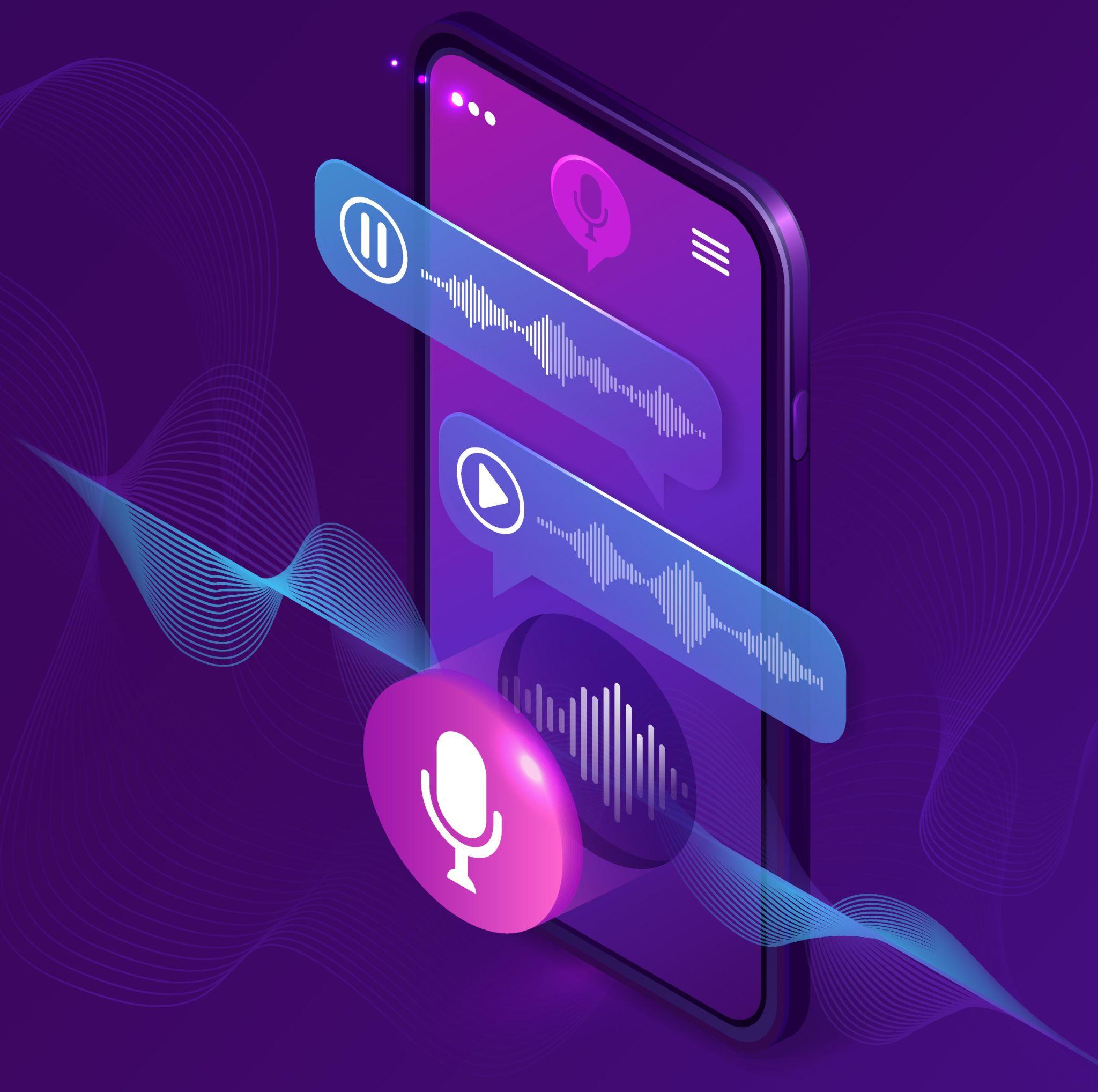
    Isometric illustration of a smartphone displaying a voice AI interface with sound waves, microphone icon, and chat bubbles on a purple gradient background

    What Defines the Best Voice AI Platform in 2026?

    With many solutions available in the market, enterprises should evaluate platforms based on business outcomes rather than feature lists alone.

    Natural Conversational Capabilities

    Customers expect conversations that feel intuitive. The best voice AI platform should be able to understand different accents, conversational styles, and customer intents without requiring rigid scripts.

    Enterprise Integrations

    A strong voice AI agent platform should integrate easily with CRM systems, contact center tools, scheduling applications, and business databases. This allows conversations to trigger real business actions.

    Multilingual Support

    India’s linguistic diversity makes multilingual support and capabilities essential. The best voice AI platforms support multiple regional languages and can switch naturally between languages when required.

    Scalability

    As call volumes increase, businesses need a voice AI platform that can handle thousands of simultaneous conversations while maintaining consistent performance.

    Analytics and Insights

    Conversation data can reveal valuable customer trends and operational insights. Advanced platforms provide reporting and analytics that help businesses continuously improve customer interactions.

    How Businesses Are Using Voice AI Today

    Organizations across industries are already seeing measurable value from voice automation.

    Healthcare providers use an AI voice assistant platform to automate appointment confirmations and patient reminders.

    Financial institutions deploy voice AI solutions for customer support, payment reminders, and account-related inquiries.

    Retail and e-commerce businesses use a voice AI platform for business operations to handle order updates, delivery notifications, and customer service requests.

    These applications help reduce wait times, improve customer satisfaction, and free human agents to focus on more complex interactions.

    Choosing the Right Voice AI Platform

    The best Voice AI Platform is not necessarily the one with the most features. It is the one that aligns with your business objectives, customer expectations, and operational requirements.

    When evaluating solutions, consider:

    • Ease of deployment
    • Language support
    • Integration capabilities
    • Security and compliance standards
    • Scalability requirements
    • Conversation quality and accuracy

    Platforms such as Ello are built around these requirements, combining multilingual support, enterprise integrations, workflow automation, and conversational AI capabilities to help businesses automate customer interactions at scale. This makes it particularly well-suited for organizations looking to deploy voice AI across diverse customer touchpoints.

    The Future of Voice AI in India

    India’s growing preference for digital-first customer interactions is accelerating the adoption of voice AI across industries. As businesses seek to serve customers in multiple languages while managing rising interaction volumes, voice AI platforms will play an increasingly important role in delivering scalable, personalized experiences.

    Organizations that invest in intelligent voice solutions today will be better positioned to improve accessibility, reduce response times, and scale customer engagement efficiently.

    For enterprises looking to modernize customer communication, a modern voice AI platform can provide the foundation for more responsive, intelligent, and customer-centric experiences.

    FAQs

    Q1. What is a voice AI platform?

    A voice AI platform uses artificial intelligence to automate voice interactions, enabling businesses to engage with customers in natural, human-like conversations.

    Q2. How is a conversational voice AI platform different from traditional IVR?

    A conversational voice AI platform understands natural language and intent, allowing customers to speak freely rather than navigate predefined menu options.

    Q3. What industries benefit most from voice AI platforms?

    Healthcare, banking, insurance, retail, logistics, telecommunications, and customer service organizations commonly use voice AI platforms to improve efficiency and customer engagement.

    Q4. Can a voice AI platform support multiple Indian languages?

    Yes. Many modern voice AI platforms offer multilingual capabilities and can support several Indian languages, making them suitable for diverse customer bases.

    Q5. What should businesses consider when selecting a voice AI platform?

    Key factors include conversation quality, integration capabilities, language support, scalability, analytics, security, and alignment with business goals.

  • Best Voice AI for Outbound Call Automation in India

    Best Voice AI for Outbound Call Automation in India

    The outbound sales and customer engagement landscape in India is undergoing a rapid evolution as we move through 2026. For years, domestic calling operations relied heavily on massive, manual call centers that struggled with high agent turnover, inconsistent quality, and low conversion rates. Today, the rise of the reasoning-first economy has changed how businesses interact with prospects. When searching for the best voice AI for outbound call automation, Indian enterprises must look beyond basic auto-dialers and focus on platforms that offer true agentic capabilities.

    Modern outbound automation is no longer about placing thousands of blind calls. It is about initiating timely, intelligent conversations with high-intent leads. To achieve this, organizations are adopting voice solutions that can reason, adapt, and speak the language of the customer.

    Key Evaluation Criteria for Indian Businesses

    Deploying voice technology in India requires an understanding of the unique market dynamics. A solution that works well in a single-language Western market often fails when faced with the diverse communication styles of the Indian subcontinent.

    Real-Time Reasoning and Active Listening

    Indian consumers expect a conversational approach that feels personal and respectful. Traditional automated systems that rely on rigid, pre-recorded scripts fail to build trust. The best voice AI for outbound call automation must utilize an adaptive prompting engine that allows for active listening.

    The technology must be able to understand when a prospect is interrupting, asking a counter-question, or requesting a callback. A reasoning-based voice agent processes these verbal cues in real-time, adjusting its responses dynamically to match the customer’s pace and needs. This capability is a primary reason why organizations are evaluating the best voice AI for outbound call automation to replace static systems.

    Voice-to-Action Integration

    An outbound call is highly effective when it leads to an immediate action. Whether the goal is to schedule a product demonstration, verify a customer address, or update a policy status, the voice system must execute these tasks autonomously.

    The ideal solution integrates directly with your enterprise CRM and ERP systems. This integration creates a seamless loop where the voice agent can update lead records, trigger follow-up emails, or assign tasks to human account executives while the conversation is still active. This level of automation eliminates manual data entry and prevents lead decay.

    Solving the Vernacular Challenge in the Indian Market

    The greatest hurdle for any communication platform in India is the country’s immense linguistic diversity. A successful outbound strategy must address this complexity to achieve national scale.

    Modern Indian call center powered by voice AI

    Managing Accent Variation and Code-Switching

    Indian English is characterized by various regional accents, and many consumers naturally switch between English and their regional languages during a conversation. This hybrid communication, often referred to as code-mixing, is difficult for basic voice recognition systems to process.

    To identify the best voice AI for outbound call automation, businesses must prioritize platforms that support regional dialects and code-mixing. The system must accurately interpret the customer’s intent regardless of whether they use regional slang or mix languages within a single sentence. This ensures that the outreach remains accessible and professional across all regions.

    Localized Personalization

    An effective voice agent adapts its tone and vocabulary to suit the specific demographic it is calling. For instance, a call to a young professional in a metro hub requires a different conversational style than a call to a retail merchant in a Tier 2 city. The technology must possess the cultural intelligence to adjust its persona, ensuring the interaction feels localized and respectful.

    Regulatory Compliance and TRAI Guidelines

    Outbound calling in India is governed by strict regulations established by the Telecom Regulatory Authority of India (TRAI). Violating these rules can lead to severe penalties and brand damage.

    Any automated outbound campaign must respect the National Do Not Call (DND) registry. The best voice AI for outbound call automation must feature built-in compliance guardrails that cross-reference calling lists with active consent registries in real-time.

    Adhering to these strict guidelines is a non-negotiable requirement for the best voice AI for outbound call automation in the domestic market. Furthermore, the platform must secure and log customer consent dynamically during the call, ensuring a clear audit trail for compliance purposes.

    Data Privacy and Enterprise Security

    As businesses handle sensitive customer information, data security remains a paramount concern. Outbound platforms must meet global standards such as SOC 2 to ensure that all conversational data, customer profiles, and voice recordings are fully encrypted and protected against unauthorized access.

    The Ello Advantage: Elevating Indian Outbound Strategy

    As an independent, proprietary agentic voice platform, Ello provides the critical infrastructure required to scale outbound operations in India. We designed Ello to stand out as the best voice AI for outbound call automation by focusing on advanced regional adaptability.

    Ello specifically supports 30 different languages and various regional accents, allowing your business to engage with customers nationwide with native-level fluency. Its Adaptive Prompting Engine enables complex, reasoning-based conversations that move beyond rigid scripts to handle objections naturally.

    A key innovation of the Ello platform is its self-evolving architecture. The system features an autonomous learning loop that monitors every interaction. After approximately 200 calls, Ello analyzes the data to rebuild its own prompts, driving a 30 percent boost in operational efficiency without requiring manual developer intervention. By combining enterprise-grade SOC 2 compliance with advanced voice-to-action capabilities, Ello helps Indian enterprises build stronger, more compliant customer relationships.

    AI Agent handling an outbound call with real-time insights

    FAQ

    Q1. What makes a platform the best voice AI for outbound call automation?

    The best voice AI for outbound call automation must process natural, unstructured speech and execute tasks without human delay. It must also handle regional accents and integrate directly with enterprise CRMs.

    Q2. How does Ello handle the linguistic diversity of the Indian market?

    Ello natively supports 30 different languages and regional accents, allowing it to process code-switching and deliver a localized experience for diverse demographics.

    Q3. Is outbound voice automation compliant with TRAI regulations?

    Yes, proprietary platforms like Ello are designed to comply with TRAI guidelines, including DND registry integration and real-time consent verification.

    Q4. Can Ello help reduce our lead response times?

    Yes, Ello’s voice-to-action engine can initiate automated, personalized calls within seconds of a lead submission, eliminating the speed-to-lead gap entirely.

    Q5. Does the system require manual updates to maintain accuracy?

    No, Ello features a self-evolving architecture that analyzes conversational data and autonomously updates its prompts after 200 sessions to improve performance.

    Conclusion: The Era of Intelligent Outreach

    The future of outbound calling in India belongs to organizations that prioritize customer experience over call volume. By deploying the best voice AI for outbound call automation, businesses can replace intrusive, scripted calls with helpful, reasoning-based conversations. This strategic shift not only protects brand reputation but also unlocks scalable, predictable growth in India’s competitive marketplace.

  • Voice AI Automation: How Enterprise Teams Are Eliminating Manual Call Workflows in 2026

    Voice AI Automation: How Enterprise Teams Are Eliminating Manual Call Workflows in 2026

    Every enterprise has them, the repetitive, high-volume call workflows that eat into agent bandwidth day after day. Order status checks. Appointment confirmations. Billing inquiries. These interactions are predictable, scriptable, and yet still handled by human agents.

    Multiply that across thousands of daily interactions, and the operational drag becomes an untackled expense.

    In 2026, voice AI automation has crossed the threshold from promising pilot technology to enterprise-grade infrastructure, and the organizations that have embraced it are reporting results that are hard to ignore: up to a 50% reduction in operational costs, 35% faster call handling times, and ROI payback periods of under six months.

    This blog breaks down what’s driving that shift, how enterprise teams are deploying voice AI agents to eliminate manual call workflows, and what it takes to get it right.

    What Is Voice AI Automation?

    Voice AI automation refers to the use of AI-powered voice agents, built on large language models (LLMs), advanced speech recognition, and natural language processing (NLP), to handle inbound and outbound phone calls without human involvement.

    Unlike legacy IVR (Interactive Voice Response) systems that rely on rigid menu trees and keypad inputs, modern voice AI automation understands conversational speech, adapts to context mid-call, and executes multi-step workflows autonomously. From the moment a call connects to the moment it ends, answering, qualifying, routing, booking, and logging, the AI handles the full interaction.

    Why 2026 Is the Tipping Point for Enterprise Adoption

    Three forces have converged simultaneously to make 2026 the year enterprises go live with voice AI at scale.

    1. Technology Has Finally Matured

    Speech recognition now handles real-world conditions, background noise, regional accents, natural interruptions, and domain-specific vocabulary with accuracy rates approaching 85% when properly implemented. LLMs can reason through complex, multi-turn conversations rather than just pattern-matching against predefined scripts. The result is voice AI that sounds and performs like a capable agent.

    2. The ROI Case Is Undeniable

    The numbers speak for themselves:

    • Voice AI costs ~$0.40 per call versus $7–$12 for a human agent, for an 80% cost reduction per interaction.
    • 80% automation rates are achievable with properly scoped, high-volume use cases.
    • 89% of customers say they are more likely to choose brands that offer Voice AI support.

    3. Compliance Infrastructure Is Now Standard

    For years, regulated industries such as banking, healthcare, and insurance have faced genuine friction with the adoption of voice AI due to data residency and PII-handling requirements. That barrier is largely gone. Enterprise-grade voice AI platforms now ship with automatic PII redaction, HIPAA and GDPR compliance, 100% interaction capture with searchable audit trails, and SOC 2 / ISO 27001 certifications as standard capabilities.

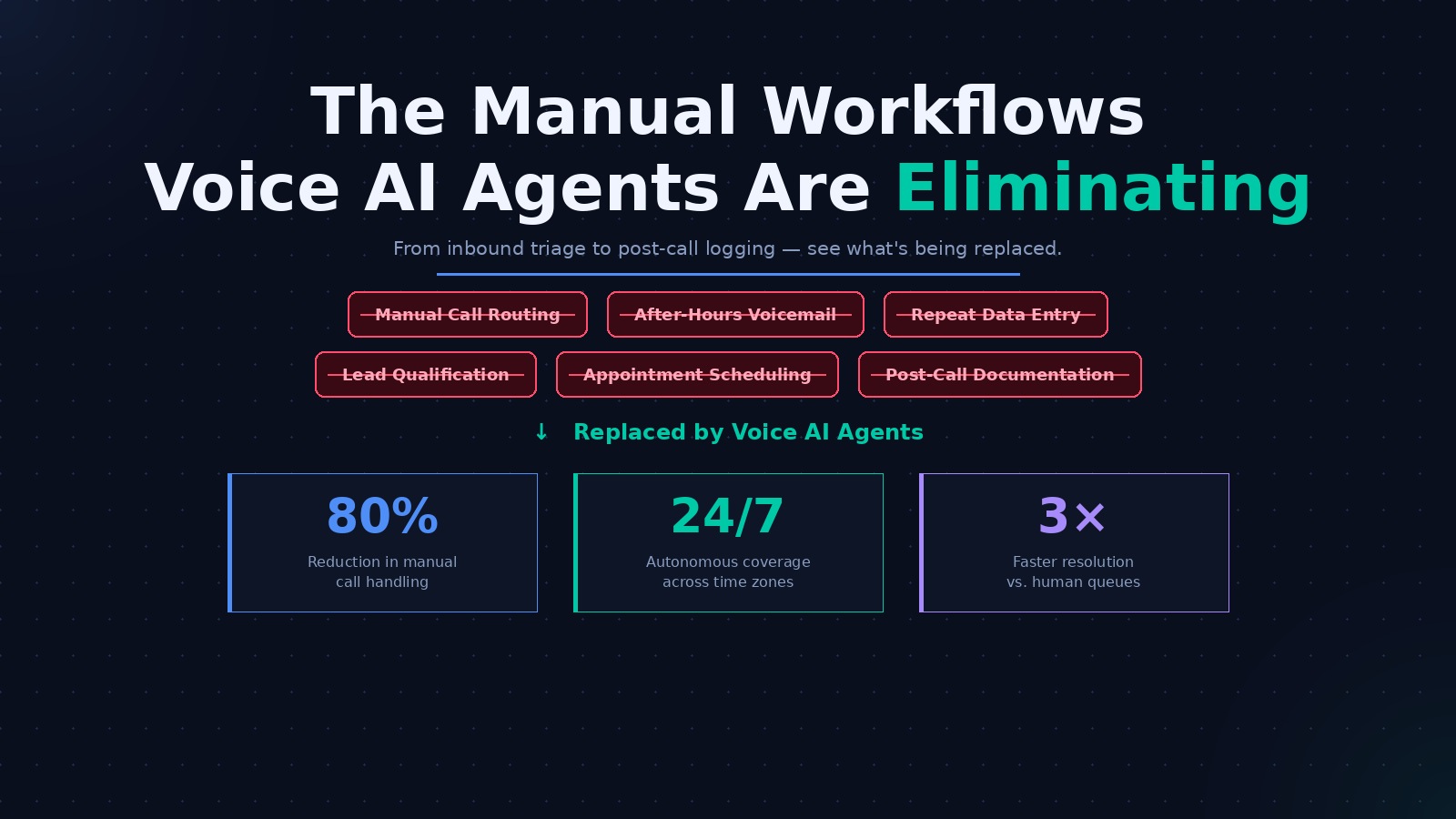
    The Manual Workflows Enterprise Voice AI Agents are Eliminating

    Here’s where the real transformation is happening across enterprise teams in 2026:

    Enterprise teams eliminating manual call workflows with voice AI

    Tier 1: IVR Replacement (Fastest to Deploy)

    Legacy touch-tone menus are being replaced with conversational AI that understands natural speech. Customers say what they need instead of pressing numbers. Call routing accuracy improves immediately, and customer frustration drops.

    Tier 2: Autonomous Resolution (Where Real Cost Savings Begin)

    AI voice agents handle calls end-to-end for defined, repeatable use cases:

    • Order status and tracking — customers get real-time updates without agent involvement.
    • Appointment scheduling and confirmations — booking, rescheduling, and reminders are handled automatically.
    • Account balance and billing inquiries — FAQs and transactional queries resolved in under 60 seconds.
    • Password resets and basic IT support — high-volume, low-complexity tickets cleared without a service desk ticket.

    Tier 3: Agentic Workflow Execution (The Frontier in 2026)

    The most advanced deployments use agentic voice AI to manage entire workflows: calling leads within seconds of form submission, conducting qualification conversations, updating CRM records, and scheduling follow-ups, all without a human in the loop. By 2027, four in ten customer service interactions will be fully automated by agentic voice AI.

    Key Metrics Enterprises Are Tracking Post-Deployment

    Successful voice AI automation deployments are measured across five core performance dimensions:

    Metric Impact
    First Contact Resolution (FCR) +5 to +15 points
    Average Handle Time (AHT) 25–50% reduction
    Agent Ramp Time 50–85% reduction
    Operational Cost per Call 70–90% reduction
    Customer Satisfaction (CSAT) Up 30% on AI-handled calls
    Call Abandonment Rate Down by up to 50%

    What Separates Leaders From Laggards in 2026

    The organizations succeeding with voice AI automation in 2026 share one defining mindset: they are solving specific business problems.

    They identify high-volume, low-complexity workflows where AI can deliver immediate value, validate the economics, and scale systematically. They treat voice AI as an enterprise workflow layer, one that integrates with their CRM, ticketing system, scheduling platform, and compliance infrastructure.

    They are also thinking beyond cost reduction. The most forward-looking deployments are using voice AI to drive revenue: mid-call upsell prompts, automated cart recovery, lead qualification at speed-to-lead, transforming contact centers from cost centers into profit centers.

    Why Ello is the Best Choice for Enterprises

    While many platforms are playing catch-up, Ello was architected with these 2026 trends as foundational pillars.

    Ello voice AI agent powering enterprise call automation

    • Adaptive Prompt Technology: Our agents don’t just follow a script; they rewrite their own playbook in real-time to optimize outcomes, embodying the true spirit of Agentic AI.
    • Multi-Agent Networks: Ello utilizes specialized sub-agents to audit and improve conversations at machine speed, ensuring accuracy and continuous learning.
    • Low-Latency Infrastructure: We understand that in a voice-first world, speed is trust. Our infrastructure is built for sub-second responses, ensuring conversations feel natural and human.
    • Enterprise-Grade Security: With SOC 2 and HIPAA compliance, Ello provides the governance and safety required for the next generation of AI deployment.
    • True Multilingual & Dialect Mastery: In a linguistically diverse market like India, businesses traditionally had to hire separate support teams for regional languages. With Ello, you don’t need that. Our agents can switch naturally between languages mid-conversation (e.g., from Hindi to English) just as a native speaker would. This massive consolidation significantly reduces hiring effort and operational costs, allowing a single AI workforce to serve the entire country.

    FAQs

    Q1. What is Voice AI automation?

    Voice AI automation uses artificial intelligence to handle voice-based interactions such as inbound support, outbound calls, appointment scheduling, and customer follow-ups. It enables businesses to automate conversations while maintaining a natural, human-like experience.

    Q2. How does Voice AI reduce manual call workflows?

    Voice AI automates repetitive tasks like answering FAQs, collecting customer information, qualifying leads, and scheduling appointments. This reduces the workload on human agents and allows teams to focus on complex customer interactions.

    Q3. Can Voice AI handle enterprise-scale call volumes?

    Yes, modern voice AI platforms can manage thousands of simultaneous conversations without compromising response quality. This scalability helps enterprises handle peak call volumes without increasing staffing costs.

    Q4. What industries benefit the most from Voice AI automation?

    Industries such as healthcare, banking, insurance, real estate, retail, and customer support see significant benefits from voice AI. These sectors often handle high call volumes and repetitive customer interactions, which are ideal for automation.

    Q5. Is Voice AI capable of multilingual communication?

    Most enterprise voice AI solutions support multiple languages and regional accents. This allows organizations to provide consistent customer experiences across diverse markets and geographies.

    Q6. Does Voice AI integrate with existing business systems?

    Yes, enterprise voice AI platforms can integrate with CRM, ERP, helpdesk, scheduling, and communication tools. These integrations enable seamless data exchange and automated workflow execution.