
Tag: contact center AI

  • AI Voice Agent Latency Explained: Why Response Time Makes or Breaks the Call

    AI Voice Agent Latency Explained: Why Response Time Makes or Breaks the Call

    A voice conversation depends on timing. Even a short pause after a customer finishes speaking can make an AI agent feel slow, uncertain, or disconnected.

    That makes AI voice agent latency a critical part of the customer experience. It affects how naturally an agent responds, handles interruptions, retrieves information, and keeps a conversation moving.

    For enterprises, even small delays can affect thousands of daily interactions. Understanding where latency comes from and how to measure it is essential for delivering reliable voice AI at scale.

    What AI Voice Agent Latency Actually Means

    AI voice agent latency refers to the time between a customer finishing their speech and hearing the AI begin its response.

    That gap can involve several stages:
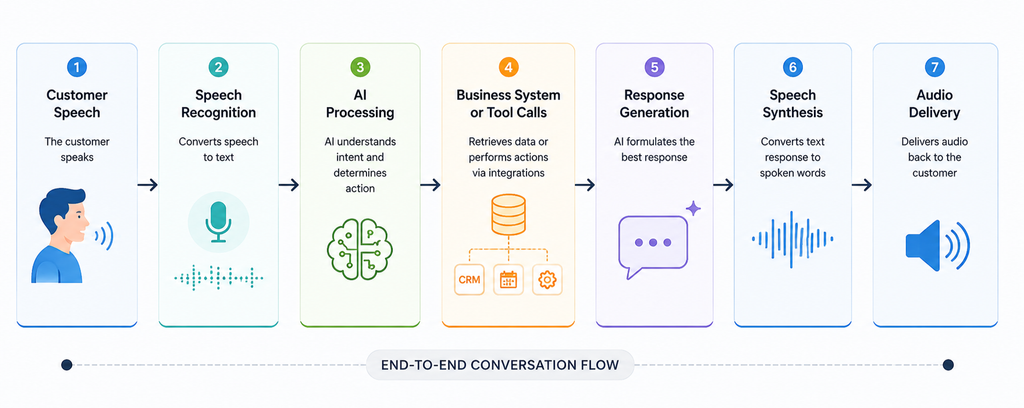
    AI voice agent latency gap can involve several stages

    Each stage can add delay. Speech-to-text needs to process what the customer said. The AI needs to interpret the request and determine what to do. If the request requires information from a CRM, payment system, scheduling platform, or other backend application, that interaction adds another layer. The response then needs to be converted into speech and delivered back to the caller.

    This means the most important factor is the end-to-end experience the customer hears, not the processing time of any single component.

    Why Latency Changes the Conversation

    When the response arrives quickly, the interaction feels continuous. When the pause becomes noticeable, customers may repeat themselves, interrupt the agent, or assume something went wrong.

    NVIDIA recommends targeting under one second between the end of a customer’s speech and the first synthesized audio for a conversational voice agent to feel responsive. Its 2026 guidance notes that delays above one second can begin to interrupt the natural flow of conversation.

    That makes response time in voice AI a practical customer experience consideration, not simply an engineering benchmark. A slower response can create a chain reaction:
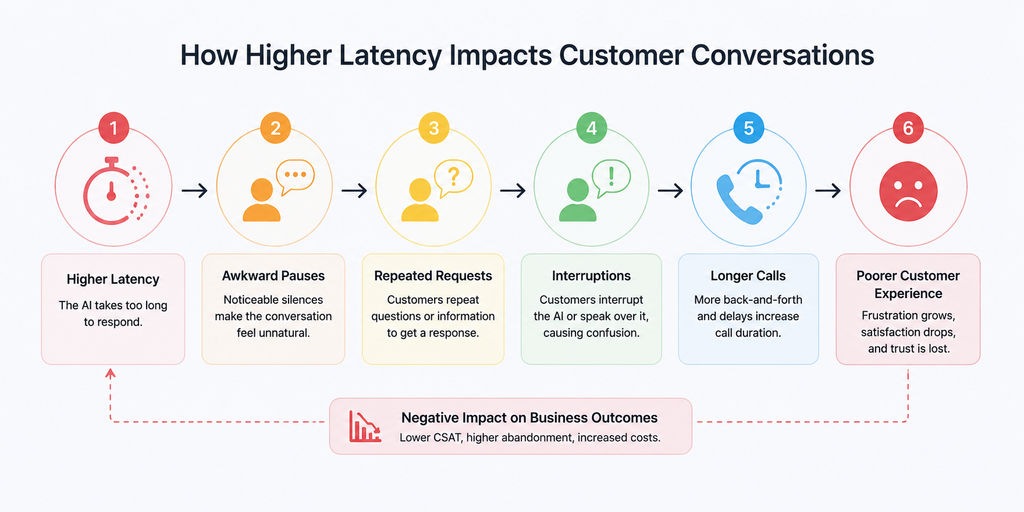
    How higher latency impacts customer conversations

    Latency also affects how well an agent handles interruptions. If a customer starts speaking while the AI is responding, the system needs to detect the interruption and stop speaking quickly. Otherwise, even an accurate response can feel disconnected from the conversation.

    The goal, therefore, is not simply to make an AI voice agent respond faster. It is to create real-time voice AI performance that keeps turn-taking natural, responses timely, and the conversation moving.

    The Fastest First Response Can Still Feel Slow

    A voice agent can respond quickly to a simple question and still create noticeable delays when it needs to complete a business action.

    Consider a customer asking, “Where is my order?”

    The AI may recognize the request immediately. But it still needs to identify the customer, retrieve the order from the relevant system, check the latest status, and formulate a response.

    The customer experiences all of that as part of one conversation.

    The same applies when a voice agent needs to:

    • Schedule or reschedule an appointment
    • Retrieve account information
    • Update a customer record
    • Verify an identity
    • Process a service request
    • Check payment or order status

    This is why real-time voice AI performance depends on the entire technology stack. A fast speech model cannot compensate for a slow backend workflow.

    Enterprises should therefore evaluate latency across the complete customer journey rather than looking only at model or platform benchmarks.

    How Enterprises Should Measure Real-Time Voice AI Performance

    Asking a provider, “What is your latency?” doesn’t provide enough information.

    Enterprises should understand how that number was measured.

    A meaningful evaluation should consider:

    • End-to-end latency: Measure the time the customer actually experiences, including network and telephony factors.
    • p50 latency: Shows the typical interaction.
    • p95 and p99 latency: Reveal how the system performs during slower interactions. An attractive average can hide delays that customers encounter regularly.
    • Geography: Network distance and telephony routing can affect response times.
    • Concurrency: A system that performs well during a small test may behave differently under production call volumes.
    • Tool calls: Test the agent while it accesses real CRM, scheduling, payment, or other enterprise systems.
    • Language: Measure performance across the languages and accents the target customer base actually uses.

    The evaluation should happen under conditions that resemble production. A laboratory benchmark provides useful information, but it doesn’t tell the whole story.

    How Enterprises Can Reduce Voice AI Latency

    Improving AI voice agent latency requires attention to the full interaction, not a single component.

    • Optimize the architecture

    Streaming speech recognition, incremental response generation, and parallel processing can reduce unnecessary waiting between stages.

    • Reduce backend delays

    If every customer request requires a slow API call, the voice experience will inherit that delay. Design critical enterprise workflows for fast retrieval and execution.

    • Improve interruption handling

    The agent should recognize when a customer starts speaking and stop its response quickly. This keeps turn-taking natural and prevents customers from talking over the system.

    • Use concise responses

    A voice agent doesn’t need to deliver a long explanation when a short answer completes the task. Concise responses reduce interaction time and keep conversations focused.

    • Monitor the complete call

    Teams should track response latency alongside task completion, transfer rates, call duration, and customer satisfaction. This provides a clearer picture of whether faster responses are actually improving the customer experience.

    How Ello Supports Real-Time Voice Experiences

    For enterprise voice AI, responsiveness depends on more than the conversational model’s speed. Customer interactions also involve business systems, workflows, data retrieval, multilingual communication, and human handoffs.

    Ello brings these elements together through AI voice agents designed for real-time customer interactions. The platform can understand customer intent, work with enterprise systems, automate workflows, and transfer conversations to human agents when additional expertise is required.

    This approach helps organizations evaluate AI voice agent latency as part of the complete customer interaction rather than as an isolated technical benchmark. Faster responses, connected workflows, and contextual conversations work together to create voice experiences that feel more natural and responsive.

    Conclusion

    AI voice agent latency directly influences how customers experience a conversation.

    A technically capable voice agent can still frustrate customers when responses arrive too slowly, interruptions take too long to register, or backend workflows create unexplained pauses. Enterprises therefore need to evaluate response time across the complete call journey, under realistic production conditions.

    The right benchmark isn’t simply the lowest latency number. It is consistent, responsive performance that helps customers complete tasks without awkward pauses, repeated requests, or unnecessary transfers.

    For businesses deploying voice AI at scale, treat real-time voice AI performance as a core customer experience metric, alongside accuracy, task completion, reliability, and service quality.

    FAQs

    1. What is AI voice agent latency?

    AI voice agent latency is the time between a customer finishing their speech and hearing the AI respond. It can include speech recognition, AI processing, backend calls, and speech generation.

    2. What is a good response time for voice AI?

    There is no single ideal number. Enterprises should evaluate end-to-end latency, including p50, p95, and p99 performance.

    3. Why does latency matter for voice AI?

    High latency creates awkward pauses, repeated requests, interruptions, and longer calls, which can affect the overall customer experience.

    4. How can enterprises improve AI voice agent latency?

    Enterprises can reduce latency by optimizing the AI architecture, backend integrations, API calls, streaming, and interruption handling.

    5. How should businesses evaluate voice AI latency?

    Test real customer scenarios across target geographies, languages, integrations, and call volumes, while measuring end-to-end p50, p95, and p99 latency.


  • From Chatbots to Intelligence: The ROI of Conversational AI in BPOs

    From Chatbots to Intelligence: The ROI of Conversational AI in BPOs

    In the global Business Process Outsourcing (BPO) sector, the year 2026 marks a definitive end to the era of labor arbitrage.

    For decades, the industry was built on the premise of moving repetitive tasks to lower-cost geographies. However, as digital transformation accelerates, the BPO model has shifted from providing “bodies in seats” to providing “intelligence in workflows.”

    This transformation is driven by the transition from first-generation chatbots to agentic voice and text systems.

    For BPO leaders, the primary metric for success has evolved. It is no longer enough to deflect a call to an automated menu. The focus has shifted to total task resolution.

    As organizations evaluate their technology investments, understanding the Conversational AI ROI has become the cornerstone of strategic planning.

    By moving beyond simple scripts to reasoning-based agents, BPOs are unlocking new levels of profitability and operational excellence.

    The Evolution of Value: Beyond Basic Automation

    The BPOs that thrived in 2025 were those that recognized basic chatbots were only a partial solution.

    While early bots could handle simple FAQs, they often lacked the context required for complex service resolution. In 2026, the industry has embraced agentic workflows.

    An agentic workflow allows the AI to act as an autonomous employee. Instead of merely providing an answer, the system can reason through a problem, access relevant enterprise data, and execute a solution.

    This shift is where the true Conversational AI ROI is realized. When an AI can handle a billing dispute or a complex booking change from start to finish, the cost per interaction drops while the quality of service remains high.

    BPO contact center agents working with AI technology

    The Power of Multi-Agent Frameworks

    A key trend defining 2026 is the deployment of multi-agent frameworks within the contact center. In this model, a BPO does not rely on a single, monolithic bot. Instead, it utilizes a coordinated group of specialized agents.

    • The Orchestrator Agent: This agent manages the customer interaction, identifies the intent, and maintains the emotional tone of the conversation.
    • The Integration Agent: This specialist focuses on interacting with legacy back-office systems, performing data entry, and pulling real-time records.
    • The Compliance Agent: This agent works in the background to ensure every interaction meets regulatory standards and internal quality protocols.

    This modular approach ensures higher accuracy and allows for easier updates to business logic, directly contributing to a higher Conversational AI ROI by reducing the need for expensive, long-term development cycles.

    Quantifying the Conversational AI ROI: Direct and Indirect Metrics

    To understand the full impact of intelligent automation, BPO executives are looking at a combination of direct cost savings and strategic value.

    Direct Operational Savings

    The most immediate component of Conversational AI ROI is the reduction in cost per interaction. In 2026, intelligent agents can handle up to 80 percent of routine inquiries at a fraction of the cost of a human agent.

    • Average Handle Time (AHT): AI agents process information and execute tasks at machine speed, often reducing handle times by 40 to 60 percent.
    • First Call Resolution (FCR): Because agentic AI has access to the same data as human employees and can reason through complex logic, FCR rates are seeing significant improvements, often reaching over 90 percent for handled intents.
    • Labor Optimization: By automating high-volume, low-complexity tasks, BPOs can optimize their workforce, allowing their most skilled human agents to focus on high-value, high-empathy interactions.

    Strategic and Long-Term Value

    Beyond the balance sheet, Conversational AI ROI includes the ability to scale and adapt. In a volatile global market, the ability to spin up thousands of intelligent agents in a matter of days provides a competitive advantage that traditional hiring cannot match.

    Furthermore, the structured data generated by every AI interaction provides a goldmine for business intelligence, allowing BPOs to offer proactive consulting services to their clients based on the trends observed on the front lines.

    Market Projections for 2026 and Beyond

    Industry analysts project that by late 2026, over 70 percent of BPO service interactions will be initiated and resolved by AI agents.

    The global market for AI in the BPO sector is expected to grow at an unprecedented rate, as the barrier to entry for intelligent automation continues to lower.

    The successful BPO of the future is an “AI-First” organization. In this model, every process is designed for automation first, with human intervention reserved for exceptions and escalations.

    This approach maximizes the Conversational AI ROI by ensuring that technology is the primary driver of efficiency, while human talent is utilized for its unique ability to manage complex relationships and creative problem-solving.

    AI bot with analytics and data visualization

    Solving the Implementation Gap with Ello

    While the potential for high Conversational AI ROI is clear, many BPOs struggle with the technical complexity of integrating agentic workflows into existing infrastructures.

    This is where Ello provides a breakthrough solution. Built on 2026-standard agentic frameworks, Ello goes beyond conversation to provide a Voice-to-Action engine that interacts directly with enterprise CRMs and operational systems.

    Its Adaptive Prompting Engine allows BPOs to deploy intelligent, reasoning agents that handle linguistic diversity and sentiment in real-time.

    By providing an enterprise-ready, SOC 2 compliant platform, Ello allows BPOs to achieve a rapid Conversational AI ROI, transforming their service centers from cost-heavy departments into agile, revenue-driving engines of growth.

    FAQ: Conversational AI ROI in BPOs

    Q1: How quickly can a BPO expect to see a Conversational AI ROI?

    Most organizations begin to see a positive return within six to nine months of implementation. This is driven by a combination of reduced labor costs and significantly higher throughput in customer service operations.

    Q2: Does implementing AI mean a BPO will have to reduce its headcount?

    Not necessarily. Many BPOs use the Conversational AI ROI to fund expansion into higher-value services. While routine roles may be automated, there is an increased demand for AI trainers, prompt engineers, and specialized human-in-the-loop agents.

    Q3: Can Conversational AI handle multilingual support as efficiently as human agents?

    In 2026, yes. Advanced platforms now support over 100 languages with native-level fluency. This allows BPOs to offer global support without the overhead of hiring and training localized teams for every market.

    Q4: What is the biggest risk to achieving a high Conversational AI ROI?

    The biggest risk is poor integration. If the AI is not properly connected to the business logic and back-office systems, it remains a “talking bot” rather than a reasoning agent, limiting its ability to resolve tasks autonomously.

    Q5: How does the ROI of voice AI compare to text-based chatbots?

    Voice AI typically offers a higher Conversational AI ROI in sectors like healthcare, finance, and hospitality, where customers value the speed and empathy of a verbal conversation over the friction of typing into a chat window.

    Conclusion: The Path to Operational Excellence

    The BPO industry is at a crossroads where technology is no longer an accessory, but the core product.

    Achieving a sustainable Conversational AI ROI requires a commitment to moving beyond simple automation and into the realm of true operational intelligence.

    By leveraging agentic workflows and multi-agent frameworks, BPO leaders can provide unprecedented value to their clients while securing their own profitability in an increasingly automated world.

    The future belongs to the BPOs that can speak the language of both their customers and their data.