Tag: AI voice agent

  • AI Voice Agents for HR: How Indian Enterprises Are Automating Candidate Screening

    AI Voice Agents for HR: How Indian Enterprises Are Automating Candidate Screening

    Managing recruitment across major Indian enterprise sectors in 2026 presents a significant operational challenge. Human resource teams in information technology, banking, retail, and business process outsourcing often receive thousands of applications for a single open role. The traditional candidate screening process, reliant on manual phone calls and spreadsheet tracking, creates a severe bottleneck. Recruiters spend countless hours chasing voicemails, confirming basic qualifications, and coordinating schedules, which leads to recruiter burnout and high candidate drop-off rates.

    To overcome these delays, forward-thinking organizations are modernizing their talent acquisition stacks. The deployment of an AI voice agent for recruitment has emerged as an essential strategy for streamlining candidate screening. By replacing manual phone screens with reasoning-based voice technology, Indian enterprises are engaging applicants instantly, evaluating candidates objectively, and accelerating time-to-hire.

    1. Closing the Recruiter Gap with Instant Outreach

    For the hiring market, speed of engagement dictates recruitment success. Research indicates that candidate interest drops sharply when applicants wait several days for a response following an initial application. When a qualified candidate applies for a role, competing employers are often evaluating the same talent pool.

    A man sitting at a desk with a laptop, gesturing while speaking to an AI voice interface on the screen

    An AI voice agent for recruitment eliminates this latency by initiating phone screens within seconds of an application submission. The moment a resume is uploaded or a web form is completed, the system can trigger an automated, conversational call to verify candidate interest, evaluate core availability, and answer initial questions about the role. This immediate touchpoint keeps candidates engaged while their interest is at its peak, drastically reducing drop-off rates at the top of the hiring funnel.

    2. Dynamic, Multi-Turn Screening Beyond Static Scripts

    Legacy automated calling tools operated on rigid, touch-tone IVR trees that forced applicants through unnatural decision logic. These static systems could not handle multi-part answers or clarify ambiguous candidate responses.

    Modern agentic voice systems bring conversational reasoning to first-round screening. An AI voice agent for recruitment conducts natural, multi-turn dialogues that adapt dynamically to the candidate’s responses. The system evaluates essential screening parameters:

    • Notice Period and Availability: Verifying immediate joiner status or exact notice obligations.
    • Compensation Expectations: Confirming alignment with fixed and variable budget bands.
    • Geographic Flexibility: Assessing willingness to relocate or commute to specific office locations.
    • Core Competency Verification: Asking structured domain questions to assess foundational technical or operational knowledge.

    If a candidate interrupts, asks a question about the company culture, or provides a complex response regarding their notice period, the voice agent processes the context smoothly and guides the conversation back to the qualification goals.

    3. Navigating the Indian Vernacular Landscape and Code-Switching

    Conducting phone screens across India requires an understanding of the country’s immense linguistic diversity. Candidates across different regions speak with varied accents and frequently mix English with regional languages during natural speech. This hybrid communication, known as code-switching, presents a major challenge for basic voice engines.

    To deliver a consistent experience, an AI voice agent for recruitment must understand regional accents and linguistic code-switching naturally. Whether a candidate switches between English and Hindi, Tamil, or Kannada mid-sentence, the system maintains comprehension without breaking the conversation. This linguistic flexibility allows Indian enterprises to scale talent acquisition across Tier 1, Tier 2, and Tier 3 cities without needing localized human screening teams in every state.

    4. Voice-to-Action Integration and Inline Scheduling

    A primary source of inefficiency in traditional hiring is the manual coordination required between candidate screening and interview scheduling. When a recruiter completes a successful phone screen, they often exchange multiple emails or messages to find a mutually agreeable time slot on a hiring manager’s calendar.

    Enterprise voice platforms solve this through voice-to-action integration with leading applicant tracking systems (ATS) like Darwinbox, Workday, Zoho Recruit, and SAP SuccessFactors.

    When an AI voice agent for recruitment identifies a high-scoring candidate, it executes an inline scheduling workflow while remaining on the call. The agent checks live calendar availability, offers available interview slots to the candidate, confirms the booking, and updates the candidate profile in the ATS automatically.

    5. Standardized Evaluation and Unbiased Talent Assessment

    Human phone screening is inherently vulnerable to subjective bias, recruiter fatigue, and inconsistent questioning. A recruiter at the end of a long day may evaluate a candidate differently than they would first thing in the morning, leading to uneven candidate experiences and potential compliance risks.

    Automating first-round screens ensures standardized evaluation criteria across every candidate interaction. Every applicant is asked the same core qualification questions, and their answers are evaluated against objective job requirements. The system generates complete audio transcripts, structured call summaries, and standardized fit scores, creating a clear audit trail for fair-hiring reviews and internal compliance audits.

    A woman wearing a headset sits at a desk with a laptop, interacting with a digital interface showing candidate profiles

    The Ello Advantage: Transforming Enterprise Talent Acquisition

    As an independent, proprietary platform, Ello provides the core technology required for enterprise recruitment automation. Built on 2026-standard agentic frameworks, Ello functions as a reasoning teammate that integrates seamlessly into major enterprise ATS and HR management systems.

    Ello specifically supports 30 different languages and various regional accents: ensuring your organization can screen candidates across diverse geographies with native-level fluency. Its Adaptive Prompting Engine allows the platform to navigate complex, non-scripted conversations naturally, adjusting its persona to address candidate queries with empathy and clarity.

    A key innovation of Ello is its self-evolving architecture. Utilizing an autonomous learning loop, Ello analyzes performance data and rebuilds its own prompts after approximately 200 screening calls. This continuous self-optimization drives a 30 percent boost in operational efficiency without requiring manual developer maintenance. Combined with enterprise-grade SOC 2 compliance, Ello offers a secure, highly effective solution for scaling enterprise recruitment operations.

    FAQ: AI Voice Agent for Recruitment

    Q1. What is an AI voice agent for recruitment?

    It is an autonomous conversational voice system that calls applicants, conducts structured screening interviews, answers candidate questions, and schedules follow-up interviews directly on hiring manager calendars.

    Q2. How does an AI voice agent handle candidate interruptions?

    The system utilizes an adaptive reasoning engine that processes natural speech, allowing candidates to ask questions, interrupt, or clarify points without breaking the screening flow.

    Q3. Can Ello integrate with our existing Applicant Tracking System?

    Yes, proprietary platforms like Ello feature Voice-to-Action capability that connects directly with enterprise ATS platforms such as Darwinbox, Workday, and Zoho Recruit to update records instantly.

    Q4. How many languages does Ello support for candidate screening?

    Ello supports 30 different languages and regional accents, allowing enterprises to conduct localized, native-level candidate screenings across diverse geographies.

    Q5. Does candidate screening using voice AI comply with data privacy regulations?

    Yes, enterprise-grade platforms maintain strict SOC 2 compliance and generate detailed audit trails for every call, ensuring full data privacy and compliance with fair-hiring standards.

    Conclusion: Accelerating Talent Acquisition at Scale

    The shift toward intelligent recruitment automation is reshaping how Indian organizations compete for talent. By deploying an AI voice agent for recruitment, enterprises are eliminating top-of-funnel delays, reducing hiring costs, and delivering a fast, transparent candidate experience. The organizations that win the competition for top talent in 2026 will be those that treat their hiring software as a strategic, reasoning partner.


  • AI Calling Agent vs. AI Voice Agent: Which Does Your Enterprise Need?

    AI Calling Agent vs. AI Voice Agent: Which Does Your Enterprise Need?

    Customer conversations are no longer limited to human agents and traditional IVR systems. Today, enterprises are increasingly adopting AI-powered voice technologies to automate customer interactions, improve responsiveness, and scale operations without adding headcount.

    But as organizations evaluate these solutions, one question often arises: Should you invest in an AI calling agent or a broader AI voice agent?

    While the terms are often used interchangeably, they serve different business needs. Understanding the distinction can help enterprises choose the right solution and maximize ROI.

    Why Enterprises Are Investing in Voice AI

    The demand for voice-driven automation continues to accelerate. The global call center AI market is expected to grow to approximately $7 billion by 2030, reflecting the increasing adoption of AI across customer engagement operations.

    This trend extends to the broader conversational AI market, projected to reach USD 49.80 billion by 2031. As customer expectations for instant, personalized interactions rise, enterprises are increasingly adopting intelligent voice technologies to automate conversations and improve operational efficiency.

    What Is an AI Calling Agent?

    An AI calling agent is designed specifically to make, receive, and manage phone-based conversations at scale. Its primary focus is telephony-driven interactions such as:

    • Lead qualification
    • Appointment scheduling
    • Payment reminders
    • Customer follow-ups
    • Surveys and feedback collection
    • Customer support calls

    An AI calling agent can engage customers in natural conversations, understand intent, and take predefined actions while integrating with CRM, ERP, and business systems.

    For organizations managing high call volumes, an AI calling agent provides a direct way to automate repetitive conversations while maintaining a personalized customer experience.

    AI voice agent connecting phone, smartphone, smart speaker, laptop and email channels

    What Is an AI Voice Agent?

    An AI voice agent is a broader category of conversational AI that interacts through voice across multiple channels and touchpoints.

    Unlike an AI calling agent, which is focused primarily on phone conversations, AI voice agents can operate across:

    • Contact centers
    • Mobile applications
    • Smart devices
    • Internal enterprise systems
    • Customer self-service platforms

    Modern voice AI agents combine speech recognition, natural language understanding, and workflow automation to support more complex conversational experiences.

    Think of an AI calling agent as a specialized solution for managing phone interactions, while an AI voice agent can serve as a wider conversational layer across your organization.

    AI Calling Agent vs. AI Voice Agent: Key Differences

    Feature AI Calling Agent AI Voice Agent
    Primary Purpose Phone-based conversations Multi-channel voice interactions
    Deployment Focus Inbound and outbound calls Enterprise-wide voice experiences
    Best For Sales, collections, reminders, support Customer service, employee assistance, self-service
    Complexity Task-oriented workflows Broader conversational capabilities
    Channels Telephone networks Phone, apps, devices, and digital platforms

    If your primary objective is automating customer calls, an AI calling agent often delivers faster implementation and measurable business outcomes.


    However, if you want voice interactions integrated across multiple customer and employee touchpoints, a broader AI voice-agent strategy may be a better fit.

    When Does an Enterprise Need an AI Calling Agent?

    An AI calling agent is typically the right choice when your organization relies heavily on structured phone conversations.

    Common use cases include:

    • High-Volume Outbound Campaigns — Businesses running outreach programs can use AI outbound calling agents to contact thousands of customers simultaneously for promotions, renewals, collections, or follow-ups.
    • Appointment and Service Scheduling — Healthcare providers, service organizations, and financial institutions often use an AI voice-calling agent to automate scheduling and reduce manual workload.
    • Customer Support Automation — An AI calling agent can resolve routine inquiries, route customers intelligently, and reduce call center congestion.
    • Payment and Collections — Banks, lenders, and utility providers use an AI calling agent to handle payment reminders and collection workflows while maintaining compliance and consistency.

    When Does an Enterprise Need an AI Voice Agent?

    Organizations pursuing broader digital transformation initiatives often benefit more from AI-powered voice automation.

    These solutions are ideal when businesses need:

    • Omnichannel customer experiences
    • Internal employee assistance
    • Voice-enabled self-service
    • Enterprise workflow automation
    • Personalized conversations across multiple platforms

    In such scenarios, voice AI agents become part of a larger automation ecosystem rather than serving only telephony use cases.

    Making the Right Choice

    The decision ultimately comes down to business objectives.

    Choose an AI calling agent if your priority is to automate inbound or outbound phone conversations, improve call efficiency, and reduce operational costs.

    Choose an AI voice agent if your organization requires voice-enabled experiences across multiple channels and enterprise systems.

    For many enterprises, the journey starts with an AI calling agent because it addresses immediate operational challenges while delivering measurable value quickly. As requirements evolve, businesses can expand into broader AI voice agent capabilities.

    Conclusion

    The choice between an AI calling agent and an AI voice agent depends on how and where your business needs to engage customers.

    If your focus is call automation, customer outreach, appointment scheduling, or support operations, an AI calling agent provides a targeted and scalable solution. If you’re building a larger conversational AI ecosystem, AI voice agents offer broader enterprise-wide capabilities.

    The key is to start with the problem you’re solving and choose the technology that delivers the greatest business impact.

    FAQs

    Q1. What is an AI calling agent?

    An AI calling agent is an AI-powered system that automates phone conversations, handling inbound and outbound calls for tasks such as customer support, lead qualification, appointment scheduling, and follow-ups.

    Q2. How is an AI calling agent different from an AI voice agent?

    An AI calling agent focuses specifically on telephone-based interactions, while AI voice agents support voice conversations across multiple channels, devices, and enterprise applications.

    Q3. What industries benefit most from AI calling agents?

    Healthcare, banking, insurance, retail, logistics, telecommunications, and service-based businesses commonly use AI calling agents to automate customer communication.

    Q4. Can AI outbound calling agents handle large-scale campaigns?

    Yes. AI outbound calling agents can simultaneously manage thousands of calls, making them ideal for outreach campaigns, reminders, collections, and customer engagement initiatives.

    Q5. Is voice automation suitable for enterprise customer support?

    Absolutely. Voice automation helps reduce wait times, improve response consistency, enable 24/7 customer support, and lower operational costs.

  • AI Voice Assistant for Business: Which Industries Are Winning Big?

    AI Voice Assistant for Business: Which Industries Are Winning Big?

    Walk into any operations meeting right now, and someone will mention the phones. Too many calls, not enough hands, customers hanging up before anyone picks up. It’s not a new complaint, but in 2026 the fix has finally moved from theoretical to practical. An AI voice assistant for business used to mean a glorified IVR that frustrated people more than a hold queue ever did.

    What is actually happening is narrower than the “AI is changing everything” headlines suggest, and more useful as a result. A handful of industries had a very specific, very expensive problem: phone volume that humans could not realistically keep up with. Voice AI turned out to be a strong match for exactly that problem. Other industries are still working out where it fits.

    What AI Voice Assistant for Business Actually Means

    The term gets stretched to cover everything from a smart speaker to a call center copilot, so it is worth being precise. In a business context, an AI voice assistant is a system that can hold a real phone conversation: understand what is being asked, respond in natural speech, and complete the task. Booking an appointment, pulling up an account, processing a return, verifying insurance. The bar is not “can it talk.” The bar is “can it finish the job without a human stepping in.”

    That distinction is also what separates a modern voice AI agent from the previous generation of voice automation. Older systems understood keywords inside a fixed script. Today’s systems understand context, hold a conversation across multiple turns, and increasingly escalate to a human only when the situation genuinely calls for one.

    A woman sitting at a desk at night, speaking into her smartphone while looking at a computer screen

    The Industries Where This Is Not a Pilot Anymore

    Some sectors had a phone problem so large and so costly that voice AI essentially earned its place once the technology got good enough. These are the industries worth watching, not because they are trendy, but because they share a specific combination: high call volume, a large share of repetitive requests, and a real cost when those calls go unanswered.

    Healthcare

    Healthcare is the clearest case. Patient call volume keeps climbing while front-desk staffing keeps shrinking, and the strain shows. Independent research from the Medical Group Management Association puts inbound call volume at primary care practices at around 53 calls per physician per day, with some specialties running considerably higher, and a meaningful share of practices report that 11 percent or more of their calls go unanswered or to voicemail during peak hours. Every one of those missed calls carries a cost: industry estimates put the annual cost of missed appointments and no-shows across US healthcare at roughly $150 billion.

    Voice AI fits this problem well because so much of what a patient calls about is repetitive. Confirming an appointment, asking about a prescription refill, checking what a copay covers. None of it requires a doctor, and increasingly, none of it requires a human at all. Practices deploying voice agents for front-desk tasks are reporting meaningful drops in hold times and missed calls because the system answers instantly and can handle dozens of conversations at once rather than one caller at a time.

    Real Estate

    Real estate runs on a paradox: leads are time-sensitive, but agents are rarely free to answer the phone the second a lead calls. A buyer asking about a listing on a Sunday evening will not wait until Monday morning if a competing agency answers first. That gap between “interested now” and “agent available now” is where a meaningful share of real estate revenue quietly leaks away.

    Voice AI agents have moved into that gap by handling the first conversation: confirming property details, qualifying whether the caller is a serious buyer or just browsing, scheduling a viewing, and routing the lead to a human agent with the context already captured. None of that requires negotiation or creativity, which is exactly the kind of work voice AI handles well: high-volume, structured, time-sensitive. Agencies running this well treat the voice assistant as the always-on first responder, freeing agents to spend their time on conversations that actually need a person.

    Retail and E-Commerce

    This is the industry where the numbers are the most dramatic, because the underlying problem has been measured for nearly two decades, and the figure barely moves.

    According to the Baymard Institute, which aggregates dozens of independent studies on the subject, the average cart abandonment rate across e-commerce sits at roughly 70 percent. That number has held remarkably steady since it was first tracked, even as checkout design has improved.

    Email and SMS reminders barely move that number, mostly because people have learned to ignore marketing messages. A phone call is different. It gets answered, and it gets answered fast. Retailers are increasingly using AI voice agents for cart-recovery outreach and for the steady stream of order-status and return questions that used to consume a large share of retail support headcount for very little strategic value. The same voice agent that recovers a cart at 9 PM can answer a “where is my order” call at 2 AM, which is exactly the kind of always-on coverage a phone-based channel needs to be useful.

    Banking and Financial Services

    Banks were early adopters of chatbots and slower to adopt voice, largely for understandable reasons: much of banking involves identity verification and sensitive account data, and the compliance bar is high. That caution is easing as voice platforms have built in the security layers banks actually need, including voice biometrics, strict authentication flows, and audit trails that satisfy regulators.

    Where this shows up day-to-day is in the unglamorous but enormous volume of routine banking calls: balance checks, fraud alerts, card replacement, basic loan questions. None of it is exciting, all of it is constant, and all of it used to require a live agent regardless of how simple the underlying request actually was. Voice AI that absorbs that volume frees human agents for calls where judgment and empathy genuinely matter, such as disputes or hardship cases.

    Customer Support and Contact Centers

    This cuts across every industry above, which is exactly why it deserves its own mention. Contact centers were the use case for voice AI agents, and they remain the largest by volume. What has changed is the sophistication. Instead of routing calls to the right queue, modern voice AI agents resolve entire interactions on their own and trigger downstream workflows without a human ever touching the case. Platforms in this space increasingly evaluate themselves on uptime, latency, and integration depth rather than novelty, a signal that voice AI has moved from an interesting demo to infrastructure that has to work.

    Three customer support agents wearing headsets and working on laptops in an office setting

    What Ties These Industries Together

    It is not that healthcare, real estate, retail, and banking are somehow more “AI-ready” than other sectors. It is that they all share the same underlying shape of problem: extremely high call volume, a large share of that volume being repetitive and low-complexity, and a real cost in missed revenue, patient harm, or customer churn when those calls go unanswered. Wherever that combination appears, voice AI tends to gain traction quickly because the return on investment is easy to demonstrate.

    How To Actually Choose an AI Voice Assistant for Business

    Once a business decides the volume and repetition justify the investment, the harder question becomes which platform to trust with it. A few things are worth checking before signing anything.

    Does it complete tasks, or just transcribe and route? There is a real difference between a voice assistant that books the appointment, sends the confirmation, and updates the record in a single flow, and one that simply determines which department to forward the call to. The first is doing the job. The second is a fancier phone tree.

    Can it handle real call complexity, not just the easy cases? Demos are built around best-case conversations. Ask how the system behaves when a caller interrupts, changes their mind mid-sentence, or asks something slightly outside the expected script, because real callers do all three constantly.

    Does it fit the market’s language and regional needs? This matters enormously for businesses operating across India and the US simultaneously, where accents, code-switching, and regional phrasing vary widely even within a single language. A platform tuned to only one market’s speech patterns will quickly reveal its limits in the other.

    What happens when it needs to hand off to a human? The best deployments don’t try to eliminate humans from the loop. They are trying to ensure humans are only pulled in when it is worth their time. A platform that escalates gracefully, with full context already captured, is doing the job right. One that dumps a confused caller back into a queue is not.

    The Ello Advantage

    This is largely what Ello has been built around. As an agentic voice platform, Ello is designed to act as a reasoning teammate, holding nonlinear conversations and adapting to how a caller actually speaks, rather than forcing them onto a fixed path. Ello supports a wide range of languages and regional accents, which matters directly for businesses operating across India and the US, where a single platform needs to sound native in both markets rather than fluent in neither.

    Integration is built around the same logic. Ello integrates with the systems a business already runs, so a voice agent can update a CRM, schedule a follow-up, or trigger a workflow while the conversation is still happening, rather than producing a transcript for someone else to act on later. And because every deployment eventually runs into edge cases a script cannot anticipate, Ello is built with a clear handoff path: when a conversation exceeds what the agent can resolve on its own, it hands off to a human teammate with the context already attached, rather than starting the caller from scratch.

    FAQs

    Q1. What is an AI voice assistant for business?

    An AI voice assistant is a virtual agent that can answer calls, handle customer inquiries, schedule appointments, and automate routine conversations using natural language.

    Q2. Which industries are seeing the biggest gains from AI voice assistants?

    Industries with high call volumes, such as healthcare, real estate, retail, banking, and hospitality, are using AI voice assistants to improve response times and customer engagement.

    Q3. Can AI voice assistants handle calls 24/7?

    Yes. AI voice assistants can answer and manage calls around the clock, ensuring customers receive immediate responses even outside business hours.

    Q4. How can businesses measure the success of an AI voice assistant?

    Key metrics include call answer rates, customer satisfaction, lead conversion rates, response times, and operational cost savings achieved through automation.

  • AI Call Center: How Indian Enterprises Are Replacing Traditional Contact Centers

    AI Call Center: How Indian Enterprises Are Replacing Traditional Contact Centers

    Indian enterprises in 2026 are rapidly modernizing their customer service operations. The traditional contact center, characterized by massive floor spaces and high agent turnover, is being replaced. Many organizations are transitioning to a modern AI call center model to manage their high-volume client interactions. This shift is driven by the need for scalability, consistency, and intelligent reasoning that human-led operations struggle to deliver at a similar pace.

    By replacing legacy telephone systems with agentic voice platforms, companies can offer immediate, non-scripted assistance. This ensures that every customer receives a high-quality, professional interaction without the frustration of long wait times or rigid menus.

    A futuristic digital dashboard interface showing AI call center metrics, including call volume, agent status, sentiment analysis, and performance overview, with a holographic representation of an AI agent working at a desk

    Moving Beyond Scripted Customer Service

    Traditional BPOs and contact centers rely on rigid scripts that agents must follow during every call. When a customer deviates from this pre-defined path or asks a complex question, the script breaks, which often leads to customer frustration.

    An advanced AI call center uses agentic workflows to reason through user queries. Instead of searching for exact keyword matches, the system analyzes unstructured speech, understands semantic intent, and formulates logical responses in real-time. This allows the automated agent to handle non-linear conversations, where a customer might jump between topics, correct their statements, or ask multi-part questions naturally.

    Managing the Indian Vernacular Landscape

    India’s domestic market presents a unique hurdle for communication platforms due to its immense linguistic diversity. A standard customer support team must employ agents fluent in various regional languages to serve customers effectively across different states.

    Modern automated calling systems address this challenge by providing sophisticated multilingual support. These platforms can interpret diverse regional accents and manage code-switching, which occurs when a caller naturally mixes regional languages and English within a single sentence. This linguistic adaptability allows enterprises to scale their customer engagement throughout the country without the massive operational overhead of regional recruitment and training.

    AI call center agent interacting with customers in Hindi, Bengali, Telugu, Tamil, Kannada, and Marathi

    Seamless CRM Integration and Voice-to-Action

    Legacy contact centers often suffer from high resolution times because human agents must manually input data across multiple disconnected software portals. This manual transfer of information increases the likelihood of data entry errors and delays the customer’s request.

    By implementing an AI call center, companies can automate these administrative tasks. The system utilizes voice-to-action capabilities to execute tasks directly within enterprise CRMs and billing systems while the caller is still on the line. Whether the customer needs to modify a delivery address, update a policy detail, or schedule a technical visit, the AI completes the task autonomously, reducing average handle times and improving overall data accuracy.

    Addressing the Attrition and Training Challenge

    The financial benefits of transitioning to an automated voice architecture are clear. Enterprises experience a significant drop in operational expenses by reducing their reliance on massive physical call center infrastructures.

    Beyond direct cost savings, these platforms solve the persistent challenge of agent attrition, which frequently exceeds fifty percent annually in traditional Indian BPOs. An intelligent calling system operates twenty-four hours a day, providing predictable service quality without requiring constant hiring and retraining cycles. This stability allows managers to focus on strategic growth rather than continuous recruitment.

    The Ello Advantage for Indian Enterprise Operations

    As an independent, proprietary platform, Ello is the premier solution for Indian businesses looking to build a state-of-the-art AI call center. Built on advanced agentic frameworks, Ello functions as a reasoning teammate that integrates seamlessly into your existing enterprise stack.

    Ello supports 30 languages and various regional accents, ensuring your domestic and global operations speak to customers with native-level fluency. Its Adaptive Prompting Engine allows the platform to navigate complex, non-scripted conversations without breaking, adjusting its persona and tone to match the customer’s sentiment.

    A defining innovation of Ello is its self-evolving architecture. Utilizing an autonomous learning loop, Ello analyzes performance data and rebuilds its own prompts after approximately 200 calls. This continuous optimization drives a 30 percent boost in operational efficiency without requiring manual developer maintenance. Additionally, banks and service organizations use Ello internally as an autonomous coaching partner, compressing core employee training times from ten days to just three. With robust SOC 2 compliance, Ello provides a secure, reliable foundation for your automated customer service strategy.

    FAQ: AI Call Center

    Q1. What is an AI call center?

    An AI call center is an automated customer service facility that uses reasoning-based voice and text agents to resolve customer queries without human intervention.

    Q2. How does Ello handle regional accents in India?

    Ello supports 30 different languages and regional accents, allowing it to understand local dialects and linguistic code-switching naturally during a conversation.

    Q3. Does this technology replace human customer service agents?

    No, it automates routine, high-volume tasks so human agents can focus on complex escalations and relationship-building tasks that require deep empathy.

    Q4. Can an AI call center integrate with our current CRM?

    Yes, proprietary engines like Ello connect directly to enterprise CRMs to execute tasks and update customer records in real-time.

    Q5. How secure is customer data on these automated platforms?

    Enterprise-grade platforms maintain SOC 2 compliance to ensure that all voice data, customer profiles, and system integrations are securely encrypted.

    Conclusion: The New Standard for Customer Engagement

    The movement toward automated customer operations is accelerating. By replacing legacy contact centers with an intelligent AI call center, Indian enterprises are unlocking unprecedented scalability, data accuracy, and service quality. The businesses that lead in 2026 will be those that view their customer service software as a strategic, reasoning partner.

  • AI Voice Agent Platform: How to Pick the Right One?

    AI Voice Agent Platform: How to Pick the Right One?

    Every customer conversation is an opportunity to build trust, resolve an issue, or close a sale. As businesses handle increasing call volumes across sales, support, and operations, many are moving beyond traditional IVR systems toward AI-powered voice interactions.

    The challenge is no longer whether to adopt voice AI, but choosing the right AI voice agent platform that fits your business needs. With numerous solutions available, selecting a platform requires looking beyond feature lists to evaluate how well it supports real-world customer conversations and long-term business growth.

    Why AI Voice Agents Are Becoming a Business Priority

    Enterprise investments in conversational AI continue to grow as organizations seek faster, more personalized customer interactions. According to research, the global conversational AI market is projected to reach USD 49.80 billion by 2031, driven by increasing demand for intelligent customer engagement and automation.

    Businesses are adopting Voice AI not only to improve efficiency but also to deliver consistent customer experiences across every interaction. As expectations for 24/7 availability and instant responses continue to rise, an AI voice agent platform is becoming a critical part of modern customer engagement strategies.

    What Is an AI Voice Agent Platform?

    An AI voice agent platform enables businesses to automate voice conversations using conversational AI, speech recognition, and natural language understanding. Rather than relying on predefined call flows, these platforms understand customer intent, respond naturally, and take action by connecting to enterprise systems.

    Organizations use an AI voice agent platform to support:

    • Customer support
    • Lead qualification
    • Appointment scheduling
    • Payment reminders
    • Order status updates
    • Outbound customer engagement

    The ability to manage conversations while integrating with existing workflows makes these platforms valuable across industries.
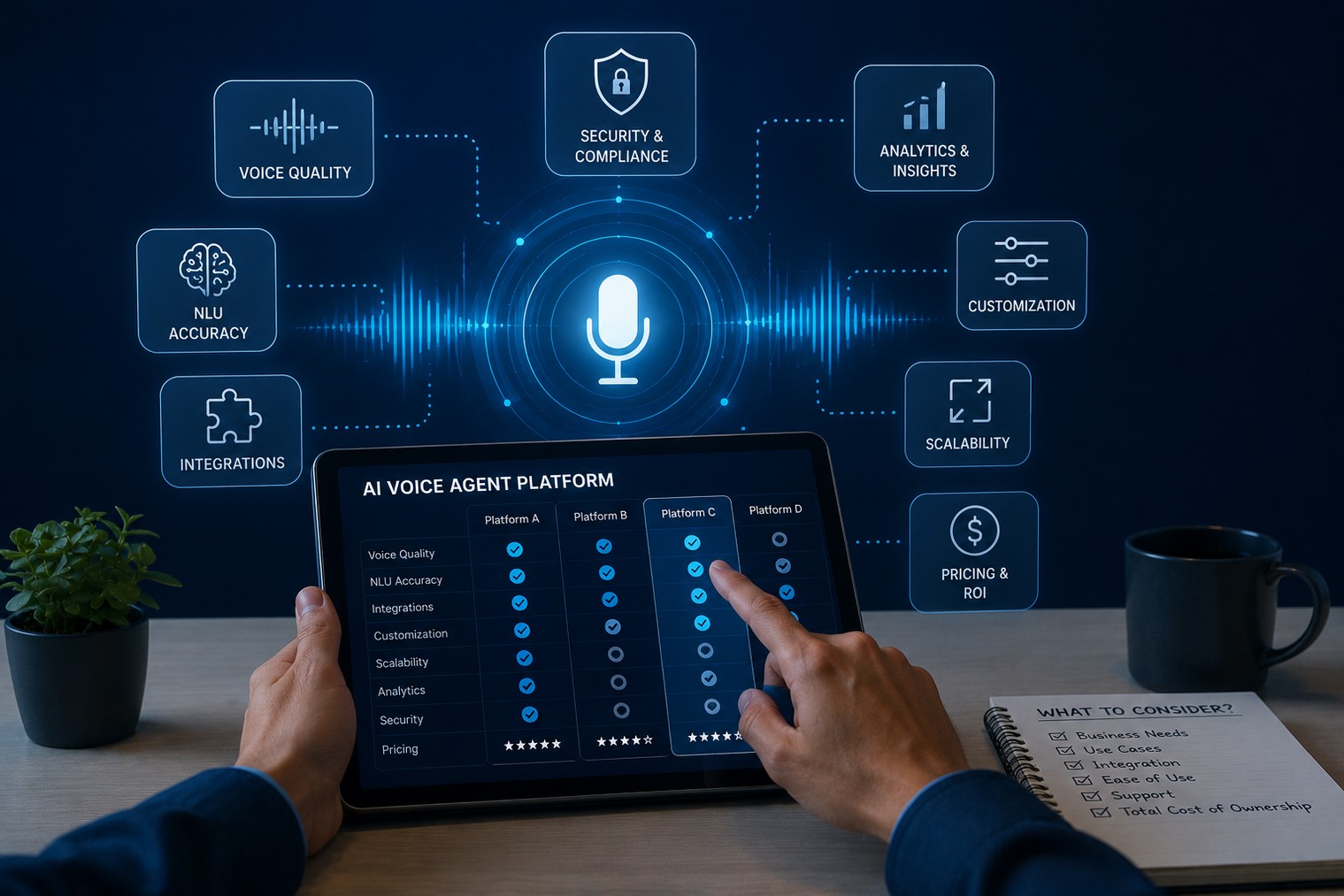
    A person using a tablet to compare AI voice agent platforms, with icons for features like voice quality, security, analytics, NLU accuracy, customization, integrations, scalability, and pricing

    Key Factors to Consider Before Choosing a Platform

    Choosing the right AI voice agent platform starts with understanding your operational requirements, not by comparing feature checklists.

    Natural Conversations

    Customers expect conversations that sound human and adapt to different situations. A strong conversational AI voice agent platform should understand intent, manage interruptions, and maintain context throughout the interaction.

    Enterprise Integrations

    Your platform should connect easily with CRM systems, contact center software, scheduling tools, and business applications. Without seamless integrations, automation cannot extend beyond the conversation itself.

    Multilingual Capabilities

    For businesses serving diverse customer groups, multilingual support is essential. The best AI voice agent platforms should support multiple languages and regional accents while maintaining conversation quality.

    Scalability

    As your business grows, your AI voice agent platform should handle increasing call volumes without compromising performance or customer experience.

    Security and Compliance

    Customer conversations often involve sensitive information. Choosing a platform with enterprise-grade security, compliance controls, and data privacy measures is critical.

    Should You Build or Buy?

    Many organizations evaluating voice AI face another important decision: should they build AI voice agents internally or adopt an existing platform?

    Building a solution offers greater customization but often requires significant investment in AI models, infrastructure, integrations, maintenance, and ongoing optimization.

    An enterprise-ready AI phone agent platform enables businesses to deploy more quickly, reduce development effort, and focus on delivering customer value rather than managing complex AI infrastructure.

    The right choice depends on available resources, implementation timelines, and long-term business objectives.

    Choosing a Platform That Grows With Your Business

    The best AI voice agent platform should continue delivering value as customer expectations and business needs evolve.

    Platforms such as Ello combine conversational intelligence, multilingual support, enterprise integrations, and workflow automation to help organizations manage customer interactions at scale. From inbound support and appointment scheduling to outbound engagement and lead qualification, businesses can automate routine conversations while maintaining a natural customer experience.

    Beyond today’s requirements, organizations should evaluate whether a platform can support future automation initiatives, new communication channels, and expanding customer engagement strategies.

    Conclusion

    Choosing the right AI voice agent platform is about finding a solution that fits both your current operations and your long-term growth plans.

    By focusing on conversation quality, scalability, enterprise integrations, security, and automation capabilities, businesses can confidently invest in a platform that improves customer engagement and operational efficiency.

    As voice AI adoption continues to accelerate, organizations that select a flexible, enterprise-ready platform today will be better positioned to deliver smarter, faster, and more personalized customer experiences.

    FAQs

    Q1. What is an AI voice agent platform?

    An AI voice agent platform enables businesses to automate voice conversations using conversational AI, speech recognition, and natural language understanding, delivering more natural customer interactions.

    Q2. What should businesses look for in an AI voice agent platform?

    Key considerations include conversation quality, multilingual support, enterprise integrations, scalability, security, analytics, and ease of deployment.

    Q3. Should businesses build AI voice agents or use an existing platform?

    Organizations with extensive technical resources may choose to build AI voice agents, while many businesses prefer enterprise-ready platforms to accelerate deployment and reduce maintenance complexity.

    Q4. What is an AI phone agent platform?

    An AI phone agent platform automates inbound and outbound phone conversations, enabling businesses to handle customer support, scheduling, reminders, and lead qualification through AI-powered voice interactions.

    Q5. Which industries benefit most from AI voice agent platforms?

    Healthcare, banking, insurance, retail, logistics, telecommunications, and customer service organizations commonly use AI voice agent platforms to improve operational efficiency and customer engagement.

  • Best Voice AI Platform in India 2026

    Best Voice AI Platform in India 2026

    Voice conversations remain one of the most important ways businesses connect with customers. Whether it’s handling support inquiries, scheduling appointments, qualifying leads, or providing account information, phone interactions continue to play a critical role across industries.

    As customer expectations evolve, businesses are looking beyond traditional IVR systems and call centers. They need solutions that can understand natural language, respond intelligently, and scale without increasing operational costs. This is where a modern voice AI platform comes into the picture.

    But what makes a platform stand out in 2026, and how can businesses identify the right solution for their needs?

    Why Voice AI Adoption Is Accelerating

    The demand for intelligent voice experiences is growing rapidly across global markets. According to research, the global conversational AI market is projected to exceed USD 82.46 billion by 2034, driven by increasing enterprise investments in customer service automation and AI-powered engagement.

    This growth reflects a broader shift toward voice-driven customer interactions. Organizations are no longer looking for simple automation. They want solutions that can hold natural conversations, understand context, and take meaningful actions in real time.

    As a result, the voice AI platform has become a strategic technology investment for businesses seeking better customer experiences and greater operational efficiency.

    What Is a Voice AI Platform?

    A voice AI platform enables businesses to automate voice-based conversations using artificial intelligence. These platforms combine speech recognition, natural language understanding, and workflow automation to interact with customers in a natural and conversational manner.

    Unlike traditional IVR systems that rely on fixed menu options, a modern conversational voice AI platform can understand intent, respond dynamically, and guide customers through complete interactions.

    Businesses use a voice AI platform for business operations to automate:

    • Customer support calls
    • Appointment scheduling
    • Lead qualification
    • Order tracking
    • Payment reminders
    • Customer feedback collection

    The goal is not simply to reduce manual effort but to create faster and more seamless customer experiences.
    Isometric illustration of a smartphone displaying a voice AI interface with sound waves, microphone icon, and chat bubbles on a purple gradient background

    What Defines the Best Voice AI Platform in 2026?

    With many solutions available in the market, enterprises should evaluate platforms based on business outcomes rather than feature lists alone.

    Natural Conversational Capabilities

    Customers expect conversations that feel intuitive. The best voice AI platform should be able to understand different accents, conversational styles, and customer intents without requiring rigid scripts.

    Enterprise Integrations

    A strong voice AI agent platform should integrate easily with CRM systems, contact center tools, scheduling applications, and business databases. This allows conversations to trigger real business actions.

    Multilingual Support

    India’s linguistic diversity makes multilingual support and capabilities essential. The best voice AI platforms support multiple regional languages and can switch naturally between languages when required.

    Scalability

    As call volumes increase, businesses need a voice AI platform that can handle thousands of simultaneous conversations while maintaining consistent performance.

    Analytics and Insights

    Conversation data can reveal valuable customer trends and operational insights. Advanced platforms provide reporting and analytics that help businesses continuously improve customer interactions.

    How Businesses Are Using Voice AI Today

    Organizations across industries are already seeing measurable value from voice automation.

    Healthcare providers use an AI voice assistant platform to automate appointment confirmations and patient reminders.

    Financial institutions deploy voice AI solutions for customer support, payment reminders, and account-related inquiries.

    Retail and e-commerce businesses use a voice AI platform for business operations to handle order updates, delivery notifications, and customer service requests.

    These applications help reduce wait times, improve customer satisfaction, and free human agents to focus on more complex interactions.

    Choosing the Right Voice AI Platform

    The best Voice AI Platform is not necessarily the one with the most features. It is the one that aligns with your business objectives, customer expectations, and operational requirements.

    When evaluating solutions, consider:

    • Ease of deployment
    • Language support
    • Integration capabilities
    • Security and compliance standards
    • Scalability requirements
    • Conversation quality and accuracy

    Platforms such as Ello are built around these requirements, combining multilingual support, enterprise integrations, workflow automation, and conversational AI capabilities to help businesses automate customer interactions at scale. This makes it particularly well-suited for organizations looking to deploy voice AI across diverse customer touchpoints.

    The Future of Voice AI in India

    India’s growing preference for digital-first customer interactions is accelerating the adoption of voice AI across industries. As businesses seek to serve customers in multiple languages while managing rising interaction volumes, voice AI platforms will play an increasingly important role in delivering scalable, personalized experiences.

    Organizations that invest in intelligent voice solutions today will be better positioned to improve accessibility, reduce response times, and scale customer engagement efficiently.

    For enterprises looking to modernize customer communication, a modern voice AI platform can provide the foundation for more responsive, intelligent, and customer-centric experiences.

    FAQs

    Q1. What is a voice AI platform?

    A voice AI platform uses artificial intelligence to automate voice interactions, enabling businesses to engage with customers in natural, human-like conversations.

    Q2. How is a conversational voice AI platform different from traditional IVR?

    A conversational voice AI platform understands natural language and intent, allowing customers to speak freely rather than navigate predefined menu options.

    Q3. What industries benefit most from voice AI platforms?

    Healthcare, banking, insurance, retail, logistics, telecommunications, and customer service organizations commonly use voice AI platforms to improve efficiency and customer engagement.

    Q4. Can a voice AI platform support multiple Indian languages?

    Yes. Many modern voice AI platforms offer multilingual capabilities and can support several Indian languages, making them suitable for diverse customer bases.

    Q5. What should businesses consider when selecting a voice AI platform?

    Key factors include conversation quality, integration capabilities, language support, scalability, analytics, security, and alignment with business goals.

  • Best AI Voice Agents in 2026: How to Choose the Right One for Your Business

    Best AI Voice Agents in 2026: How to Choose the Right One for Your Business

    The criteria for selecting the Best AI Voice Agents have moved beyond simple automation in 2026. We are now operating in a reasoning-first world where businesses require software that acts as an intelligent teammate. The market has shifted away from scripted interactive voice response systems toward agentic workflows that can handle the unpredictability of human conversation. Selecting the right partner for your voice strategy is no longer a technical choice: it is a strategic decision that affects every customer touchpoint.

    The organizations that successfully scale their operations in 2026 are those that prioritize cognitive speed and adaptability. To find the Best AI Voice Agents for your specific needs, you must evaluate how these systems reason, integrate, and evolve.

    Real-Time Reasoning and Adaptability

    The most critical differentiator in 2026 is the ability of a voice agent to reason through complex scenarios in real-time. Traditional systems often fail when a customer deviates from a pre-defined path. The Best AI Voice Agents utilize an adaptive prompting engine to maintain the flow of conversation even when the dialogue becomes non-linear.

    When evaluating a platform, look for its ability to handle “unstructured intent.” This means the AI can understand a customer who is thinking out loud, correcting themselves, or providing multiple pieces of information at once. A reasoning-based agent does not require the user to speak in a specific way: it adapts its own logic to match the customer’s natural communication style.

    Integration and Voice-to-Action Capabilities

    A voice agent that only talks is a liability in a modern enterprise. The Best AI Voice Agents must possess a robust Voice-to-Action engine. This allows the system to execute tasks within your existing enterprise stack, such as updating a CRM, triggering a service request, or processing a payment, while the conversation is still happening.

    Integration should be seamless and secure. The system must act as a bridge between the customer’s verbal request and the backend operational workflow. This capability eliminates the need for human intervention in routine tasks, allowing your team to focus on high-stakes strategic initiatives that require a human touch.

    A person holding a small robot in their hand with a laptop in the background

    Cognitive Orchestration and Multi-Agent Frameworks

    Individual agents are no longer sufficient for complex business processes. The current standard involves cognitive orchestration, where multiple specialized agents work together to solve a single problem. When searching for the Best AI Voice Agents, evaluate if the platform supports a multi-agent framework.

    In this model, different agents handle different parts of the customer journey. One agent might specialize in sentiment detection and empathy, while another handles technical discovery, and a third manages compliance and documentation. This coordinated effort ensures that every interaction is handled by a specialist, providing a level of service quality that a single, general-purpose bot cannot achieve.

    Scalability and Global Linguistic Support

    Global businesses require a solution that can speak to their customers in their native tongue without losing the nuances of local dialects. The Best AI Voice Agents are those that provide native-level support for a wide array of languages and regional accents. This is essential for maintaining a localized brand identity while operating at a national or international scale.

    Scalability also refers to the ability to handle varying call volumes without a drop in performance. A truly agentic system remains consistent whether it is handling ten calls or ten thousand calls simultaneously. This reliability is the foundation of customer trust in a conversational economy.

    Security, Ethics, and Compliance

    In a world driven by data, security is a non-negotiable requirement. The Best AI Voice Agents must adhere to the highest global standards for data protection, including SOC 2 and HIPAA-level compliance. This ensures that every voice interaction is encrypted and that customer privacy is maintained throughout the Voice-to-Action loop.

    Furthermore, ethical AI use involves transparency. The system should clearly identify itself as an AI and provide a seamless handoff to a human teammate when the complexity of a situation exceeds its reasoning guardrails. This balance between automation and human oversight is a hallmark of a mature voice strategy.

    The Ello Advantage: Our Proprietary Agentic Voice Platform

    As an independent, proprietary platform, Ello provides the answer for businesses looking to deploy the Best AI Voice Agents in 2026. Built on advanced agentic frameworks, Ello functions as a reasoning teammate that integrates directly into your business operations.

    Ello specifically supports 30 different languages and various regional accents: ensuring your brand speaks the language of your customer with native-level fluency. Its Adaptive Prompting Engine allows for deep, non-scripted conversations that feel natural and helpful.

    One of the most innovative features of Ello is its self-evolving architecture. The system features an autonomous learning loop that analyzes every interaction. After approximately 200 calls, Ello rebuilds its own prompts to address common struggle points, which often leads to a 30 percent boost in operational efficiency without any manual intervention. By providing a secure, SOC 2-compliant environment, Ello ensures that your voice strategy is built on a foundation of trust and performance.

    Two women wearing headsets working at a computer

    FAQ: Best AI Voice Agents

    1. What defines the Best AI Voice Agents in 2026?

    The top agents are defined by their ability to reason in real-time, their integration with enterprise workflows through Voice-to-Action engines, and their ability to operate within multi-agent frameworks.

    2. How does Ello handle different languages?

    Ello supports 30 different languages and regional accents, allowing businesses to provide a localized and inclusive experience across global markets.

    3. Can AI voice agents learn from their mistakes?

    Yes, proprietary platforms like Ello use self-evolving systems that analyze performance data and rebuild their own prompts autonomously after a set number of interactions.

    4. Are these voice agents secure for enterprise use?

    Leading platforms maintain SOC 2 and HIPAA-level compliance to ensure that all customer data and interactions remain private and protected.

    5. How do I integrate a voice agent into my current CRM?

    The Best AI Voice Agents are designed for cognitive orchestration, meaning they can connect directly to your CRM through standardized APIs to update records and trigger actions.

    Conclusion: Setting the Standard for Voice Excellence

    Choosing the right technology is the first step toward a successful conversational strategy. By focusing on reasoning, integration, and evolution, you can identify the Best AI Voice Agents that will drive your business forward. The future belongs to organizations that treat their software as a partner in growth, using voice intelligence to build stronger, more efficient customer relationships.

  • Top Use Cases of an AI Voice Agent for Real Estate

    Top Use Cases of an AI Voice Agent for Real Estate

    In recent years, real estate professionals have been at the forefront of adopting advanced technologies to streamline operations, improve client experiences, and drive growth. One of the most transformative innovations reshaping the industry is the AI Voice Agent for real estate. This sophisticated conversational artificial intelligence interacts with buyers, sellers, and agents through natural speech. In a sector where responsiveness, timely communication, and personalized service make all the difference, AI voice agents are quickly emerging as indispensable tools. From lead capture and customer support to property tours and transaction assistance, their use cases span every part of the real estate lifecycle. This blog explores the top use cases of an AI voice agent for real estate and why forward-thinking real estate businesses are integrating them into their workflows.

    What Are Voice AI Agents?

    Voice AI agents are intelligent, conversational systems powered by artificial intelligence that can understand spoken language, interpret intent, and respond naturally, just like a human. In real estate, a Voice AI Agent for real estate can handle phone calls, answer property-related questions, qualify leads, schedule appointments, and provide updates without human intervention. These agents use technologies such as natural language processing (NLP), speech recognition, and machine learning to improve conversations over time. Unlike traditional IVRs or scripted bots, voice AI agents understand context, handle complex queries, and escalate conversations to human agents when required.

    Voice AI for Real Estate

    Why Real Estate Needs AI Voice Agents

    Real estate conversations are high-volume, repetitive, and time-sensitive. Missed calls or delayed responses often mean missed deals. An AI Voice Agent for real estate ensures:

    • No inquiry goes unanswered
    • Prospects receive instant, accurate information
    • Agents focus on closing, not chasing calls

    Top Use Cases of an AI Voice Agent for Real Estate

    24/7 Inbound Lead Capture and Inquiry Handling

    The most immediate and impactful use case for an AI Voice Agent for real estate is handling inbound calls. Property inquiries do not adhere to standard business hours. Potential buyers often browse listings late at night or on weekends, and when they call, they expect an answer.

    The Problem: A prospective buyer sees a “For Sale” sign or a listing at 8:00 PM on a Friday. They call the number, get a voicemail, and likely hang up to call the next agent on their list. By the time the human agent returns the call the next morning, the lead has gone cold or engaged with a competitor.

    The AI Solution: An AI voice agent answers the call immediately with a professional greeting. It can answer specific questions about the property, such as:

    • “What is the asking price?”
    • “How many bedrooms does it have?”
    • “Is there a backyard?”
    • “What are the school districts like?”

    Because the AI is integrated with the brokerage’s listing database, it provides accurate, real-time information. It captures the caller’s details and logs the interaction, ensuring zero missed opportunities.

    Intelligent Lead Qualification

    Not all leads are created equal. One of the biggest time-sinks for real estate professionals is sifting through “tire kickers”, people who are browsing but have no intention or ability to buy soon.

    The Problem: Real estate agents spend hours on the phone with leads who are not pre-qualified, have no timeline, or are looking for rentals, even though the agent only sells premier homes.

    The AI Solution: An AI Voice Agent for real estate can act as a rigorous gatekeeper. When a lead calls (or when the AI calls a lead), it can execute a qualification script based on the BANT framework (Budget, Authority, Need, Timeline). The AI might ask:

    • “Have you been pre-approved for a mortgage?”
    • “What is your ideal timeframe for moving?”
    • “What is your budget range?”

    Based on the answers, the AI can score the lead. If the lead is “hot” (e.g., pre-approved, cash buyer, moving in 30 days), the AI can instantly transfer the call to a human agent. If the lead is “warm” or “cold,” the AI can add them to a nurturing drip campaign, saving the human agent from low-value conversations.

    Automated Appointment Scheduling

    The back-and-forth dance of scheduling property viewings is a major productivity killer. “Are you free Tuesday?” “No, how about Wednesday?” “Wednesday morning works.” “Sorry, the seller isn’t available then.”

    The Problem: Coordinating schedules between the buyer, the buyer’s agent, the seller, and the seller’s agent can take dozens of texts and calls.

    The AI Solution: The AI Voice Agent for real estate integrates directly with the agent’s calendar (e.g., Google Calendar or CRM schedulers). During a conversation, when a prospect expresses interest in viewing a property, the AI can check real-time availability and book the slot. This automation removes friction and locks in the buyer’s commitment while their interest is at its peak.

    Outbound Database Reactivation

    Every veteran real estate agent has a database full of old leads, people who inquired six months or two years ago but never bought. These leads are often ignored because agents are too busy chasing new business.

    The Problem: Calling hundreds of cold leads is tedious, demoralizing, and time-consuming.

    The AI Solution: An AI Voice Agent for real estate can be deployed to “mine” this database. The AI can make hundreds of outbound calls in a fraction of the time it would take a human. It can use a friendly, non-intrusive script:

    AI Database Reactivation

    “Hi [Name], this is Alex’s assistant. You inquired about a home in [Area] a few months ago. We just had a few new listings come up that match your criteria. Are you still in the market?”

    If the answer is “No,” the AI updates the CRM to “Dead Lead.” If the answer is “Yes,” the AI qualifies them and books an appointment for the agent. This turns a dormant database into a source of “found money” without the agent having to lift a finger.

    Post-Showing Feedback Collection

    Feedback is essential for sellers. They want to know why their home isn’t selling. However, buyer’s agents are notoriously bad at providing feedback after a showing.

    The Problem: Listing agents chase buyer’s agents for days to get simple feedback like “The price is too high” or “They didn’t like the kitchen.”

    The AI Solution: An AI Voice Agent for real estate can automatically call the buyer’s agent 2 hours after a scheduled showing.

    AI: “Hi, I’m calling on behalf of the listing agent for Juhu, Mumbai. Thanks for showing the home today. What did your clients think?”

    The AI can record the response, transcribe it, and even categorize the sentiment (e.g., Price Objection, Condition Objection). This report is then automatically sent to the seller, keeping them informed and helping the listing agent justify price reductions if necessary.

    Multilingual Support

    Real estate is often a global market. In cosmopolitan cities, agents frequently deal with buyers who may not speak the local language fluently.

    The Problem: Language barriers can kill deals or lead to misunderstandings regarding contracts and property details.

    The AI Solution: AI Voice Agents for real estate support dozens of languages. An agent can set up their AI to detect the caller’s language and switch effortlessly. If a Hindi-speaking buyer calls a listing in Hyderabad, or a Bengali-speaking buyer calls a listing in Kolkata, the AI can conduct the initial inquiry and qualification in their native language, dramatically improving the customer experience and expanding the potential buyer pool.

    How AI Voice Agents Complement Human Agents

    It’s important to note that AI voice agents are not replacements for human real estate professionals, they are force multipliers. Instead of spending hours on repetitive tasks, agents can focus on:

    • Building client relationships
    • Negotiating deals
    • Providing nuanced, expert advice
    • Delivering high-touch service where it matters most

    AI voice agents handle volume and automation; human agents provide empathy, local market expertise, and strategic guidance.

    Conclusion

    The real estate industry is evolving rapidly, and the adoption of an AI voice agent for real estate is one of the most impactful shifts. From lead capture and property recommendations to transaction support and analytics, these conversational agents provide scalable, intelligent, and personalized interactions that elevate both customer experience and operational efficiency. For real estate professionals looking to stay competitive, embracing AI voice technology isn’t just an option, it’s a strategic imperative.

    Harness the power of AI voice agents for real estate, and you’ll be better positioned to serve clients, close more deals, and lead in an increasingly digital marketplace.

    Why Ello.ai is Built for 2026

    While many platforms are playing catch-up, Ello.ai was architected with these 2026 trends as foundational pillars.

    • Adaptive Prompt Technology: Our agents don’t just follow a script; they rewrite their own playbook in real-time to optimize outcomes, embodying the true spirit of Agentic AI.
    • Multi-Agent Networks: Ello utilizes specialized sub-agents to audit and improve conversations at machine speed, ensuring accuracy and continuous learning.
    • Low-Latency Infrastructure: We understand that in a voice-first world, speed is trust. Our infrastructure is built for sub-second responses, ensuring conversations feel natural and human.
    • Enterprise-Grade Security: With SOC 2 and HIPAA compliance, Ello provides the governance and safety required for the next generation of AI deployment.
    • True Multilingual & Dialect Mastery: In a linguistically diverse market like India, businesses traditionally had to hire separate support teams for regional languages. With Ello.ai, you don’t need that. Our agents can switch naturally between languages mid-conversation (e.g., from Hindi to English) just as a native speaker.

    This massive consolidation significantly reduces hiring effort and operational costs, allowing a single AI workforce to serve the entire country.

    FAQs

    How does an AI Voice Agent for real estate work?

    It uses speech recognition and AI to understand user queries, respond naturally, and automate tasks like lead qualification, scheduling, and follow-ups.

    Can AI voice agents replace real estate agents?

    No. AI voice agents support agents by handling repetitive tasks, while human agents focus on relationships, negotiations, and deal closures.

    Are AI voice agents suitable for small real estate firms?

    Yes. They are scalable and cost-effective, making them ideal for both small agencies and large real estate enterprises.

    Can voice AI agents integrate with CRM systems?

    Yes. Most AI voice agents integrate seamlessly with CRMs, calendars, and property management tools for smooth data flow.

    Is customer data safe with AI voice agents?

    When implemented correctly, AI voice agents follow strict security and compliance standards to protect customer data. Ello.ai is SOC 2 and HIPAA compliant.

    Get a FREE DEMO. Visit https://getello.ai/in