
Tag: AI lead generation

  • How Lead Generation Automation Helps Sales Teams Close More Deals

    How Lead Generation Automation Helps Sales Teams Close More Deals

    Generating leads is only the first step in the sales process. The real challenge lies in quickly qualifying prospects, engaging them at the right time, and ensuring no opportunity slips through the cracks. As customer conversations become a key part of the buying journey, businesses are increasingly using voice AI to automate lead engagement without losing the personal touch.

    This is where lead generation automation is transforming how modern sales teams operate. By automating repetitive tasks and enabling faster engagement through intelligent voice conversations, businesses can focus more on building relationships and closing deals.

    Why Sales Teams Are Investing in Automation

    Sales teams today are expected to engage more prospects, respond faster, and deliver personalized experiences across every interaction. As pipelines grow, manual outreach and repetitive follow-ups make it difficult to maintain speed and consistency.

    The global conversational AI market is projected to reach USD 49.80 billion by 2031, driven by increasing enterprise demand for intelligent customer engagement and automation. This shift reflects how businesses are embracing AI to improve productivity while creating better customer experiences.

    For sales teams, automation isn’t about replacing human interactions. It’s about giving representatives more time to focus on meaningful conversations while AI handles routine engagement.

    What Is Lead Generation Automation?

    Lead generation automation uses AI and automation technologies to identify, qualify, engage, and nurture potential customers throughout the sales funnel.

    Instead of relying on manual outreach, businesses can automate activities such as:

    • Lead qualification
    • Follow-up calls
    • Appointment scheduling
    • CRM updates
    • Lead nurturing
    • Customer data collection

    The goal is not simply to reduce manual effort but to engage prospects faster and create a smoother path from inquiry to conversion.
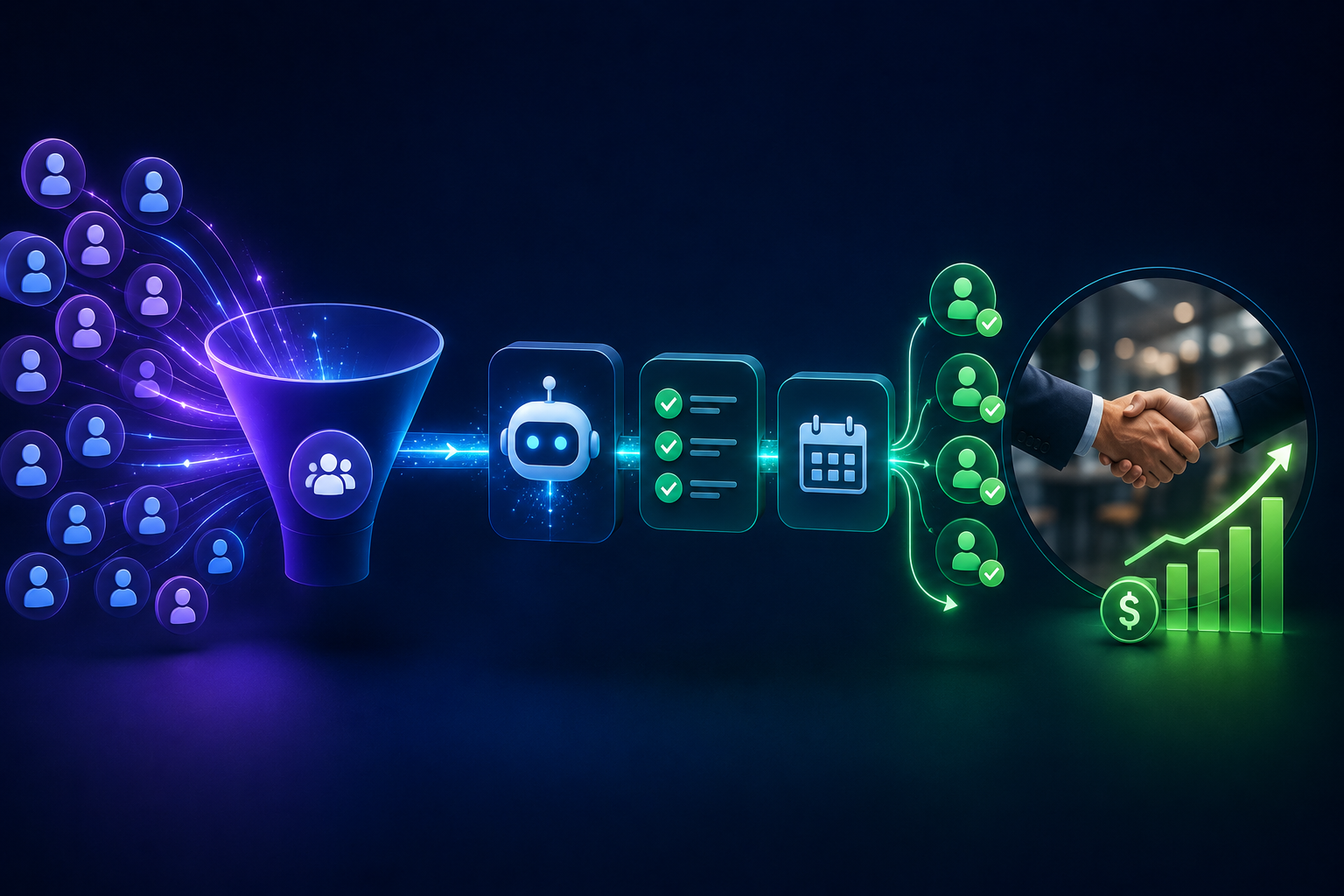
    Illustration of an AI-powered lead generation funnel with connected nodes representing automation and CRM workflows

    How AI Is Improving Lead Generation

    Traditional lead generation often depends on forms, delayed responses, and manual qualification. Today’s AI lead generation solutions help businesses engage prospects in real time and prioritize the leads most likely to convert.

    Faster Response Times

    Responding to inquiries within minutes significantly improves the chances of connecting with prospects before they lose interest or explore alternative solutions.

    Better Lead Qualification

    AI can collect customer information, understand intent, and qualify prospects based on predefined business criteria before routing them to the sales team.

    Consistent Engagement

    Automation ensures every lead receives timely communication, reducing the likelihood of missed opportunities. With Voice AI, these interactions happen through natural conversations, allowing businesses to qualify leads and schedule follow-ups without requiring immediate involvement from sales representatives.

    The Role of Voice AI in Lead Generation

    Voice remains one of the most effective channels for engaging prospects, particularly in industries where personalized conversations influence purchasing decisions.

    A lead generation voice AI agent can qualify leads, answer common questions, schedule meetings, and capture customer information through natural conversations, without requiring immediate involvement from sales representatives. This allows sales teams to spend less time on repetitive outreach and more time speaking with qualified prospects.

    By making every interaction faster, more consistent, and available around the clock, Voice AI has become an essential part of modern lead generation automation.

    Why It Matters for B2B Sales

    For organizations focused on B2B lead generation, buying journeys often involve multiple decision-makers and longer sales cycles. Consistent engagement throughout this process is critical.

    Lead generation automation helps businesses:

    • Engage prospects faster
    • Prioritize high-intent leads
    • Reduce manual workflows
    • Improve sales productivity
    • Maintain consistent communication across the buying journey

    Combined with voice AI, automation enables sales teams to focus their efforts where they create the greatest impact.

    Choosing the Right Lead Generation Automation Solution

    The best lead generation automation solution is one that fits your sales process, integrates with your existing systems, and helps your team engage prospects more effectively.

    Ello brings these capabilities together through AI-powered voice conversations that automate lead qualification, outbound outreach, appointment scheduling, and follow-ups. With multilingual support, enterprise integrations, and workflow automation, Ello helps sales teams respond faster, reduce manual effort, and move qualified leads through the pipeline more efficiently.

    Businesses should also look beyond immediate needs and choose a solution that can support future sales automation initiatives as customer expectations continue to evolve.

    Conclusion

    Successful sales teams don’t simply generate more leads. They engage the right prospects at the right time and spend more time building relationships that drive revenue.

    Lead generation automation is most effective when it combines AI with natural customer conversations. Ello helps businesses engage prospects earlier, qualify leads faster, and give sales teams more time to focus on closing deals. As voice AI continues to reshape customer engagement, organizations that invest in intelligent automation will be better positioned to build stronger pipelines and improve conversion rates.

    FAQs

    Q1. What is Lead Generation Automation?

    Lead Generation Automation uses AI and automation tools to identify, qualify, engage, and nurture potential customers with minimal manual effort.

    Q2. How does AI lead generation improve sales performance?

    AI lead generation helps businesses qualify leads faster, automate follow-ups, prioritize high-intent prospects, and improve overall sales productivity.

    Q3. What is a lead generation voice AI agent?

    A lead generation voice AI agent interacts with prospects through natural voice conversations to qualify leads, answer questions, collect information, and automatically schedule meetings.

    Q4. How does Lead Generation Automation benefit B2B lead generation?

    For B2B lead generation, automation ensures consistent engagement across longer sales cycles, helping sales teams focus on qualified opportunities while reducing manual work.

    Q5. How does marketing automation support lead generation?

    Marketing automation lead generation combines automated outreach, AI insights, customer data, and workflow automation to improve lead nurturing and increase conversion opportunities.


  • Conversational AI Lead Generation for SaaS

    Conversational AI Lead Generation for SaaS

    Somewhere between your homepage hero and your “Book a Demo” button, you are losing thousands of potential customers.

    They arrive curious, scroll for thirty seconds, and leave, not because your product failed to impress them, but because no one was there to talk to them. That gap, the silence between interest and action, is exactly where conversational AI lead generation steps in.

    For SaaS businesses competing in crowded categories, the old lead generation playbook is showing its age.

    Gated PDF downloads, six-field contact forms, and automated drip sequences written for an imaginary average buyer no longer convert the way they once did.

    Modern buyers have been trained by consumer apps to expect immediate, relevant, personalized responses. When they visit your site, they are looking for a conversation, not a form.

    What Is Conversational AI Lead Generation?

    Conversational AI lead generation uses intelligent, dialogue-driven systems such as voice AI agents to identify, engage, qualify, and convert website visitors into actionable sales leads in real time and at scale.

    By offering immediate, personalized interactions that streamline the lead process compared to traditional methods.

    Unlike rule-based chat widgets that funnel every visitor into the same script, modern conversational AI systems powered by large language models can understand intent, respond dynamically to questions, adapt their tone to the visitor’s behavior, and route qualified leads to the right human or automated follow-up sequence.

    This distinction matters enormously for SaaS. Your product is nuanced. Buyers have specific use cases, integration requirements, team sizes, and budget constraints.

    A static form cannot explore those dimensions. A well-designed AI lead-generation conversation can generate more qualified opportunities than any passive-capture mechanism ever could.

    A person using a tablet with holographic AI interface elements

    Why SaaS Companies Are Adopting AI Lead Generation Now

    1. Shift in Buyer Behavior

    Research consistently shows that the majority of B2B buyers prefer to conduct their own research before engaging with a sales representative. Conversational AI honors this preference by providing answers on demand, without requiring a calendar invite.

    2. Always-On Lead Capture

    Even the most productive SDR team can only handle so many conversations at once. An AI lead generation system operates in every visitor session and every hour, capturing opportunities that would otherwise evaporate during off-hours or traffic spikes.

    3. Human-Like AI Conversations

    Earlier generations of chatbots were notorious for frustrating users with robotic, brittle responses. Today’s large language model-powered assistants can handle nuanced, multi-turn conversations in ways that genuinely help buyers move forward and genuinely impress them in the process.

    4. Insight-Driven Conversations

    Every exchange with a conversational AI system is a structured data point: what questions prospects ask, what objections surface, which pricing tiers draw the most interest. This corpus of intent data is something no form submission can replicate.

    How Conversational AI Lead Generation Actually Works in SaaS

    Phase 1: Discovery and Qualification

    The AI initiates a structured yet natural discovery conversation, identifying key details such as the visitor’s role, company size, primary use case, current tools, and timeline.

    These are the same qualification criteria your best SDRs rely on, but delivered conversationally instead of through static forms.

    Throughout the interaction, the AI continuously provides value by answering product-related questions, sharing relevant case studies, and demonstrating capabilities in real time.

    Phase 2: Lead Capture and Routing

    At the right moment in the conversation, after trust has been established and intent confirmed, the AI naturally requests contact information or offers to connect the prospect with a human expert.

    Because the ask arrives after the value has been delivered, conversion rates at this stage dramatically outperform cold form submissions.

    The captured lead arrives in your CRM pre-qualified, with conversation context attached, ready for a warm handoff rather than a cold call.

    Phase 3: Post-Conversation Nurture

    The conversation does not end when the visitor leaves. AI lead generation platforms can trigger personalized follow-up sequences based on the specific topics discussed, schedule demo invitations timed to expressed preferences, and re-engage visitors who dropped off before qualifying.

    The entire nurture arc is shaped by what the AI learned, making every subsequent touchpoint feel relevant rather than generic.

    A woman in a business suit presenting in front of a whiteboard with charts and sticky notes, while two colleagues listen attentively

    Common Mistakes SaaS Teams Make With AI Lead Generation

    Adopting conversational AI lead generation without a clear strategy produces mixed results at best. These are the most frequent missteps to avoid.

    Deploying before training: A generic, out-of-the-box AI assistant that knows nothing specific about your product, positioning, or ideal customer profile will frustrate visitors rather than convert them. Invest in product knowledge documentation before going live.

    Optimizing for volume over quality: It is tempting to instruct the AI to capture every email address it can. Resist this. An AI that feels pushy or premature in its data capture attempts damages trust and produces low-quality leads that waste your sales team’s time. Calibrate the AI to prioritize quality signals over raw volume.

    Treating it as a set-and-forget tool: The best AI lead generation programs are actively managed. Review conversation transcripts weekly. Identify where visitors drop off, what questions the AI struggles to answer, and what new objections are emerging. Update the AI’s knowledge base accordingly. The teams seeing the strongest results treat their conversational AI like a junior SDR, one that needs coaching and refinement, not just deployment.

    Ignoring mobile experience: A significant portion of SaaS research happens on mobile devices. Ensure your conversational AI interface is fully optimized for smaller screens and touch interactions, or you will forfeit a meaningful share of your traffic.

    Conclusion

    The way businesses generate leads is evolving rapidly. Static forms and delayed follow-ups are no longer enough to capture modern buyers.

    Conversational AI Lead Generation represents the next phase of AI Lead Generation, prioritizing real-time interaction, personalization, and efficiency.

    For SaaS businesses looking to scale, improve lead quality, and deliver exceptional user experiences, adopting conversational AI enables more meaningful interactions, streamlines the buyer journey, and drives conversions.

    As customer expectations continue to rise, the brands that win will be those that engage instantly, understand intent deeply, and respond intelligently. Conversational AI empowers SaaS companies to do exactly that, turning every interaction into an opportunity and every conversation into a potential conversion.

    Strategic Implementation: The Role of Ello

    While the potential of these technologies is vast, successful implementation requires a bridge between digital intelligence and physical execution. This is where Ello provides a definitive advantage.

    As a Voice-to-Action engine built for 2026 standards, Ello moves beyond mere conversation to provide true operational orchestration.

    Its Adaptive Prompting Engine allows businesses to deploy intelligent agents that understand sentiment and linguistic variety while maintaining native-level fluency in over 100 languages.

    By integrating directly with existing enterprise stacks, Ello ensures that Voice AI Technology is a practical, enterprise-ready solution that drives 20 to 30 percent gains in efficiency through its self-evolving architecture.

    FAQs

    1. What is Conversational AI Lead Generation?

    Conversational AI Lead Generation uses voice AI agents or voice assistants to interact with website visitors in real time. It helps capture, qualify, and nurture leads through natural conversations instead of static forms.

    2. Is Conversational AI suitable for all SaaS businesses?

    Yes, it works for both early-stage and enterprise SaaS companies. It scales easily and adapts to different customer journeys and use cases.

    3. Does Conversational AI work outside business hours?

    Yes, it operates 24/7, engaging visitors, answering queries, and capturing leads even when your team is offline.

    4. What are the key benefits of Conversational AI Lead Generation for SaaS?

    It boosts conversions, improves lead quality, reduces manual effort, and delivers personalized user experiences at scale.