
Modern enterprise support operations face a persistent paradox: ticket volumes scale faster than headcount. Traditional support tiers are buckling under repetitive Tier-0 and Tier-1 requests, causing resolution times to balloon and operational costs to surge. Organizations can no longer scale their support teams by simply adding more human agents to the queue. Intelligent helpdesk automation provides the structural remedy needed to absorb unbounded ticket volume while protecting gross margins and maintaining high service level agreements.
The transition from reactive ticketing systems to proactive automation marks a fundamental shift in how organizations manage internal IT service desks and external customer operations. Legacy macros and rigid, rule-based routing trees fail when faced with nuanced customer queries or complex, multi-step technical troubleshooting. Modern support infrastructures require systems that can handle ambiguity and execute tasks autonomously, a trend Ello’s voice AI insights explore in greater depth.
The Architectural Limits of Legacy Support Systems
Traditional support desks rely on static knowledge bases, keyword-matching bots, and manual ticket triage workflows. These legacy tools create friction rather than resolution. When an enterprise customer or employee encounters a multifaceted issue, legacy systems typically route them through frustrating menu trees before dumping them into an overflowing human queue. This architecture produces high abandonment rates, excessive average handle times, and inflated operational expenditures.
Traditional interactive voice response structures often exacerbate this bottleneck. Examining how modern channels surpass legacy setups highlights why forward-thinking enterprises are actively retiring legacy IVR systems in favor of intelligent frameworks. Scaling human-only support teams linearly against revenue growth creates unsustainable margin compression. Enterprise leaders must decouple support volume from headcount requirements by moving past basic string-matching bots toward architectures capable of true conversational comprehension and backend execution.
The Evolution to Cognitive and Conversational Workflows
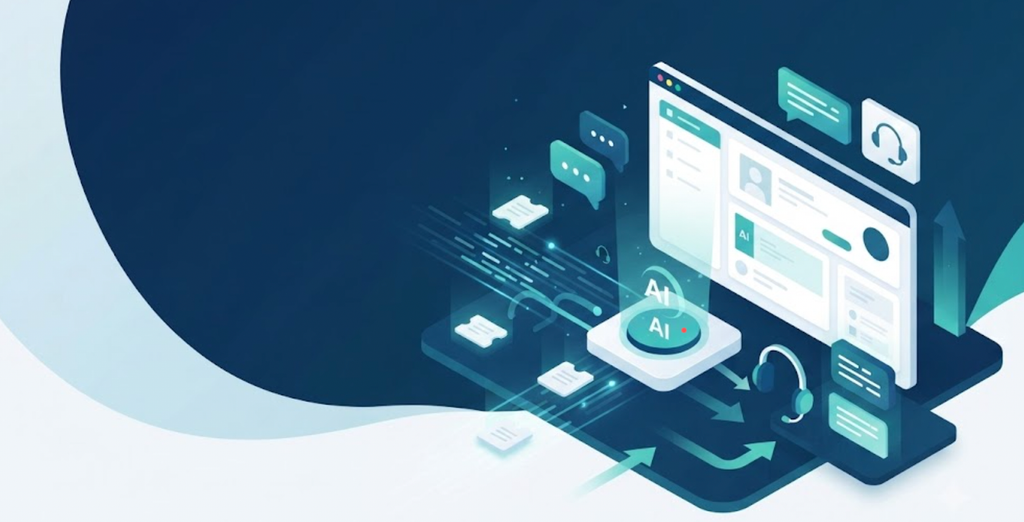
Advanced support environments demand real-time resolution capabilities that match human tier-1 capabilities. Automated service desks have evolved past text-only chat interfaces that frequently abandon users when faced with complex scenarios. Deploying a voice AI agent for helpdesk operations now enables natural, spoken interactions that instantly interpret user intent, emotional tone, and urgency.
Mini Case Study: Consider a mid-sized e-commerce enterprise handling thousands of daily order-tracking and return inquiries. Instead of routing callers through rigid IVR menus, an intelligent voice agent converses naturally with the customer, verifies account details, checks real-time shipping logs, and initiates a replacement order or refund in seconds—all while the user remains on the line.
These autonomous systems leverage large language models fine-tuned for enterprise operational logic. They maintain context across lengthy troubleshooting sessions, handle dynamic user interruptions gracefully, and execute system commands in real time. Rather than merely deflecting calls to an FAQ page, these intelligent agents diagnose system errors, verify user credentials, and initiate backend remediation workflows. Understanding the core mechanics behind these platforms involves analyzing how voice AI agents operate as comprehensive conversational engines.
Multi-Agent Orchestration in Complex Enterprise Environments
Enterprise ecosystems consist of fragmented software stacks, ranging from proprietary ERP systems and CRM platforms to ticketing tools and human resources databases. Resolving a single support ticket often requires querying multiple systems of record. AI-driven customer service automation addresses this complexity through multi-agent orchestration frameworks where specialized cognitive agents collaborate to solve intricate requests, mirroring advanced agentic voice AI architectures.
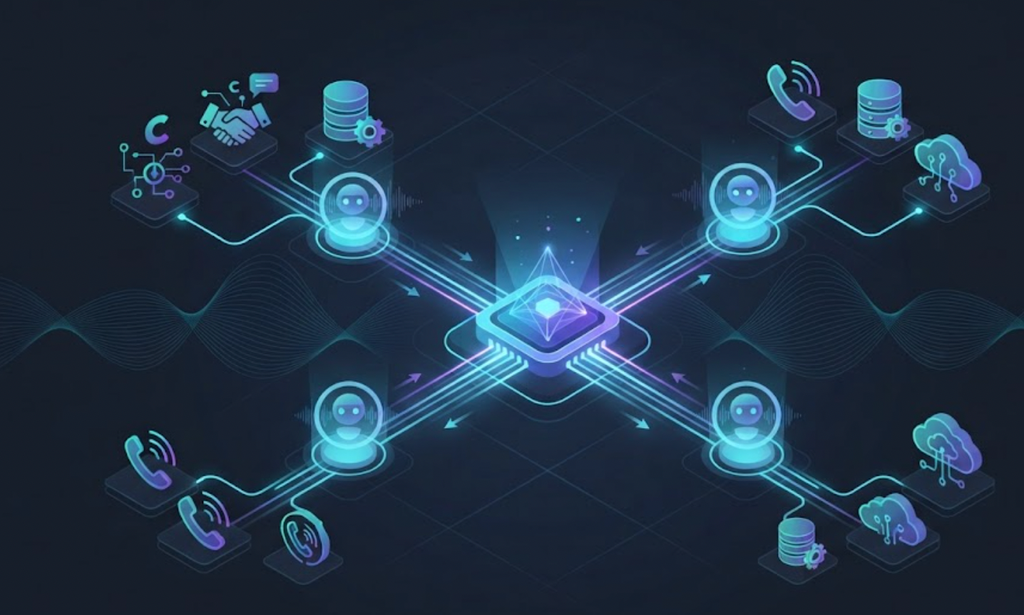
In these distributed architectures, a primary conversational agent manages the dialogue while background reasoning agents simultaneously query inventory databases, check shipping logs, or update account permissions. This division of labor eliminates the latency associated with human agents navigating multiple browser tabs and legacy interfaces. The result is near-instantaneous resolution for complex operational workflows that traditionally required multiple internal escalations.
Overcoming Linguistic and Regional Operational Barriers
Global enterprises face significant hurdles when deploying automated support across diverse geographic markets. Linguistic diversity, regional accents, and the common practice of code-switching between languages present severe challenges for standard speech recognition engines. Enterprise support automation must accommodate these linguistic variations without degrading accuracy or forcing users into unnatural phrasing.
Modern enterprise support systems incorporate advanced multilingual models that can natively understand dozens of languages and regional dialects. These systems process colloquialisms and mixed-language inputs fluidly, ensuring that regional customers and remote employees receive the same high-quality support experience as domestic headquarters staff. This linguistic versatility is essential for maintaining brand equity and operational continuity across international footprints, similar to regional deployments seen in multilingual enterprise voice assistants.
The Ello Advantage: Autonomous Cognitive Support
Organizations deploying enterprise-grade support automation require infrastructure that continuously adapts to shifting operational patterns without requiring constant developer intervention. The Ello platform delivers this capability through a proprietary, self-evolving architecture designed specifically for demanding enterprise environments. Ello combines advanced multi-agent cognitive orchestration with an adaptive prompting engine that processes dynamic, non-scripted dialogues, handles interruptions effortlessly, and perceives caller urgency in real time.
A defining capability of the platform is its self-evolving architecture, which autonomously analyzes conversational data and rebuilds its own prompts after approximately 200 calls. This automated refinement loop drives a 30 percent boost in operational efficiency over time without manual engineering overhead. Furthermore, Ello’s voice-to-action engine executes tasks directly inside enterprise CRMs, ERPs, ATS, and PMS platforms while remaining live on the call. Natively supporting 30 languages with seamless regional code-switching, Ello operates under enterprise-grade SOC 2 compliance, strict hallucination guardrails, and automated adherence to regional regulatory frameworks.
Frequently Asked Questions
1) What is helpdesk automation?
Helpdesk automation uses software, artificial intelligence, and autonomous agents to triage, route, and resolve IT and customer support tickets without human intervention. It streamlines repetitive workflows and accelerates time-to-resolution.
2) How does voice AI improve enterprise support operations?
Voice AI enables natural, spoken interactions that instantly interpret user intent and execute complex backend workflows in real time. This reduces average handle times and eliminates the friction associated with traditional text chatbots.
3) Can automated support systems integrate with existing enterprise software?
Yes. Advanced support automation platforms feature voice-to-action engines that connect directly to existing enterprise CRMs, ERPs, and ticketing systems to update data in real time and execute tasks.
4) How do modern support agents handle multiple languages and regional dialects?
Modern support platforms leverage advanced multilingual models that natively support numerous languages and regional accents. They process colloquial code-switching seamlessly to deliver consistent experiences across global markets.
5) What security standards should enterprise support automation maintain?
Enterprise automation platforms must maintain strict security frameworks, including SOC 2 compliance, robust data encryption, hallucination guardrails, and automated adherence to regional calling and data privacy regulations.
Conclusion
Reshaping enterprise support requires moving past incremental optimizations to adopt fully autonomous architectures. As ticket volumes scale, organizations that rely on legacy ticketing and static chat tools will continue to face escalating costs and lagging customer satisfaction metrics. Implementing advanced support automation allows enterprises to protect operating margins while delivering frictionless, instant resolutions across every operational channel.
Ready to transform your enterprise support operations? Get started with Ello today.