
Customer conversations are no longer limited to human agents and traditional IVR systems. Today, enterprises are increasingly adopting AI-powered voice technologies to automate customer interactions, improve responsiveness, and scale operations without adding headcount.
But as organizations evaluate these solutions, one question often arises: Should you invest in an AI calling agent or a broader AI voice agent?
While the terms are often used interchangeably, they serve different business needs. Understanding the distinction can help enterprises choose the right solution and maximize ROI.
Why Enterprises Are Investing in Voice AI
The demand for voice-driven automation continues to accelerate. The global call center AI market is expected to grow to approximately $7 billion by 2030, reflecting the increasing adoption of AI across customer engagement operations.
This trend extends to the broader conversational AI market, projected to reach USD 49.80 billion by 2031. As customer expectations for instant, personalized interactions rise, enterprises are increasingly adopting intelligent voice technologies to automate conversations and improve operational efficiency.
What Is an AI Calling Agent?
An AI calling agent is designed specifically to make, receive, and manage phone-based conversations at scale. Its primary focus is telephony-driven interactions such as:
- Lead qualification
- Appointment scheduling
- Payment reminders
- Customer follow-ups
- Surveys and feedback collection
- Customer support calls
An AI calling agent can engage customers in natural conversations, understand intent, and take predefined actions while integrating with CRM, ERP, and business systems.
For organizations managing high call volumes, an AI calling agent provides a direct way to automate repetitive conversations while maintaining a personalized customer experience.
What Is an AI Voice Agent?
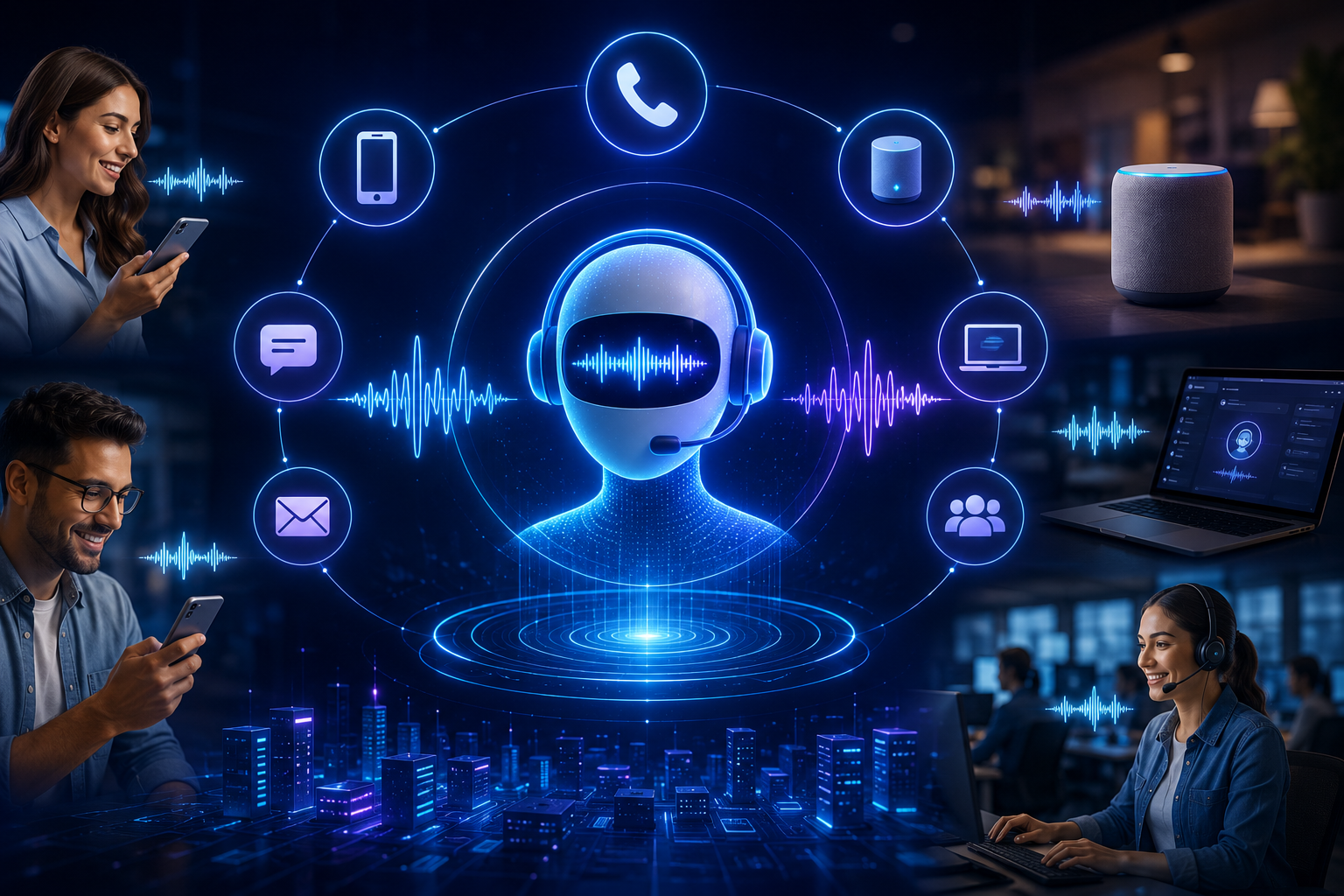
An AI voice agent is a broader category of conversational AI that interacts through voice across multiple channels and touchpoints.
Unlike an AI calling agent, which is focused primarily on phone conversations, AI voice agents can operate across:
- Contact centers
- Mobile applications
- Smart devices
- Internal enterprise systems
- Customer self-service platforms
Modern voice AI agents combine speech recognition, natural language understanding, and workflow automation to support more complex conversational experiences.
Think of an AI calling agent as a specialized solution for managing phone interactions, while an AI voice agent can serve as a wider conversational layer across your organization.
AI Calling Agent vs. AI Voice Agent: Key Differences
| Feature | AI Calling Agent | AI Voice Agent |
|---|---|---|
| Primary Purpose | Phone-based conversations | Multi-channel voice interactions |
| Deployment Focus | Inbound and outbound calls | Enterprise-wide voice experiences |
| Best For | Sales, collections, reminders, support | Customer service, employee assistance, self-service |
| Complexity | Task-oriented workflows | Broader conversational capabilities |
| Channels | Telephone networks | Phone, apps, devices, and digital platforms |
If your primary objective is automating customer calls, an AI calling agent often delivers faster implementation and measurable business outcomes.
However, if you want voice interactions integrated across multiple customer and employee touchpoints, a broader AI voice-agent strategy may be a better fit.
When Does an Enterprise Need an AI Calling Agent?
An AI calling agent is typically the right choice when your organization relies heavily on structured phone conversations.
Common use cases include:
- High-Volume Outbound Campaigns — Businesses running outreach programs can use AI outbound calling agents to contact thousands of customers simultaneously for promotions, renewals, collections, or follow-ups.
- Appointment and Service Scheduling — Healthcare providers, service organizations, and financial institutions often use an AI voice-calling agent to automate scheduling and reduce manual workload.
- Customer Support Automation — An AI calling agent can resolve routine inquiries, route customers intelligently, and reduce call center congestion.
- Payment and Collections — Banks, lenders, and utility providers use an AI calling agent to handle payment reminders and collection workflows while maintaining compliance and consistency.
When Does an Enterprise Need an AI Voice Agent?
Organizations pursuing broader digital transformation initiatives often benefit more from AI-powered voice automation.
These solutions are ideal when businesses need:
- Omnichannel customer experiences
- Internal employee assistance
- Voice-enabled self-service
- Enterprise workflow automation
- Personalized conversations across multiple platforms
In such scenarios, voice AI agents become part of a larger automation ecosystem rather than serving only telephony use cases.
Making the Right Choice
The decision ultimately comes down to business objectives.
Choose an AI calling agent if your priority is to automate inbound or outbound phone conversations, improve call efficiency, and reduce operational costs.
Choose an AI voice agent if your organization requires voice-enabled experiences across multiple channels and enterprise systems.
For many enterprises, the journey starts with an AI calling agent because it addresses immediate operational challenges while delivering measurable value quickly. As requirements evolve, businesses can expand into broader AI voice agent capabilities.
Conclusion
The choice between an AI calling agent and an AI voice agent depends on how and where your business needs to engage customers.
If your focus is call automation, customer outreach, appointment scheduling, or support operations, an AI calling agent provides a targeted and scalable solution. If you’re building a larger conversational AI ecosystem, AI voice agents offer broader enterprise-wide capabilities.
The key is to start with the problem you’re solving and choose the technology that delivers the greatest business impact.
FAQs
Q1. What is an AI calling agent?
An AI calling agent is an AI-powered system that automates phone conversations, handling inbound and outbound calls for tasks such as customer support, lead qualification, appointment scheduling, and follow-ups.
Q2. How is an AI calling agent different from an AI voice agent?
An AI calling agent focuses specifically on telephone-based interactions, while AI voice agents support voice conversations across multiple channels, devices, and enterprise applications.
Q3. What industries benefit most from AI calling agents?
Healthcare, banking, insurance, retail, logistics, telecommunications, and service-based businesses commonly use AI calling agents to automate customer communication.
Q4. Can AI outbound calling agents handle large-scale campaigns?
Yes. AI outbound calling agents can simultaneously manage thousands of calls, making them ideal for outreach campaigns, reminders, collections, and customer engagement initiatives.
Q5. Is voice automation suitable for enterprise customer support?
Absolutely. Voice automation helps reduce wait times, improve response consistency, enable 24/7 customer support, and lower operational costs.