Category: Voice AI

  • Agentic Voice AI: What It Is and Why It’s the Next Evolution Beyond Chatbots

    Agentic Voice AI: What It Is and Why It’s the Next Evolution Beyond Chatbots

    As we evaluate enterprise software capabilities in 2026, a clear division has emerged between simple conversational interfaces and true reasoning systems. For over a decade, organizations relied on text chatbots and scripted interactive voice response menus to handle customer communications. While these tools offered basic automation, they frequently created user friction due to their rigid design. The advent of agentic voice AI marks a fundamental transition in digital transformation.

    Instead of acting as digital pamphlets that merely display or read static information, modern agentic systems function as intelligent digital workers. By combining advanced reasoning engines with direct system access, agentic voice AI represents the next major evolutionary milestone in enterprise communication.

    1. The Architectural Limits of Legacy Chatbots

    To understand this technological shift, one must examine the core limitations of traditional chatbots. First-generation bots were built on deterministic decision trees and simple keyword triggers. They functioned through linear logic: if a user mentioned a specific term, the bot returned a pre-scripted answer.

    When a customer deviated from the pre-programmed path or presented a multi-part query, the chatbot failed. This forced the customer to restart the interaction or wait for a human supervisor. These static systems could not reason, adapt to context, or execute complex administrative tasks independently. They created an operational compromise between cost reduction and service quality.

    A woman sitting at a table looking intently at a laptop screen which displays a chat interface with a robot icon

    2. Defining Agentic Voice AI: Reasoning Over Scripts

    Agentic voice AI moves beyond static logic by introducing autonomous reasoning and agency.
    An agentic system does not follow a fixed script: it evaluates user speech against an enterprise knowledge base and determines the optimal path to resolve the user’s objective.

    This autonomy allows the AI to manage unstructured intent and complex human speech behaviors. If a caller interrupts, changes their mind mid-sentence, or presents several requests at once, the system processes the semantic context in real-time. It guides the conversation logically toward a solution, acting with the nuance and comprehension expected of an experienced human professional.

    3. The Power of the Voice-to-Action Engine

    The defining capability of agentic voice AI is its ability to execute tasks directly within enterprise software stacks. While a traditional chatbot might instruct a customer on how to update their billing details, an agentic voice system completes the task autonomously while remaining on the call.

    Through secure application programming interfaces, the AI connects directly with customer relationship management platforms, enterprise resource planning systems, and core databases.
    During a single verbal interaction, the system can verify user credentials, update account records, trigger confirmation messages, and schedule follow-up actions. This voice-to-action capability turns conversational software into a high-throughput engine for business operations.

    4. Multi-Agent Frameworks and Cognitive Orchestration

    Modern enterprise deployments utilize cognitive orchestration through multi-agent frameworks.
    Rather than relying on a single generalist model, multi-agent architectures deploy a network of specialized agents that collaborate in real-time to solve complex customer challenges.

    • Discovery Agents: Manage initial greeting, intent classification, and sentiment detection.
    • Operational Agents: Execute specific backend transactions, such as CRM updates or calendar bookings.
    • Compliance Agents: Monitor the live dialogue continuously to ensure strict adherence to industry regulations and data privacy guardrails.

    This coordinated multi-agent workflow ensures every interaction is handled with extreme accuracy, reducing resolution times and improving overall operational reliability.

    5. Continuous Adaptation Through Autonomous Learning

    Legacy chatbots required constant manual updates by technical teams whenever business policies changed or new products were launched. This manual maintenance created significant engineering overhead and kept automated systems perpetually behind real-world business needs.

    Agentic voice AI features a self-evolving architecture. Utilizing autonomous learning loops, the platform analyzes performance data from every interaction to identify where communication broke down or where resolution times lagged. The system then rebuilds its own operational prompts to improve performance autonomously, ensuring that the software becomes more accurate and effective through daily use.

    The Ello Advantage: The Premier Proprietary Voice Platform

    As an independent, proprietary platform built on 2026-standard frameworks, Ello provides the critical infrastructure for enterprise agentic voice AI deployments. Ello operates as a reasoning teammate that integrates into existing operational workflows to deliver secure, high-fidelity customer engagement.

    Ello supports 30 different languages and various regional accents, allowing organizations to deploy localized voice operations globally while accommodating regional code-switching naturally. Its Adaptive Prompting Engine enables real-time adjustments in tone and logic based on caller sentiment.

    A core innovation of Ello is its self-evolving framework. After analyzing approximately 200 calling sessions, Ello autonomously rebuilds its own prompts to address common user friction points. This continuous self-optimization drives a 30 percent boost in operational efficiency without requiring manual developer maintenance. Combined with enterprise-grade SOC 2 compliance, Ello provides a secure, highly scalable solution for businesses looking to transition beyond basic chatbots.

    A man smiling while speaking into a smartphone in a cafe setting

    FAQs

    Q1. What is Agentic Voice AI?

    It is an advanced voice technology that uses reasoning engines and autonomous workflows to evaluate user intent, adapt to natural dialogue, and execute multi-step business tasks directly within enterprise software systems.

    Q2. How does Agentic Voice AI differ from a traditional chatbot?

    Traditional chatbots rely on rigid decision trees and keywords to provide static answers. Agentic voice systems use real-time reasoning to understand context, handle non-linear conversations, and complete real-world tasks autonomously.

    Q3. Can Agentic Voice AI execute actions in our CRM?

    Yes, proprietary platforms like Ello feature Voice-to-Action engines that connect directly with enterprise CRMs and ERPs to update records, schedule appointments, and trigger workflows during the call.

    Q4. How many languages does Ello support?

    Ello supports 30 different languages and regional accents, enabling native-level, localized communication across diverse global markets.

    Q5. Is Agentic Voice AI secure for enterprise operations?

    Yes, enterprise platforms maintain rigorous security standards, including full SOC 2 compliance and encrypted voice-to-action loops, ensuring complete data protection.

    Conclusion: Securing Competitive Advantage in 2026

    The era of static, frustrating chatbots has reached its end. By deploying Agentic Voice AI, forward-thinking enterprises are replacing basic automated answering tools with intelligent, reasoning teammates. This transition enables organizations to eliminate operational friction, reduce administrative expenses, and deliver exceptional service quality at scale.


  • Voice AI for Business: 7 High-ROI Use Cases Enterprises Are Deploying Right Now

    Voice AI for Business: 7 High-ROI Use Cases Enterprises Are Deploying Right Now

    Enterprise operations in 2026 are defined by the search for measurable efficiency and cognitive speed. The era of experimenting with simple, non-reasoning automation is behind us. Today, organizations are deploying sophisticated, agentic voice systems that function as independent teammates. The implementation of voice AI for business has moved from a speculative technology trial to a core strategic driver that delivers rapid, compounding returns on investment.

    By utilizing multi-agent frameworks and advanced reasoning engines, companies are removing the operational bottlenecks that previously slowed down customer service, sales, and employee development. Here are seven high-return use cases that leading enterprises are deploying in the market today.

    1. Zero-Latency Lead Qualification and Outreach

    In modern sales operations, speed is the primary driver of conversion success. When a prospect submits an online inquiry, the probability of qualifying that lead drops significantly with each passing hour.

    Enterprises are using voice AI for business to completely eliminate this lead decay. As soon as a digital trigger occurs on a website or portal, the voice system initiates a personalized, outgoing call to the prospect. The agent conducts a cognitive discovery session, qualifies the prospect based on custom parameters, and syncs the data directly with the enterprise CRM. This immediate response ensures that high-intent prospects are engaged while their interest is at its peak.

    2. Inbound Customer Support and Triage

    Inbound call centers often suffer from high wait times and complex menu structures that frustrate the caller. By integrating agentic voice systems at the front line of inbound support, companies can offer immediate, non-scripted assistance.

    These systems do more than route calls; they resolve queries. A customer can state their problem in natural language, and the AI will reason through the database to provide a precise solution. If the query requires human intervention, the system performs a warm handoff to a live specialist, passing along the full context and transcript of the initial interaction. This reduces average handle times and increases first-contact resolution rates.

    3. First Notice of Loss in Insurance

    Filing an insurance claim is typically a high-friction process for the policyholder. Utilizing voice AI for business allows insurance firms to automate the first notice of loss process, ensuring that claims are registered and validated immediately.

    Voice AI Agent handling a cashless hospitalization request on an insurance call

    The intelligent agent conducts a structured yet empathetic conversation, gathering all necessary incident details, policy numbers, and descriptions of damage. Because the system can reason, it dynamically adjusts its questions based on the answers provided by the caller. Once the details are confirmed, the AI initiates the validation process automatically within the backend systems, reducing claims processing cycles by several days.

    4. High-Volume Billing and Collections

    Automating collection calls requires a delicate balance of firmness, compliance, and empathy. Traditional automated message players or rigid robocalls often damage customer relationships and fail to yield results.

    Modern voice agents handle collections by engaging in polite, collaborative dialogues. The system can explain outstanding balances, clarify billing details, and help the customer set up a payment plan. During the call, the voice-to-action engine can securely process payment details or send a digital payment link to the customer’s mobile device. This approach maintains professional relationships while improving cash flow.

    5. Automated Appointment Scheduling and Coordination

    Managing calendars and coordinating appointments manually consumes significant administrative hours. Enterprises use specialized voice agents to manage scheduling workflows autonomously.

    Whether booking a medical consultation, a service check-up, or a technical sales call, the voice agent communicates with the customer to identify convenient times. It references live calendar availability and updates scheduling systems instantly. This coordination eliminates scheduling conflicts and reduces no-show rates through automated, conversational reminders that allow customers to easily reschedule if their plans change.

    6. Post-Purchase Satisfaction Surveys

    Gathering accurate feedback is essential for long-term customer loyalty, yet traditional email surveys suffer from extremely low response rates. Voice AI for business provides a more engaging way to capture customer sentiment.

    The platform initiates friendly, post-transaction calls to ask about the customer’s experience. Instead of choosing a number on a scale, the customer provides detailed verbal feedback. The AI analyzes the sentiment and tone of the response in real-time, identifying specific areas of frustration or delight. This unstructured feedback is compiled into structured data, allowing product and service teams to make rapid, customer-driven improvements.

    7. Interactive Employee Training and Coaching

    Enterprise learning and development is undergoing a massive shift away from static video modules. Organizations are deploying voice-led simulations to act as personal, always-on coaches for their staff.

    New hires can practice high-stakes scenarios, such as handling customer objections or conducting complex product discovery, with a reasoning-based voice agent. The system plays the role of a customer, reacting naturally to the trainee’s input and introducing realistic challenges. The platform provides immediate, data-driven feedback on sentiment and compliance, allowing employees to master their roles in a safe, self-paced environment before interacting with actual clients.

    Enterprise team practicing high-stakes scenarios with a voice AI training agent

    The Ello Advantage for Enterprise Deployment

    As an independent, proprietary agentic voice platform, Ello is the premier solution for organizations seeking to implement these high-ROI use cases. Designed for the demands of the modern enterprise, Ello goes beyond basic call automation to deliver a fully integrated Voice-to-Action engine.

    Ello supports 30 different languages and regional accents, allowing global enterprises to scale their workflows across diverse demographics with native-level fluency. Its Adaptive Prompting Engine enables deep, reasoning-based dialogues that handle non-linear conversations and customer objections with ease.

    A key innovation of Ello is its self-evolving architecture. Featuring an autonomous learning loop, Ello monitors every interaction and automatically rebuilds its own prompts after approximately 200 calls. This continuous optimization drives a 30 percent boost in operational efficiency without requiring manual programming or development. Combined with SOC 2 compliance, Ello provides a secure, reliable, and intelligent framework for your voice AI for business strategy.

    FAQ: Voice AI for Business

    Q1. What is the typical return on investment for Voice AI for Business?

    Enterprises typically see returns through a significant reduction in operational costs, a compression of training cycles, faster lead qualification, and increased customer satisfaction scores.

    Q2. Can voice agents integrate with our existing enterprise software?

    Yes, proprietary platforms are built with robust integration layers, allowing the Voice-to-Action engine to connect directly to major CRMs, ERPs, and ticketing systems.

    Q3. How does Ello ensure the security of customer interactions?

    Ello meets enterprise-grade security standards, maintaining SOC 2 compliance to ensure that all voice data and system integrations remain encrypted and protected.

    Q4. How do reasoning voice agents handle regional dialects?

    Ello supports 30 languages and various regional accents, utilizing advanced natural language understanding to interpret local nuances, slang, and linguistic code-switching.

    Q5. Does the system require constant developer maintenance?

    No, Ello features a self-evolving architecture that automatically analyzes performance data and updates its own prompts after 200 calls, minimizing manual administrative overhead.

    Conclusion: Turning Voice into a Strategic Asset

    The conversational economy is here, and the transition toward voice-first automation is accelerating. Implementing voice AI for business is no longer a luxury for forward-thinking brands; it is an operational necessity for scaling customer and internal workflows. By deploying reasoning-based agents that can execute tasks and adapt autonomously, enterprises are transforming their voice interactions into a scalable source of competitive advantage.

  • Best Voice AI Platform in India 2026

    Best Voice AI Platform in India 2026

    Voice conversations remain one of the most important ways businesses connect with customers. Whether it’s handling support inquiries, scheduling appointments, qualifying leads, or providing account information, phone interactions continue to play a critical role across industries.

    As customer expectations evolve, businesses are looking beyond traditional IVR systems and call centers. They need solutions that can understand natural language, respond intelligently, and scale without increasing operational costs. This is where a modern voice AI platform comes into the picture.

    But what makes a platform stand out in 2026, and how can businesses identify the right solution for their needs?

    Why Voice AI Adoption Is Accelerating

    The demand for intelligent voice experiences is growing rapidly across global markets. According to research, the global conversational AI market is projected to exceed USD 82.46 billion by 2034, driven by increasing enterprise investments in customer service automation and AI-powered engagement.

    This growth reflects a broader shift toward voice-driven customer interactions. Organizations are no longer looking for simple automation. They want solutions that can hold natural conversations, understand context, and take meaningful actions in real time.

    As a result, the voice AI platform has become a strategic technology investment for businesses seeking better customer experiences and greater operational efficiency.

    What Is a Voice AI Platform?

    A voice AI platform enables businesses to automate voice-based conversations using artificial intelligence. These platforms combine speech recognition, natural language understanding, and workflow automation to interact with customers in a natural and conversational manner.

    Unlike traditional IVR systems that rely on fixed menu options, a modern conversational voice AI platform can understand intent, respond dynamically, and guide customers through complete interactions.

    Businesses use a voice AI platform for business operations to automate:

    • Customer support calls
    • Appointment scheduling
    • Lead qualification
    • Order tracking
    • Payment reminders
    • Customer feedback collection

    The goal is not simply to reduce manual effort but to create faster and more seamless customer experiences.
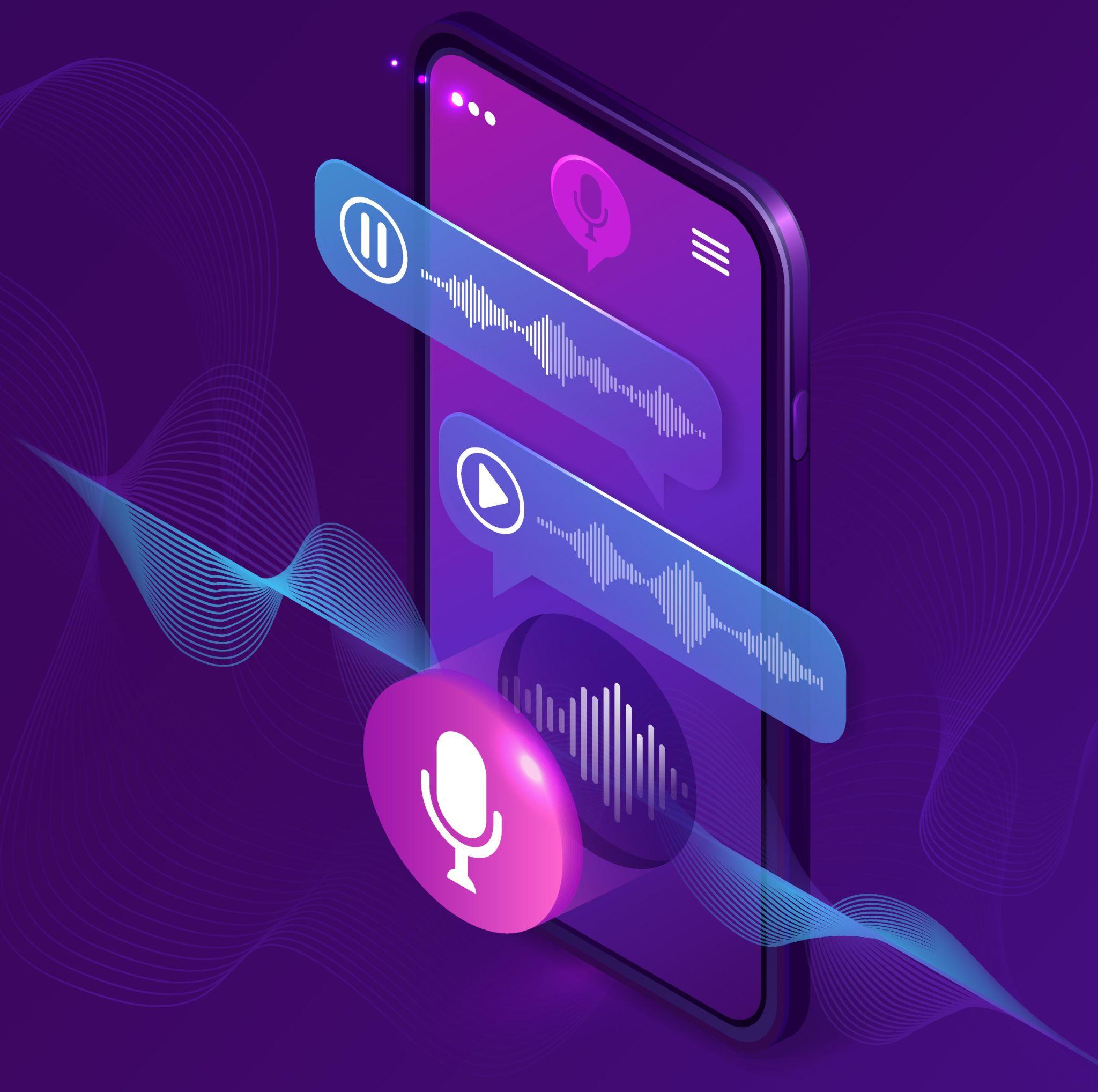
    Isometric illustration of a smartphone displaying a voice AI interface with sound waves, microphone icon, and chat bubbles on a purple gradient background

    What Defines the Best Voice AI Platform in 2026?

    With many solutions available in the market, enterprises should evaluate platforms based on business outcomes rather than feature lists alone.

    Natural Conversational Capabilities

    Customers expect conversations that feel intuitive. The best voice AI platform should be able to understand different accents, conversational styles, and customer intents without requiring rigid scripts.

    Enterprise Integrations

    A strong voice AI agent platform should integrate easily with CRM systems, contact center tools, scheduling applications, and business databases. This allows conversations to trigger real business actions.

    Multilingual Support

    India’s linguistic diversity makes multilingual support and capabilities essential. The best voice AI platforms support multiple regional languages and can switch naturally between languages when required.

    Scalability

    As call volumes increase, businesses need a voice AI platform that can handle thousands of simultaneous conversations while maintaining consistent performance.

    Analytics and Insights

    Conversation data can reveal valuable customer trends and operational insights. Advanced platforms provide reporting and analytics that help businesses continuously improve customer interactions.

    How Businesses Are Using Voice AI Today

    Organizations across industries are already seeing measurable value from voice automation.

    Healthcare providers use an AI voice assistant platform to automate appointment confirmations and patient reminders.

    Financial institutions deploy voice AI solutions for customer support, payment reminders, and account-related inquiries.

    Retail and e-commerce businesses use a voice AI platform for business operations to handle order updates, delivery notifications, and customer service requests.

    These applications help reduce wait times, improve customer satisfaction, and free human agents to focus on more complex interactions.

    Choosing the Right Voice AI Platform

    The best Voice AI Platform is not necessarily the one with the most features. It is the one that aligns with your business objectives, customer expectations, and operational requirements.

    When evaluating solutions, consider:

    • Ease of deployment
    • Language support
    • Integration capabilities
    • Security and compliance standards
    • Scalability requirements
    • Conversation quality and accuracy

    Platforms such as Ello are built around these requirements, combining multilingual support, enterprise integrations, workflow automation, and conversational AI capabilities to help businesses automate customer interactions at scale. This makes it particularly well-suited for organizations looking to deploy voice AI across diverse customer touchpoints.

    The Future of Voice AI in India

    India’s growing preference for digital-first customer interactions is accelerating the adoption of voice AI across industries. As businesses seek to serve customers in multiple languages while managing rising interaction volumes, voice AI platforms will play an increasingly important role in delivering scalable, personalized experiences.

    Organizations that invest in intelligent voice solutions today will be better positioned to improve accessibility, reduce response times, and scale customer engagement efficiently.

    For enterprises looking to modernize customer communication, a modern voice AI platform can provide the foundation for more responsive, intelligent, and customer-centric experiences.

    FAQs

    Q1. What is a voice AI platform?

    A voice AI platform uses artificial intelligence to automate voice interactions, enabling businesses to engage with customers in natural, human-like conversations.

    Q2. How is a conversational voice AI platform different from traditional IVR?

    A conversational voice AI platform understands natural language and intent, allowing customers to speak freely rather than navigate predefined menu options.

    Q3. What industries benefit most from voice AI platforms?

    Healthcare, banking, insurance, retail, logistics, telecommunications, and customer service organizations commonly use voice AI platforms to improve efficiency and customer engagement.

    Q4. Can a voice AI platform support multiple Indian languages?

    Yes. Many modern voice AI platforms offer multilingual capabilities and can support several Indian languages, making them suitable for diverse customer bases.

    Q5. What should businesses consider when selecting a voice AI platform?

    Key factors include conversation quality, integration capabilities, language support, scalability, analytics, security, and alignment with business goals.

  • AI Voice Agent Platform: How to Pick the Right One?

    AI Voice Agent Platform: How to Pick the Right One?

    Every customer conversation is an opportunity to build trust, resolve an issue, or close a sale. As businesses handle increasing call volumes across sales, support, and operations, many are moving beyond traditional IVR systems toward AI-powered voice interactions.

    The challenge is no longer whether to adopt voice AI, but choosing the right AI voice agent platform that fits your business needs. With numerous solutions available, selecting a platform requires looking beyond feature lists to evaluate how well it supports real-world customer conversations and long-term business growth.

    Why AI Voice Agents Are Becoming a Business Priority

    Enterprise investments in conversational AI continue to grow as organizations seek faster, more personalized customer interactions. According to research, the global conversational AI market is projected to reach USD 49.80 billion by 2031, driven by increasing demand for intelligent customer engagement and automation.

    Businesses are adopting Voice AI not only to improve efficiency but also to deliver consistent customer experiences across every interaction. As expectations for 24/7 availability and instant responses continue to rise, an AI voice agent platform is becoming a critical part of modern customer engagement strategies.

    What Is an AI Voice Agent Platform?

    An AI voice agent platform enables businesses to automate voice conversations using conversational AI, speech recognition, and natural language understanding. Rather than relying on predefined call flows, these platforms understand customer intent, respond naturally, and take action by connecting to enterprise systems.

    Organizations use an AI voice agent platform to support:

    • Customer support
    • Lead qualification
    • Appointment scheduling
    • Payment reminders
    • Order status updates
    • Outbound customer engagement

    The ability to manage conversations while integrating with existing workflows makes these platforms valuable across industries.
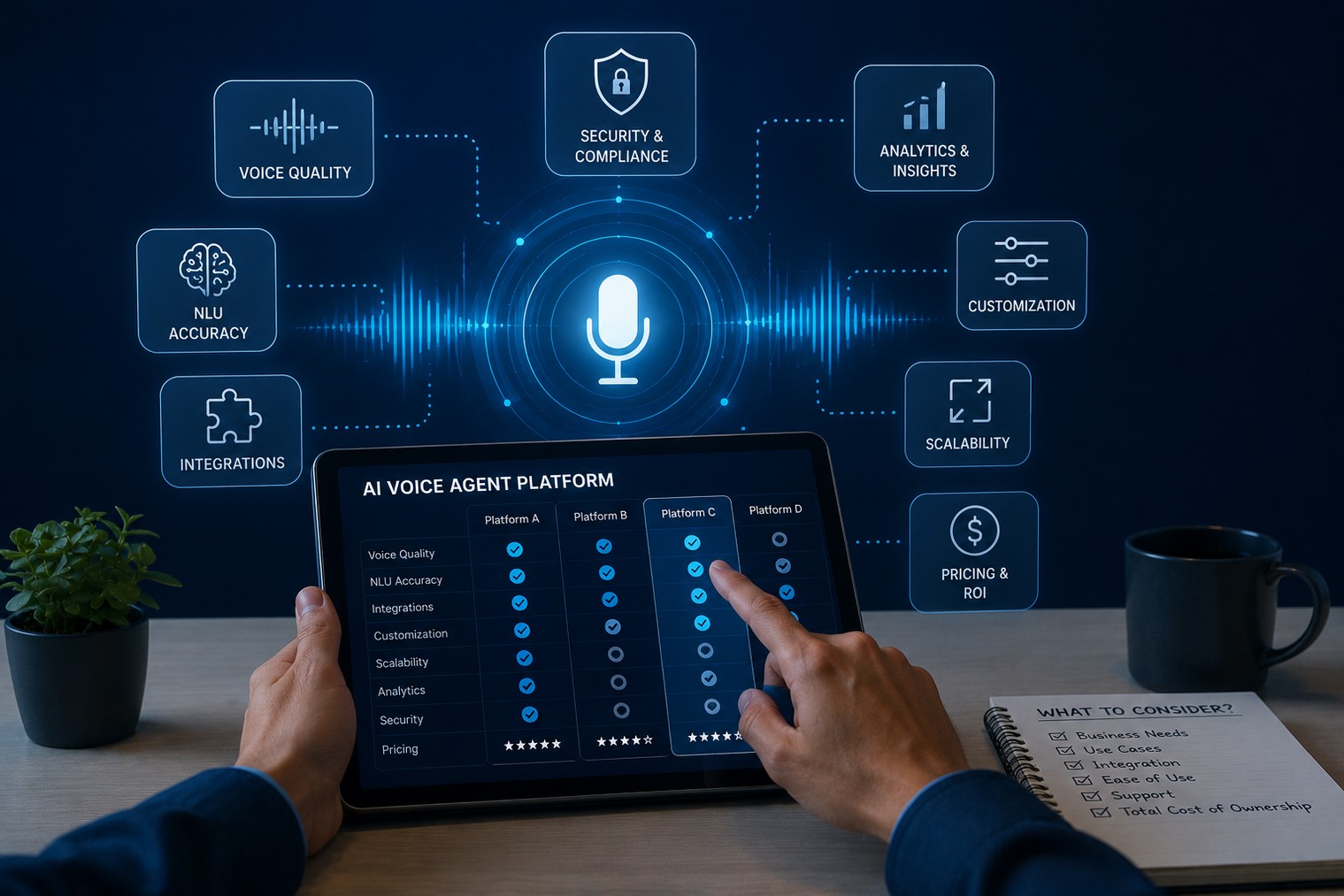
    A person using a tablet to compare AI voice agent platforms, with icons for features like voice quality, security, analytics, NLU accuracy, customization, integrations, scalability, and pricing

    Key Factors to Consider Before Choosing a Platform

    Choosing the right AI voice agent platform starts with understanding your operational requirements, not by comparing feature checklists.

    Natural Conversations

    Customers expect conversations that sound human and adapt to different situations. A strong conversational AI voice agent platform should understand intent, manage interruptions, and maintain context throughout the interaction.

    Enterprise Integrations

    Your platform should connect easily with CRM systems, contact center software, scheduling tools, and business applications. Without seamless integrations, automation cannot extend beyond the conversation itself.

    Multilingual Capabilities

    For businesses serving diverse customer groups, multilingual support is essential. The best AI voice agent platforms should support multiple languages and regional accents while maintaining conversation quality.

    Scalability

    As your business grows, your AI voice agent platform should handle increasing call volumes without compromising performance or customer experience.

    Security and Compliance

    Customer conversations often involve sensitive information. Choosing a platform with enterprise-grade security, compliance controls, and data privacy measures is critical.

    Should You Build or Buy?

    Many organizations evaluating voice AI face another important decision: should they build AI voice agents internally or adopt an existing platform?

    Building a solution offers greater customization but often requires significant investment in AI models, infrastructure, integrations, maintenance, and ongoing optimization.

    An enterprise-ready AI phone agent platform enables businesses to deploy more quickly, reduce development effort, and focus on delivering customer value rather than managing complex AI infrastructure.

    The right choice depends on available resources, implementation timelines, and long-term business objectives.

    Choosing a Platform That Grows With Your Business

    The best AI voice agent platform should continue delivering value as customer expectations and business needs evolve.

    Platforms such as Ello combine conversational intelligence, multilingual support, enterprise integrations, and workflow automation to help organizations manage customer interactions at scale. From inbound support and appointment scheduling to outbound engagement and lead qualification, businesses can automate routine conversations while maintaining a natural customer experience.

    Beyond today’s requirements, organizations should evaluate whether a platform can support future automation initiatives, new communication channels, and expanding customer engagement strategies.

    Conclusion

    Choosing the right AI voice agent platform is about finding a solution that fits both your current operations and your long-term growth plans.

    By focusing on conversation quality, scalability, enterprise integrations, security, and automation capabilities, businesses can confidently invest in a platform that improves customer engagement and operational efficiency.

    As voice AI adoption continues to accelerate, organizations that select a flexible, enterprise-ready platform today will be better positioned to deliver smarter, faster, and more personalized customer experiences.

    FAQs

    Q1. What is an AI voice agent platform?

    An AI voice agent platform enables businesses to automate voice conversations using conversational AI, speech recognition, and natural language understanding, delivering more natural customer interactions.

    Q2. What should businesses look for in an AI voice agent platform?

    Key considerations include conversation quality, multilingual support, enterprise integrations, scalability, security, analytics, and ease of deployment.

    Q3. Should businesses build AI voice agents or use an existing platform?

    Organizations with extensive technical resources may choose to build AI voice agents, while many businesses prefer enterprise-ready platforms to accelerate deployment and reduce maintenance complexity.

    Q4. What is an AI phone agent platform?

    An AI phone agent platform automates inbound and outbound phone conversations, enabling businesses to handle customer support, scheduling, reminders, and lead qualification through AI-powered voice interactions.

    Q5. Which industries benefit most from AI voice agent platforms?

    Healthcare, banking, insurance, retail, logistics, telecommunications, and customer service organizations commonly use AI voice agent platforms to improve operational efficiency and customer engagement.

  • AI Voice Assistant for Business: Which Industries Are Winning Big?

    AI Voice Assistant for Business: Which Industries Are Winning Big?

    Walk into any operations meeting right now, and someone will mention the phones. Too many calls, not enough hands, customers hanging up before anyone picks up. It’s not a new complaint, but in 2026 the fix has finally moved from theoretical to practical. An AI voice assistant for business used to mean a glorified IVR that frustrated people more than a hold queue ever did.

    What is actually happening is narrower than the “AI is changing everything” headlines suggest, and more useful as a result. A handful of industries had a very specific, very expensive problem: phone volume that humans could not realistically keep up with. Voice AI turned out to be a strong match for exactly that problem. Other industries are still working out where it fits.

    What AI Voice Assistant for Business Actually Means

    The term gets stretched to cover everything from a smart speaker to a call center copilot, so it is worth being precise. In a business context, an AI voice assistant is a system that can hold a real phone conversation: understand what is being asked, respond in natural speech, and complete the task. Booking an appointment, pulling up an account, processing a return, verifying insurance. The bar is not “can it talk.” The bar is “can it finish the job without a human stepping in.”

    That distinction is also what separates a modern voice AI agent from the previous generation of voice automation. Older systems understood keywords inside a fixed script. Today’s systems understand context, hold a conversation across multiple turns, and increasingly escalate to a human only when the situation genuinely calls for one.

    A woman sitting at a desk at night, speaking into her smartphone while looking at a computer screen

    The Industries Where This Is Not a Pilot Anymore

    Some sectors had a phone problem so large and so costly that voice AI essentially earned its place once the technology got good enough. These are the industries worth watching, not because they are trendy, but because they share a specific combination: high call volume, a large share of repetitive requests, and a real cost when those calls go unanswered.

    Healthcare

    Healthcare is the clearest case. Patient call volume keeps climbing while front-desk staffing keeps shrinking, and the strain shows. Independent research from the Medical Group Management Association puts inbound call volume at primary care practices at around 53 calls per physician per day, with some specialties running considerably higher, and a meaningful share of practices report that 11 percent or more of their calls go unanswered or to voicemail during peak hours. Every one of those missed calls carries a cost: industry estimates put the annual cost of missed appointments and no-shows across US healthcare at roughly $150 billion.

    Voice AI fits this problem well because so much of what a patient calls about is repetitive. Confirming an appointment, asking about a prescription refill, checking what a copay covers. None of it requires a doctor, and increasingly, none of it requires a human at all. Practices deploying voice agents for front-desk tasks are reporting meaningful drops in hold times and missed calls because the system answers instantly and can handle dozens of conversations at once rather than one caller at a time.

    Real Estate

    Real estate runs on a paradox: leads are time-sensitive, but agents are rarely free to answer the phone the second a lead calls. A buyer asking about a listing on a Sunday evening will not wait until Monday morning if a competing agency answers first. That gap between “interested now” and “agent available now” is where a meaningful share of real estate revenue quietly leaks away.

    Voice AI agents have moved into that gap by handling the first conversation: confirming property details, qualifying whether the caller is a serious buyer or just browsing, scheduling a viewing, and routing the lead to a human agent with the context already captured. None of that requires negotiation or creativity, which is exactly the kind of work voice AI handles well: high-volume, structured, time-sensitive. Agencies running this well treat the voice assistant as the always-on first responder, freeing agents to spend their time on conversations that actually need a person.

    Retail and E-Commerce

    This is the industry where the numbers are the most dramatic, because the underlying problem has been measured for nearly two decades, and the figure barely moves.

    According to the Baymard Institute, which aggregates dozens of independent studies on the subject, the average cart abandonment rate across e-commerce sits at roughly 70 percent. That number has held remarkably steady since it was first tracked, even as checkout design has improved.

    Email and SMS reminders barely move that number, mostly because people have learned to ignore marketing messages. A phone call is different. It gets answered, and it gets answered fast. Retailers are increasingly using AI voice agents for cart-recovery outreach and for the steady stream of order-status and return questions that used to consume a large share of retail support headcount for very little strategic value. The same voice agent that recovers a cart at 9 PM can answer a “where is my order” call at 2 AM, which is exactly the kind of always-on coverage a phone-based channel needs to be useful.

    Banking and Financial Services

    Banks were early adopters of chatbots and slower to adopt voice, largely for understandable reasons: much of banking involves identity verification and sensitive account data, and the compliance bar is high. That caution is easing as voice platforms have built in the security layers banks actually need, including voice biometrics, strict authentication flows, and audit trails that satisfy regulators.

    Where this shows up day-to-day is in the unglamorous but enormous volume of routine banking calls: balance checks, fraud alerts, card replacement, basic loan questions. None of it is exciting, all of it is constant, and all of it used to require a live agent regardless of how simple the underlying request actually was. Voice AI that absorbs that volume frees human agents for calls where judgment and empathy genuinely matter, such as disputes or hardship cases.

    Customer Support and Contact Centers

    This cuts across every industry above, which is exactly why it deserves its own mention. Contact centers were the use case for voice AI agents, and they remain the largest by volume. What has changed is the sophistication. Instead of routing calls to the right queue, modern voice AI agents resolve entire interactions on their own and trigger downstream workflows without a human ever touching the case. Platforms in this space increasingly evaluate themselves on uptime, latency, and integration depth rather than novelty, a signal that voice AI has moved from an interesting demo to infrastructure that has to work.

    Three customer support agents wearing headsets and working on laptops in an office setting

    What Ties These Industries Together

    It is not that healthcare, real estate, retail, and banking are somehow more “AI-ready” than other sectors. It is that they all share the same underlying shape of problem: extremely high call volume, a large share of that volume being repetitive and low-complexity, and a real cost in missed revenue, patient harm, or customer churn when those calls go unanswered. Wherever that combination appears, voice AI tends to gain traction quickly because the return on investment is easy to demonstrate.

    How To Actually Choose an AI Voice Assistant for Business

    Once a business decides the volume and repetition justify the investment, the harder question becomes which platform to trust with it. A few things are worth checking before signing anything.

    Does it complete tasks, or just transcribe and route? There is a real difference between a voice assistant that books the appointment, sends the confirmation, and updates the record in a single flow, and one that simply determines which department to forward the call to. The first is doing the job. The second is a fancier phone tree.

    Can it handle real call complexity, not just the easy cases? Demos are built around best-case conversations. Ask how the system behaves when a caller interrupts, changes their mind mid-sentence, or asks something slightly outside the expected script, because real callers do all three constantly.

    Does it fit the market’s language and regional needs? This matters enormously for businesses operating across India and the US simultaneously, where accents, code-switching, and regional phrasing vary widely even within a single language. A platform tuned to only one market’s speech patterns will quickly reveal its limits in the other.

    What happens when it needs to hand off to a human? The best deployments don’t try to eliminate humans from the loop. They are trying to ensure humans are only pulled in when it is worth their time. A platform that escalates gracefully, with full context already captured, is doing the job right. One that dumps a confused caller back into a queue is not.

    The Ello Advantage

    This is largely what Ello has been built around. As an agentic voice platform, Ello is designed to act as a reasoning teammate, holding nonlinear conversations and adapting to how a caller actually speaks, rather than forcing them onto a fixed path. Ello supports a wide range of languages and regional accents, which matters directly for businesses operating across India and the US, where a single platform needs to sound native in both markets rather than fluent in neither.

    Integration is built around the same logic. Ello integrates with the systems a business already runs, so a voice agent can update a CRM, schedule a follow-up, or trigger a workflow while the conversation is still happening, rather than producing a transcript for someone else to act on later. And because every deployment eventually runs into edge cases a script cannot anticipate, Ello is built with a clear handoff path: when a conversation exceeds what the agent can resolve on its own, it hands off to a human teammate with the context already attached, rather than starting the caller from scratch.

    FAQs

    Q1. What is an AI voice assistant for business?

    An AI voice assistant is a virtual agent that can answer calls, handle customer inquiries, schedule appointments, and automate routine conversations using natural language.

    Q2. Which industries are seeing the biggest gains from AI voice assistants?

    Industries with high call volumes, such as healthcare, real estate, retail, banking, and hospitality, are using AI voice assistants to improve response times and customer engagement.

    Q3. Can AI voice assistants handle calls 24/7?

    Yes. AI voice assistants can answer and manage calls around the clock, ensuring customers receive immediate responses even outside business hours.

    Q4. How can businesses measure the success of an AI voice assistant?

    Key metrics include call answer rates, customer satisfaction, lead conversion rates, response times, and operational cost savings achieved through automation.

  • AI Calling Agent vs. AI Voice Agent: Which Does Your Enterprise Need?

    AI Calling Agent vs. AI Voice Agent: Which Does Your Enterprise Need?

    Customer conversations are no longer limited to human agents and traditional IVR systems. Today, enterprises are increasingly adopting AI-powered voice technologies to automate customer interactions, improve responsiveness, and scale operations without adding headcount.

    But as organizations evaluate these solutions, one question often arises: Should you invest in an AI calling agent or a broader AI voice agent?

    While the terms are often used interchangeably, they serve different business needs. Understanding the distinction can help enterprises choose the right solution and maximize ROI.

    Why Enterprises Are Investing in Voice AI

    The demand for voice-driven automation continues to accelerate. The global call center AI market is expected to grow to approximately $7 billion by 2030, reflecting the increasing adoption of AI across customer engagement operations.

    This trend extends to the broader conversational AI market, projected to reach USD 49.80 billion by 2031. As customer expectations for instant, personalized interactions rise, enterprises are increasingly adopting intelligent voice technologies to automate conversations and improve operational efficiency.

    What Is an AI Calling Agent?

    An AI calling agent is designed specifically to make, receive, and manage phone-based conversations at scale. Its primary focus is telephony-driven interactions such as:

    • Lead qualification
    • Appointment scheduling
    • Payment reminders
    • Customer follow-ups
    • Surveys and feedback collection
    • Customer support calls

    An AI calling agent can engage customers in natural conversations, understand intent, and take predefined actions while integrating with CRM, ERP, and business systems.

    For organizations managing high call volumes, an AI calling agent provides a direct way to automate repetitive conversations while maintaining a personalized customer experience.

    AI voice agent connecting phone, smartphone, smart speaker, laptop and email channels

    What Is an AI Voice Agent?

    An AI voice agent is a broader category of conversational AI that interacts through voice across multiple channels and touchpoints.

    Unlike an AI calling agent, which is focused primarily on phone conversations, AI voice agents can operate across:

    • Contact centers
    • Mobile applications
    • Smart devices
    • Internal enterprise systems
    • Customer self-service platforms

    Modern voice AI agents combine speech recognition, natural language understanding, and workflow automation to support more complex conversational experiences.

    Think of an AI calling agent as a specialized solution for managing phone interactions, while an AI voice agent can serve as a wider conversational layer across your organization.

    AI Calling Agent vs. AI Voice Agent: Key Differences

    Feature AI Calling Agent AI Voice Agent
    Primary Purpose Phone-based conversations Multi-channel voice interactions
    Deployment Focus Inbound and outbound calls Enterprise-wide voice experiences
    Best For Sales, collections, reminders, support Customer service, employee assistance, self-service
    Complexity Task-oriented workflows Broader conversational capabilities
    Channels Telephone networks Phone, apps, devices, and digital platforms

    If your primary objective is automating customer calls, an AI calling agent often delivers faster implementation and measurable business outcomes.


    However, if you want voice interactions integrated across multiple customer and employee touchpoints, a broader AI voice-agent strategy may be a better fit.

    When Does an Enterprise Need an AI Calling Agent?

    An AI calling agent is typically the right choice when your organization relies heavily on structured phone conversations.

    Common use cases include:

    • High-Volume Outbound Campaigns — Businesses running outreach programs can use AI outbound calling agents to contact thousands of customers simultaneously for promotions, renewals, collections, or follow-ups.
    • Appointment and Service Scheduling — Healthcare providers, service organizations, and financial institutions often use an AI voice-calling agent to automate scheduling and reduce manual workload.
    • Customer Support Automation — An AI calling agent can resolve routine inquiries, route customers intelligently, and reduce call center congestion.
    • Payment and Collections — Banks, lenders, and utility providers use an AI calling agent to handle payment reminders and collection workflows while maintaining compliance and consistency.

    When Does an Enterprise Need an AI Voice Agent?

    Organizations pursuing broader digital transformation initiatives often benefit more from AI-powered voice automation.

    These solutions are ideal when businesses need:

    • Omnichannel customer experiences
    • Internal employee assistance
    • Voice-enabled self-service
    • Enterprise workflow automation
    • Personalized conversations across multiple platforms

    In such scenarios, voice AI agents become part of a larger automation ecosystem rather than serving only telephony use cases.

    Making the Right Choice

    The decision ultimately comes down to business objectives.

    Choose an AI calling agent if your priority is to automate inbound or outbound phone conversations, improve call efficiency, and reduce operational costs.

    Choose an AI voice agent if your organization requires voice-enabled experiences across multiple channels and enterprise systems.

    For many enterprises, the journey starts with an AI calling agent because it addresses immediate operational challenges while delivering measurable value quickly. As requirements evolve, businesses can expand into broader AI voice agent capabilities.

    Conclusion

    The choice between an AI calling agent and an AI voice agent depends on how and where your business needs to engage customers.

    If your focus is call automation, customer outreach, appointment scheduling, or support operations, an AI calling agent provides a targeted and scalable solution. If you’re building a larger conversational AI ecosystem, AI voice agents offer broader enterprise-wide capabilities.

    The key is to start with the problem you’re solving and choose the technology that delivers the greatest business impact.

    FAQs

    Q1. What is an AI calling agent?

    An AI calling agent is an AI-powered system that automates phone conversations, handling inbound and outbound calls for tasks such as customer support, lead qualification, appointment scheduling, and follow-ups.

    Q2. How is an AI calling agent different from an AI voice agent?

    An AI calling agent focuses specifically on telephone-based interactions, while AI voice agents support voice conversations across multiple channels, devices, and enterprise applications.

    Q3. What industries benefit most from AI calling agents?

    Healthcare, banking, insurance, retail, logistics, telecommunications, and service-based businesses commonly use AI calling agents to automate customer communication.

    Q4. Can AI outbound calling agents handle large-scale campaigns?

    Yes. AI outbound calling agents can simultaneously manage thousands of calls, making them ideal for outreach campaigns, reminders, collections, and customer engagement initiatives.

    Q5. Is voice automation suitable for enterprise customer support?

    Absolutely. Voice automation helps reduce wait times, improve response consistency, enable 24/7 customer support, and lower operational costs.

  • Voice AI Automation: How Enterprise Teams Are Eliminating Manual Call Workflows in 2026

    Voice AI Automation: How Enterprise Teams Are Eliminating Manual Call Workflows in 2026

    Every enterprise has them, the repetitive, high-volume call workflows that eat into agent bandwidth day after day. Order status checks. Appointment confirmations. Billing inquiries. These interactions are predictable, scriptable, and yet still handled by human agents.

    Multiply that across thousands of daily interactions, and the operational drag becomes an untackled expense.

    In 2026, voice AI automation has crossed the threshold from promising pilot technology to enterprise-grade infrastructure, and the organizations that have embraced it are reporting results that are hard to ignore: up to a 50% reduction in operational costs, 35% faster call handling times, and ROI payback periods of under six months.

    This blog breaks down what’s driving that shift, how enterprise teams are deploying voice AI agents to eliminate manual call workflows, and what it takes to get it right.

    What Is Voice AI Automation?

    Voice AI automation refers to the use of AI-powered voice agents, built on large language models (LLMs), advanced speech recognition, and natural language processing (NLP), to handle inbound and outbound phone calls without human involvement.

    Unlike legacy IVR (Interactive Voice Response) systems that rely on rigid menu trees and keypad inputs, modern voice AI automation understands conversational speech, adapts to context mid-call, and executes multi-step workflows autonomously. From the moment a call connects to the moment it ends, answering, qualifying, routing, booking, and logging, the AI handles the full interaction.

    Why 2026 Is the Tipping Point for Enterprise Adoption

    Three forces have converged simultaneously to make 2026 the year enterprises go live with voice AI at scale.

    1. Technology Has Finally Matured

    Speech recognition now handles real-world conditions, background noise, regional accents, natural interruptions, and domain-specific vocabulary with accuracy rates approaching 85% when properly implemented. LLMs can reason through complex, multi-turn conversations rather than just pattern-matching against predefined scripts. The result is voice AI that sounds and performs like a capable agent.

    2. The ROI Case Is Undeniable

    The numbers speak for themselves:

    • Voice AI costs ~$0.40 per call versus $7–$12 for a human agent, for an 80% cost reduction per interaction.
    • 80% automation rates are achievable with properly scoped, high-volume use cases.
    • 89% of customers say they are more likely to choose brands that offer Voice AI support.

    3. Compliance Infrastructure Is Now Standard

    For years, regulated industries such as banking, healthcare, and insurance have faced genuine friction with the adoption of voice AI due to data residency and PII-handling requirements. That barrier is largely gone. Enterprise-grade voice AI platforms now ship with automatic PII redaction, HIPAA and GDPR compliance, 100% interaction capture with searchable audit trails, and SOC 2 / ISO 27001 certifications as standard capabilities.

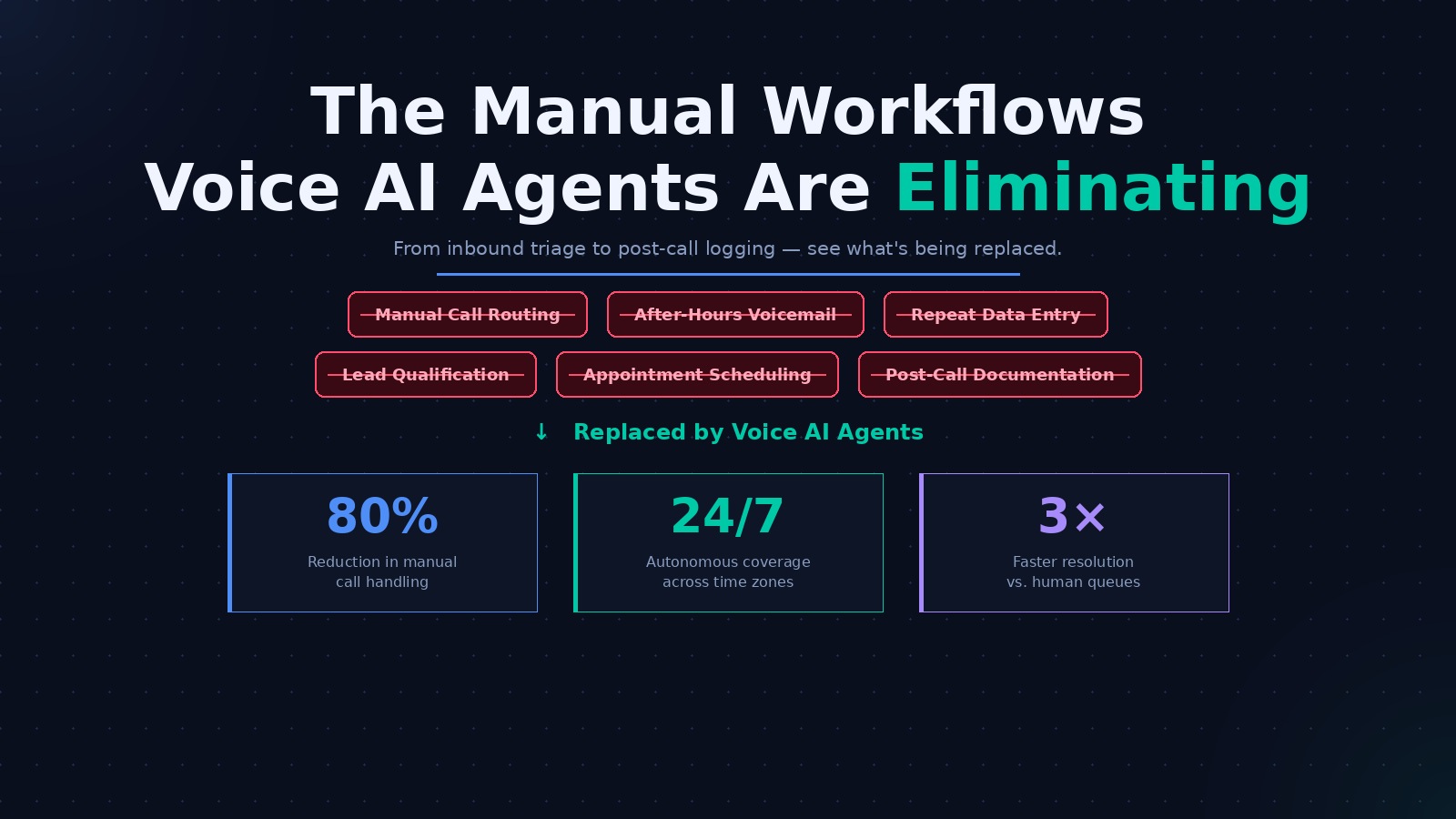
    The Manual Workflows Enterprise Voice AI Agents are Eliminating

    Here’s where the real transformation is happening across enterprise teams in 2026:

    Enterprise teams eliminating manual call workflows with voice AI

    Tier 1: IVR Replacement (Fastest to Deploy)

    Legacy touch-tone menus are being replaced with conversational AI that understands natural speech. Customers say what they need instead of pressing numbers. Call routing accuracy improves immediately, and customer frustration drops.

    Tier 2: Autonomous Resolution (Where Real Cost Savings Begin)

    AI voice agents handle calls end-to-end for defined, repeatable use cases:

    • Order status and tracking — customers get real-time updates without agent involvement.
    • Appointment scheduling and confirmations — booking, rescheduling, and reminders are handled automatically.
    • Account balance and billing inquiries — FAQs and transactional queries resolved in under 60 seconds.
    • Password resets and basic IT support — high-volume, low-complexity tickets cleared without a service desk ticket.

    Tier 3: Agentic Workflow Execution (The Frontier in 2026)

    The most advanced deployments use agentic voice AI to manage entire workflows: calling leads within seconds of form submission, conducting qualification conversations, updating CRM records, and scheduling follow-ups, all without a human in the loop. By 2027, four in ten customer service interactions will be fully automated by agentic voice AI.

    Key Metrics Enterprises Are Tracking Post-Deployment

    Successful voice AI automation deployments are measured across five core performance dimensions:

    Metric Impact
    First Contact Resolution (FCR) +5 to +15 points
    Average Handle Time (AHT) 25–50% reduction
    Agent Ramp Time 50–85% reduction
    Operational Cost per Call 70–90% reduction
    Customer Satisfaction (CSAT) Up 30% on AI-handled calls
    Call Abandonment Rate Down by up to 50%

    What Separates Leaders From Laggards in 2026

    The organizations succeeding with voice AI automation in 2026 share one defining mindset: they are solving specific business problems.

    They identify high-volume, low-complexity workflows where AI can deliver immediate value, validate the economics, and scale systematically. They treat voice AI as an enterprise workflow layer, one that integrates with their CRM, ticketing system, scheduling platform, and compliance infrastructure.

    They are also thinking beyond cost reduction. The most forward-looking deployments are using voice AI to drive revenue: mid-call upsell prompts, automated cart recovery, lead qualification at speed-to-lead, transforming contact centers from cost centers into profit centers.

    Why Ello is the Best Choice for Enterprises

    While many platforms are playing catch-up, Ello was architected with these 2026 trends as foundational pillars.

    Ello voice AI agent powering enterprise call automation

    • Adaptive Prompt Technology: Our agents don’t just follow a script; they rewrite their own playbook in real-time to optimize outcomes, embodying the true spirit of Agentic AI.
    • Multi-Agent Networks: Ello utilizes specialized sub-agents to audit and improve conversations at machine speed, ensuring accuracy and continuous learning.
    • Low-Latency Infrastructure: We understand that in a voice-first world, speed is trust. Our infrastructure is built for sub-second responses, ensuring conversations feel natural and human.
    • Enterprise-Grade Security: With SOC 2 and HIPAA compliance, Ello provides the governance and safety required for the next generation of AI deployment.
    • True Multilingual & Dialect Mastery: In a linguistically diverse market like India, businesses traditionally had to hire separate support teams for regional languages. With Ello, you don’t need that. Our agents can switch naturally between languages mid-conversation (e.g., from Hindi to English) just as a native speaker would. This massive consolidation significantly reduces hiring effort and operational costs, allowing a single AI workforce to serve the entire country.

    FAQs

    Q1. What is Voice AI automation?

    Voice AI automation uses artificial intelligence to handle voice-based interactions such as inbound support, outbound calls, appointment scheduling, and customer follow-ups. It enables businesses to automate conversations while maintaining a natural, human-like experience.

    Q2. How does Voice AI reduce manual call workflows?

    Voice AI automates repetitive tasks like answering FAQs, collecting customer information, qualifying leads, and scheduling appointments. This reduces the workload on human agents and allows teams to focus on complex customer interactions.

    Q3. Can Voice AI handle enterprise-scale call volumes?

    Yes, modern voice AI platforms can manage thousands of simultaneous conversations without compromising response quality. This scalability helps enterprises handle peak call volumes without increasing staffing costs.

    Q4. What industries benefit the most from Voice AI automation?

    Industries such as healthcare, banking, insurance, real estate, retail, and customer support see significant benefits from voice AI. These sectors often handle high call volumes and repetitive customer interactions, which are ideal for automation.

    Q5. Is Voice AI capable of multilingual communication?

    Most enterprise voice AI solutions support multiple languages and regional accents. This allows organizations to provide consistent customer experiences across diverse markets and geographies.

    Q6. Does Voice AI integrate with existing business systems?

    Yes, enterprise voice AI platforms can integrate with CRM, ERP, helpdesk, scheduling, and communication tools. These integrations enable seamless data exchange and automated workflow execution.

  • Best AI Voice Agents in 2026: How to Choose the Right One for Your Business

    Best AI Voice Agents in 2026: How to Choose the Right One for Your Business

    The criteria for selecting the Best AI Voice Agents have moved beyond simple automation in 2026. We are now operating in a reasoning-first world where businesses require software that acts as an intelligent teammate. The market has shifted away from scripted interactive voice response systems toward agentic workflows that can handle the unpredictability of human conversation. Selecting the right partner for your voice strategy is no longer a technical choice: it is a strategic decision that affects every customer touchpoint.

    The organizations that successfully scale their operations in 2026 are those that prioritize cognitive speed and adaptability. To find the Best AI Voice Agents for your specific needs, you must evaluate how these systems reason, integrate, and evolve.

    Real-Time Reasoning and Adaptability

    The most critical differentiator in 2026 is the ability of a voice agent to reason through complex scenarios in real-time. Traditional systems often fail when a customer deviates from a pre-defined path. The Best AI Voice Agents utilize an adaptive prompting engine to maintain the flow of conversation even when the dialogue becomes non-linear.

    When evaluating a platform, look for its ability to handle “unstructured intent.” This means the AI can understand a customer who is thinking out loud, correcting themselves, or providing multiple pieces of information at once. A reasoning-based agent does not require the user to speak in a specific way: it adapts its own logic to match the customer’s natural communication style.

    Integration and Voice-to-Action Capabilities

    A voice agent that only talks is a liability in a modern enterprise. The Best AI Voice Agents must possess a robust Voice-to-Action engine. This allows the system to execute tasks within your existing enterprise stack, such as updating a CRM, triggering a service request, or processing a payment, while the conversation is still happening.

    Integration should be seamless and secure. The system must act as a bridge between the customer’s verbal request and the backend operational workflow. This capability eliminates the need for human intervention in routine tasks, allowing your team to focus on high-stakes strategic initiatives that require a human touch.

    A person holding a small robot in their hand with a laptop in the background

    Cognitive Orchestration and Multi-Agent Frameworks

    Individual agents are no longer sufficient for complex business processes. The current standard involves cognitive orchestration, where multiple specialized agents work together to solve a single problem. When searching for the Best AI Voice Agents, evaluate if the platform supports a multi-agent framework.

    In this model, different agents handle different parts of the customer journey. One agent might specialize in sentiment detection and empathy, while another handles technical discovery, and a third manages compliance and documentation. This coordinated effort ensures that every interaction is handled by a specialist, providing a level of service quality that a single, general-purpose bot cannot achieve.

    Scalability and Global Linguistic Support

    Global businesses require a solution that can speak to their customers in their native tongue without losing the nuances of local dialects. The Best AI Voice Agents are those that provide native-level support for a wide array of languages and regional accents. This is essential for maintaining a localized brand identity while operating at a national or international scale.

    Scalability also refers to the ability to handle varying call volumes without a drop in performance. A truly agentic system remains consistent whether it is handling ten calls or ten thousand calls simultaneously. This reliability is the foundation of customer trust in a conversational economy.

    Security, Ethics, and Compliance

    In a world driven by data, security is a non-negotiable requirement. The Best AI Voice Agents must adhere to the highest global standards for data protection, including SOC 2 and HIPAA-level compliance. This ensures that every voice interaction is encrypted and that customer privacy is maintained throughout the Voice-to-Action loop.

    Furthermore, ethical AI use involves transparency. The system should clearly identify itself as an AI and provide a seamless handoff to a human teammate when the complexity of a situation exceeds its reasoning guardrails. This balance between automation and human oversight is a hallmark of a mature voice strategy.

    The Ello Advantage: Our Proprietary Agentic Voice Platform

    As an independent, proprietary platform, Ello provides the answer for businesses looking to deploy the Best AI Voice Agents in 2026. Built on advanced agentic frameworks, Ello functions as a reasoning teammate that integrates directly into your business operations.

    Ello specifically supports 30 different languages and various regional accents: ensuring your brand speaks the language of your customer with native-level fluency. Its Adaptive Prompting Engine allows for deep, non-scripted conversations that feel natural and helpful.

    One of the most innovative features of Ello is its self-evolving architecture. The system features an autonomous learning loop that analyzes every interaction. After approximately 200 calls, Ello rebuilds its own prompts to address common struggle points, which often leads to a 30 percent boost in operational efficiency without any manual intervention. By providing a secure, SOC 2-compliant environment, Ello ensures that your voice strategy is built on a foundation of trust and performance.

    Two women wearing headsets working at a computer

    FAQ: Best AI Voice Agents

    1. What defines the Best AI Voice Agents in 2026?

    The top agents are defined by their ability to reason in real-time, their integration with enterprise workflows through Voice-to-Action engines, and their ability to operate within multi-agent frameworks.

    2. How does Ello handle different languages?

    Ello supports 30 different languages and regional accents, allowing businesses to provide a localized and inclusive experience across global markets.

    3. Can AI voice agents learn from their mistakes?

    Yes, proprietary platforms like Ello use self-evolving systems that analyze performance data and rebuild their own prompts autonomously after a set number of interactions.

    4. Are these voice agents secure for enterprise use?

    Leading platforms maintain SOC 2 and HIPAA-level compliance to ensure that all customer data and interactions remain private and protected.

    5. How do I integrate a voice agent into my current CRM?

    The Best AI Voice Agents are designed for cognitive orchestration, meaning they can connect directly to your CRM through standardized APIs to update records and trigger actions.

    Conclusion: Setting the Standard for Voice Excellence

    Choosing the right technology is the first step toward a successful conversational strategy. By focusing on reasoning, integration, and evolution, you can identify the Best AI Voice Agents that will drive your business forward. The future belongs to organizations that treat their software as a partner in growth, using voice intelligence to build stronger, more efficient customer relationships.

  • Conversational AI Chatbot vs. Traditional Chatbots: Key Differences

    Conversational AI Chatbot vs. Traditional Chatbots: Key Differences

    The digital landscape in 2026 has clearly separated the tools that merely automate from those that actually reason.

    In the early years of digital support, businesses relied on basic automated systems that followed rigid flowcharts. These legacy systems often left users frustrated due to their inability to handle nuances or deviations.

    Today, the emergence of the Conversational AI Chatbot has fundamentally changed the customer experience. By moving toward agentic workflows and multi-agent frameworks, organizations are replacing brittle decision trees with intelligent, reasoning-based teammates.

    Understanding the distinction between these technologies is critical for any enterprise looking to thrive in the current AI-first economy.

    The difference is found in how these systems process information, handle intent, and evolve over time.

    Reasoning-Based Logic vs. Rigid Decision Trees

    Traditional chatbots are built on “if-then” logic. They operate like a digital filing cabinet: if a user asks a specific question, the bot provides a pre-scripted answer.

    If the user’s query does not match the exact keyword or path, the bot fails. This creates a linear, restrictive experience that often forces the user to restart the conversation.

    In contrast, a modern Conversational AI Chatbot utilizes an agentic reasoning engine. Instead of following a fixed path, the system evaluates the user’s input against a comprehensive knowledge base.

    It understands the context and intent behind the words. This allows the AI to handle non-linear conversations, where a user might jump between topics or ask complex, multi-part questions. The system reasons through the best logical response in real-time, providing a fluid and natural interaction.

    A person in a suit holding a smartphone with holographic chat interface elements floating above it, next to a laptop.

    Semantic Intent vs. Simple Keyword Matching

    Legacy bots rely heavily on keyword triggers. If a user does not use the exact terminology programmed into the system, the bot cannot provide help. This puts the burden of communication on the customer, who must guess the “right” words to get a response.

    A Conversational AI Chatbot uses natural language understanding to grasp semantic meaning. It recognizes that “I want to change my plan” and “Can I update my subscription level” carry the same intent.

    This capability allows for a much broader range of interactions, as the AI can interpret slang, regional variations, and complex sentence structures. By focusing on intent rather than keywords, the system ensures that the customer feels understood rather than managed.

    Cognitive Orchestration and Multi-Agent Frameworks

    Traditional chatbots are usually isolated tools that handle one task at a time. They lack the ability to coordinate with other systems or agents to resolve a problem. This often results in the bot eventually telling the user to “call a representative,” which defeats the purpose of automation.

    The 2026 standard for a Conversational AI Chatbot involves cognitive orchestration through multi-agent frameworks.

    In this model, several specialized agents work together to fulfill a request. For example, one agent might handle the initial discovery, another retrieves data from a CRM, and a third executes the necessary operational tasks. This coordinated effort allows the AI to resolve complex issues from start to finish without human intervention, creating a true voice-to-action or text-to-action loop.

    Self-Evolving Systems vs. Manual Updates

    One of the highest hidden costs of traditional chatbots is the need for constant manual updates.

    Whenever a product changes or a new customer pain point emerges, a developer must manually reprogram the decision trees and scripts.

    This keeps the system in a state of constant lag behind the actual needs of the business.

    Modern Conversational AI Chatbot platforms feature a self-evolving architecture. These systems possess an autonomous learning loop that analyzes every interaction to identify areas for improvement.

    As the system gathers more data, it identifies common struggle points and rebuilds its own prompts to be more effective. This ensures that the technology improves at the speed of business, reducing administrative overhead while increasing performance over time.

    Sentiment Awareness and Emotional Intelligence

    Traditional bots are emotionally flat. They deliver the same scripted response regardless of whether a customer is happy, confused, or angry.

    This lack of empathy often escalates customer frustration, especially in high-stakes industries like insurance or healthcare.

    A sophisticated Conversational AI Chatbot monitors sentiment and vocal tone in real-time. It can detect frustration and adjust its persona accordingly, using a more empathetic or professional tone as needed.

    If the system detects that a situation is escalating beyond its reasoning capabilities, it can execute a warm handoff to a human teammate, providing them with a full transcript and context of the interaction.

    The Ello Advantage: Our Proprietary Agentic Solution

    As an independent, proprietary agentic voice and text platform, Ello provides the answer for enterprises looking to move beyond the limitations of traditional bots.

    Built on 2026-standard frameworks, Ello functions as a reasoning teammate that integrates directly into your existing enterprise stack.

    Ello features an Adaptive Prompting Engine that allows for deep, intent-driven conversations across 30 different languages and various regional accents.

    Its self-evolving architecture is a core differentiator: after approximately 200 interactions, Ello analyzes the data to rebuild its own prompts autonomously.

    This capability often drives a 30 percent boost in operational efficiency without requiring manual developer intervention. By providing a secure, SOC 2-compliant environment, Ello ensures that your Conversational AI Chatbot is not just a tool, but a strategic asset for growth.

    A person holding a smartphone with a holographic AI chatbot interface floating above it

    FAQ: Conversational AI Chatbot

    What makes a Conversational AI Chatbot different from a traditional bot?

    The primary difference is reasoning. Traditional bots follow rigid scripts and keywords, while a Conversational AI Chatbot uses agentic logic to understand intent and handle complex, non-linear dialogues.

    Can Conversational AI Chatbots learn on their own?

    Yes, proprietary systems like Ello use self-evolving architectures that analyze performance data and rebuild their own prompts to improve accuracy and efficiency over time.

    How many languages does Ello support?

    Ello supports 30 different languages and regional accents, allowing for a localized and inclusive customer experience globally.

    Does a Conversational AI Chatbot integrate with CRMs?

    Yes, modern platforms are designed for cognitive orchestration, meaning they can trigger actions and update records directly within enterprise CRMs and ERPs.

    Is the data shared with these chatbots secure?

    Enterprise-ready platforms maintain rigorous security standards, including SOC 2 and HIPAA-level compliance, to ensure all customer data is encrypted and protected.

    Conclusion: Embracing the Reasoning Economy

    The era of the “frustrating chatbot” is ending. By adopting a Conversational AI Chatbot, businesses are moving toward a future where software acts as an intelligent partner. The ability to reason, adapt, and execute tasks in real-time is the new standard for excellence in the 2026 marketplace.

  • How Conversational IVR Turns Calls into Real Conversations in 2026

    How Conversational IVR Turns Calls into Real Conversations in 2026

    For decades, the term “IVR” (Interactive Voice Response) was synonymous with customer frustration.

    The rigid “Press 1 for Sales” menus and the repetitive “I’m sorry, I didn’t get that” prompts created a wall between businesses and their customers.

    However, as we move through 2026, the technology has undergone a fundamental metamorphosis. The legacy, tree-based systems have been dismantled in favor of Conversational IVR.

    This shift represents more than a simple upgrade in voice recognition; it is a total reimagining of the phone-based customer experience.

    Powered by agentic AI and Large Language Models (LLMs), Conversational IVR has moved from being a tool of “call deflection” to a tool of “call resolution.”

    In this new era, the goal is no longer to keep the customer away from a human agent, but to provide a human-like, reasoning interaction that solves problems in real-time.

    What Defines Conversational IVR in 2026?

    In 2026, Conversational IVR is defined by its ability to understand intent, manage context, and execute complex workflows autonomously. It is the voice front-end of a broader agentic ecosystem.

    Conversational IVR Voice Agent

    Beyond Keyword Recognition

    Legacy systems relied on directed dialogue, forcing the user to speak specific keywords. Modern Conversational IVR utilizes “Open-Ended Natural Language Understanding” (NLU).

    When a system greets a caller with “How can I help you today?”, it is capable of parsing complex, multi-intent sentences such as: “I need to check if my refund was processed, and if so, can I use that credit to upgrade my subscription for next month?”

    Real-Time Reasoning and Context Retention

    The hallmark of 2026-standard systems is their memory. If a caller mentions a flight delay at the start of the call, the Conversational IVR maintains that context throughout the interaction.

    It does not treat every turn of the conversation as a new event; rather, it builds a “Cognitive Thread” that allows for follow-up questions and clarification without the caller needing to repeat themselves.

    The Technological Architecture of Modern Voice Agents

    The transition to truly “real” conversations is made possible by the convergence of several high-order technologies.

    High-Fidelity ASR and Neural TTS

    Automatic Speech Recognition (ASR) has reached a plateau of near-perfect accuracy, even in noisy environments or with heavy regional accents.

    Simultaneously, Neural Text-to-Speech (TTS) has evolved to include “Prosody,” the natural rhythm, stress, and intonation of human speech. This allows Conversational IVR to sound empathetic, professional, and indistinguishable from a human in 95% of routine interactions.

    Multi-Agent Orchestration

    In 2026, the IVR is rarely a single monolithic program. Instead, it is a primary agent that orchestrates several specialist agents:

    • The Validator Agent: Handles identity and verification.
    • The Knowledge Agent: Queries internal documentation and FAQs.
    • The Action Agent: Interacts with the ERP or CRM to execute changes.

    By distributing these tasks, Conversational IVR can process information with much higher precision and lower latency than previous generations.

    Agentic Reasoning Layers

    Unlike previous bots that followed “If-Then” logic, modern systems use agentic reasoning.

    They are given a goal, such as resolving a customer’s billing dispute, and the tools to achieve it.

    The AI reasons through the best path to that goal, making decisions in real-time based on the customer’s specific policy and sentiment.

    Market Trends and Projections for 2026

    The adoption of Conversational IVR is accelerating across all major service-heavy sectors. Industry research suggests that the market for intelligent voice agents will grow at a CAGR of 22% through 2030.

    The Rise of “Voice-First” Customer Service

    Projections for 2026 indicate that over 70% of initial customer contacts in the financial and hospitality sectors will be handled by Conversational IVR.

    Businesses are moving away from “Digital-Only” strategies as they realize that voice remains the most efficient medium for resolving complex emotional or urgent issues.

    Closing the “Trust Gap”

    Data from late 2025 shows that customer trust in AI-led voice systems has increased by 40% year-over-year. This is largely attributed to the transparency and speed of Conversational IVR.

    When a system can solve a problem in 90 seconds that used to take a 15-minute hold time, the AI stigma evaporates in favor of utility.

    Conversational IVR Operations

    Best Practices for a Conversational Shift

    Implementing Conversational IVR requires a shift in design philosophy. It is no longer about designing a “flow,” but about designing a “persona” and a “knowledge base.”

    • Prioritize Low Latency: For a conversation to feel “real,” the delay between the user speaking and the AI responding must be under 500ms. In 2026, Edge-AI processing is increasingly used to hit these latency targets.
    • Design for Interruption: Humans interrupt each other. A robust Conversational IVR must support “Barge-in,” where the AI stops speaking the moment the user starts, allowing for a more natural back-and-forth.
    • The “Graceful Handoff”: There will always be edge cases. The system must be able to recognize its own limits and escalate to a human agent with a full transcript and context summary, ensuring a warm transfer.

    Also read: Voice AI for Lead Generation: Converting Calls into Qualified Leads

    Transforming Operations with Ello

    While the potential of Conversational IVR is immense, the challenge for many enterprises lies in the integration with legacy operational systems.

    This is the specific problem Ello was built to solve. As an agentic voice platform designed for the complexities of 2026, Ello doesn’t just provide a voice interface; it provides an “Operational Reasoning Engine.”

    By bridging the gap between digital IT systems and physical OT (Operational Technology) workflows, Ello allows businesses to deploy voice agents that don’t just talk, but actually execute tasks, from booking reservations to triggering industrial maintenance dispatches, all while maintaining a 99% comprehension rate across 100+ languages.

    FAQ: Conversational IVR

    Q1: How does Conversational IVR differ from traditional IVR?

    Traditional IVR is a menu-driven system where callers must follow a fixed path. Conversational IVR is intent-driven, allowing callers to speak naturally and skip menus to get directly to a resolution.

    Q2: Can the AI detect if a caller is angry or upset?

    Yes. Modern systems use sentiment analysis to monitor the caller’s pitch, tone, and vocabulary. If the AI detects high levels of frustration, it can adjust its persona to be more empathetic or trigger an immediate escalation to a human supervisor.

    Q3: Is Conversational IVR secure for sensitive data?

    In 2026, security is a priority. Leading platforms use voice biometrics for authentication and ensure that sensitive data, such as credit card numbers, are tokenized and never stored in the AI’s training logs.

    Q4: How long does it take to train a Conversational IVR on my business?

    With 2026-standard RAG (Retrieval-Augmented Generation) frameworks, you can ground an AI agent on your company’s specific documentation in a matter of days, rather than the months of manual coding required in the past.

    Q5: What happens if the AI doesn’t understand the caller?

    Instead of the dreaded “I’m sorry, I didn’t get that,” Conversational IVR uses clarification loops. It might say, “I’m not quite sure if you mean your checking or savings account; could you clarify that for me?” If it still cannot resolve the issue, it performs a seamless handoff to a human.

    Conclusion: The Strategic Imperative

    The transition to Conversational IVR is not just a technological upgrade; it is a fundamental shift in the customer-brand relationship. In an era where “Speed-to-Resolution” is the ultimate currency, businesses that continue to rely on legacy “Press 1” menus will find themselves losing customers to more agile, AI-integrated competitors.

    The goal for 2026 and beyond is clear: turn every phone call into a real, productive, and intelligent conversation.