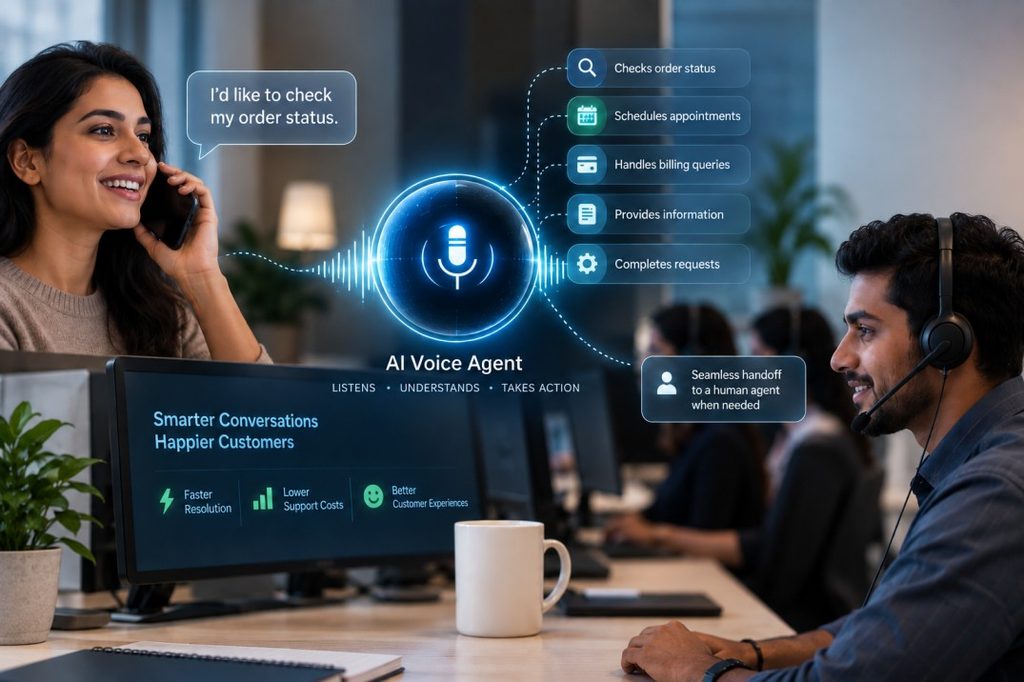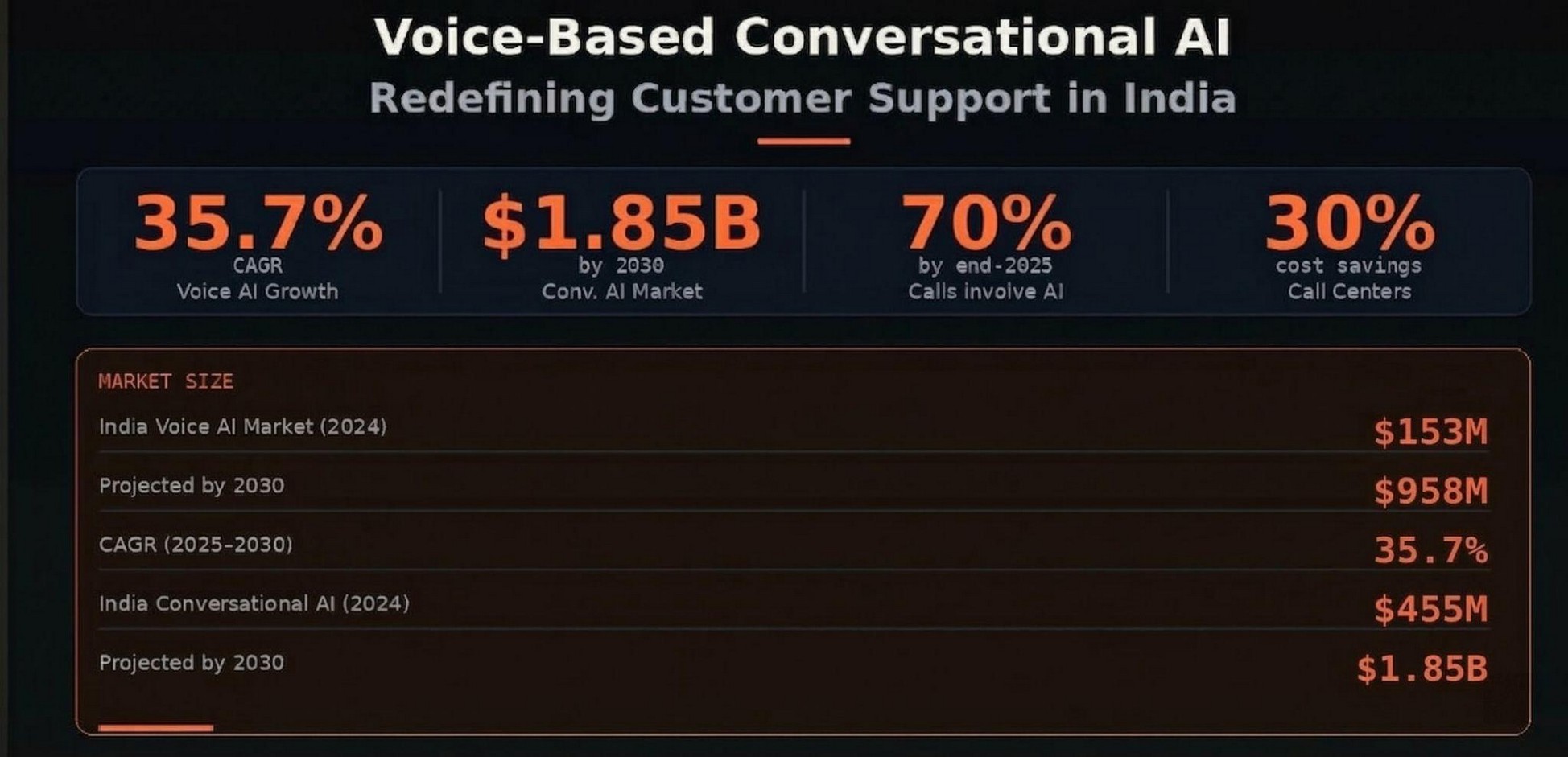
Scaling customer support automation requires more than incremental fixes: high contact center handle times, rising staffing overhead, and fragmented ticket routing continue to strain operational margins across enterprise service organizations. Traditional self-service options, such as rigid Interactive Voice Response (IVR) phone trees and rule-based chatbots, routinely fail when confronted with complex customer requests. Modern contact center automation strategies address these operational bottlenecks.
The industry is shifting away from static decision trees toward cognitive, agentic workflows. At the center of this transformation is the rise of real-time voice AI, enabling enterprises to resolve high-consequence customer service issues over the phone without human intervention.
The Structural Limits of Legacy Support Automation
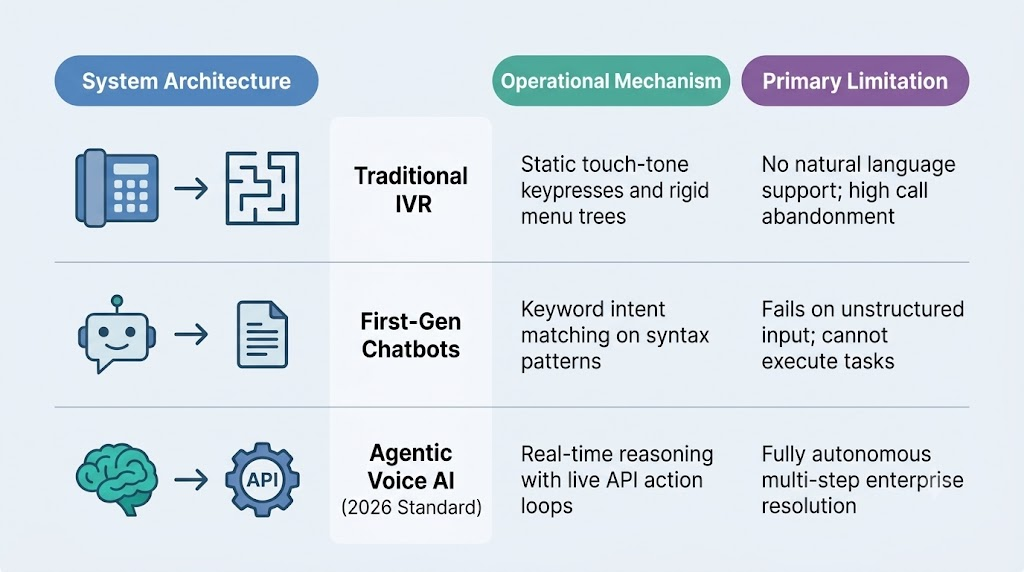
For over a decade, automated customer service relied on deterministic branching logic. Traditional text chatbots that matched basic intent triggers worked for simple tasks like checking an account balance or checking an order status. However, when transactional inquiries required dynamic reasoning, context switching, or multi-system database updates, rule-based systems collapsed.
Legacy voice infrastructure suffered even greater limitations. Traditional voice menus forced customers through repetitive touch-tone options, only to land them in a waiting queue to repeat their issue to a human agent. This dynamic is why enterprises are increasingly retiring legacy IVR systems in favor of dynamic conversation. True efficiency demands a system that can handle natural conversation and execute tasks immediately and autonomously.
Deconstructing Voice AI for Autonomous Support
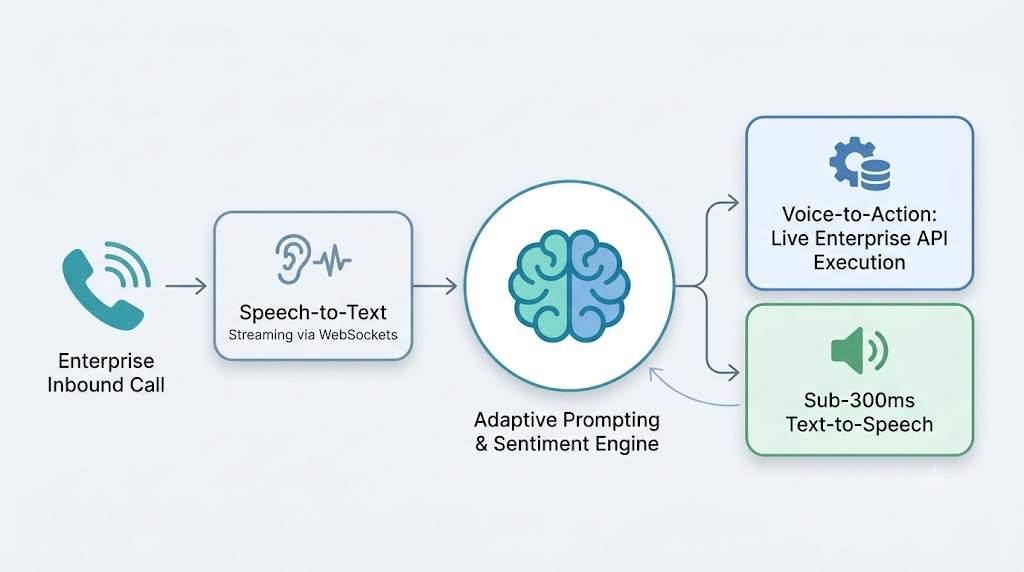
Modern voice AI for support operates on a cognitive architecture that processes speech, reasons through policy rules, and executes operational workflows in real time. Unlike legacy text bots wrapped in a basic text-to-speech engine, an agentic voice AI framework handles the unpredictable nature of human speech, including interruptions, sudden context shifts, and background noise.
Ultra-Low Latency Conversational Processing
Human conversation relies on turn-taking intervals of 200 to 300 milliseconds. Early voice software introduced 2-to-3-second latencies between a caller finishing a sentence and the machine responding, creating an awkward, unnatural experience. Understanding and managing voice AI latency is critical for maintaining fluid dialogue. Current architectures stream audio via WebSockets directly into speech recognition and language models, keeping total response latency below 300 milliseconds for seamless, fluid dialogue.
Dynamic Context Management and Non-Linear Dialogue
Customers rarely state their issues in neat, structured sentences. A caller reporting a damaged shipment might interrupt the system mid-verification to change their delivery address or ask about a refund policy. An advanced customer service AI agent maintains state tracking across multi-turn interactions, holding context variables in memory while dynamically updating conversation branches.
Real-Time Voice-to-Action Execution
Answering a question is only half the challenge; resolving an issue requires action. Modern voice systems don’t just read script responses. Instead, they trigger backend system functions during the call, authenticate user identities, modify records in enterprise platforms, update support tickets, and process payments securely while staying live on the phone.
Architectural Pillars of Enterprise Support Automation
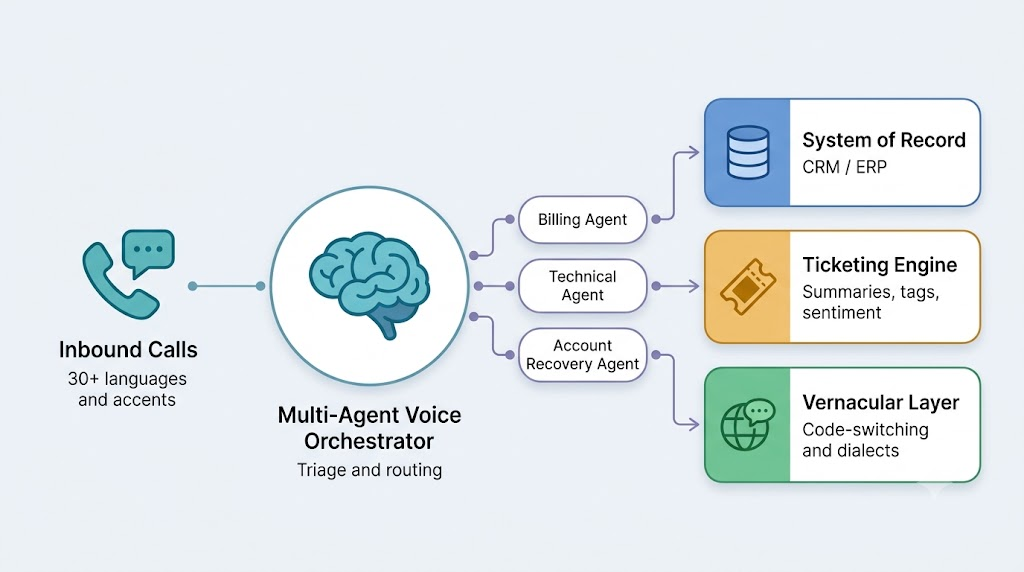
Building a scalable framework for AI customer support automation requires unifying voice interactions with back-office data pipelines and ticket systems.
1. Multi-Agent Cognitive Orchestration:
Rather than relying on a single monolithic model to process every inquiry, enterprise systems use dedicated micro-agents to eliminate manual call workflows across specialized operational domains. A primary triage agent evaluates caller intent and hands off execution to specialized sub-agents optimized for specific domains, such as billing adjustments, technical troubleshooting, or account recovery.
2. Autonomous Support Ticket Automation:
Manual data entry remains a major driver of post-call agent fatigue and administrative overhead. Deploying modern AI agents in call centers ensures every interaction handled by a voice agent generates structured call summaries, tag categories, sentiment metrics, and resolution logs directly in systems like Zendesk or Salesforce.
3. Vernacular Code-Switching and Accent Adaptation:
Global enterprises serve diverse user bases speaking multiple languages and regional accents. Modern voice architectures handle colloquial phrasing, dialect variations, and mid-sentence language transitions. Adopting multilingual voice AI strategies allows global enterprises to serve diverse user bases seamlessly.
Overcoming Security, Guardrails, and Hallucination Risks
Deploying autonomous voice interactions in production environments requires strict security operational controls and compliance enforcement.
- Hallucination Containment: Voice models operate within defined knowledge spaces, pulling responses strictly from verified policy docs and API payloads. If a query falls outside permitted guidelines, the system gracefully transfers the call with full context.
- Deterministic Guardrails: Hard-coded security rules sit on top of probabilistic models, ensuring the system never wavers on identity verification, refund limits, or regulatory disclosures.
- Data Privacy and Regulatory Compliance: Voice pipelines enforce SOC 2, HIPAA, and regional telephony compliance standards (including TRAI rules and local calling window restrictions), ensuring customer audio data is encrypted in transit and at rest.
The Ello Advantage: Autonomous Voice AI Built for the Enterprise
Ello provides the specialized cognitive infrastructure required to fully automate complex contact center operations, moving beyond general enterprise systems that only streamline basic workflows. Designed explicitly for high-volume enterprise environments, Ello moves past static scripts to deliver fully agentic voice interactions across operations, sales, and customer care:
- Ello’s Self-Evolving Architecture: Features an autonomous learning loop that continuously analyzes live conversational telemetry and post-call resolution rates. After processing approximately 200 calls on a given workflow, the system autonomously refines its prompting parameters and dialogue paths, delivering a 30 percent boost in operational efficiency without manual developer updates.
- Ello’s Adaptive Prompting & Voice-to-Action Engine: Dynamically adapts to real-time caller emotion, urgency, and sudden speech interruptions. The platform authenticates callers and executes complex transactional tasks directly inside CRMs, ERPs, and ticketing tools while maintaining natural conversation on the line.
- Ello’s Multilingual Vernacular Capabilities: Natively supports 30 languages and hundreds of regional accents. It handles fluid, mid-sentence code-switching and local colloquialisms seamlessly, ensuring high resolution rates across diverse global markets.
- Ello’s Enterprise Security Standards: Built with enterprise-grade guardrails, Ello guarantees SOC 2 compliance, robust data encryption, zero-hallucination policy enforcement, and automatic adherence to localized telecommunication mandates.
Frequently Asked Questions
1) How does voice AI differ from traditional speech recognition IVR systems?
Legacy speech recognition IVRs use strict keyword matching to navigate pre-programmed touch-tone menus. Voice AI utilizes real-time natural language reasoning to understand conversational intent, handle non-linear dialogue interruptions, and execute downstream enterprise API tasks directly during the call.
2) Can customer support automation handle complex, multi-step user inquiries?
Yes. Modern support automation uses agentic orchestration to break complex requests into sub-tasks. The system authenticates user identities, queries backend databases, executes policy rules, and updates records across enterprise platforms within a single continuous interaction.
3) How does voice AI handle caller interruptions or sudden changes in context?
Advanced voice AI architectures maintain dynamic state tracking while operating low-latency streaming pipelines. If a caller interrupts mid-sentence or changes the topic, the engine halts current speech generation, updates its internal context variables, and responds naturally to the new query.
4) What happens when an automated customer service agent cannot resolve an issue?
If an inquiry falls outside predefined operational boundaries or requires human authorization, the system executes a context-aware handoff. It routes the call to a live agent alongside a real-time transcript, sentiment score, and complete summary of steps taken, eliminating caller repetition.
5) How does voice AI maintain compliance and security during sensitive support calls?
Enterprise voice AI platforms incorporate strict guardrails, zero-retention data pipelines, and end-to-end encryption. They adhere to industry frameworks such as SOC 2 and HIPAA and enforce strict identity verification checks before sharing sensitive account information.
Conclusion
The shift from reactive deflection to fully autonomous voice interaction represents the next major evolution in enterprise customer care. Legacy IVRs and basic text chatbots exposed the limits of rigid decision trees, creating operational bottlenecks and driving up cost-per-contact metrics. By combining ultra-low latency speech processing, dynamic reasoning, and real-time backend API execution, agentic voice AI enables enterprises to resolve complex, multi-step inquiries entirely over the phone while preserving natural, human-like dialogue.
Organizations that modernize their contact center infrastructure with self-evolving voice architectures can eliminate handling delays, scale operational capacity, and deliver immediate customer resolution at lower overall overhead. To discover how autonomous voice agents can elevate your enterprise contact center capabilities, explore Ello’s enterprise voice platform.